


Eurozone economic sentiment weakened in September even as confidence among businesses improved. The Economic Sentiment Indicator fell from 98.4 to 97.9, missing the 99.0 consensus and remaining below its long-term average of 100. But the composition was more constructive than the headline suggested: industrial confidence improved from -5.0 to -3.8, while services confidence rose from 5.6 to 6.1. Retail confidence was broadly unchanged at -6.4 and construction held at -5.0.
The weakness came instead from households and employment expectations. Consumer confidence fell from -15.5 to -16.5, while the Employment Expectations Indicator dropped from 98.8 to 97.5, moving further below its long-term average. The broader EU survey showed consumers becoming more pessimistic about both their household finances and the general economy, while major-purchase intentions also deteriorated. Hiring expectations weakened particularly in retail and services, even as industry and construction reported better employment plans.
The September survey therefore points to an increasingly uneven eurozone recovery signal rather than broad deterioration. Manufacturers are becoming less pessimistic and services remain positive, but households are turning more cautious just as hiring expectations soften. The inflation backdrop also became less comfortable, with EU consumer inflation expectations rising and selling-price expectations increasing sharply in industry and construction. One caveat is that September’s euro-area aggregate excludes Italy’s consumer survey because of a structural break, limiting direct comparison with previous months.
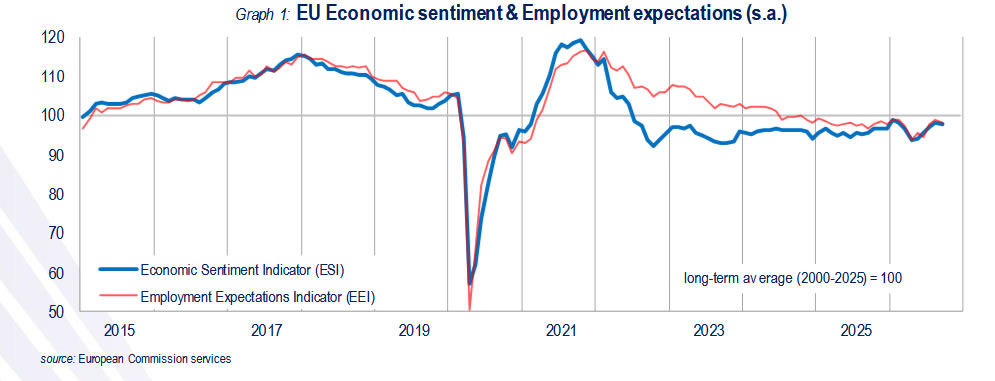
Data Summary
| Indicator | Previous | Current |
|---|---|---|
| Eurozone Economic Sentiment Indicator | 98.4 | 97.9 |
| Eurozone Employment Expectations Indicator | 98.8 | 97.5 |
The ESI also missed the 99.0 consensus. Both indicators remain below their long-term average of 100.
Confidence Components
| Component | Previous | Current |
|---|---|---|
| Industrial confidence | -5.0 | -3.8 |
| Services confidence | 5.6 | 6.1 |
| Consumer confidence | -15.5 | -16.5 |
| Retail trade confidence | -6.3 | -6.4 |
| Construction confidence | -5.0 | -5.0 |
Key Takeaways
- Eurozone economic sentiment slipped from 98.4 to 97.9, missing expectations and moving further below the long-term average of 100.
- The headline decline masked an improvement in business confidence: industry strengthened from -5.0 to -3.8, while services rose from 5.6 to 6.1.
- Consumers were the main weak spot, with confidence falling from -15.5 to -16.5. Across the broader EU survey, households became more pessimistic about finances, the economy and major purchases.
- Hiring expectations weakened more clearly than overall sentiment, with the eurozone EEI falling from 98.8 to 97.5.
- Inflation signals were less comfortable: EU consumer inflation expectations rose 1.8 points, while selling-price expectations increased sharply in industry and construction.
- The overall message is uneven rather than uniformly weak: businesses are becoming somewhat more confident, while households and employment expectations are moving in the opposite direction.
- September’s eurozone aggregate excludes Italy’s consumer survey because of a structural break, so direct month-to-month comparisons should be treated with some caution.





