


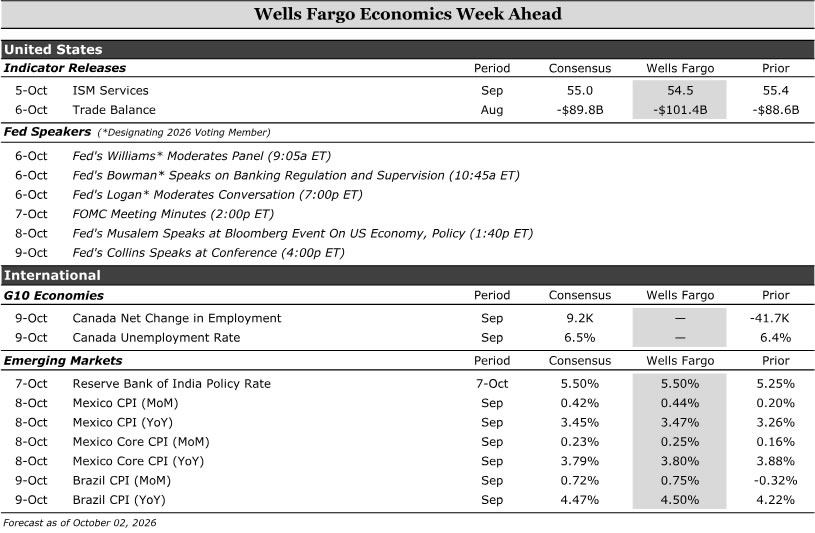
In the U.S., the September ISM Services index is expected to ease modestly while continuing to signal expansion, with particular attention on whether price pressures remain elevated. In Canada, the labor market likely rebounded in September, although broader trends still point to a cooling pace of employment growth. Elsewhere, we expect the Reserve Bank of India to begin its tightening cycle, bringing the policy rate to 5.50%. September inflation reports in Mexico and Brazil should show some firming in headline price growth, although much of the pickup reflects temporary and seasonal factors.
United States:
- ISM Services (Monday)
Advanced Economies:
- Canada Labor Force Survey (Friday)
Emerging Markets:
- Reserve Bank of India (Wednesday), Mexico CPI (Thursday), Brazil CPI (Friday)
Source: Bloomberg Finance L.P. and Wells Fargo Economics
U.S. Week Ahead
ISM Services • Monday
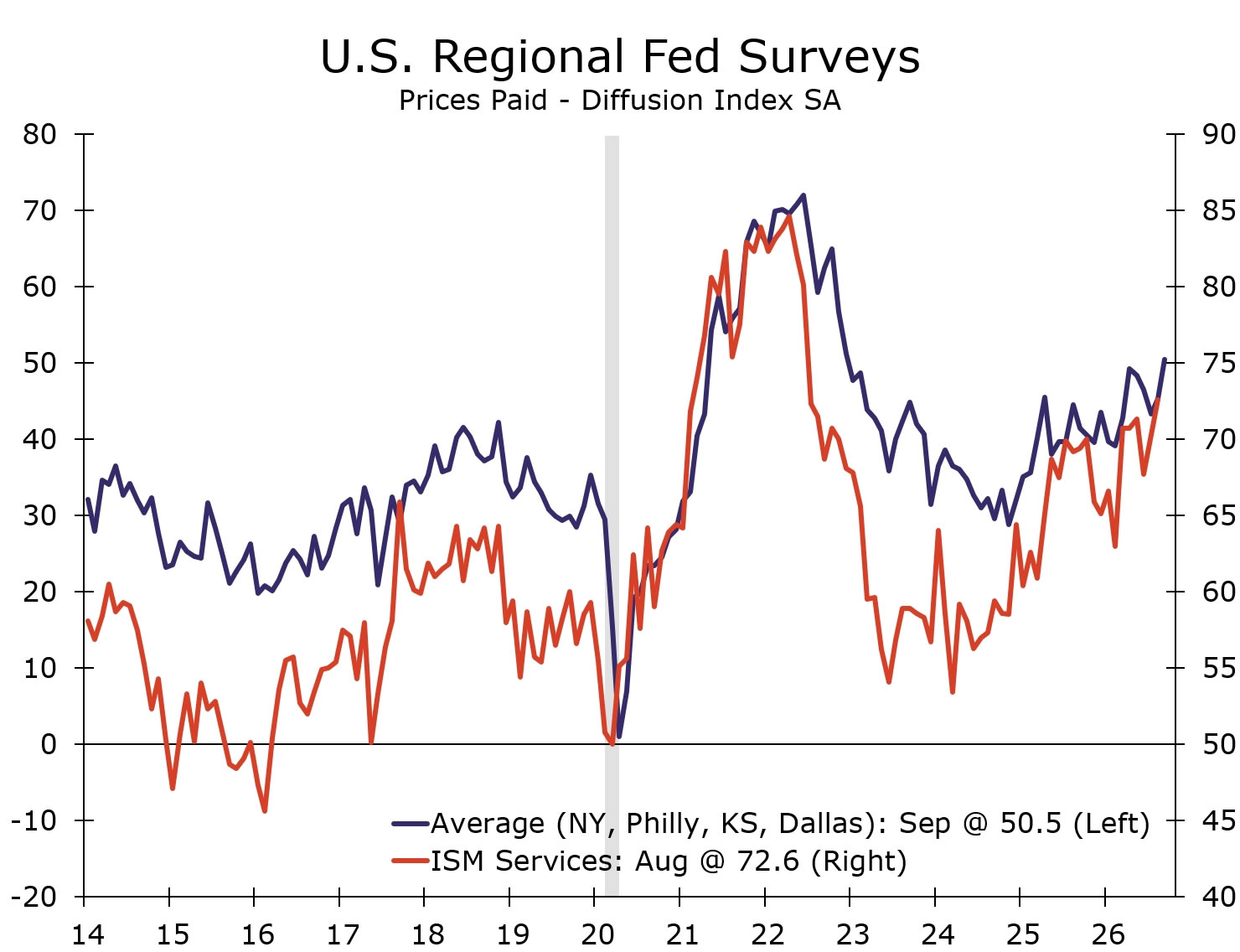
The September ISM Services report should continue to point to a healthy, expanding services sector, though we look for some moderation after August’s surprisingly strong gain. We expect the headline index to slip to 54.5 from 55.4, giving back some of the recent gain while remaining comfortable above the 50 breakeven threshold. Regional Fed business surveys remained soft in September, suggesting some easing in activity, while the nearly four-point jump in new orders last month may prove difficult to sustain. Beyond that, the employment component could also edge lower after the September payroll data showed relatively modest hiring across service-providing industries.
The greater focus, however, will likely remain on inflation pressures. Last week’s ISM manufacturing report showed input costs continuing to build, and regional surveys point to a similar firming in service-sector price measures. That would add to evidence that underlying cost pressures remain elevated.
Even so, the prices paid component should not be interpreted as a one-for-one signal for future consumer inflation. While the services measure has historically provided a better guide to core inflation trends than its manufacturing counterpart, pass-through from higher input costs to final consumer prices is far from automatic. Anecdotally, many firms continue to report resistance to price increases, suggesting margins could absorb at least part of the recent rise in costs.
Advanced Economies Week Ahead
Canada Labor Force Survey • Friday
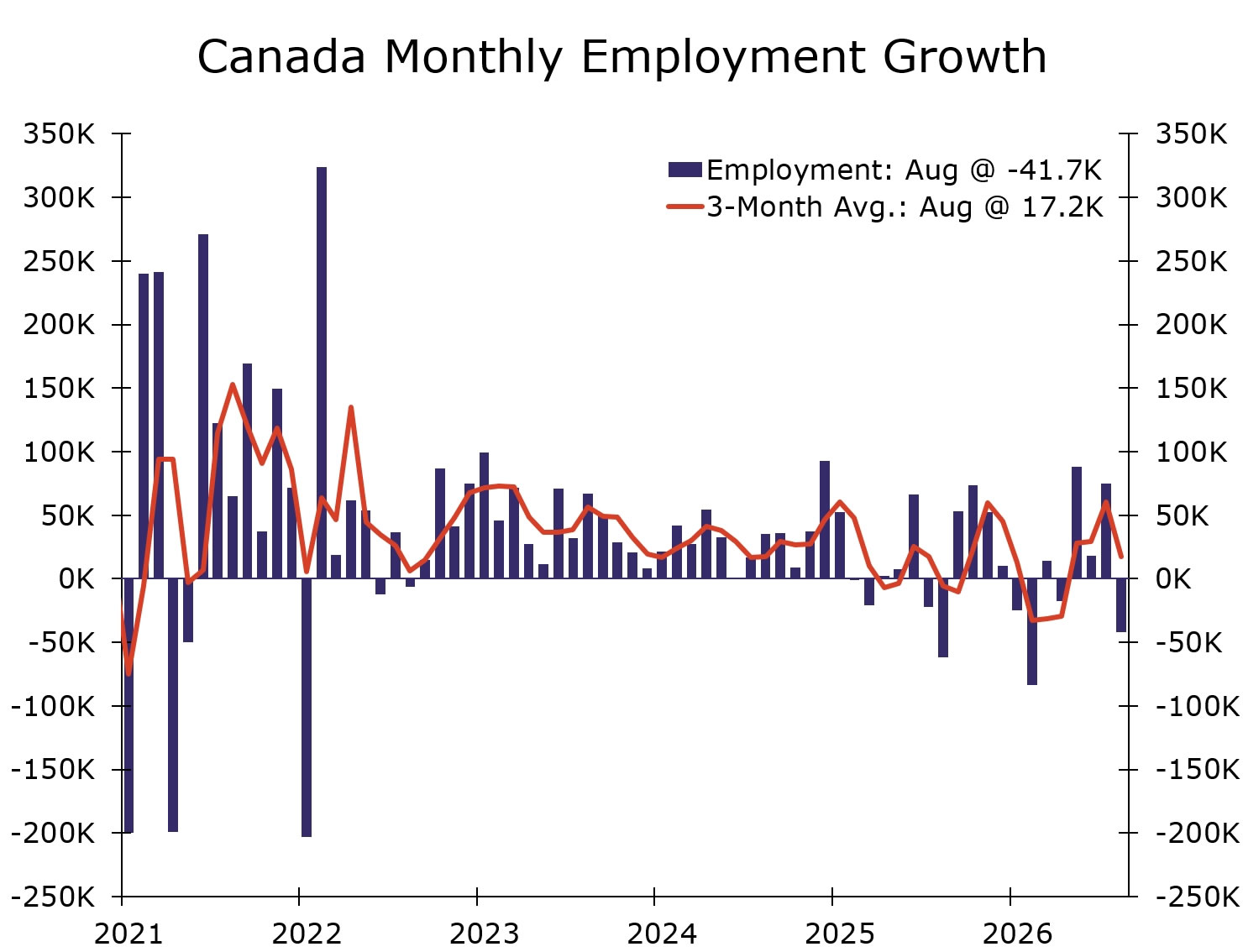
Canada’s labor market lost some momentum following a strong showing earlier in the summer. Employment fell by 42K in August, driven primarily by declines in full-time positions and service-providing industries. Even so, the unemployment rate held steady, suggesting the deterioration was not broad enough to materially alter the overall labor market backdrop. We look for a modest rebound in September employment.
The unemployment rate is expected to remain near 6.4%, continuing to run within the relatively narrow range that has prevailed for much of the past year. Slower labor force growth continues to limit upward pressure on unemployment, while wage growth and other measures of labor demand have continued to cool gradually. Although August’s decline serves as a reminder that hiring conditions remain uneven, there is still little evidence of a more pronounced weakening in labor market conditions.
The labor market no longer appears to be strengthening, but neither does it appear to be deteriorating materially. Employment growth has slowed, unemployment has stabilized, and broader economic activity has generally remained resilient despite ongoing headwinds. The largest near-term risk stems from trade tensions with the U.S. and the potential for tariffs to weigh on business confidence and hiring decisions. For the Bank of Canada, however, the labor market is only part of the story. Any tariff-related drag on growth would argue for greater policy caution, but the ultimate policy path looks more dependent on how inflation evolves in the months ahead, particularly if higher oil prices begin to exert renewed upward pressure on consumer prices.
Source: Bloomberg Finance L.P. and Wells Fargo Economics
EM Week Ahead
Reserve Bank of India Monetary Policy Meeting • Wednesday
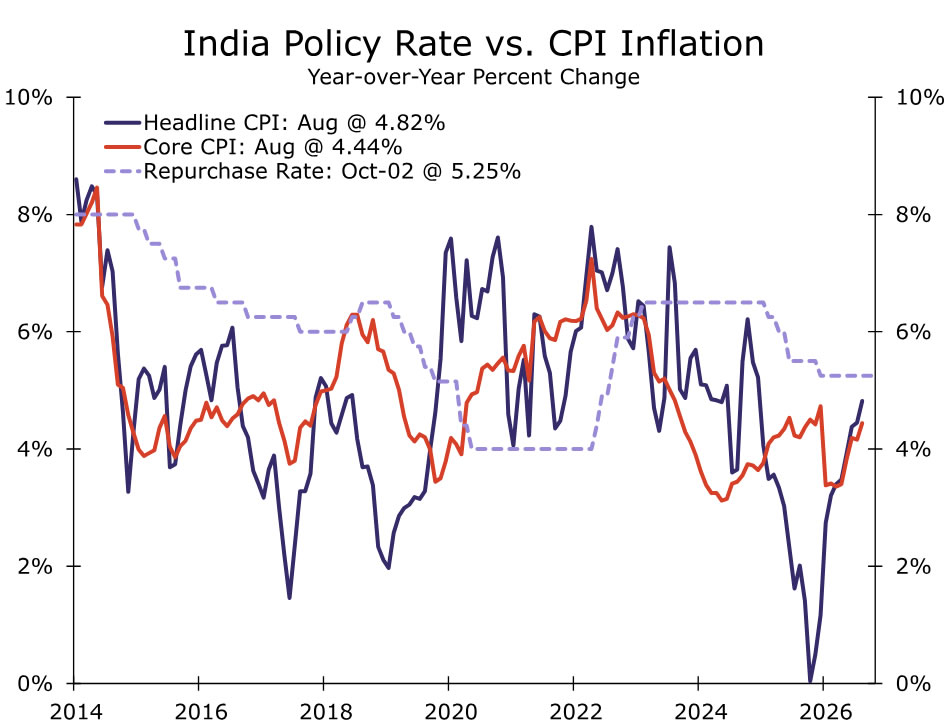
We expect the Reserve Bank of India (RBI) to begin its tightening cycle next week with a 25 bps rate hike, taking the policy rate to 5.50%. Inflation risks have increased as India’s monsoon rainfall ended 12.6% below normal, the weakest since 2015, while El Niño conditions and higher oil prices could add further pressure to food and fuel prices. Government measures should continue to limit the pass-through to households, although recent increases in refined product prices suggest some pressure is beginning to emerge.
At the same time, resilient domestic growth gives the RBI room to raise rates. Recent PMI data point to renewed momentum in Q3, while industrial production rose 8.0% year-over-year in August. Higher oil prices have also widened the trade deficit and added pressure on the current account. Rupee weakness has increased imported cost pressures and prompted greater RBI intervention, while a rate hike could provide some support to the currency.
Overall, broader inflation risks, moderately resilient growth and continued rupee pressure support the start of a gradual tightening cycle. We expect another 25 bps hike in 2027, taking the policy rate to 5.75%, where we expect it to remain through our forecast horizon.
Source: Bloomberg Finance L.P. and Wells Fargo Economics
Mexico CPI • Thursday
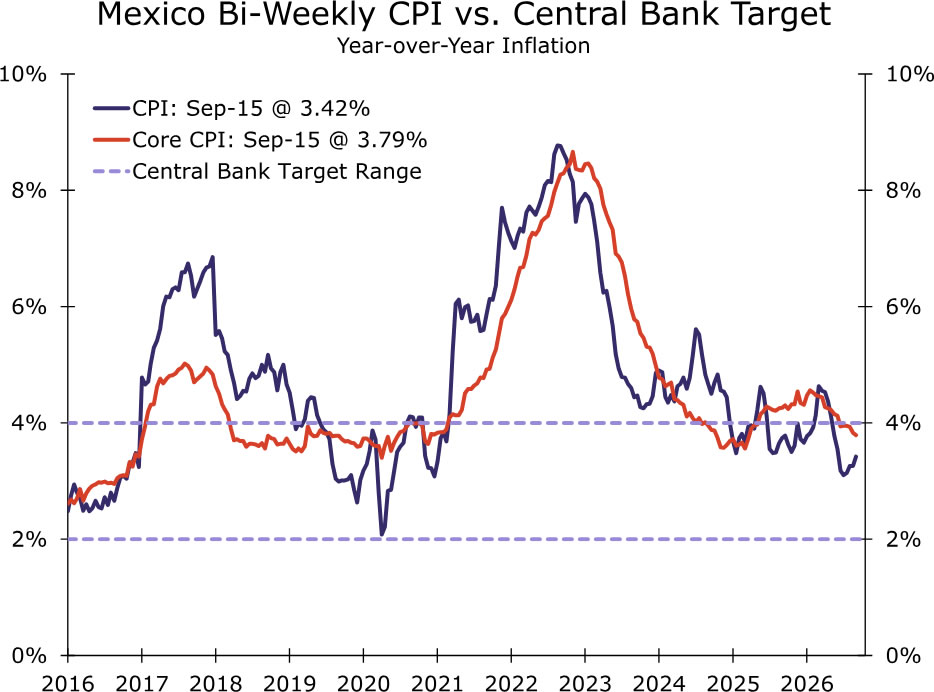
We expect Mexico’s headline inflation to rise 0.44% month-over-month in September, taking the year-over-year rate to 3.47% from 3.26%. Core inflation should rise 0.25% month-over-month but slow to 3.80% year-over-year from 3.88%. Agricultural prices will likely be the main driver, with tomato prices rising sharply in the first half of September. Education prices also increased due to the start of the school year, although this is more seasonal than a sign of stronger underlying demand. LP gas prices could add some upside pressure, but government energy subsidies should continue to limit the broader pass-through from higher global prices.
Overall, higher headline inflation and a slight cooling in core inflation present a mixed picture. With the growth outlook subdued, the unemployment rate at 3.01%, its highest since August 2024, and services inflation still sticky, we remain comfortable with our view that Banxico will keep rates at 6.50% into 2027.
Source: Bloomberg Finance L.P. and Wells Fargo Economics
Brazil CPI • Friday
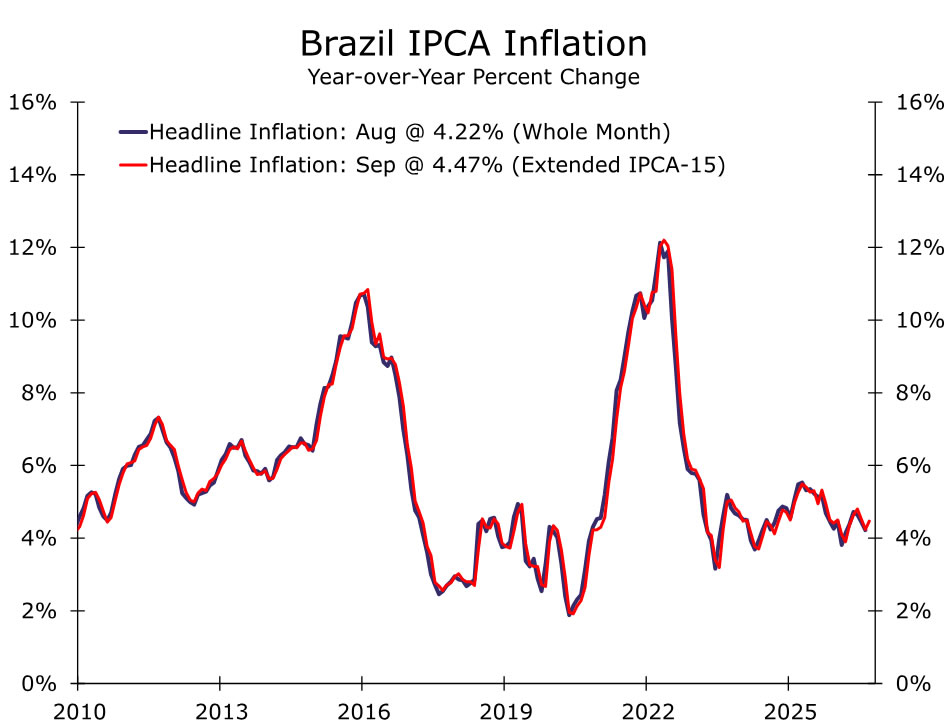
Brazil’s presidential election will take center stage this weekend, with the outcome likely to have important implications for the fiscal outlook, inflation expectations and the path of interest rates. Still, next week’s September CPI release will also matter for COPOM. We expect headline inflation to rise to 4.50% year-over-year and 0.75% month-over-month. The pickup should largely reflect the reversal of August’s one-off electricity credit rather than a sudden rise in underlying inflation. Mid-September CPI already showed this payback, with higher electricity and food prices among the main drivers. Fuel prices should make a more modest contribution as temporary tax cuts and subsidies continue to cushion the impact of higher global oil prices.
Beyond these temporary factors, weaker industrial production and other high-frequency indicators point to downside risks for Q3 growth. However, election-related spending, fiscal uncertainty and inflation near the upper end of the target range should keep COPOM cautious. The Nov. 3-4 meeting will come shortly after a potential October 25 runoff, which will give policymakers an early opportunity to assess the election’s impact on fiscal policy, the currency and inflation expectations. For now, we expect the Selic Rate to remain at 13.75% through year-end, with additional easing in 2027.
Source: Bloomberg Finance L.P. and Wells Fargo Economics





