TL;DR: Bitcoin and Ether fell sharply after months of fading momentum collided with a surge in oil prices and Treasury yields near 5.35%—triggering $484.9m in single-day ETF redemptions and nearly $974m in liquidations, with Bitcoin’s next key support at 75,026–76,040 and Ether already testing its 55-day EMA near 2,480.
Why This Matters
Bitcoin and Ether are entering a more developed corrective phase after their September rallies stalled below 87,354.33 and 2,805.98 respectively. Both cryptocurrencies failed twice to extend their advances, while daily momentum had already begun deteriorating before the latest risk-off move. Bearish MACD divergence developed as prices tested their highs, rising trendlines subsequently gave way, and the pace of spot Bitcoin ETF inflows slowed even while prices struggled to make further progress.
That sequence matters. The latest selloff was not created by one macro headline or by ETF redemptions alone. The rally had already become vulnerable as momentum faded and marginal ETF demand weakened. Higher oil prices, elevated Treasury yields and renewed concerns around AI-related financing then provided the catalyst for investors to reduce risk, while subsequent ETF withdrawals and leveraged liquidations amplified the decline.
The result still looks more like a correction than a collapse. Bitcoin fell into roughly the 80,400–81,800 area on Thursday depending on the pricing feed before recovering above 82,000, while Ether is holding around 2,500. Neither market is showing panic conditions, but the September uptrend has clearly lost momentum and now needs fresh demand to prevent a deeper retracement.
Oil and Yields Hit Risk Appetite From the Macro Side
The immediate macro pressure came from another simultaneous rise in energy prices and long-term borrowing costs. Brent settled at $104.28, up around 4%, as attacks on commercial shipping around the Strait of Hormuz and Gulf hurricane disruption tightened supply concerns. Oil pared some of its advance after US President Donald Trump said the United States would not attack Iran before the November midterm elections, but crude retained most of the move.
For crypto, the important channel is not oil itself but what sustained high energy prices imply for inflation and monetary policy. The US 10-year Treasury yield reached around 5.35% this week, its highest level since 2002, before easing toward 5.23% following a reasonably well-received $22bn 30-year auction. Higher risk-free yields increase the opportunity cost of holding assets such as Bitcoin and Ether while simultaneously tightening financial conditions across the broader speculative complex.
Fed communication has offered little reason to expect rapid relief. Governor Christopher Waller said further rate hikes are likely if the economy evolves as anticipated, although the moves “do not need to come at consecutive meetings.” September’s FOMC minutes similarly showed most policymakers expected another hike by year-end. Markets still put a high probability on a hold at the October 27–28 meeting, but that increasingly looks like a question of timing rather than an end to the tightening cycle.
AI Selloff Adds Another Financing Channel
The latest weakness in technology stocks added a second route through which high borrowing costs reached crypto-related assets. Questions around AI-sector revenues and financing weighed on Nvidia, Oracle and CoreWeave, while the Nasdaq fell 1.25%.
The largest declines were concentrated among Bitcoin miners that have increasingly expanded toward AI and data-center infrastructure. Riot fell around 9%, Hut 8 about 8%, Cipher roughly 7.9%, CleanSpark 7.1% and IREN 6.3%.
That pattern argues against treating the move simply as generic crypto weakness. These businesses are particularly capital intensive and often depend on external financing to fund infrastructure expansion. With long-term yields elevated and investors scrutinizing the economics of AI investment more closely, the cost and availability of capital become a direct transmission mechanism between the bond-market selloff and crypto-linked equities.
ETF Demand Faded Before Redemptions Accelerated
Spot Bitcoin ETFs were an important source of support during September, when billions of dollars of inflows helped push Bitcoin back above 85,000. But the pace of buying had already begun to fade by early October while Bitcoin repeatedly failed to break decisively above its September high.
That distinction is important because the major ETF outflow came after price momentum had begun weakening. Spot Bitcoin ETFs recorded about $484.9m of net redemptions on October 7, the largest single-day outflow since June. IBIT led with $207.7m, followed by FBTC at $105.1m and ARKB at $101.7m.
The short-term flow picture has therefore deteriorated, with five-day flows around -$162.9m. But that sits against approximately +$1.76bn over 30 days and +$6.09bn over three months. One large redemption day is consequently a warning that marginal demand is weakening, but it is not yet evidence of a structural institutional retreat.
The timing strengthens the macro interpretation. The large ETF outflow arrived on the same day Treasury yields surged, suggesting redemptions became one channel through which the rate shock reached Bitcoin. Fading inflows helped leave the rally vulnerable; the outflow then amplified weakness that was already developing.
Leverage Turned Weakness Into a Faster Correction
Leveraged positioning added another layer. Around $974m of crypto positions were liquidated over 24 hours on Thursday, according to CoinGlass, with roughly $896m involving long positions. Ether accounted for around $311m of liquidations and Bitcoin around $238m.
Those forced unwinds help explain why price action accelerated once trend support gave way. But liquidations are largely an amplifier rather than the original cause. Momentum had weakened first, macro conditions then deteriorated, and leverage magnified the resulting move.
That makes the next ETF readings potentially more informative than Thursday’s liquidation total. If inflows resume as Treasury yields stabilize, the episode would remain consistent with a macro-driven correction and temporary deleveraging. If ETF outflows continue even as yields retreat, the argument would shift toward an independent weakening in underlying crypto demand.
ActionForex’s Technical View
Bitcoin Correction Has Room to Extend
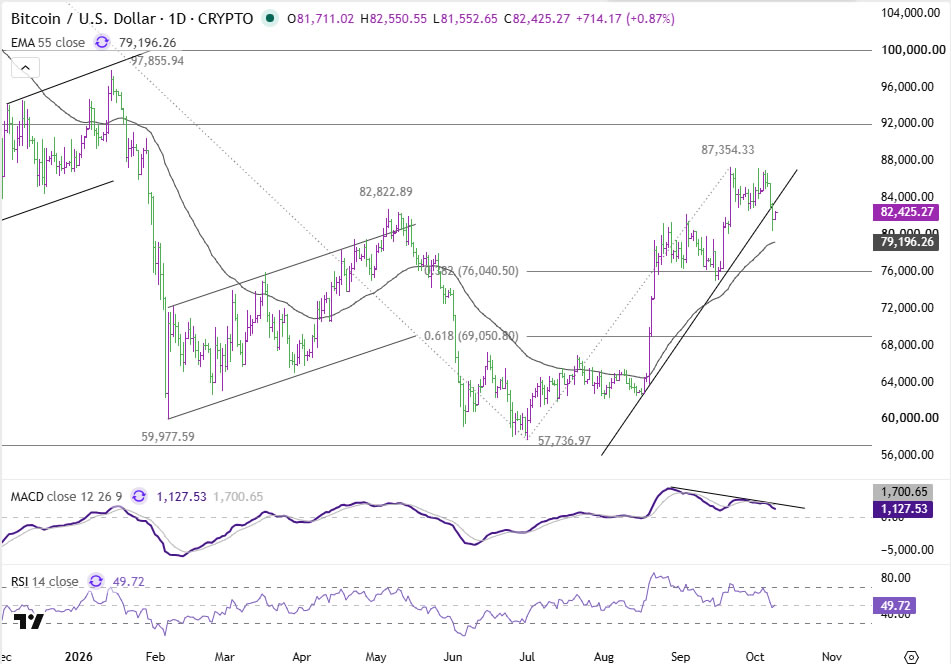
Technically, Bitcoin’s rally from 57,736.97 to 87,354.33 can be treated as a completed five-wave advance that is now being corrected. The break of the rising trendline and bearish divergence in daily MACD support that interpretation.
Bitcoin remains above its 55-day EMA near 79,196, making that area the first important test. Below there, the 38.2% retracement at 76,040.50 sits close to the 75,026.09 September low, creating a more significant support region.
A sustained break below 75,026 would break the September higher-low structure and increase the probability of a deeper retracement toward 72,545.65, the 50% level, and potentially 69,050.80, the 61.8% retracement.
The near-term bias remains to the downside while 87,354.33 holds as resistance. A recovery through that high would invalidate the present corrective interpretation.
Ether Is Already Closer to Its Key Support Test
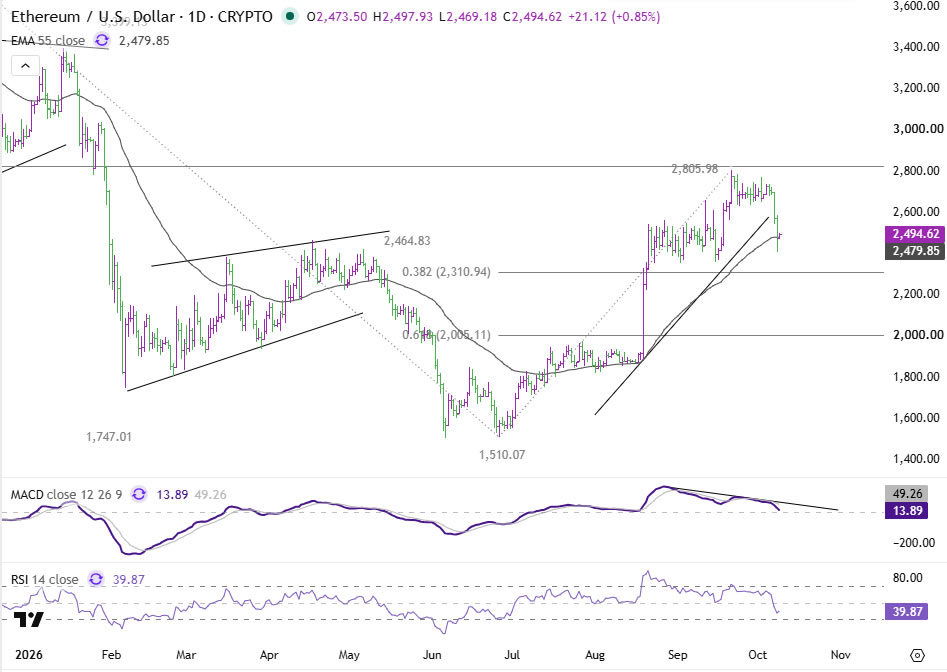
Ether shows the same broad pattern but is technically closer to confirmation of a deeper correction. Its rally from 1,510.07 to 2,805.98 also produced bearish daily MACD divergence before breaking its rising trendline.
Price is now only slightly above the 55-day EMA around 2,479.85. A sustained daily break beneath that level would bring the 2,358.79 September low into focus, followed by the 38.2% retracement at 2,310.94.
As with Bitcoin, the current downside bias remains intact while the September high at 2,805.98 holds. The difference is that Ether has already returned almost completely to its daily trend average, leaving less technical room than Bitcoin before the correction starts testing deeper support.
The Next ETF Prints Could Decide the Narrative
The September crypto rally did not fail because of one ETF outflow or one bad session for technology stocks. Momentum weakened first. Macro pressure then exposed that weakness, and leverage accelerated the correction.
That leaves several tests ahead. Oil and Iran headlines remain relevant through inflation expectations, while the US 10-year yield needs to be watched for either another attempt toward the 5.35–5.42% area or a more durable retreat. AI-sector financing developments remain important for crypto-linked miners, and the Fed’s October meeting will determine whether the market’s expectation of a pause is justified.
But the most immediate diagnostic may come from ETF flows. If institutional demand returns as yields ease, Bitcoin and Ether would have a stronger case for treating the current decline as a normal correction within a broader recovery. If redemptions continue independently of the macro backdrop, the problem would no longer be just higher rates — it would be weakening crypto demand itself.
Key Takeaways
- Bitcoin and Ether’s correction was building before the selloff—bearish MACD divergence and fading ETF inflows appeared weeks before oil and Treasury yields provided the catalyst.
- The US 10-year yield’s spike toward 5.35% raised the opportunity cost of holding crypto, while a $484.9m single-day Bitcoin ETF outflow on October 7 was the largest since June.
- Nearly $974m in leveraged positions were liquidated in 24 hours, with Bitcoin miners expanding into AI infrastructure (Riot, Hut 8, Cipher, CleanSpark, IREN) among the hardest hit.
- Bitcoin’s key support sits at 75,026–76,040; a break below would open the door to 72,545 and 69,050, while 87,354.33 remains the level that would invalidate the correction.
- Ether is technically closer to confirming a deeper correction, trading just above its 55-day EMA near 2,480, with the next watch levels at 2,358.79 and 2,310.94.
Related Reading
- US 10-Year Yield Tests Its Ceiling as 5.3% Draws Buyers, FOMC Minutes Bring AI Debt Into the Discussion
- Could Gold’s Selloff Run Out of Road Below 4,000?
- Oil Surges Past $104 as Hormuz Shipping Attacks Tighten Supply Concerns
Stay ahead of the crypto correction and the macro forces driving it—subscribe to ActionForex’s daily market commentary for real-time technical and fundamental analysis.