


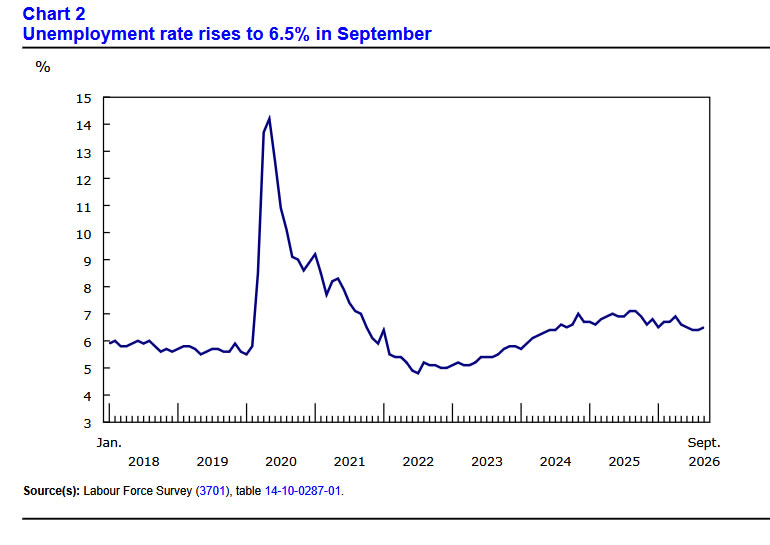
Canada’s labor market weakened sharply in September, with employment falling 68.3K, far worse than expectations for a 6.2K increase and following August’s roughly 42K decline. The drop marked a second consecutive monthly contraction, with losses split between full-time employment at 35.4K and part-time employment at 32.9K. The employment rate fell 0.2 percentage points to 60.6%, while unemployment edged up from 6.4% to 6.5%, matching expectations.
The headline weakness was significant, though the composition was somewhat less alarming for private-sector demand. Public-sector employment plunged 70K, accounting for essentially all of the net decline, while private-sector employment rose 24K and self-employment fell 22.5K. By industry, the largest losses came from educational services (-35K), health care and social assistance (-23K) and manufacturing (-13K). Youth employment also fell sharply by 48K, extending its decline for a second month.
Broader labor-market momentum nevertheless softened. The participation rate fell to 64.8%, its lowest since December 1997 excluding the pandemic, while the labor force contracted by about 53K. Statistics Canada noted that population aging explains much of the longer-term decline in participation, limiting how much of the move should be read as purely cyclical weakness. Meanwhile, average hourly wages accelerated to 2.3% y/y from 2.0%, providing one counterweight to the otherwise soft report.
Data Summary
| Indicator | Actual | Expected | Previous |
|---|---|---|---|
| Employment change | -68.3K | +6.2K | -41.7K |
| Unemployment rate | 6.5% | 6.5% | 6.4% |
Labour Market Details
| Component | September |
|---|---|
| Full-time employment | -35.4K |
| Part-time employment | -32.9K |
| Employment rate | 60.6% |
| Participation rate | 64.8% |
| Average hourly wages, y/y | +2.3% |
| Public-sector employment | -70.0K |
| Private-sector employment | +24.1K |
| Self-employment | -22.5K |
Statistics Canada reported that September’s 68.3K employment decline followed another drop in August, while both full-time and part-time employment contracted. Public-sector employment fell 70K, while private-sector employment rose modestly.
Key Takeaways
- Canada suffered a second consecutive monthly employment decline, with September’s -68.3K result dramatically undershooting expectations for a 6.2K gain.
- Weakness was broad across working arrangements, with full-time employment down 35.4K and part-time employment down 32.9K.
- The headline decline was heavily influenced by the public sector, which lost 70K jobs, while private-sector employment increased by 24.1K.
- The unemployment rate rose to 6.5%, but the increase was contained partly because the participation rate fell to 64.8% and the labour force shrank.
- Participation fell to its lowest level since December 1997 excluding the pandemic, although Statistics Canada attributed much of the longer-term decline to population aging.
- Wage pressure did not weaken with employment: average hourly earnings accelerated to 2.3% y/y from 2.0%.





