TL;DR: The probability of an October 28 BoC hike jumped from 30% to 82.8% in a single weekend, driving USD/CAD toward the 1.4000 reversal zone. But with markets already pricing roughly four hikes through September 2027, one increase may not be enough—the Bank’s updated inflation projections and guidance will decide whether the breakdown holds.
Why This Matters
USD/CAD is approaching a potentially decisive reversal test around 1.4000, as markets increasingly expect the Bank of Canada to raise rates on October 28. The probability of a hike surged from around 30% on Friday to 82.8% by Monday evening, helping sustain Canadian Dollar strength despite softer core inflation.
But the challenge now extends beyond the next decision. With markets already pricing roughly four hikes through September 2027, a single rate increase may not be enough to sustain a bearish USD/CAD breakdown. The BoC’s updated inflation projections and guidance will need to provide credible support for the broader tightening expectations already reflected in the currency.
BoC Hike Expectations Drive Canadian Dollar Strength
The shift in Bank of Canada expectations has been particularly rapid. Following Canada’s weak September employment report, markets initially assigned only around 25% probability to an October increase. That probability had risen to approximately 30% by Friday, October 16, before jumping to around 80% on Monday. The latest October 19 OIS snapshot placed the likelihood at 82.8%.
Governor Tiff Macklem’s weekend remarks accelerated the repricing. Speaking on Saturday, he indicated that the BoC expects to raise its quarterly inflation forecast substantially because of persistently elevated oil and petroleum-product prices. He also acknowledged growing risks that inflation could broaden and become more persistent, emphasizing that the Bank was “prepared to adjust monetary policy as needed.”
However, the shift toward tightening had begun before Macklem spoke. Markets were already anticipating approximately 100bps of cumulative increases over the coming year. His remarks primarily brought expectations for the next hike forward, rather than establishing an entirely new tightening outlook.
The repricing has been accompanied by a notable rebound in CAD. From its October 9 close around 1.4256, USD/CAD has declined approximately 1.2% toward 1.4084. Over the same period, Dollar Index fell only around 0.4%, indicating that Canadian-specific developments contributed significantly to the move.
Higher oil prices have also provided support, with Brent rising approximately 5% over the period. CAD’s appreciation therefore reflects the combined influence of stronger BoC tightening expectations and elevated crude prices, rather than simply a retreat in the broader US Dollar.
Energy Inflation Strengthens the Case for Tightening, but Core Measures Disagree
The BoC’s increasingly hawkish outlook contrasts with September’s softer-than-expected inflation report. Headline CPI accelerated from 3.0% to 3.1% yoy, but undershot expectations of 3.2%. The increase was largely energy-driven, with gasoline inflation rising to 27.8% and overall energy inflation reaching 19.0%.
More importantly, all three BoC core inflation measures declined, and all three came in below market expectations—evidence that underlying price pressures were moderating despite the higher headline reading:
- Headline CPI: 3.0% → 3.1% yoy (vs. 3.2% expected)
- CPI-trim: 1.9% → 1.8%
- CPI-median: 2.0% → 1.9%
- CPI-common: 2.6% → 2.4%
- Gasoline inflation: 27.8%; overall energy inflation: 19.0%
However, the shorter-term inflation picture is less reassuring. Scotiabank estimates that three-month annualized CPI-trim and CPI-median are running around 2.6% and 2.7%, respectively. The bank also cautioned that unusually weak travel-related prices may have exaggerated the improvement in September’s core readings.
Inflation expectations add another complication. Recent BoC surveys showed consumers becoming more concerned about longer-term price pressures, while businesses also reported higher near-term inflation expectations following the deterioration in trade relations with the United States.
The case for patience nevertheless remains substantial. Canada’s labor market has weakened, with employment declining in August and September and unemployment around 6.5%. Consumer spending intentions are subdued, while business confidence has been affected by trade uncertainty and tariffs.
The central policy question is whether underlying inflation can return toward target without additional tightening, or whether persistent energy costs and inflation expectations require a more immediate response. The latest data offer credible arguments on both sides, explaining why economists remain divided even as financial markets increasingly expect a hike.
Markets Are Pricing a Tightening Cycle, Not Just One Hike
The more important development is the extent of tightening now embedded in interest rate markets. The October 19 OIS snapshot indicates an 82.8% probability of a hike on October 28, with expectations extending well beyond that single decision:
- October 28: 82.8% probability of a hike (policy rate to ~2.46%, from 2.25% currently)
- December 9: 68.0% probability of another hike (cumulative implied rate: ~2.63%)
- March 2027: implied policy rate of 2.93%
- September 2027: implied policy rate of 3.29%—roughly 104bps of cumulative tightening from today’s level
These figures represent the expected cumulative rate path, while the individual meeting probabilities describe the likelihood of an increase at each meeting. They do not imply that every increase is certain.
The longer path is also more aggressive than some economists anticipate. Scotiabank has argued for a precautionary increase to contain inflation risks, but its assessment does not necessarily imply the extended series of hikes already reflected in the OIS curve.
This creates an important asymmetry for CAD. Markets have moved beyond expecting a single October adjustment and are increasingly anticipating a sustained tightening cycle. Consequently, even if the BoC raises rates next week, the decision could provide limited additional support unless the Bank also signals that further increases may be needed.
October 28 Will Test Whether the BoC Validates Market Pricing
The October 28 decision will be accompanied by the BoC’s quarterly Monetary Policy Report, making the updated inflation outlook particularly important.
Macklem has already indicated that the Bank expects to revise its inflation forecast significantly higher because of energy costs. However, a higher headline inflation projection alone may not be sufficient to validate the market’s expectations for an extended tightening cycle.
A 25bps hike accompanied by forecasts showing persistent inflation risks and guidance consistent with additional tightening would provide stronger support for CAD. Under that scenario, a sustained USD/CAD break below 1.4000 would become more plausible.
Alternatively, the BoC could raise rates while emphasizing that further decisions depend on incoming evidence. Such an outcome would deliver the widely anticipated first increase without necessarily endorsing the aggressive path priced for 2027. CAD could then face disappointment as investors reassess expectations for December and subsequent meetings.
A decision to leave rates unchanged would represent a more immediate negative surprise for CAD, given the substantial probability already assigned to an October hike. The reaction could be particularly significant if the Bank also downplayed the need for further tightening.
The distinction is therefore between delivering the next rate increase and validating the broader policy path. With the first move already largely reflected in prices, the Monetary Policy Report and accompanying guidance could matter more than the headline decision itself.
Fed and Oil Prices Could Reinforce or Challenge CAD Strength
The BoC decision will not occur in isolation. The Federal Reserve also concludes its policy meeting on October 28, creating the potential for simultaneous changes in expectations on both sides of USD/CAD.
As of the October 19 FedWatch snapshot, markets assigned approximately 17% probability to another Fed hike in October, with a hold overwhelmingly favored. That contrasts with the roughly 83% probability of BoC tightening in the latest Canadian OIS snapshot.
This divergence has helped narrow the expected future policy-rate gap between the two countries, providing a supportive backdrop for Canadian Dollar. However, the relative outlook could change if the Fed delivers a more hawkish message or US Treasury yields rise sharply.
The most supportive combination for CAD would be a BoC hike accompanied by guidance favoring further tightening, alongside a Fed decision that does not materially revive near-term US tightening expectations. Conversely, a cautious BoC and unexpectedly hawkish Fed would challenge the recent USD/CAD decline.
Oil is another important variable. Brent is trading near $110 a barrel following its substantial recent rally, supported by concerns over Middle East supply disruptions and renewed threats to energy infrastructure.
Elevated oil prices support Canada’s external earnings, but they are now influencing BoC expectations directly through their potential impact on inflation. A renewed rise could reinforce both commodity-related CAD support and expectations for tighter monetary policy. A sharp oil reversal, particularly if accompanied by improving supply prospects, could weaken both channels.
The interaction between relative interest rate expectations and oil prices will therefore remain important even if the BoC delivers the expected rate increase.
ActionForex’s Technical View: USD/CAD, 1.4000 Holds the Reversal Key
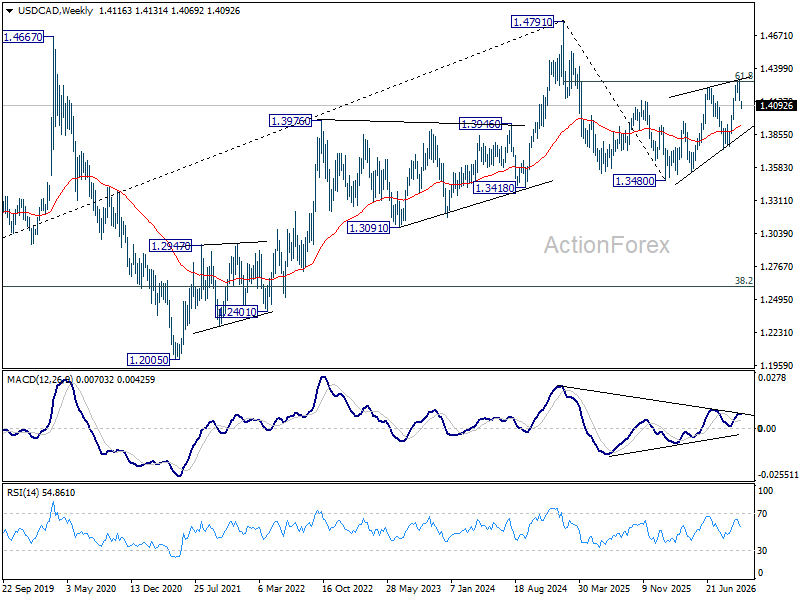
USD/CAD’s accelerated decline from 1.4298 has strengthened the case that the broader rebound from 1.3480, the January 2026 low, may have completed as a corrective move.
The pair encountered strong resistance around the 61.8% retracement of the decline from 1.4791, the 2025 high, to 1.3480, located at 1.4290. The subsequent rejection, together with bearish divergence in daily MACD, raises the possibility of a more substantial reversal.
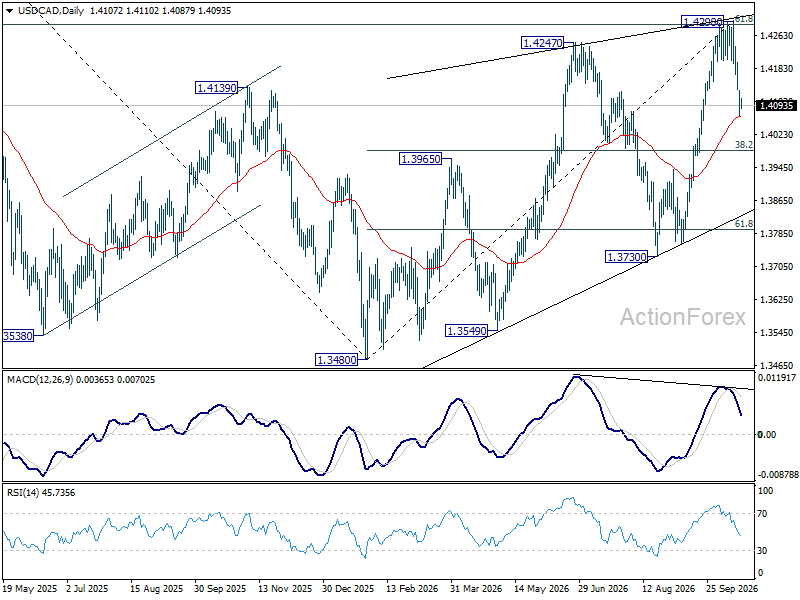
However, the bearish reversal has not yet been confirmed. The first important test is the daily 55 EMA, currently around 1.4067. Sustained break below this level would add credibility to the view that the advance from 1.3480 has ended.
The more decisive support lies around 1.4000–1.3986, with 1.3986 representing the 38.2% retracement of the rise from 1.3480 to 1.4298. A firm break through this area would considerably strengthen the bearish reversal case and shift focus toward the 61.8% retracement at 1.3792.
From a fundamental perspective, a sustained breakdown would be more convincing if supported by a BoC decision and inflation projections consistent with continued tightening. The move could occur before October 28 as expectations evolve, but confirmation from the central bank would strengthen its sustainability.
Conversely, failure to break through the daily 55 EMA and the 1.4000 support region would leave open the possibility that the decline from 1.4298 is merely another correction within the broader rally.
What Will Determine Whether USD/CAD Breaks Lower?
The immediate direction will depend on whether the BoC’s policy outlook can justify the tightening already priced by markets.
Friday’s Canadian retail sales release will provide another reading on domestic demand, but October 28 remains the central event, with both the BoC and Fed announcing policy decisions. The BoC’s new inflation projections and guidance will be particularly important in determining whether expectations for additional hikes remain credible.
A BoC increase accompanied by a clear case for further tightening, together with sustained oil prices and a relatively stable US Dollar, would strengthen the conditions for a decisive USD/CAD breakdown below 1.4000–1.3986.
Alternatively, cautious guidance, a decision to hold rates, a sharp oil decline or renewed Fed hawkishness could undermine CAD’s recent outperformance. Under those conditions, the technical reversal case could lose momentum before the key support gives way.
USD/CAD’s decline has already reflected a substantial shift in BoC expectations. The next test is whether the central bank delivers enough to sustain that repricing. A single hike may bring policy into line with immediate expectations, but a more durable bearish reversal toward 1.3792 would be better supported by evidence that the broader tightening cycle remains justified.
Key Takeaways
- The probability of an October 28 BoC hike jumped from 30% to 82.8% over a single weekend, driven by Governor Macklem’s remarks on rising energy-driven inflation risk.
- September’s inflation report was mixed: headline CPI rose to 3.1% on energy, but all three BoC core measures (trim, median, common) declined and undershot expectations.
- Markets are pricing roughly four cumulative hikes through September 2027 (to 3.29%)—far more than one October move, meaning the Bank’s guidance may matter more than the decision itself.
- USD/CAD’s key technical test is the daily 55 EMA (~1.4067) and the 1.4000–1.3986 support zone; a firm break opens 1.3792, while failure keeps the broader rally intact.
- October 28 brings both the BoC decision and the Fed meeting simultaneously, plus the BoC’s Monetary Policy Report—with oil prices near $110 adding a second variable to CAD’s path.