


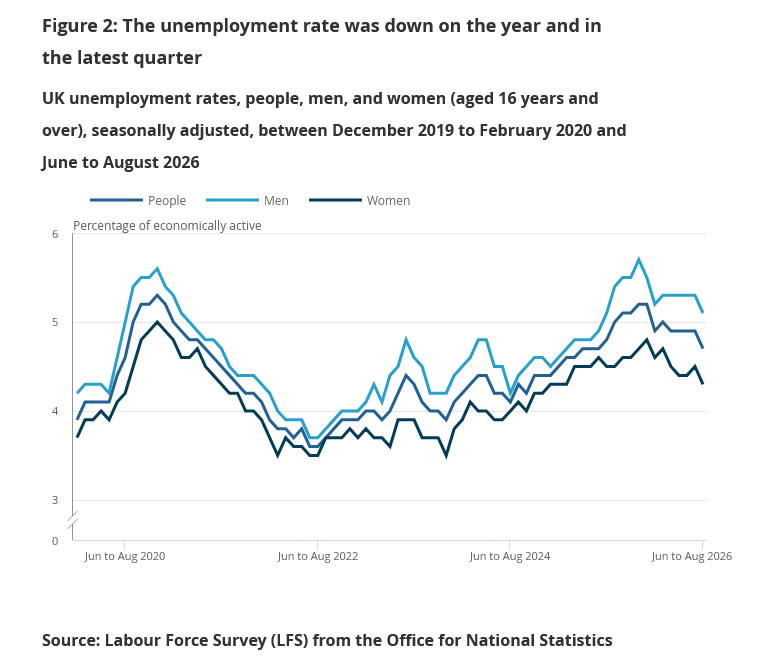
UK unemployment fell unexpectedly from 4.9% to 4.7% in the three months to August, beating market expectations of 5.0%, while the employment rate increased from 75.1% to 75.3% compared with the previous quarter. The Labour Force Survey also showed employment rising by 102K and unemployment declining by 47K on a quarterly basis. Meanwhile, regular wage growth improved from 3.6% to 3.7% yoy, exceeding expectations, although total earnings growth slowed from 3.9% to 3.7%, its weakest pace since 2020. The stronger headline employment and wage figures offered some encouragement, but other indicators revealed a considerably less convincing picture of labor demand.
Payroll employment showed tentative signs of stabilization, although the longer-term trend remained weak. According to HMRC’s PAYE Real Time Information data, payrolled employment increased by a provisional 13K in September to 30.3 million. More significantly, August’s previously reported decline of 26K was revised to a marginal increase of 1K, substantially improving the recent employment picture. Nevertheless, payroll numbers remained 66K, or 0.2%, below September 2025 levels. The divergence between rising Labour Force Survey employment and weaker payroll figures partly reflects differences in coverage, including self-employment. September’s preliminary payroll estimate also remains subject to revision, limiting confidence that a sustained recovery in hiring has begun.
Hiring demand continued to show more persistent weakness. Job vacancies fell by 21K to 691K in the three months to September, their lowest non-pandemic level since 2014, and were down 37K from a year earlier. The ONS noted that smaller businesses continued to cite increased labor costs as a constraint on recruitment. Meanwhile, September’s Claimant Count rose by 30.3K, exceeding expectations of 19.4K, and reached 1.701 million. Wage pressures were also uneven. Private-sector regular pay growth edged up from 2.9% to 3.0%, while public-sector growth remained elevated at 6.3%, partly reflecting the timing of pay awards rather than a broad acceleration in underlying wages.
Overall, the UK labor market appears more stable than the headline payroll estimates previously suggested, but the evidence for a meaningful recovery in hiring remains limited. Lower unemployment, improving Labour Force Survey employment and upward payroll revisions provide some reassurance, while falling vacancies, rising benefit claims and negative annual payroll growth point to continued caution among employers. Regular wage growth has steadied rather than accelerated decisively, with private-sector pay pressures remaining relatively contained. The mixed report offers little conclusive evidence of either renewed labor-market strength or an abrupt deterioration, leaving Wednesday’s inflation release particularly important for assessing the persistence of domestic price pressures.
Data Summary
Headline Labor-Market Indicators
| Indicator | Previous | Expected | Current |
|---|---|---|---|
| ILO unemployment rate (3m, Aug) | 4.9% | 5.0% | 4.7% |
| Regular earnings (% yoy, 3m) | 3.6% | 3.6% | 3.7% |
| Total earnings (% yoy, 3m) | 3.9% | 3.8% | 3.7% |
| Claimant Count change (Sep) | +27.8K | +19.4K | +30.3K |
| Employment rate (3m) | 75.1% | — | 75.3% |
| Economic inactivity rate (3m) | 20.9%* | — | 20.9% |
The ONS reports a 0.1 percentage-point quarterly decline in economic inactivity based on unrounded estimates.
PAYE Payroll Employment
| Indicator | Previous | Current |
|---|---|---|
| Monthly payroll change | +1K (Aug, revised) | +13K (Sep, provisional) |
| Total payrolled employees | 30.268M | 30.281M |
| Annual payroll change (Sep) | — | -66K (-0.2%) |
| Median monthly PAYE pay | £2,548 (Sep 2025) | £2,660 (Sep 2026) |
| Median PAYE pay growth (% yoy) | — | +4.4% |
August’s payroll change was revised upward by 27K, from an initially reported decline of 26K to a gain of 1K. September’s estimate is preliminary and subject to revision.
Additional Employment and Earnings Indicators
| Indicator | Previous | Current |
|---|---|---|
| LFS employment level | 34.475M | 34.577M |
| LFS unemployment level | 1.760M | 1.712M |
| Job vacancies | 712K | 691K |
| Private-sector regular pay (% yoy) | 2.9% | 3.0% |
| Public-sector regular pay (% yoy) | 6.3% | 6.3% |
| Real regular pay (% yoy, CPIH) | 0.6% | 0.6% |
| Real total pay (% yoy, CPIH) | 1.0% | 0.7% |
LFS comparisons use the preceding non-overlapping quarter. Vacancies compare April–June with July–September. Earnings figures cover June–August.
Source: ONS and HMRC, October 20, 2026 labor-market releases.
Key Takeaways
- Unemployment falls unexpectedly: The ILO unemployment rate declined from 4.9% to 4.7%, beating expectations of 5.0%. LFS employment increased by 102K on the quarter, while unemployment fell by approximately 47K. The employment rate improved from 75.1% to 75.3%, suggesting stronger headline labor-market conditions than anticipated.
- Payroll revisions improve the recent employment picture: September payrolled employment increased by a provisional 13K, while August was revised sharply from a 26K decline to a 1K gain. The revisions suggest greater near-term stability than previously reported. However, payroll employment remained 66K below its year-earlier level, leaving a sustained hiring recovery unconfirmed.
- Vacancies reveal persistent weakness in labor demand: Job vacancies fell by 21K to 691K in July–September, the lowest non-pandemic level since 2014. Vacancies were also down 37K, or 5.1%, from a year earlier. The ONS noted that smaller businesses continued to cite increased labor costs as a constraint on recruitment.
- Claimant Count rises despite lower survey unemployment: September’s Claimant Count increased by 30.3K, exceeding expectations of 19.4K, and reached approximately 1.701 million. The divergence suggests that improvements in headline unemployment are not being matched uniformly across labor-market indicators, although differences in definitions and methodology require caution.
- Wage growth remains mixed rather than broadly accelerating: Regular earnings growth edged up from 3.6% to 3.7%, beating expectations, while total earnings growth slowed from 3.9% to 3.7%, its weakest pace since 2020. Private-sector regular pay growth improved only marginally from 2.9% to 3.0%. Public-sector pay growth held at 6.3%, partly reflecting the timing of pay awards.
- Stabilization is emerging, but hiring recovery remains uncertain: Lower unemployment, stronger LFS employment and substantial upward payroll revisions provide some reassurance. Nevertheless, continued annual payroll contraction, falling vacancies and rising benefit claims indicate that employers remain cautious about expanding their workforces. The report points to tentative stabilization rather than a convincing recovery in hiring demand.