TL;DR: Yen is the top-performing major currency as Asian tech and semiconductor stocks sell off sharply and China stimulus hopes fade. AUD/JPY has been rejected at the 111.04–111.19 resistance zone and broken below 110.37 support, suggesting its rebound from 108.62 may already be over, while USD/JPY’s 156.36 level holds the key to a broader bearish reversal.
Why This Matters
Yen is outperforming all major currencies as Asian equity markets decline, with heavy selling in technology and semiconductor stocks weighing on Japan and South Korea, while Hong Kong faces renewed pressure from fading Chinese stimulus expectations. Swiss Franc is also firm, while Australian and New Zealand Dollars are at the bottom of the currency rankings. The pattern is consistent with a more defensive market tone, although Asian risk aversion should be regarded as a leading explanation for Yen strength rather than its sole driver.
The reversal is particularly notable in AUD/JPY, which has surrendered part of its recent recovery despite stronger expectations for another RBA rate hike in November. The cross’s rejection near the 111.04–111.19 resistance zone and subsequent break below 110.37 minor support suggest that its rebound from 108.62 may have completed at 111.30. Meanwhile, USD/JPY is weakening toward 156.36, where a decisive break would carry more significant bearish implications.
Yen Leads as Asian Stocks Retreat
Yen has emerged as the strongest major currency in Thursday’s Asian session, followed by Swiss Franc, as falling regional equities coincide with renewed demand for defensive currencies. The latest daily heat map places Canadian Dollar third, followed by Euro, Sterling and US Dollar, while Kiwi and Aussie are the weakest. The ranking reflects a marked change from Wednesday, when Australian Dollar led on expectations of further RBA tightening.
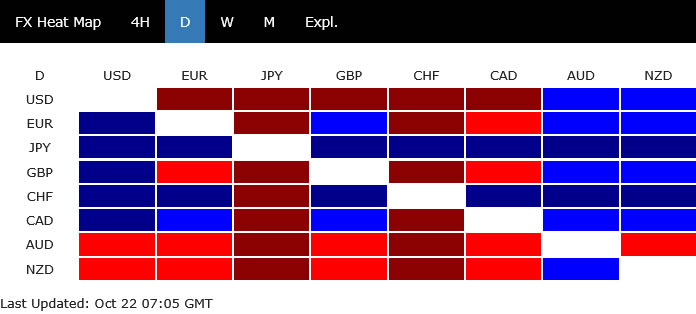
USD/JPY has fallen toward 157.04 from around 158.14 earlier in the session, slipping below the 157.50 area that had supported its recent trading range. AUD/JPY has retreated toward 110.26, while EUR/JPY is also lower near 176.75. Dollar Index, meanwhile, has eased approximately 0.2% toward 101.50, suggesting that Yen strength extends beyond a general decline in Dollar. Nevertheless, the currency moves remain measured, and their persistence will depend partly on whether the defensive tone carries into European and US trading.
Asian Technology Selloff Intensifies as China Stimulus Hopes Fade
Asian equities are under broad pressure, with steep declines concentrated in technology and semiconductor shares:
- Hang Seng: −3.1%
- KOSPI (South Korea): −3.5%
- Nikkei 225 (Japan): −2.7%
- TAIEX (Taiwan): −1.8%, after reversing an earlier advance
The declines reflect renewed concerns about AI investment valuations and financing despite recent positive earnings developments.
In South Korea, Samsung Electronics and SK Hynix were among the major decliners, while Japanese semiconductor-related names including Tokyo Electron and Advantest also suffered substantial losses. The weakness suggests that investors remain sensitive to questions surrounding the sustainability of AI-related investment and whether anticipated returns can justify elevated valuations. With technology companies carrying significant weight in regional equity indices, selling in these shares has had an outsized impact on broader market performance.
Hong Kong faces an additional source of pressure as expectations for further Chinese economic stimulus fade. China’s third-quarter GDP growth accelerated relative to forecasts, coming in at 4.5% yoy against expectations of 4.4%, while growth over the first nine months reached 4.6%. The figures have reduced expectations among some investors that Beijing will need to introduce substantial additional support to meet its annual growth objective. Hang Seng Tech consequently came under particularly heavy selling pressure, with large technology companies including Alibaba and Tencent declining.
The combination of regional equity weakness and broad Yen gains is consistent with a defensive adjustment in currency positioning, particularly against growth-sensitive currencies such as Aussie and Kiwi. However, the equity selloff reflects several overlapping factors, including AI investment concerns and China-specific policy expectations. Elevated oil prices, with Brent trading above $110, add to the uncertain backdrop but remain a secondary consideration in explaining the immediate currency moves.
Aussie Gives Back Gains Despite RBA Hike Repricing
Australian Dollar’s reversal is notable after Wednesday’s strong performance following RBA Deputy Governor Andrew Hauser’s warning that the inflation outlook had deteriorated materially. November hike probability climbed to 52.0% in the October 21 OIS snapshot, compared with 23.2% before his remarks. However, that monetary-policy support has not prevented AUD/JPY from retreating as Yen strengthens alongside the Asian equity selloff. The development highlights how changing risk sentiment can outweigh domestic rate expectations in currency crosses, without necessarily invalidating the underlying RBA tightening argument. Australia’s October 28 Q3 CPI release remains the next major policy catalyst.
For further discussion of RBA repricing and the Australian Dollar outlook, see AUD/USD Tests Bullish Reversal as Hauser Revives RBA November Hike Risk.
ActionForex’s Technical View: AUD/JPY, Rejection at Resistance Favors 108.62 Retest
AUD/JPY’s break below 110.37 minor support argues that the rebound from 108.62 might have completed at 111.30. The recovery was rejected around an important resistance confluence comprising the 38.2% retracement of 114.95 to 108.62 at 111.04, horizontal resistance at 111.13 and the daily 55 EMA near 111.19. The failure to sustain gains through this area keeps the broader decline from 114.95 intact and suggests that the recent recovery was corrective.
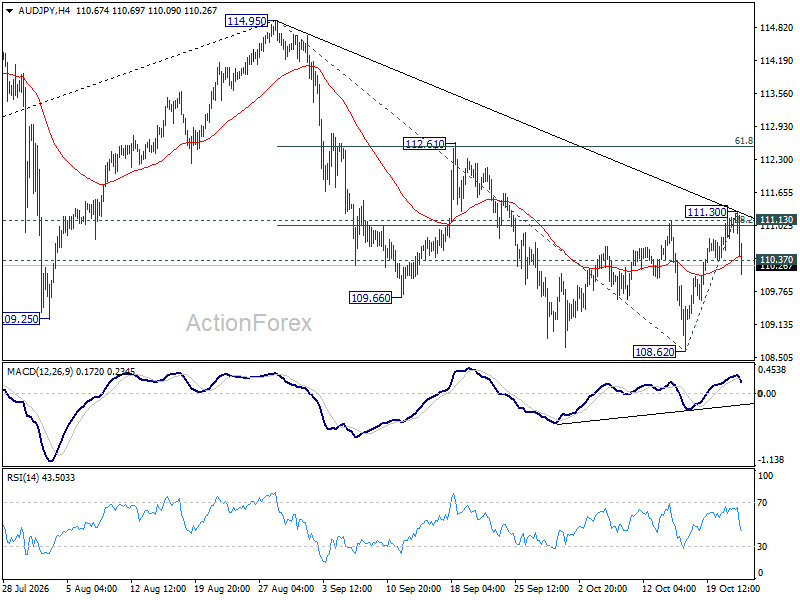
A retest of 108.62 is now favored, with a firm break opening the way toward the 61.8% projection of 114.95 to 108.62 from 111.30 at approximately 107.39. Such a development would confirm that the decline from 114.95 is extending rather than merely consolidating. The weakening technical structure is consistent with renewed Yen strength, although a sustained breakdown would still require confirmation through the existing low.
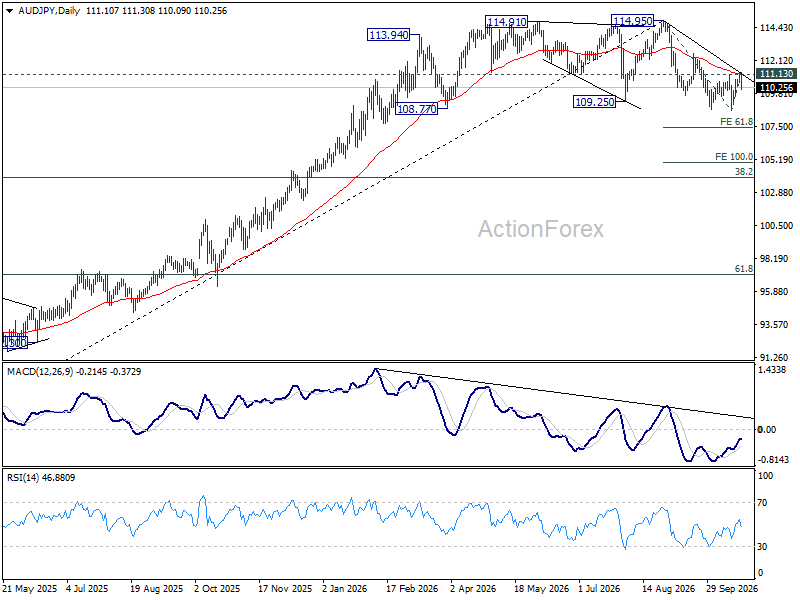
On the upside, a break above 111.30 would invalidate the immediate bearish interpretation and suggest that the recovery from 108.62 remains in progress. Until then, the rejection at the daily moving average and subsequent loss of minor support favor further downside, particularly if Asian risk aversion persists.
ActionForex’s Technical View: USD/JPY, 156.36 Holds the Key to a Bearish Reversal
USD/JPY’s retreat has shifted attention back toward 156.36 support after the recovery from 152.87 stalled around the 159 area. However, as long as 156.36 holds, further upside from 152.87 remains mildly favored, despite the latest Yen strength. The broader bearish case therefore requires more substantial technical confirmation than the decline already developing in AUD/JPY.
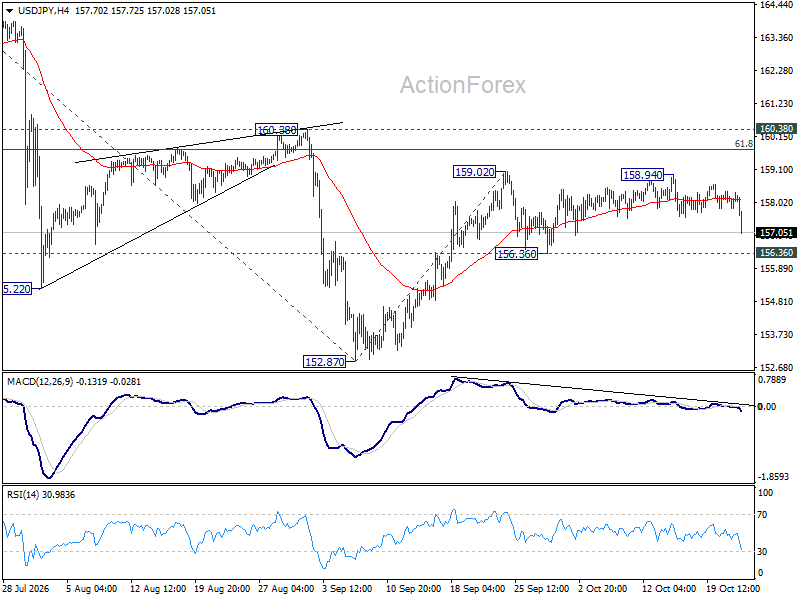
A firm break below 156.36 would complete a double-top formation around 159.02 and 158.94, suggesting that the rebound from 152.87 has finished. It would also reinforce the rejection at the daily 55 EMA and indicate that the corrective decline from 163.97 is likely resuming. Under this scenario, a further fall through 152.87 would become increasingly likely, with the 61.8% projection of 163.97 to 152.87 from 159.02 at approximately 152.16 providing the next larger downside objective.
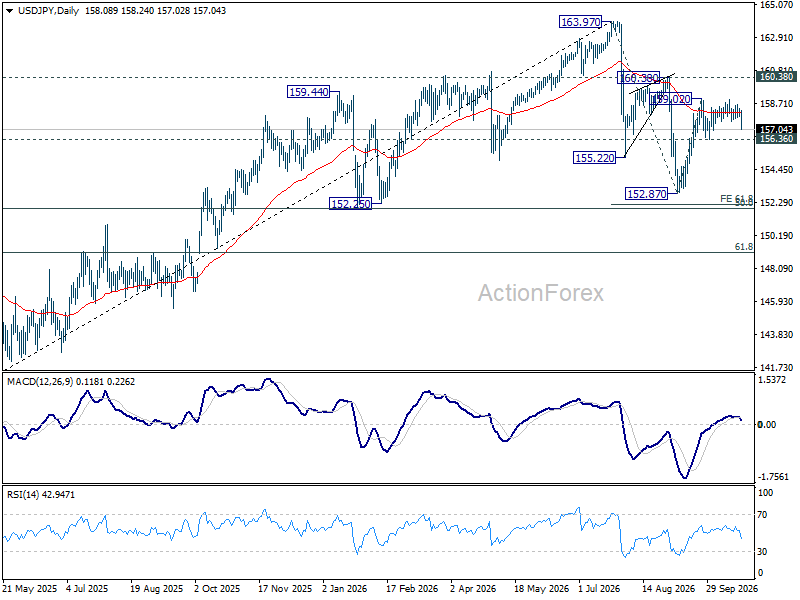
Conversely, a recovery through the recent highs around 158.94–159.02 would weaken the developing bearish pattern and revive the case for extending the rebound from 152.87. For now, USD/JPY remains at an earlier stage of potential reversal than AUD/JPY, making 156.36 the decisive level to monitor.
The immediate outlook for Yen is increasingly constructive, but technical confirmation remains uneven across currency pairs. AUD/JPY has already rejected important resistance and broken minor support, while USD/JPY still needs to clear its critical downside threshold. Whether Asian equity weakness extends into other markets will be an important test of the durability of Yen’s latest recovery, alongside upcoming Japanese inflation data and the BoJ’s October 30 policy decision.
Key Takeaways
- Yen is the top-performing major currency as Asian tech and semiconductor stocks sell off broadly (Hang Seng −3.1%, KOSPI −3.5%, Nikkei −2.7%, TAIEX −1.8%) and China stimulus hopes fade.
- AUD/JPY’s rejection at 111.04–111.19 resistance and break below 110.37 suggest its rebound from 108.62 has already completed, despite RBA November hike odds climbing to 52.0%—a reminder that risk sentiment can override domestic rate expectations in crosses.
- USD/JPY is at an earlier stage of reversal: 156.36 is the decisive level, with a break confirming a double-top and reviving the decline from 163.97 toward 152.16.
- China’s Q3 GDP beat forecasts (4.5% yoy vs. 4.4% expected), reducing expectations for additional stimulus and adding fresh pressure on Hang Seng Tech names like Alibaba and Tencent.
- The BoJ’s October 30 policy decision and Australia’s October 28 Q3 CPI are the next catalysts that could confirm or unwind the current defensive, Yen-led tone.