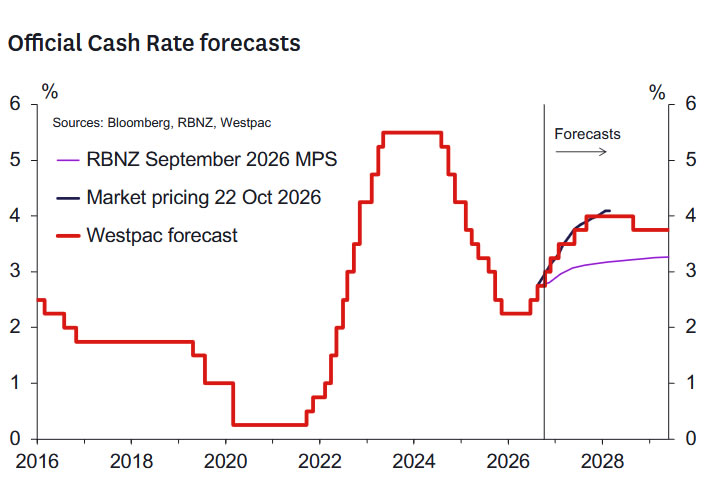
- We expect the RBNZ to raise the OCR by 25bps to 3% at the 28 October Review.
- A vote seems very possible as differences in view will likely remain among the MPC about how much the medium-term inflation outlook has really shifted in recent weeks.
- Data since September show a higher outlook for year-end inflation and a stronger GDP starting point, but increased risks to domestic consumption and residential investment. On balance, the medium-term inflation picture will probably be judged to have worsened slightly given recent movements in energy prices and the exchange rate.
- Forward guidance will likely leave open the option to raise the OCR further at the December Monetary Policy Statement without presenting it as a sure thing.
- Given the ‘pause’ signal in September, the press release will likely emphasise the more concerning short-term inflation picture driven by the lower exchange rate and higher energy prices. The tightening in financial conditions through higher short- and long-term interest rates, as well as lingering spare capacity, will be presented as offsets that means the MPC retains confidence that inflation will return towards 2% over time.
- We still think a more measured tightening approach is appropriate from here. Raising the OCR at every meeting until something ‘breaks’ could be a risky strategy if downside growth concerns crystalise.
- Nonetheless, the expected hike will bring the OCR to the top of the RBNZ’s neutral range more quickly. We now think the OCR will hit 3.5% a meeting earlier in February. Thereafter we expect further 25bp hikes at the June and September 2027 meetings, lifting the OCR to a peak of 4%.
RBNZ Decision and Communication
We expect the RBNZ to raise the OCR by 25bps to 3% at the 28 October Review. As there will likely be differences in perspective about recent developments in energy prices and the exchange rate, we think it is quite possible that the decision will be reached after a formal vote, rather than by consensus.
As the RBNZ will not be presenting new forecasts (aside perhaps from updated short-term CPI forecasts) we will not see an updated OCR forecast track. Rather we expect the RBNZ will aim to leave their options open at the next meeting in December. As in September, we expect the RBNZ to note that conditional on the central economic outlook, the OCR may need to increase further (the September projection had portrayed an OCR eventually rising to 3.25%). The RBNZ will emphasise the future OCR path is not predetermined.
In September, the MPC agreed that further tightening in policy was likely required. The bulk of the MPC saw upside risks to the inflation outlook while two members (Conway and Hansen) thought the risks were balanced. Recent developments will likely not have made those seeing upside risks to inflation more comfortable, while the more dovish MPC members will likely still see the growth downside risks given continued softness in house prices and the mounting pressure on real incomes. Indeed, all MPC members saw some degree of downside risks to growth which likely remain relevant. All these messages should remain in the RBNZ’s updated views.
The MPC will likely continue to present their decision as a gradual evolution of the approach taken since July, where a higher OCR now is insurance against a much higher OCR later should upside medium-term inflation risks arise. We doubt the objective will be to push market interest rates materially higher.
The exchange rate will likely have greater prominence at this Review, as it did at the July meeting. The TWI is just over 3% lower than previously assumed which — if sustained — will add some inflation pressure over the next few quarters. We suspect this will not have shifted the RBNZ’s medium term outlook for inflation. So, the discussion will seek to link the implications of the lower exchange rate for short term inflation projections with the risk this spills over into medium term inflation. We doubt the RBNZ will be trying to actively support the exchange rate in any meaningful way, and indeed the lower exchange rate may be presented as something supportive of the medium-term growth profile, reducing risks there.
Financial conditions more broadly are likely to receive some attention. While the exchange rate is lower than assumed, there have also been marked increases in wholesale long-term interest rates and (to a lesser extent) mortgage rates. The impact of higher interest rates on managing medium term inflation risks will likely be noted.
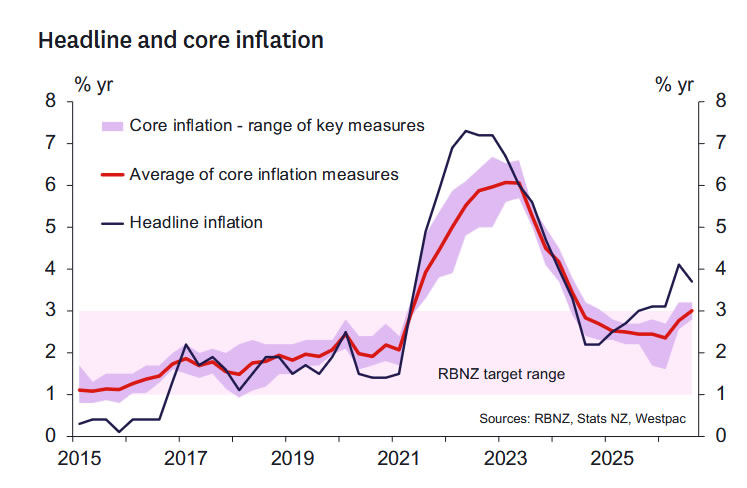
The RBNZ is likely to continue to emphasise that at this stage there is little evidence of second-round inflation impacts coming from the Iran war and the associated rise in energy prices. We note that most other central banks are drawing a similar judgement at this point. Today’s CPI might be consistent with that judgement, although core inflation measures have increased and will likely be noted by the more hawkish members of the MPC. We expect the RBNZ to point to the risks that such persistent inflation pressures might emerge at some point. But that would depend on the duration of the oil price shock. We expect the RBNZ to continue to have the assumption that the shock dissipates and that energy prices and hence CPI inflation will be appreciably lower in the medium term.
We expect the RBNZ to note the labour market remains cyclically weak and is not a significant driver of inflation. Still-weak employment growth compared to labour force growth, weak job vacancies growth and low levels of labour market turnover are in line with this view and could be emphasised.
Finally, the RBNZ is likely to acknowledge a still-solid global growth outlook but with significant downside risks looking forward given the Iran war and concerns around the sustainability of the AI investment cycle.
Implications for Westpac’s Forecast Profile for the OCR
The expected hike will bring the OCR to the top of the range of the RBNZ’s neutral rate estimates more quickly. It seems likely that the OCR will hit 3.5% a meeting earlier now. Beyond the pause that we had previously expected at next week’s meeting, we had expected the RBNZ would be looking to slow the pace of OCR increases once it had reached 3.5%. We retain the latter expectation, so this earlier hike also implies that the pause will come a little earlier, after two further 25bp hikes at the December 2026 and February 2027 reviews.
We continue to see further 25bp hikes at the June and September 2027 meetings — taking the OCR to a peak of 4.0% — as it’s likely that more restrictive conditions will be required to push core inflation back sustainably to 2%. Needless to say, the path of the OCR in 2027 will depend on the evolution of numerous factors that remain very uncertain, not least being developments in the Middle East.
Arguments in Favour of a Hike
- The ongoing conflict in the Middle East and related developments in global energy markets point to upside risk for headline inflation, at least in the near term. Westpac’s forecasts for headline inflation are now at 2.5% or above for most of 2027 now. Upside risks to core inflation and inflation expectations also may emerge the longer the oil price remains above $90-100/bbl.
- The exchange rate is notably weaker in recent months as global interest rates have been rising, and the NZ OCR is low compared to Australian and US settings. Financial markets even envisage further interest rate increases in Europe given the high levels of inflation implied by their September adverse scenarios (3.2% 2027 HICP inflation vs 2.5% baseline). If the NZ OCR doesn’t keep pace with global trends, then the risk is for more inflation generated by a lower NZD exchange rate.
- The ‘real’ OCR rate is relatively low — plausibly around -1 to -2% based on headline inflation projections. Based on core CPI levels the real policy rate is likely negative. An OCR in the 3.25-3.5% range would deliver positive real rates based on core CPI forecasts.
- The economy has grown above trend in the last year reflecting strong export sector incomes and the lagged impact of past low OCR settings. The output gap is likely still negative but is closing. Relying on a prolonged negative output gap to bring core inflation pressures down could be risky.
- The areas of economic strength in the last year are not yet waning. Agriculture sector returns remain strong, while global growth forecasts are being revised up as the AI investment boom proceeds. The construction sector is picking up, as is the manufacturing sector. Tourism is strong, supported by an advantageous exchange rate.
- Market pricing leans strongly towards an OCR hike at this meeting. It may be less disruptive to go along with market pricing, especially given the RBNZ’s forecasts imply two further OCR increases including one by year-end. Moving now versus six weeks later is of little consequence from a macro view. A smaller ‘splash’ at this meeting could be desirable given the proximity to the election.
Arguments in Favour of No Change
- For all the upward pressure on short term inflation, there is little evidence that the medium-term inflation outlook has shifted much. Domestic inflation in the September quarter was 0.3ppts weaker than the RBNZ had expected, which should be a source of comfort. In addition, energy and exchange rate inflation impacts on inflation occur too early for the MPC to offset and will be what they will be. And measures of pricing behaviour and inflation expectations in recent consumer and business surveys seem benign given the scale of recent energy price increases.
- Firms report pressure on margins and an inability to set prices high enough to recoup cost increases. Profitability is struggling which clouds the outlook. Firms expect better times ahead — perhaps because they think energy prices will fall — but note tougher trading conditions now. Hiring still seems modest albeit positive. It does not appear that hiring is yet strong enough to reduce the high unemployment rate.
- Housing market trends look quite weak and seem set to constrain consumer spending and residential investment. Despite very low mortgage rates in the last year, house sales have declined and house prices are flat to falling. It seems unlikely we will see a change in these weak trends soon — especially if interest rates continue to rise. The result is we are not seeing a ‘consumption rich’ recovery and growth is relatively unbalanced. There could be additional risks to the sustainability of this recovery should external demand suddenly weaken for some reason.
How Might the Election Play into the Decision?
While next week’s meeting is close to the General Election on 7 November, the decision taken by the MPC will not be politically motivated. However, the election outcome is close. And should it result in a Labour Party-led coalition, it seems likely the new government would adopt the Labour Party’s promise to restore the RBNZ’s dual mandate. That would require the MPC to weigh the degree of labour market slack more highly in its deliberations. As the degree of labour market slack currently seems high, a new mandate might justify the MPC taking more time to return inflation to the middle of the target range ([LINK?]our earlier note[/LINK?] discusses this issue). This could figure into the deliberations of some MPC members if the decision between leaving the OCR unchanged and raising it now is viewed as finely balanced.
Scenarios
Our core scenario, with perhaps around a 60% probability, is that the RBNZ increases the OCR by 25bp and signals the December meeting is live but without committing to a markedly tighter future stance than presented in September. Alternative scenarios include:
- A hawkish scenario (around a 20% probability) would see the OCR increase to 3% and have the RBNZ more strongly emphasise the upside risks to core and medium-term inflation, leading to the implication that an upward revision of the RBNZ’s forward OCR profile is in the offing in December. The downside risks to the exchange rate could also be emphasised.
- A dovish scenario (around a 20% probability) is one where the RBNZ leaves the OCR unchanged and signals that the medium-term outlook for inflation has not yet changed meaningfully relative to that forecast in the September meeting, despite the higher near-term inflation outlook. This would cause the RBNZ to reiterate its previous forecast, i.e. one 25bp increase in December and one more hike in 2027 sometime.
Appendix: Key Developments Since the September Monetary Policy Statement
Activity: The economy is coming from a stronger starting point than the RBNZ assumed in September. GDP rose by 0.2% in the June quarter, and along with revisions to earlier quarters, the annual growth rate lifted to 2.6% against the RBNZ’s forecast of 2.1%. Against this, recent high-frequency data and the resurgence in fuel prices presents some downside risk to the RBNZ’s growth forecasts for the second half of the year. The RBNZ’s Nowcast estimates of growth have drifted lower in recent weeks, and while these are not the same as the RBNZ’s official forecasts, they may be a useful guide as to the direction of change.
Sentiment-based activity indicators: The NZIER’s Quarterly Survey of Business Opinion was mixed. Firms were more optimistic about the coming months, but recent performance has been more subdued and continues to fall short of expectations. Hiring and investment intentions picked up compared to last quarter, but more firms cited a lack of demand rather than capacity as their main constraint on growth. Meanwhile, the monthly PMI surveys have shown ongoing strength in manufacturing, with more modestly positive readings for service industries.
Housing market: Housing market conditions have remained soft. House sales have fallen a further 4% since July, the average time to sell remains elevated, and prices have continued to edge lower. The RBNZ had already assumed a modest decline in prices over 2026, and the recent performance has been broadly in line with their assumption.
Labour market: Filled jobs have picked up in the last two months, having been flat through the first half of this year. That’s in line with the RBNZ’s forecast of a rise in employment and a tick down in the unemployment rate to 5.5% in the September quarter. The QSBO showed some tightening in the availability of skilled workers and a lift in hiring intentions. Net migration has been in line with the RBNZ’s assumptions.
Inflation: Annual inflation slowed to 3.7% in the September quarter, below the RBNZ’s forecast of 3.9%. The downside surprise was on non-tradables inflation, while tradables inflation was in line with the RBNZ’s forecast. Underlying inflation pressures remain elevated, with the various measures of core inflation close to or above the top of the RBNZ’s 1-3% target range. Since the September MPS forecasts were finalised, oil prices have surged higher again, with petrol prices setting new record highs. The Dubai crude spot price is currently around $110/bbl, compared to the RBNZ’s assumption of an average price of around $84/bbl for the December quarter.
Inflation expectations: The QSBO showed that firms’ expectations of costs and prices remain elevated, but lower than they were in the June quarter. ANZ’s monthly survey showed a small dip in inflation expectations among both businesses and consumers, although the survey period may have pre-dated the worst of the latest resurgence in fuel prices (the next updates will be released just after the OCR review).
Trade: The June quarter terms of trade were in line with the RBNZ’s forecast. Prices for New Zealand’s commodity exports have generally remained firm in recent months, with a pickup in dairy prices against some easing in beef and lamb prices.
Financial conditions: Domestic financial conditions have provided mixed signals since the September MPS. Long-term interest rates have risen sharply along with global markets, which the RBNZ may regard as an unwarranted tightening of financial conditions to the extent that it hasn’t reflected domestic economic conditions. Most fixed-term mortgage rates have risen by 5-15 basis points since the September MPS, but rates for the popular two-year term have actually fallen a little as lenders have looked to compete in this space. Meanwhile, the New Zealand dollar has fallen sharply and the trade-weighted index is just over 3% below the RBNZ’s assumed average for the December quarter. If sustained, this will add to imported inflation pressures over the year ahead.