


French Government Bond Yields Are Again Approaching 5%, Keeping Euro Under Pressure Even as Dollar Weakens Broadly
Today’s themes:
- Euro lags on France: The French 10-year yield is around 4.96% and the OAT–Bund spread is 152.5bps, keeping Euro under pressure despite a broadly weaker Dollar.
- Sterling gains on jobs: UK unemployment fell to 4.7%, reinforcing a November 5 BoE hike, with Wednesday’s UK CPI the next test.
- CAD leads on BoC bets: BoC hike odds for October 28 have jumped from around 30% to about 83%, pushing USD/CAD toward 1.4053.
The moves reflect separate domestic catalysts rather than a uniform shift in global risk appetite, and Dollar has fallen against all seven major counterparts.
French government bond yields are again approaching 5%, keeping Euro under pressure even as Dollar weakens broadly. EUR/CHF and EUR/GBP are falling, while Sterling and Canadian Dollar are among the strongest major currencies. The contrast reflects two competing forces: mounting concerns over France’s fiscal and political outlook, and expectations for further monetary tightening in Britain and Canada.
The divergence is particularly striking as Dollar has fallen against all seven major counterparts, yet Euro is struggling to capitalize on that weakness. Canadian Dollar leads the currency rankings, followed by Sterling, while Euro is second weakest ahead of Dollar. The moves reflect separate domestic catalysts rather than a uniform shift in global risk appetite, with Wednesday’s UK inflation report and France’s approaching fiscal and credit-rating tests providing the next potential triggers.
French Sovereign Risks Keep Euro on Defensive
France’s sovereign bond market remains under pressure, with the 10-year OAT yield rising to around 4.96%, approaching its early-October peak of 4.9937%, the highest since July 2002. More importantly, the OAT–Bund spread widened by approximately 5.5bps to 152.5bps, moving closer to the earlier peak of 158.67bps, the widest since November 2011.
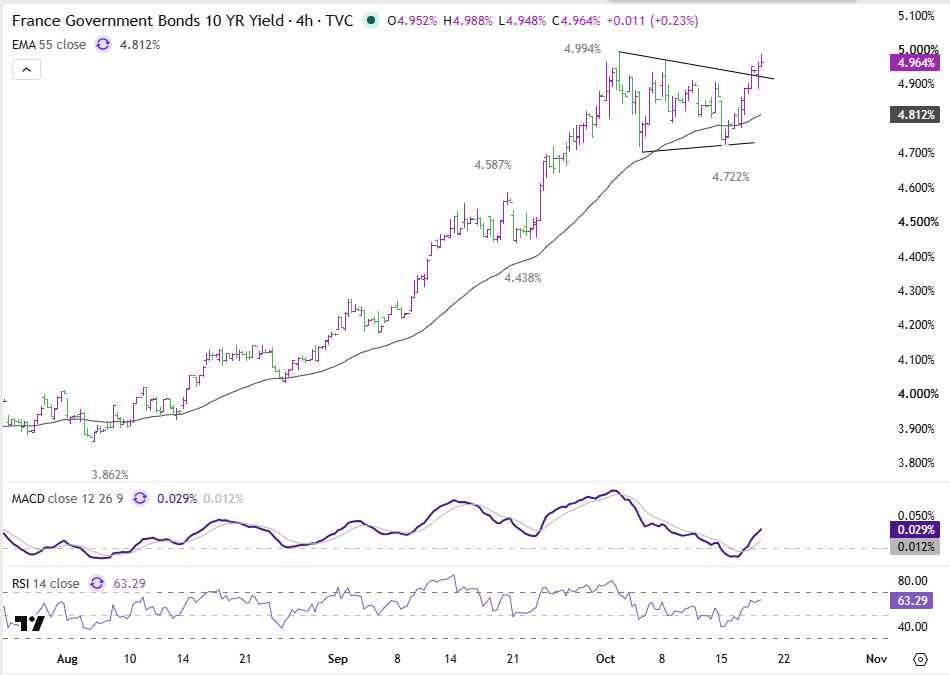
The spread widening partly reflected a decline in German Bund yields, with the 10-year yield easing toward 3.43% while remaining within its recent trading range. Nevertheless, the sustained elevation of the OAT–Bund spread highlights a substantial France-specific sovereign risk premium, rather than merely a generalized increase in European borrowing costs. A renewed move beyond 159bps would strengthen concerns that French fiscal risks are intensifying.
Weekend unrest has compounded an already difficult political environment. Nationwide protests over living costs and education descended into violence, prompting further government intervention, while organizers have announced another round of demonstrations for Saturday. The unrest adds pressure to Prime Minister Sébastien Lecornu’s minority government as it attempts to implement fiscal consolidation amid widespread resistance to spending restraint.
The immediate budget outlook has also become more uncertain. Tuesday’s planned parliamentary vote on the revenue portion of the 2027 budget was postponed, with more than 2,000 amendments remaining. Examination is expected to resume on October 27, but the precise timing of the delayed vote remains unsettled. The government is targeting a deficit reduction from 5.4% of GDP this year to 5.0% in 2027, leaving limited room for additional concessions.
Friday’s scheduled Moody’s review represents another potential catalyst. France currently carries an Aa3 rating with a negative outlook. An unfavorable decision, particularly alongside further political disruption, could reinforce pressure on sovereign bonds. Conversely, a benign outcome accompanied by narrowing spreads would help contain the immediate risks.
In currency markets, the effect is clearer across Euro crosses than against Dollar. Euro’s relative weakness, particularly against Swiss Franc, suggests that French sovereign concerns are limiting its participation in the broader Dollar retreat.
Sterling Advances as Jobs Data Reinforce November BoE Hike
Sterling is benefiting from stronger-than-expected UK employment data, with GBP/USD advancing approximately 0.36% to 1.3350 and EUR/GBP retreating toward 0.8402. The latest figures showed unemployment declining from 4.9% to 4.7% in the three months to August, beating expectations of 5.0%, while regular earnings growth improved from 3.6% to 3.7% yoy.
However, the broader labor-market picture remains mixed. Total earnings growth slowed from 3.9% to 3.7%, while job vacancies declined to 691K, their lowest non-pandemic level since 2014. Payroll employment also remained below its year-earlier level, despite tentative signs of stabilization. The report therefore points to greater employment resilience than expected, rather than a decisive acceleration in labor demand.
For the Bank of England, the data reinforce expectations for a November 5 rate hike without necessarily strengthening the case for a faster tightening cycle afterward. Money markets had already assigned approximately 93% probability to a November increase before the release, leaving relatively limited scope for additional repricing of the immediate decision.
The more important test comes with Wednesday’s September CPI report. Headline inflation is expected to accelerate from 3.1% to around 3.4%, largely reflecting higher energy costs. However, core and services inflation, previously at 2.6% and 3.4%, will be more important for assessing whether domestic price pressures justify further tightening beyond November.
UK CPI: Two Outcomes for Sterling
| Core and services inflation | Likely effect |
|---|---|
| Stronger underlying readings | Could reinforce expectations for another hike in December or early 2027, providing additional support for Sterling |
| Softer core and services readings | Could challenge expectations for an extended tightening cycle, even if November remains largely settled |
Canadian Dollar Leads as BoC Tightening Bets Hold Firm
Canadian Dollar is Tuesday’s strongest major currency, outperforming all seven counterparts in the daily currency rankings. USD/CAD has fallen approximately 0.42% toward 1.4053, extending its recent decline as markets continue to anticipate a Bank of Canada rate hike on October 28.
BoC Repricing
- October hike probability (OIS): approximately 83%, up from around 30% on Friday
- USD/CAD: down approximately 0.42% toward 1.4053
The latest available OIS snapshot showed an approximately 83% probability of an October increase, up sharply from around 30% on Friday. Governor Tiff Macklem’s warning that elevated oil prices would push the BoC’s inflation forecast substantially higher helped accelerate that repricing.
The tightening expectations have persisted despite September’s softer-than-expected Canadian inflation report, in which all three BoC core measures declined. Markets are increasingly focused on the risk that sustained energy costs could produce more persistent inflation pressures rather than simply reacting to the latest underlying price readings.
More in USD/CAD Falls as BoC Hike Bets Surge: Can One Hike Break 1.4000?
Dollar Trails as Yen Benefits From Japanese Bond Demand
Dollar has slipped broadly, with Dollar Index retreating approximately 0.16% to 101.82 after Monday’s modest rebound. However, the weakness has not been accompanied by a meaningful fresh repricing of Federal Reserve expectations, suggesting that developments among its counterparts are playing an important role.
US Treasury yields are modestly lower, with the 10-year yield around 5.11% after recovering on Monday as defensive bond demand eased. Markets continue to favor unchanged Fed rates at the October 28 meeting, while expectations for another increase in December remain substantial.
Japanese Yen has also found support following exceptionally strong demand at Japan’s 20-year government bond auction. USD/JPY declined toward 158.10, while Swiss Franc remained firm amid weaker Asian and European equities. The defensive demand supporting Yen and Franc has not translated into comparable strength for Dollar, reinforcing the unusual divergence across major currencies.
The immediate market focus now shifts to Wednesday’s UK CPI report, which will test whether Sterling’s tightening expectations can extend beyond November. France faces Moody’s scheduled review on Friday and further budget proceedings the following week, while the BoC decision on October 28 will determine whether aggressive Canadian tightening expectations can be sustained.
For now, Euro remains constrained by French sovereign risks even as Dollar weakens broadly, while Sterling and CAD continue benefiting from their respective monetary-policy outlooks. The contrast underscores a currency market increasingly driven by relative policy expectations and country-specific vulnerabilities rather than a single global risk narrative.
Related Coverage
Canada and Sterling
- USD/CAD Falls as BoC Hike Bets Surge: Can One Hike Break 1.4000?: the technical outlook for USD/CAD near 1.4000, with markets already pricing roughly four hikes through September 2027.
- UK Unemployment Falls to 4.7%, but Payrolls and Vacancies Reveal Weak Hiring: the labor market is holding up better than feared, yet benefit claims keep rising and hiring demand remains weak.
Gold and Germany
- Gold’s $4,000 Floor Faces Oil-Yield Test as AI Haven Bid Wavers: Gold struggles to recover above $4,100 with 4,066 support increasingly important as Brent tests $110.
- Germany’s ZEW Expectations Fall to 28.1 Despite Sharp Improvement in Current Conditions: October sentiment missed forecasts even as the Current Situation index improved, with high energy costs still weighing on confidence.
FAQ
Why is Euro lagging when Dollar is weakening?
Dollar has fallen against all seven major counterparts, yet French sovereign concerns are limiting Euro’s participation. The French 10-year yield is around 4.96% and the OAT–Bund spread has widened to 152.5bps, and Euro is second weakest ahead of Dollar. EUR/CHF has fallen about 0.36%, EUR/CAD 0.35% and EUR/GBP 0.30%, while EUR/USD is only marginally higher near 1.1218.
What do the UK jobs data mean for the Bank of England?
UK unemployment fell from 4.9% to 4.7%, beating the 5.0% forecast, and regular earnings growth improved to 3.7%. The data reinforce expectations for a November 5 hike, which money markets had already priced at about 93%, without necessarily strengthening the case for faster tightening afterward. Wednesday’s UK CPI, particularly core and services inflation, will show whether tightening can extend beyond November.
Why is the Canadian Dollar leading the majors?
Markets now assign roughly 83% odds to a Bank of Canada hike on October 28, up from around 30% on Friday, after Governor Macklem warned that elevated oil prices would push the BoC’s inflation forecast substantially higher. That repricing has held despite softer September inflation, with all three BoC core measures declining, and USD/CAD has fallen toward 1.4053.
Key Takeaways
- Dollar fell against all seven major counterparts on Tuesday, yet Euro, second weakest ahead of Dollar, failed to benefit.
- France’s 10-year OAT yield rose to around 4.96%, close to its early-October peak of 4.9937%, and the OAT–Bund spread widened to 152.5bps; a move beyond 159bps would deepen concerns.
- The vote on the revenue portion of France’s 2027 budget was postponed with more than 2,000 amendments remaining, with examination expected to resume on October 27, and Moody’s reviews its Aa3 rating, which has a negative outlook, on Friday.
- UK unemployment fell from 4.9% to 4.7%, but vacancies of 691K were the lowest non-pandemic level since 2014, and total earnings growth slowed to 3.7%.
- A November 5 BoE hike was already priced at about 93%, so Wednesday’s UK CPI, with headline expected near 3.4%, is the more important test.
- BoC hike odds for October 28 jumped from around 30% to about 83% after Macklem’s warning on oil, and CAD led the currency rankings with USD/CAD near 1.4053.
- Dollar Index fell about 0.16% to 101.82 without a fresh Fed repricing, while USD/JPY declined toward 158.10 after strong demand at Japan’s 20-year bond auction.
What to Watch Next
The French sovereign test spans several dates: another round of demonstrations on Saturday, the resumption of budget examination on October 27, and a spread move beyond 159bps or a break of the 4.9937% yield peak that would signal intensifying fiscal risks.
On the policy side, Wednesday’s UK CPI shapes the BoE outlook beyond the expected November 5 hike, while the October 28 meetings, the BoC decision and the Fed, will show whether aggressive Canadian tightening expectations can be sustained and whether the Fed stays on hold with a December increase still in view.