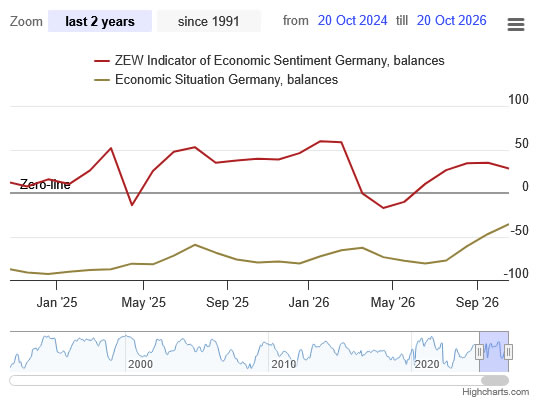
Germany’s ZEW Economic Sentiment declined from 34.7 to 28.1 in October, missing market expectations of 31.6 and reversing part of the steady improvement recorded over the summer. However, the Current Situation index improved sharply from -47.1 to -35.9, comfortably exceeding expectations of -45.0. The divergence suggests that Germany’s economy is gradually emerging from stagnation, but confidence in the sustainability of the recovery is weakening. While the improvement in current conditions is encouraging, the index remains deeply negative, indicating that the economic environment is still challenging.
ZEW President Achim Wambach cautioned that “the recovery is not self-sustaining,” citing elevated energy prices that continue to squeeze household real incomes, raise production costs and keep inflation higher for longer. Sector expectations reflected the uneven outlook. Banks and insurance recorded sharp declines of 18.4 and 9.0 points respectively, although their readings remained positive at 34.5 and 37.4. Services and telecommunications also weakened, while steel, metal manufacturing and electronics showed more encouraging developments. The contrasting sector performance highlights the difficulty of building broader economic momentum while private consumption and investment remain subdued.
Eurozone sentiment also deteriorated, with the ZEW Economic Sentiment index falling from 25.8 to 18.5, below expectations of 24.2. The Current Situation index edged down from -13.9 to -14.8, offering little evidence of a broader regional improvement. Taken together, the surveys suggest that Germany is making tentative progress out of stagnation, but elevated energy costs and weak domestic demand continue to constrain expectations for sustained growth. The sharp improvement in Germany’s current conditions provides some reassurance, although declining forward-looking sentiment indicates that a durable recovery has yet to establish itself.
Data Summary
Germany and Eurozone ZEW — October 2026
| Indicator | Previous | Expected | Current |
|---|---|---|---|
| Germany Economic Sentiment | 34.7 | 31.6 | 28.1 |
| Germany Current Situation | -47.1 | -45.0 | -35.9 |
| Eurozone Economic Sentiment | 25.8 | 24.2 | 18.5 |
| Eurozone Current Situation | -13.9 | — | -14.8 |
Changes from September
- Germany Economic Sentiment: -6.6 points
- Germany Current Situation: +11.2 points
- Eurozone Economic Sentiment: -7.3 points
- Eurozone Current Situation: -0.9 points
Key Takeaways
- Economic expectations weaken despite improving current conditions: Germany’s ZEW Economic Sentiment dropped from 34.7 to 28.1, missing expectations of 31.6 and reversing part of the improvement recorded over the summer. However, the Current Situation index jumped from -47.1 to -35.9, substantially exceeding expectations of -45.0. The divergence suggests improving present conditions but declining confidence in the sustainability of the recovery.
- Germany is emerging from stagnation, but recovery remains fragile: ZEW President Achim Wambach described the recovery as “not self-sustaining.” Despite the sharp improvement in the Current Situation index, its deeply negative reading indicates that economic conditions remain challenging. The survey does not yet establish a durable recovery.
- High energy prices constrain consumption and investment: Elevated energy costs continue to squeeze household real incomes, increase business production costs and prolong inflation pressures. According to ZEW, these factors are limiting private consumption and investment, helping explain why improving current conditions have not translated into stronger economic expectations.
- Sector expectations reveal uneven momentum: Banks and insurance recorded substantial declines of 18.4 and 9.0 points respectively, although both remained firmly positive at 34.5 and 37.4. Services and telecommunications also weakened, while steel, metal manufacturing and electronics showed more encouraging developments. The divergence highlights the uneven nature of the emerging recovery.
- Eurozone sentiment deteriorates more broadly: Eurozone Economic Sentiment fell from 25.8 to 18.5, missing expectations of 24.2. The Current Situation index also edged down from -13.9 to -14.8. Unlike Germany, the wider Eurozone showed no comparable improvement in assessments of present economic conditions.
- Forward-looking confidence remains the main concern: The simultaneous deterioration in German and Eurozone expectations suggests that respondents are becoming more cautious about future economic growth. Germany’s improving current conditions provide some reassurance, but weak domestic demand and persistent energy pressures continue to threaten the durability of the recovery.