Japan’s private-sector activity continued expanding in October, with PMI Composite unchanged at 52.3, marking the nineteenth consecutive month of growth, although the pace remained the joint-weakest since May. PMI Services improved from 51.3 to 52.0, offsetting a moderation in PMI Manufacturing from 54.1 to 53.3. Manufacturing output also slowed from 54.9 to 53.1, its weakest expansion since March. The divergence between stronger services activity and softer manufacturing growth kept overall momentum steady, but below the average recorded so far this year.
Underlying demand and employment conditions were less encouraging. Overall new business growth slowed to a three-month low, reflecting weaker manufacturing orders despite faster expansion in services demand. Export orders also increased at their slowest pace in four months. More notably, overall employment growth weakened to a 14-month low, with services payrolls declining for the first time since August 2025, while manufacturing employment continued to increase moderately. The hiring slowdown came despite outstanding business accumulating at its fastest pace since June, suggesting greater caution toward staffing even as existing workloads increased.
Meanwhile, input cost inflation accelerated slightly and remained elevated, with companies citing higher raw-material and labor costs. Selling price inflation, however, eased to a four-month low despite firms continuing to raise charges substantially, indicating some moderation in the pace of cost pass-through. Business confidence also declined to its lowest since July as inflation concerns weighed on expectations for the year ahead. Overall, the survey points to continued moderate expansion, but softer demand, weaker hiring momentum and persistent cost pressures suggest that Japan’s private-sector growth remains vulnerable to further slowing.
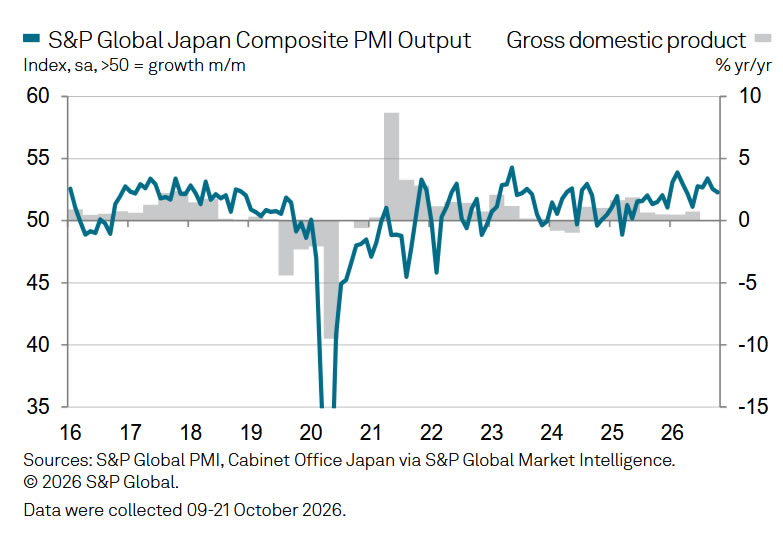
Data Summary
Headline PMI Data
| Indicator | Previous | Current |
|---|---|---|
| PMI Composite | 52.3 | 52.3 |
| PMI Services | 51.3 | 52.0 |
| PMI Manufacturing | 54.1 | 53.3 |
| PMI Manufacturing Output | 54.9 | 53.1 |
Readings above 50 indicate expansion, while readings below 50 indicate contraction. Survey responses were collected October 9–21.
Additional Survey Details
| Indicator | October Development |
|---|---|
| Private-Sector Activity | 19th consecutive month of expansion; joint-weakest growth since May |
| Manufacturing Output | Slowest expansion since March |
| Overall New Business | Slowest growth in three months |
| Manufacturing New Orders | Slowest growth since March |
| Services New Business | Growth accelerated |
| Export Orders | Slowest growth in four months |
| Overall Employment | Slowest increase in 14 months |
| Services Employment | First decline since August 2025 |
| Manufacturing Employment | Moderate increase |
| Backlogs of Work | Fastest accumulation since June |
| Manufacturing Stocks of Purchases | Largest accumulation in almost four years |
| Input Cost Inflation | Accelerated slightly; remained elevated |
| Selling Price Inflation | Eased to four-month low |
| Business Confidence | Lowest since July |
Key Takeaways
- Private-sector expansion remains steady: PMI Composite held at 52.3, marking the nineteenth consecutive month of growth. However, the pace remained the joint-weakest since May and below the year-to-date average.
- Services improve as manufacturing loses momentum: PMI Services rose from 51.3 to 52.0, while PMI Manufacturing declined from 54.1 to 53.3. Manufacturing output slowed from 54.9 to 53.1, its weakest expansion since March.
- Underlying demand conditions soften: Overall new business growth eased to a three-month low, reflecting slower manufacturing orders despite stronger services demand. Export order growth also moderated to its weakest pace in four months.
- Hiring slows to a 14-month low: Overall employment increased only marginally, with services payrolls declining for the first time since August 2025. Manufacturing employment continued growing moderately, highlighting diverging labor-market conditions between sectors.
- Backlogs increase despite weaker hiring: Outstanding business accumulated at its fastest pace since June, suggesting that firms were cautious about adding staff even as existing workloads increased.
- Input inflation accelerates, but selling-price pressures moderate: Higher raw-material and labor costs pushed input inflation slightly higher. However, selling price inflation eased to a four-month low, indicating slower increases in charges to customers despite persistent cost pressures.
- Business confidence weakens: Expectations for future output remained positive but slipped to their lowest since July, with inflation concerns weighing on the outlook. Overall, the survey indicates continued growth but increasing constraints on demand and employment momentum.