


Yen Leads Major Currencies as Renewed Technology Selling Spreads Across Asia and Europe, While French Sovereign Stress Adds a Separate Pressure on Euro
Today’s themes:
- Tech selloff favors Yen: Technology stocks are falling across Asia and Europe, with Nasdaq-100 futures down around 1.8–1.9%, as investors question the financing and returns of AI investment. Yen and Swiss Franc lead, while Aussie and Kiwi are weakest.
- French stress weighs on Euro: The French 10-year yield surged to 5.14%, its highest since 2002, and the spread over Bunds widened to around 173bps ahead of Moody’s review on Friday.
- Oil adds geopolitical risk: Brent advanced above $112 on security threats in Saudi Arabia and reports of possible renewed US-Israeli strikes on Iran.
The pressure reflects several overlapping developments rather than a single catalyst.
Yen is leading major currencies as renewed selling in technology stocks spreads across Asia and Europe, with US equity futures also under pressure. Investors are increasingly questioning the financing and eventual returns of large-scale AI investment, with recent corporate earnings failing to resolve those concerns. Swiss Franc is also firm, while Aussie and Kiwi are the weakest major currencies. The pattern points to a defensive shift in market sentiment, although the pressure reflects several overlapping developments rather than a single catalyst.
Meanwhile, French sovereign-bond stress is adding a separate source of pressure on Euro. France’s 10-year yield surged to 5.14%, its highest since 2002, while the spread over German Bunds widened beyond 170 basis points amid mounting fiscal and political uncertainty. The divergence is particularly striking as US Treasury and German yields declined on defensive demand. Brent crude also advanced above $112 as security threats in Saudi Arabia and reports of possible renewed US-Israeli strikes on Iran added to geopolitical supply concerns.
AI Investment Concerns Drive Global Technology Selloff
Asian equities suffered broad losses, led by technology and semiconductor stocks. Samsung Electronics and SK Hynix were among the major decliners in South Korea, while Japanese semiconductor-related companies including Tokyo Electron and Advantest also came under heavy selling pressure.
Equity Moves
- South Korea’s KOSPI: down approximately 3.5%
- Nikkei 225: down 2.7%
- Hang Seng: down 3.0%
- Hang Seng Tech index: down approximately 4.6%
- Taiwan’s TAIEX: closed 1.8% lower after reversing an earlier advance
- European technology stocks: down approximately 2.1%
- Nasdaq-100 futures: down around 1.8–1.9%
- S&P 500 futures: down approximately 1.1%
The weakness extended into European trading, with ASML, Infineon and STMicroelectronics among the notable losers. The geographic breadth of the selling suggests that concerns about AI investment are no longer confined to individual corporate results or markets.
The central issue is shifting from earnings growth toward the cost and returns of AI investment. Recent results have generally demonstrated resilient demand, but investors remain uncertain whether the substantial spending required for AI infrastructure will generate sufficient returns. Meta’s continued expansion of capital expenditure has reinforced concerns about funding requirements, while Tesla’s reduced investment plans have raised different questions about the pace of future development. The contrasting signals illustrate how strong earnings alone have become insufficient to sustain investor confidence in the broader technology investment cycle.
China-related concerns have added to regional weakness. Expectations for further stimulus have faded after third-quarter GDP growth came in at 4.5% yoy, exceeding the 4.4% consensus and leaving the economy broadly on course to meet its annual growth target. That has reduced expectations among some investors for additional policy support, contributing to heavy selling in Hong Kong technology shares, with Alibaba and other major Chinese technology companies under pressure.
Yen Leads Defensive Currency Demand, Aussie and Kiwi Lag
The shift in equity sentiment is reflected in currency performance. This configuration is consistent with a reduction in risk appetite favoring defensive currencies over those more sensitive to global growth and commodity demand.
Currency Rankings: Defensive vs Growth-Sensitive
| Position | Currencies | Driver |
|---|---|---|
| Strongest | JPY, CHF | Defensive demand as technology shares fall |
| Middle | CAD, USD | Dollar’s position distinguishes the session from a generalized Dollar rally |
| Weaker | EUR, GBP | Euro faces the additional burden of France-specific sovereign risk |
| Weakest | AUD, NZD | Sensitivity to global growth and commodity demand; Kiwi also faces a domestic headwind from slower inflation |
Aussie’s underperformance is notable given Wednesday’s sharp repricing of RBA tightening expectations. Deputy Governor Andrew Hauser’s inflation warning had strengthened expectations for a November rate hike, but that support has been overshadowed by renewed selling in Asian equities and broader Yen strength. Kiwi faces an additional domestic headwind after New Zealand’s third-quarter inflation slowed from 4.1% to 3.7% yoy, below expectations of 3.8%.
Dollar’s position in the middle of the currency rankings also distinguishes the current environment from a generalized Dollar rally. Yen and Franc are the clearest beneficiaries of the defensive market tone, while Euro faces the additional burden of France-specific sovereign risk.
French Bond Stress Deepens Ahead of Moody’s Review
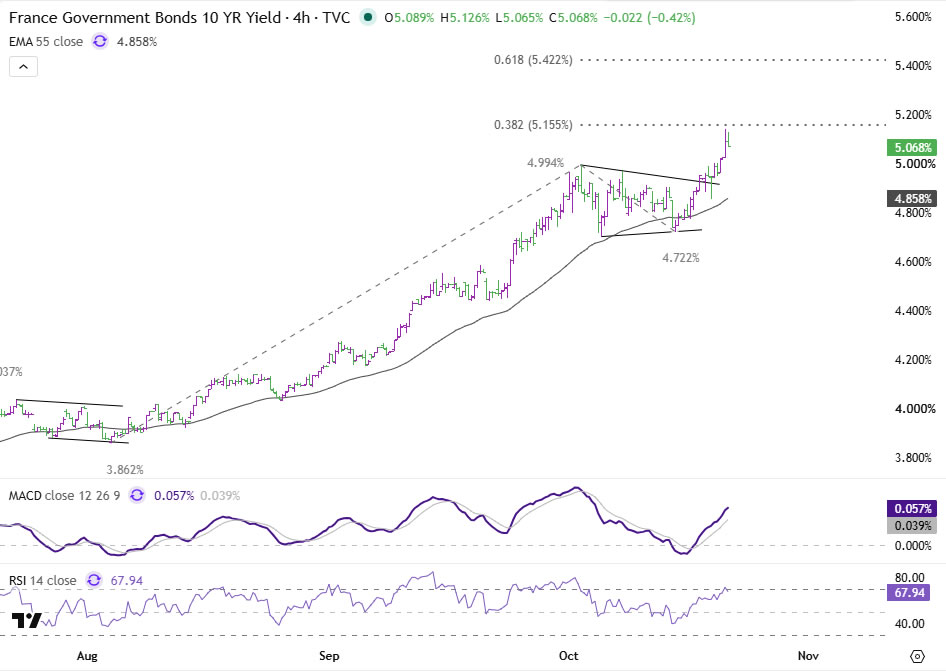
French government bonds continued to underperform sharply as political and fiscal concerns intensified. The 10-year yield climbed to an intraday high of approximately 5.14%, extending its advance beyond the 5% threshold first tested on Wednesday. The spread over German 10-year yields widened to around 173 basis points, its highest since 2011, signaling a growing risk premium attached specifically to French sovereign debt.
French Yields vs Other Major Bond Markets
| Market | Move | Context |
|---|---|---|
| France 10-year yield | Rose to an intraday high of about 5.14% | Highest since 2002, beyond the 5% threshold first tested Wednesday |
| OAT–Bund spread | Widened to around 173bps | Highest since 2011 |
| German Bund yields | Declined | Defensive demand during the global equity selloff |
| US Treasury yields | Declined | French 10-year yields moved above Treasury yields for the first time since 2013 |
The divergence from other major bond markets is particularly significant. The widening spread therefore reflects concerns about French fiscal and political risk rather than simply a broader rise in global interest rates.
Investors remain concerned about the minority government’s ability to secure parliamentary support for a budget aimed at reducing the deficit toward 5% of GDP. Political fragmentation, continuing protests and further trade-union mobilization are complicating the fiscal outlook. Attention is now turning to Moody’s scheduled review on Friday, October 23, with France’s Aa3 sovereign rating carrying a negative outlook. A downgrade remains a risk rather than a confirmed outcome, but the uncertainty is contributing to pressure on French bonds and weighing on Euro.
For Euro, the critical signal is whether French borrowing costs continue diverging from German yields. Further widening would reinforce concerns about sovereign risk within the Eurozone, while a narrowing spread would suggest some stabilization in the pressure on the single currency.
Brent Tops $112 as Middle East Supply Risks Intensify
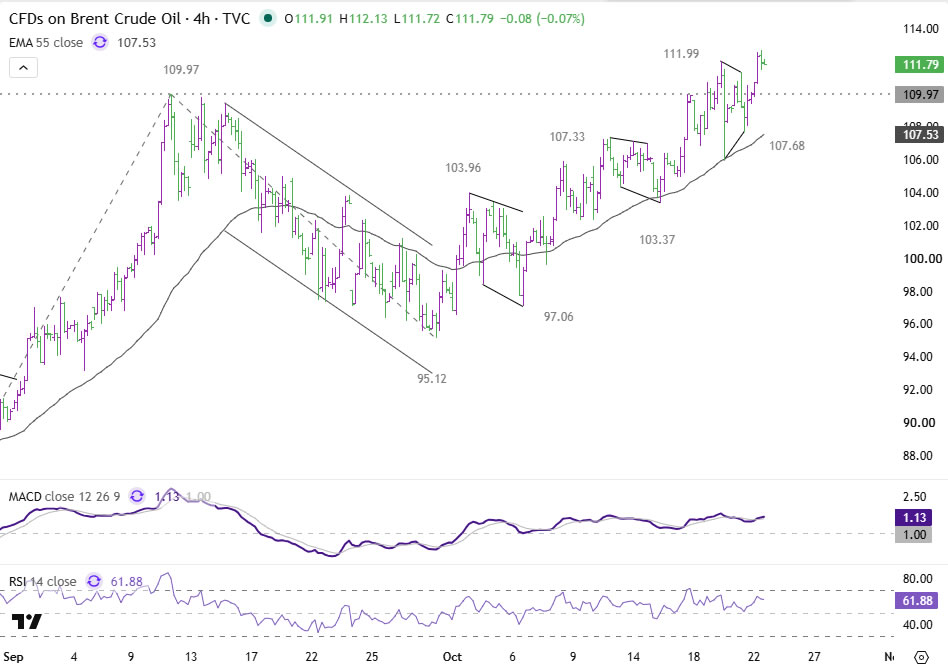
Oil prices added another complication to an already cautious market environment. Brent advanced above $112 intraday, extending its recent gains as attacks on Saudi Arabian infrastructure raised concerns about regional supply security.
Middle East Supply Risks
- Saudi Arabia: falling debris from an intercepted drone near Aramco’s Shaybah oilfield killed two people, with no disruption to operations reported
- US personnel: the US ordered non-emergency government personnel and their families to leave Saudi Arabia amid heightened security threats
- Iran: a report said US and Israeli military planners had prepared options for renewed strikes after the November 3 US midterm elections, with no new operation approved
The report on Iran reportedly includes potential targets such as nuclear facilities, missile and drone capabilities, and possibly energy infrastructure. However, the reported preparations should not be interpreted as confirmation that strikes will take place.
The principal market implication is a higher perceived risk of future energy-supply disruption, rather than an established reduction in production. Sustained elevated oil prices could reinforce inflation concerns and complicate the monetary-policy outlook, adding a further source of uncertainty alongside the technology-led equity selloff. Nevertheless, oil’s geopolitical drivers remain distinct from the AI investment concerns that are weighing on equities.
Selective Market Stress Rather Than a Single Global Catalyst
The immediate outlook hinges on whether the technology selloff extends through US trading and whether French sovereign yields continue diverging from German Bunds. Further weakness in semiconductor shares would reinforce the defensive currency environment, while a recovery could ease pressure on Aussie and Kiwi. For Euro, Friday’s Moody’s review is the next major test of whether France’s widening sovereign risk premium can stabilize.
Oil presents a separate risk. Further escalation involving Saudi Arabia or Iran could sustain the geopolitical premium, while diplomatic progress or reduced security threats could weaken it. For now, the dominant picture is one of selective market stress: Yen and Franc are benefiting from defensive demand, growth-sensitive currencies are under pressure, and Euro faces additional weakness from French fiscal uncertainty. The interaction of these distinct risks, rather than any single global catalyst, is defining the market’s cautious tone.
Related Coverage
Yen, Franc and Metals
- Yen Rallies as Asian Stocks Tumble, AUD/JPY Rejected at Key Resistance: the technical view, with AUD/JPY rejected near 111.30 and USD/JPY approaching 156.36 support.
- SNB Flags Franc Carry-Trade Appeal as FX Intervention Readiness Eases: the SNB held its policy rate at 0% and judged that heightened FX intervention readiness was no longer necessary.
- Silver Slides Toward Breakdown Support as Saudi Escalation Revives Oil Supply Risks: Silver has dropped around 2.8% and is underperforming Gold, with support at 55.37 and 54.77 in focus.
US and New Zealand Data
- US Jobless Claims Fall to 194K, Continuing Claims Edge Higher: initial claims fell below the 200K expectation while continuing claims rose to 1.728M, leaving the labor market picture relatively stable.
- NZ Inflation Slows to 3.7%, but Core Pressures and Price Breadth Strengthen: headline disinflation from falling petrol prices masks stronger underlying measures and broader price increases across the CPI basket.
FAQ
Why is the Yen leading the major currencies?
Renewed selling in technology stocks has spread across Asia and Europe, shifting sentiment defensively. KOSPI fell about 3.5%, the Nikkei 2.7% and the Hang Seng 3.0%, while Nasdaq-100 futures are down around 1.8–1.9%. Investors are questioning the financing and eventual returns of AI investment, and Yen and Swiss Franc are the clearest beneficiaries of the defensive tone.
Why is Euro under pressure?
French sovereign stress is adding a separate source of pressure. France’s 10-year yield rose to about 5.14%, its highest since 2002, and the spread over Bunds widened to around 173bps, the widest since 2011, while US Treasury and German yields fell. Moody’s reviews France’s Aa3 rating, which carries a negative outlook, on Friday, October 23.
Why are Aussie and Kiwi the weakest majors?
They are more sensitive to global growth and commodity demand, which makes them vulnerable when risk appetite falls. Aussie’s support from Wednesday’s repricing of RBA tightening expectations has been overshadowed by the equity selloff and Yen strength. Kiwi also faces a domestic headwind after New Zealand’s Q3 inflation slowed from 4.1% to 3.7%, below the 3.8% expectation.
Key Takeaways
- Yen is the strongest major currency, followed by Swiss Franc, as technology selling spreads across Asia and Europe; Aussie and Kiwi are the weakest.
- Asian equities fell broadly, with KOSPI down about 3.5%, Nikkei down 2.7%, Hang Seng down 3.0% and the Hang Seng Tech index down about 4.6%.
- The central issue is shifting from earnings growth to the cost and returns of AI investment, and strong earnings alone are no longer enough to sustain confidence.
- France’s 10-year yield surged to about 5.14%, its highest since 2002, and the spread over Bunds widened to around 173bps, the widest since 2011.
- French 10-year yields rose above US Treasury yields for the first time since 2013 while German and US yields fell, so the move reflects French fiscal and political risk, not a global rate rise.
- Brent advanced above $112 on Saudi security threats and reports of possible US-Israeli strike options on Iran after the November 3 midterms, though no operation has been approved.
- Moody’s reviews France’s Aa3 rating, which has a negative outlook, on Friday, October 23, making it the next test for Euro.
What to Watch Next
Friday’s Moody’s review is the next major test for Euro, alongside whether French borrowing costs keep diverging from German yields. Watch also whether the technology selloff extends through US trading, since further weakness in semiconductor shares would reinforce the defensive currency environment.
In oil, any escalation involving Saudi Arabia or Iran, or the November 3 US midterm elections that reports link to possible strike planning, could sustain the geopolitical premium, while diplomatic progress could weaken it.