Australian household spending increased 0.6% mom in September, with annual growth reaching 6.8%, according to the Australian Bureau of Statistics (ABS). Spending rose across six of the nine categories and all eight states and territories, indicating continued expansion in household demand despite tighter financial conditions. In inflation-adjusted terms, household spending volumes increased 0.7% qoq in Q3 and 3.2% yoy, marking a fourth consecutive quarter of growth. However, the stronger headline figures concealed an uneven composition, with essential expenditure and selected services accounting for much of the monthly increase.
Non-discretionary spending rose 1.2% mom, substantially outpacing the 0.3% increase in discretionary expenditure. Services spending climbed 1.1%, compared with a 0.3% gain in goods, with transport and health recording the largest category increases at 1.5% each, followed by recreation and culture at 0.8%. Higher spending on air travel, healthcare and recreational activities supported the improvement, while ABS also identified increased purchases of entertainment, electronic goods and services associated with major sporting events. Some entertainment spending reflected advance ticket purchases rather than services consumed during September. In volume terms, Q3 growth was led by transport (+1.6%), clothing and footwear (+1.2%) and health (+1.1%), with the recovery in air travel partly reflecting a rebound from subdued activity during the June quarter.
The figures suggest household demand remains resilient, but provide less convincing evidence of a broad acceleration in discretionary consumption. The fourth consecutive quarterly increase in spending volumes points to continued real consumption growth, while the geographical breadth of September’s gains reinforces the positive headline. Nevertheless, the faster rise in non-discretionary expenditure indicates that essential expenses were a more important driver than optional purchases, while temporary factors supported some services categories. The release therefore presents a mixed picture for the economic outlook: household spending is continuing to expand despite restrictive financial conditions, but its composition suggests that underlying consumer momentum remains uneven rather than firmly strengthening.
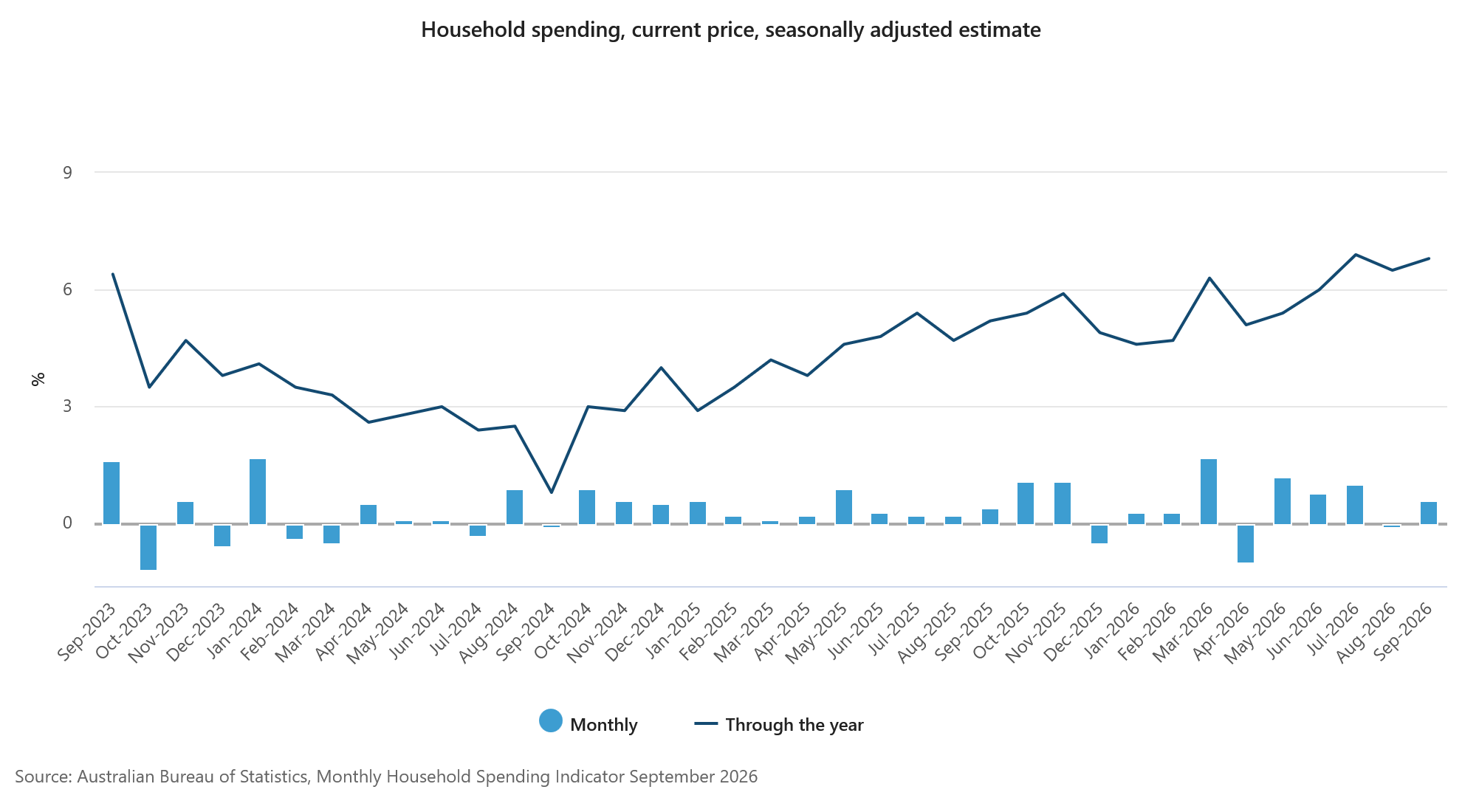
Data Summary
Australia Household Spending — September 2026
| Indicator | Latest | Period |
|---|---|---|
| Household spending | +0.6% | Monthly |
| Household spending | +6.8% | Annual |
| Spending volumes | +0.7% | Q3 qoq |
| Spending volumes | +3.2% | Q3 yoy |
| Goods spending | +0.3% | Monthly |
| Services spending | +1.1% | Monthly |
| Discretionary spending | +0.3% | Monthly |
| Non-discretionary spending | +1.2% | Monthly |
Monthly figures are seasonally adjusted and measured at current prices. Quarterly spending volumes are inflation-adjusted.
Monthly Spending by Category
| Category | September |
|---|---|
| Transport | +1.5% |
| Health | +1.5% |
| Recreation and culture | +0.8% |
| Services overall | +1.1% |
| Goods overall | +0.3% |
| Discretionary | +0.3% |
| Non-discretionary | +1.2% |
Q3 Household Spending Volumes
| Category | Q3 qoq |
|---|---|
| Total household spending | +0.7% |
| Transport | +1.6% |
| Clothing and footwear | +1.2% |
| Health | +1.1% |
Key Takeaways
- Household spending continued expanding: Australian household spending rose 0.6% mom and 6.8% yoy in September. Spending increased across six of nine categories and all eight states and territories.
- Real consumption recorded another quarterly gain: Inflation-adjusted spending volumes increased 0.7% qoq and 3.2% yoy in Q3, marking a fourth consecutive quarter of expansion.
- Essential expenses outpaced discretionary purchases: Non-discretionary spending rose 1.2% mom, compared with just 0.3% for discretionary expenditure. The divergence indicates that essential spending was a more significant contributor to September’s increase.
- Services provided stronger support than goods: Services spending climbed 1.1% mom, while goods increased 0.3%. Transport and health led the monthly gains at 1.5% each, followed by recreation and culture at 0.8%.
- Travel and entertainment added temporary support: Increased air travel and spending associated with major sporting events contributed to growth. Some entertainment expenditure reflected advance ticket purchases, while the quarterly transport rebound partly followed subdued activity during the June quarter.
- Spending growth was geographically widespread: All eight states and territories recorded increases, led by Northern Territory (+1.2%), Western Australia (+1.1%) and Victoria (+1.0%).
- Resilience does not necessarily signal a broad consumer recovery: Continued growth in spending volumes suggests household demand is holding up, but the stronger contribution from non-discretionary expenses and selected services limits evidence of sustained acceleration in discretionary consumption.