TL;DR: The Nikkei 225 plunged 4.84% to 60,030.10, its lowest since May, after the US midterms, then rebounded toward 61,944 to cut its loss to about 1.8%. The reversal leaves open whether it was a knee-jerk reaction or an AI reset, with key support at 59,072–59,332 and resistance at 64,831.29.
Why Did the Nikkei Plunge, Then Rebound, After the US Midterms?
Japan’s Nikkei 225 came close to falling 5% on Wednesday before staging a dramatic recovery, turning what initially looked like another technology-led rout into a more complicated market signal. The index plunged to 60,030.10, down 4.84% and its lowest level since May, before recovering toward 61,944 and cutting its losses to approximately 1.8%. The reversal left investors with a difficult question: was the initial selloff an exaggerated response to the US midterm results, or an early warning that the AI investment trade is entering a deeper correction?
The election introduced new uncertainty over the future of AI infrastructure development, particularly after projected Democratic gains in Congress and key state governorships raised concerns about tighter restrictions on data-centre construction. Japanese semiconductor and AI-related shares were hit particularly hard.
Yet the broader market picture was less dramatic. Korean equities recovered, Hong Kong advanced, and US yields and the Dollar softened. The Nikkei also attracted substantial buying near 60,000, well before reaching its most important longer-term support levels.
The result was a sharp selloff that exposed the fragility of the AI trade, but also a recovery strong enough to leave the bearish conclusion unconfirmed.
Follow the Nikkei, AI stocks and the US midterm fallout on the ActionForex Telegram channel.
US Midterms Add a Political Risk to an Already Fragile AI Trade
The immediate backdrop was the US midterm election, where election-night projections indicated that Democrats were on course to gain control of both chambers of Congress.
CNBC’s Election Desk projected Democratic majorities in the House and Senate during Wednesday’s Asian trading session, while individual race calls continued to develop.
The overall direction was not a major surprise. Prediction markets had already assigned approximately a 77% probability to a Democratic sweep before voting began.
But the political implications for the AI sector may matter more than whether the congressional outcome itself surprised investors.
One of the most closely watched developments was Texas, where the projected Democratic gubernatorial victory brought renewed attention to proposals for restricting data-centre construction and withdrawing certain investment incentives.
Texas is central to the US AI infrastructure expansion. Wells Fargo estimates put the state’s share of planned US data-centre capacity at approximately 27%, with Georgia, Ohio and Pennsylvania accounting for another combined 17%.
Taken together, these four states represent a substantial portion of planned development.
That concentration makes local and state policy decisions potentially important for the wider AI supply chain.
If restrictions delay data-centre approvals or alter financial incentives, companies could face longer construction schedules, additional financing costs or uncertainty over when projects will generate returns.
Such developments would matter not only for data-centre operators, but also for the semiconductor manufacturers and technology suppliers expecting to benefit from continued infrastructure expansion.
For Japan, where several large Nikkei constituents are closely exposed to global chipmaking and AI investment, the potential transmission is straightforward.
A slower or more uncertain data-centre build-out could change expectations for future demand, even if current demand for AI computing remains strong.
However, potential regulation should not be confused with enacted policy.
A Democratic Congress would still face the possibility of a presidential veto, while proposed state-level restrictions would need to pass through their respective political and administrative processes.
Nor is it possible to attribute the Nikkei’s entire decline specifically to the Texas election results.
The index had already fallen substantially before the major Texas race projections, although the deeper phase of selling occurred around the same period.
That timing is consistent with a market becoming increasingly concerned about regulatory risks, but it does not establish a direct causal link.
The better interpretation is that the election added a fresh uncertainty to an AI investment trade that was already showing signs of strain.
Japanese Chip Stocks Take the Hit, but Asia Does Not Follow Uniformly
The concentration of selling among Japanese technology shares was striking.
Disco dropped approximately 10%, while SoftBank and Advantest lost more than 8%. Renesas fell around 7.6%, and Tokyo Electron declined about 7%.
- Disco: down approximately 10%.
- SoftBank and Advantest: each down more than 8%.
- Renesas: down around 7.6%.
- Tokyo Electron: down about 7%.
These companies occupy different positions in the technology and semiconductor investment cycle, but their common sensitivity to AI-related spending made them vulnerable to a deterioration in sentiment.
The weakness extended beyond Japan, with South Korea’s SK Hynix and Samsung also declining during the session.
Yet the rest of Asia did not respond in the same way.
KOSPI recovered from earlier weakness to trade slightly higher, while Hong Kong’s Hang Seng gained approximately 1%.
Outside equities, the Dollar Index weakened toward 101.44, US Treasury yields declined modestly, and both Gold and Silver recovered.
- KOSPI: recovered to trade slightly higher.
- Hang Seng: up approximately 1%.
- Dollar Index: weaker, toward 101.44.
- US Treasury yields: down modestly; Gold and Silver both recovered.
Those movements offer an important counterweight to the initial impression of a broad market panic.
Investors were selling particular AI-related exposures aggressively, but they were not abandoning all risk assets or moving uniformly into traditional defensive positions.
There was another unusual contrast.
AMD reported stronger-than-expected quarterly earnings and a favourable outlook after Tuesday’s US close. Its shares initially jumped around 7% in after-hours trading, while Super Micro and Arista also attracted strong buying interest.
Under different circumstances, those results might have been sufficient to lift sentiment across semiconductor and AI-related stocks.
Instead, the broader technology market remained vulnerable as investors assessed the election results and possible regulatory consequences.
The divergence suggests that the market’s concerns have moved beyond whether AI companies can deliver strong near-term earnings.
Increasingly, the questions involve how much capital the industry requires, how quickly planned infrastructure can be completed, and whether future returns justify existing valuations.
Those questions were already present before the midterms.
The AI Reset Argument Did Not Begin With the Election
The deeper bearish interpretation rests on the fact that technology stocks were already weakening before Wednesday.
Nasdaq-100 had entered correction territory toward the end of October, with more than $2 trillion reportedly erased from its value during the month.
Concerns were building around the scale of data-centre investment, the cost of financing new infrastructure and the possibility that spending commitments were advancing faster than investors could confidently assess future returns.
Oracle’s recently announced plan to raise $20 billion through equity and debt offerings added to those questions.
Major institutional investors have also begun warning about financing concentration and the enormous amount of capital that AI infrastructure development may require.
None of that means the AI boom has ended.
Demand for computing capacity remains substantial, while strong earnings from several technology companies continue to demonstrate that the investment cycle has considerable underlying momentum.
But a sector can maintain strong operational growth while its share prices undergo a significant valuation adjustment.
The risk is that investors begin applying more demanding assumptions to the financing costs, regulatory environment and eventual profitability of AI projects.
The US midterm results potentially add another variable to that reassessment.
If developers face restrictions in important US states, or if the regulatory environment becomes less predictable, the market may begin reconsidering the pace at which infrastructure spending can continue.
For Japanese semiconductor shares, that would be relevant even without an immediate deterioration in current earnings.
The question is therefore not simply whether the election results were expected.
It is whether the election has changed the risks surrounding an investment cycle that was already being reassessed.
Why Wednesday’s Nikkei Plunge Could Still Be an Overreaction
There is a credible opposing case.
The first and most visible piece of evidence is the size of the Nikkei’s recovery.
After falling as much as 4.84%, the index rebounded roughly 3.2% from its intraday low, cutting the day’s losses substantially.
The reversal developed close to the psychologically important 60,000 level, suggesting that buyers were prepared to enter after the initial selloff.
That is particularly notable because the Nikkei had fallen through the July low at 60,448.90, yet did not continue directly toward the next major support levels.
The broader regional picture also improved during the session.
KOSPI recovered into positive territory, while the Hang Seng advanced, reducing the impression that Asian investors were responding to the election with a general retreat from equities.
There is also a fundamental argument for caution before extrapolating the political implications.
The Democratic sweep was widely anticipated, and proposals for data-centre restrictions are not equivalent to immediate changes in construction activity or corporate investment plans.
Congressional legislation would face political constraints, while state-level measures could take time to become effective.
US Treasury yields also eased, potentially providing some support for equity valuations if the move persists.
Together, these factors leave room for a recovery as investors distinguish between the initial reaction to election headlines and their eventual economic consequences.
The strongest argument for a knee-jerk reaction is that the selling was severe, the broader market response was uneven, and the Nikkei attracted buyers before reaching its most important longer-term support.
But that argument still needs confirmation.
The index remains below its key moving averages, and its correction began weeks before the election.
A rebound from one intraday low does not establish that the selling cycle has ended.
ActionForex’s Technical View: Nikkei, Approaching the Decisive Support Test
Daily Chart — Correction From 72,831.73 Could Be Nearing a Turning Point
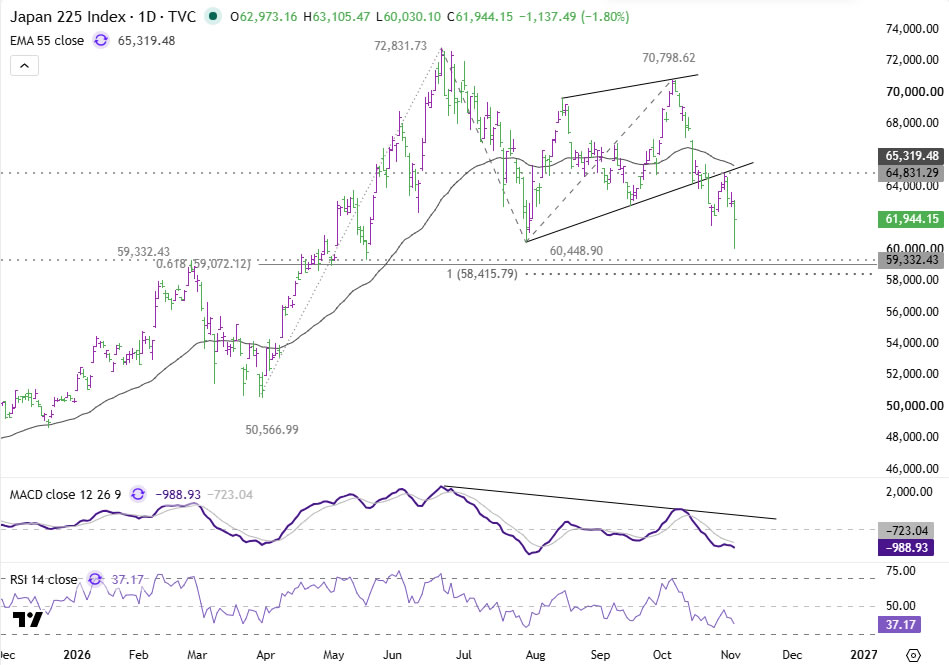
The Nikkei’s correction from the 72,831.73 medium-term top extended to 60,030.10 on Wednesday, confirming a further deterioration in the technical structure.
The index has already broken below the rising recovery channel established after the July low at 60,448.90, while Wednesday’s selloff carried prices beneath that earlier low.
Daily MACD continues to show negative momentum, reinforcing the bearish divergence that developed around the earlier highs.
The Nikkei also remains below its 55-day EMA, currently near 65,319, indicating that the medium-term correction has not yet reversed.
However, the decline is approaching a particularly important support confluence.
The 61.8% retracement of 50,566.99 to 72,831.73 lies at 59,072.13, close to the previous resistance-turned-support level at 59,332.43.
Below that area, the 100% projection of 72,831.73 to 60,448.90 from 70,798.62 stands at 58,415.79.
The psychological 60,000 level adds another reference point immediately above the main support region.
Together, these levels provide the next major test for the medium-term outlook.
A strong rebound from the 59,072–59,332 support region, followed by a break above 64,831.29 resistance, would keep the decline from 72,831.73 consistent with a correction and suggest that it may have completed.
That would support the argument that the latest election-related selloff had pushed the market temporarily too far.
Conversely, a decisive break through the broader support confluence, including the deeper 58,415.79 projection, would substantially weaken the corrective interpretation.
Such a development would raise the possibility that the decline from 72,831.73 is evolving into a larger-scale downtrend.
Wednesday’s low remained above the main confluence, leaving the market’s response to this critical support area still to be determined.
Hourly Chart — Sharp Rebound From 60,030, but Recovery Faces Resistance
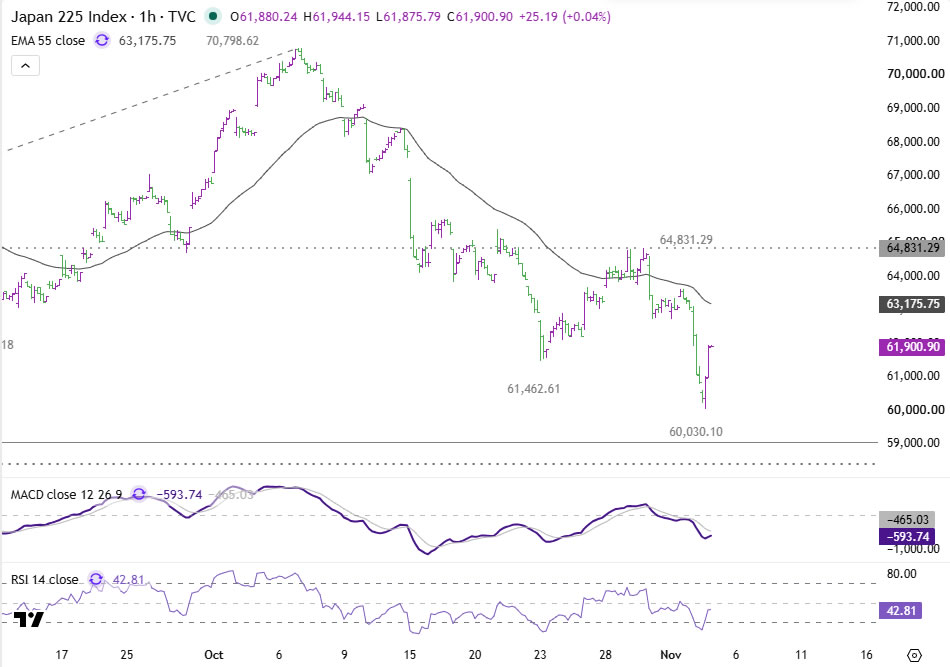
The hourly chart captures the dramatic intraday reversal.
The Nikkei plunged through 60,448.90 before finding buying interest at 60,030.10, subsequently rebounding toward 61,900.
The recovery produced a pronounced lower wick and helped hourly momentum indicators stabilize following the sharp decline.
However, the rebound has not yet overcome the resistance levels needed to establish a short-term bottom.
The index remains below its falling 55-hour EMA, currently around 63,176, while the more important resistance at 64,831.29 remains considerably higher.
That resistance is particularly relevant because it also lies near the broader broken support structure visible on the daily chart.
A recovery through the hourly EMA would strengthen the case for additional short-term upside. A subsequent break above 64,831.29 would provide more convincing evidence that the decline from the October high has ended.
But if the rebound stalls below these levels, sellers could regain control and force another test of 60,000 and the major support area beneath it.
For now, the hourly chart shows an impressive recovery from oversold conditions, but not a confirmed reversal of the bearish trend.
ActionForex’s Technical View: Nasdaq Composite, Will US Technology Investors Reinforce or Reject the Selloff?
4-Hour Chart — 25,800 Is an Important Recovery Threshold
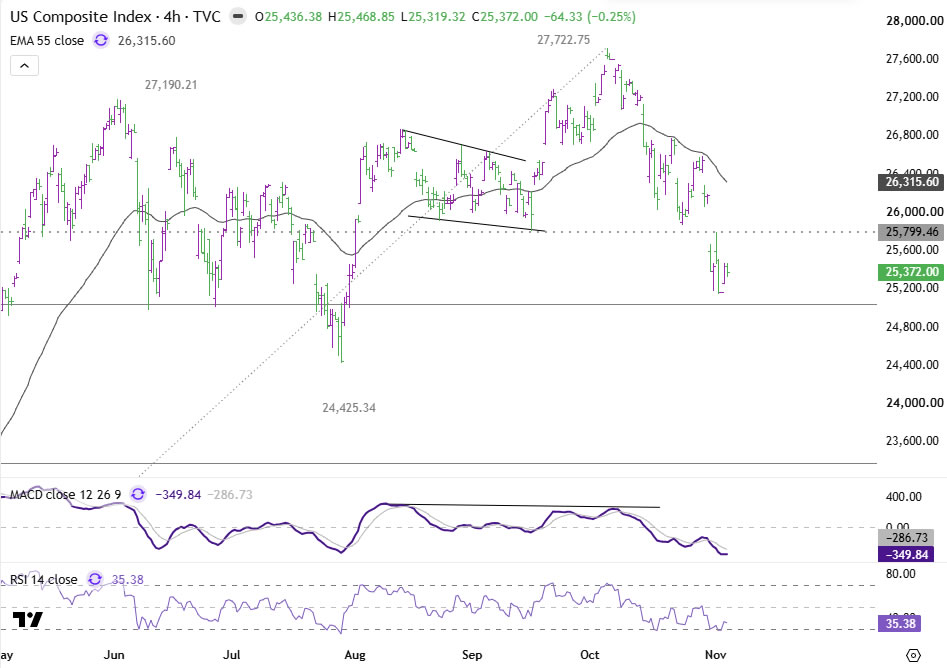
The next important test will come from the US technology market itself.
The Nasdaq Composite has already developed a bearish short-term structure following its decline from 27,722.75, with prices trading below the falling 55-period EMA near 26,316.
Tuesday’s recovery did not reverse that structure, leaving the market vulnerable to another decline as US investors respond to the election results.
The immediate focus is whether the Nasdaq can recover through Tuesday’s high and subsequently reclaim the 25,799–25,800 resistance region, which coincides with the lower boundary of an earlier price gap.
A sustained recovery above that area would suggest that buying interest is returning and provide support for the view that the initial election-related selling was excessive.
Conversely, renewed weakness through recent lows around 25,000 would reinforce the bearish outlook and suggest that the broader AI-related correction remains in progress.
The significance for the Nikkei is direct: if US semiconductor and technology shares continue weakening, the recovery in Japanese AI-linked companies may prove difficult to sustain.
If the Nasdaq stabilizes and reclaims important resistance, however, the argument that Wednesday’s Nikkei plunge was an exaggerated reaction would gain credibility.
Knee-Jerk Reaction or AI Reset? The Answer Is Still in the Price Action
Wednesday’s Nikkei performance contains evidence supporting both interpretations.
The near-5% intraday decline reflects the vulnerability of AI-linked equities to new regulatory concerns, particularly when the sector is already facing questions about financing requirements, capital spending and valuations.
Yet the subsequent recovery was substantial, and the selling did not extend uniformly across regional equities or other financial markets.
The election may have intensified an existing AI-related correction, but it has not yet established that a lasting deterioration in the investment outlook is underway.
For the Nikkei, the technical distinction is becoming increasingly clear.
A strong recovery from the 59,072–59,332 support region, followed by a break above 64,831, would favour the interpretation that the decline remains corrective and may be approaching completion.
A decisive breakdown through the broader support confluence, including 58,416, would instead strengthen the case for a larger bearish reversal.
The Nasdaq’s response to the election results will provide an equally important external test.
For now, the sharp rebound keeps the possibility of a knee-jerk reaction alive. But until the Nikkei reclaims meaningful resistance and the US technology market stabilizes, the risk of a deeper AI-related reset cannot be dismissed.
Key Takeaways
- The Nikkei plunged 4.84% to 60,030.10, its lowest since May, before recovering toward 61,944 and cutting its loss to about 1.8%.
- Projected Democratic gains raised concerns over data-centre restrictions; Texas alone accounts for about 27% of planned US data-centre capacity, with Georgia, Ohio and Pennsylvania adding another 17%.
- Japanese chip stocks bore the brunt (Disco about −10%, SoftBank and Advantest more than −8%), while KOSPI recovered, the Hang Seng gained about 1% and the Dollar Index eased toward 101.44.
- The key support zone is 59,072–59,332, with 58,415.79 below; a rebound followed by a break above 64,831.29 would favour a completed correction.
- The Nasdaq Composite needs to reclaim 25,799–25,800 to support the overreaction view, while a break of 25,000 would keep the AI correction in play.
Stay ahead of the Nikkei’s next move and the AI trade after the US midterms—join the ActionForex Telegram channel for regular market updates and analysis.