

GBP/USD rose sharply to 1.3463 on Wednesday, remaining near its highest level since 15 September. Over the past four weeks, the pair has gained approximately 1.67%, and over the past 12 months, 3.01%. The pound is supported by expectations that the Bank of England will return to policy tightening, while nervousness over the US midterm election results is weighing on the dollar.
Markets expect the Bank of England to raise interest rates on Thursday for the first time since 2023. The main argument for such a step remains heightened inflation risks amid the war with Iran, combined with the relative resilience of the UK economy.
At the same time, the BoE is likely to try to manage market expectations about a series of further rate hikes next year. The pound’s reaction will therefore depend not only on the decision itself but also on the Bank of England’s guidance on the future path of interest rates.
An additional factor for GBP/USD is the US midterm elections. Voters have been assessing the first two years of Donald Trump’s second presidential term. Overall, Democrats have a good chance of regaining control of the House, though the Senate race remains uncertain. Political uncertainty has limited demand for the dollar so far and helped the pound remain near seven-week highs.
Technical Analysis
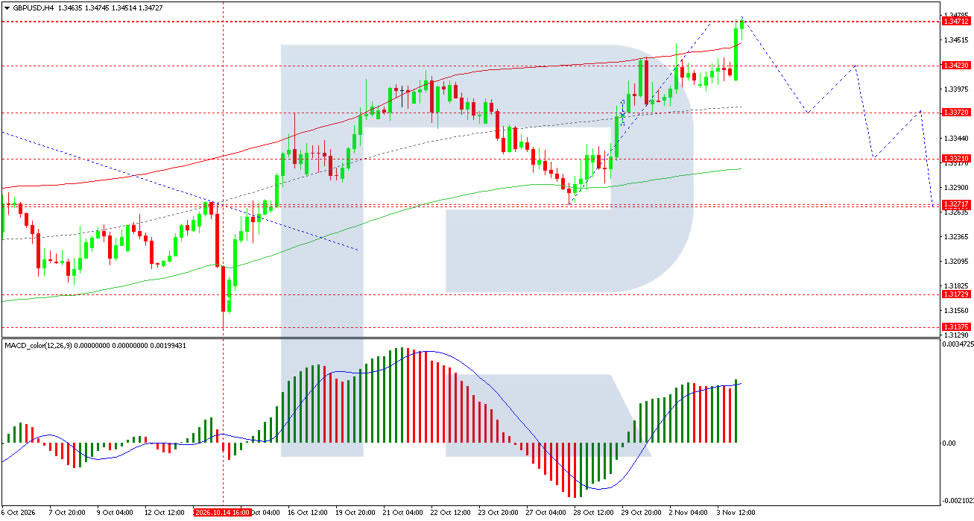
On the H4 chart, GBP/USD maintains an upward structure: after recovering from 1.3271, the market reached a new local high around 1.3471. The sequence of higher lows indicates that buyers retain the advantage. Any potential decline should therefore be considered a correction, and confirmation of a reversal would require a break below support levels.
For the trading session on 4 November 2026, the baseline scenario envisages a pullback from 1.3471 towards 1.3423. A close below this level would open the way towards 1.3372. After testing support, a return to 1.3420 is possible. If the recovery ends with a lower high, the next target for sellers will be 1.3320. A break below this level would create stronger conditions for a further decline towards 1.3271, though reaching the target may require several trading sessions.
The MACD indicator on H4 is above zero, and its signal line continues to point upwards. The indicator therefore continues to confirm the upward impulse and does not yet signal the start of a decline. For the corrective scenario to develop, momentum would need to weaken and the indicator would need to turn downwards.
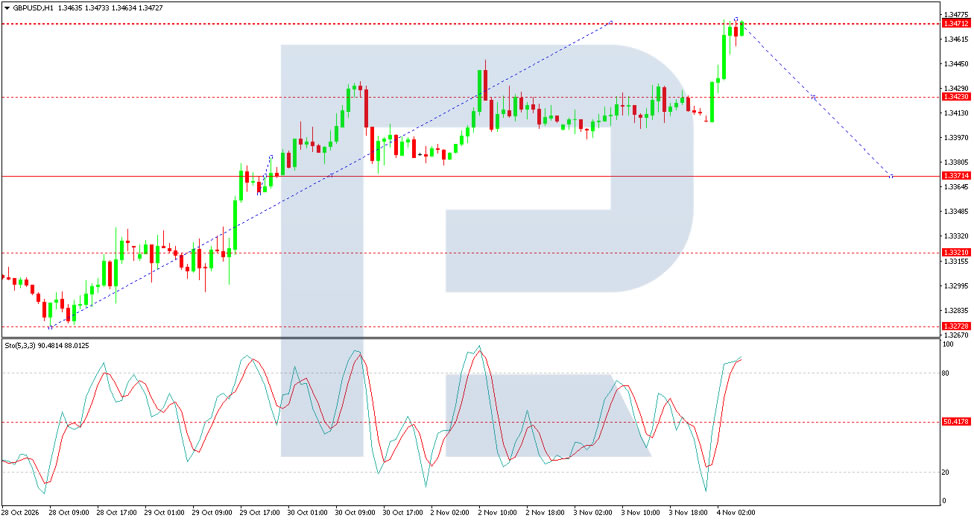
On the H1 GBP/USD chart, a tight consolidation has formed around 1.3471 following the sharp rise. The Stochastic lines are above 80 in the overbought zone, but there is no confirmed move out of this zone yet. A cross back below 80 would increase the likelihood of a move towards 1.3423 and then 1.3371. An alternative scenario envisages consolidation above 1.3471: in that case, the downside scenario would be invalidated, and the upward structure would remain intact until new signs of weakening buying activity appear.
Conclusion
GBP/USD has surged to a seven-week high as markets anticipate the Bank of England’s first rate hike since 2023, driven by inflation risks linked to the Iran conflict and the UK economy’s relative resilience. The pound’s reaction on Thursday will hinge not only on the decision itself but also on the BoE’s guidance regarding future rate increases. Meanwhile, political uncertainty surrounding the US midterm elections has weighed on the dollar, further supporting sterling. Technically, the pair retains an upward structure, with resistance at 1.3471 and support at 1.3423 and 1.3372. A short-term corrective pullback is possible, especially with the Stochastic in overbought territory, but any decline would likely be corrective unless support levels break decisively. The BoE decision and US election results will be the key catalysts for the pair’s next move.