Eurozone inflation accelerated in October, with headline CPI rising from 3.8% to 4.0% yoy, matching market expectations and reaching twice ECB’s 2% target. Consumer prices increased 0.4% mom, according to Eurostat’s flash estimate. However, core CPI remained unchanged at 2.5% yoy, also in line with expectations, while inflation excluding energy held steady at 2.3%. The divergence indicates that the latest increase in headline inflation was primarily driven by energy rather than a comparable acceleration in underlying price pressures.
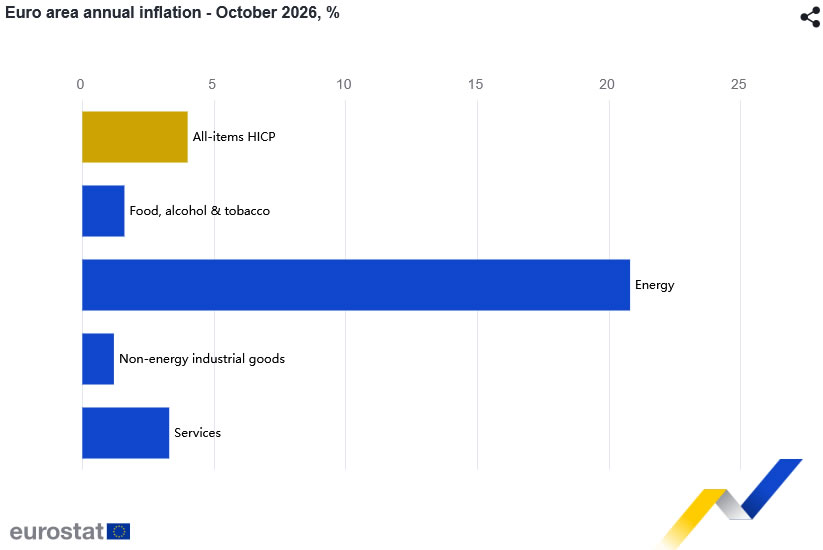
Energy inflation climbed from 18.9% to 20.8% yoy, remaining by far the fastest-rising component, with prices increasing 1.4% on the month. Other categories also recorded more modest increases. Services inflation edged up from 3.2% to 3.3%, food, alcohol and tobacco inflation accelerated from 1.3% to 1.6%, and non-energy industrial goods inflation increased from 1.1% to 1.2%. Within food, unprocessed food inflation rose more noticeably from 4.0% to 4.6%. Nevertheless, the stability of core CPI and inflation excluding energy suggests that the energy shock has not yet produced a similarly pronounced acceleration across underlying consumer prices, although the modest increases in several non-energy categories warrant monitoring.
Inflation developments also diverged considerably across major eurozone economies. Italy recorded a sharp increase from 4.2% to 5.6%, while France accelerated from 3.4% to 3.8% and Belgium from 4.5% to 5.2%. Germany moved in the opposite direction, with inflation easing from 3.3% to 2.8%, while Spain edged down from 5.0% to 4.9%. The October figures therefore reinforce concerns about persistent above-target inflation, but the unchanged core rate provides an important qualification. While elevated energy costs could eventually feed into broader prices, the latest release does not establish a substantial new acceleration in underlying inflation. The distinction remains particularly relevant as ECB policymakers assess the persistence of price pressures against signs of weakening economic momentum.
Data Summary
Eurozone CPI — October 2026 Flash Estimate
| Indicator | Sep | Oct |
|---|---|---|
| Headline CPI y/y | 3.8% | 4.0% |
| Core CPI y/y | 2.5% | 2.5% |
| CPI excluding energy y/y | 2.3% | 2.3% |
| CPI excluding energy and unprocessed food y/y | 2.2% | 2.2% |
Headline and core inflation both matched market expectations. Headline CPI increased 0.4% mom, while core CPI increased 0.3% mom.
Inflation Components — Annual Rates
| Component | Sep | Oct |
|---|---|---|
| Energy | 18.9% | 20.8% |
| Services | 3.2% | 3.3% |
| Food, alcohol and tobacco | 1.3% | 1.6% |
| Unprocessed food | 4.0% | 4.6% |
| Processed food, alcohol and tobacco | 0.4% | 0.5% |
| Non-energy industrial goods | 1.1% | 1.2% |
Major Eurozone Economies — CPI y/y
| Economy | Sep | Oct |
|---|---|---|
| Germany | 3.3% | 2.8% |
| France | 3.4% | 3.8% |
| Italy | 4.2% | 5.6% |
| Spain | 5.0% | 4.9% |
| Netherlands | 3.0% | 3.3% |
| Belgium | 4.5% | 5.2% |
All figures are from Eurostat’s October flash estimate. Final October inflation data are scheduled for November 18, 2026.
Key Takeaways
- Headline inflation reached twice ECB’s target: Eurozone CPI accelerated from 3.8% to 4.0% yoy in October, matching expectations. Monthly consumer prices increased 0.4%.
- Core inflation remained unchanged: Core CPI held at 2.5% yoy, while inflation excluding energy remained at 2.3%. The stability of underlying measures suggests that the latest headline acceleration was not accompanied by a comparable broad-based increase in prices.
- Energy remained the dominant inflation pressure: Annual energy inflation climbed from 18.9% to 20.8%, with prices increasing 1.4% mom. The acceleration was substantially larger than those recorded in other major CPI categories.
- Other price categories edged higher: Services inflation increased from 3.2% to 3.3%, food, alcohol and tobacco from 1.3% to 1.6%, and non-energy industrial goods from 1.1% to 1.2%. Unprocessed food inflation rose more noticeably from 4.0% to 4.6%.
- Inflation trends diverged across member states: Italy recorded a sharp acceleration from 4.2% to 5.6%, while France and Belgium also registered increases. Germany eased from 3.3% to 2.8%, and Spain declined slightly from 5.0% to 4.9%.
- Broader inflation pass-through remains a risk, not a confirmed development: Higher energy prices could eventually affect other goods and services, but unchanged core inflation provides limited evidence of a substantial new acceleration in underlying pressures.
- ECB faces persistent inflation alongside slower growth: The headline increase reinforces concern about above-target inflation, while recent PMI data indicate weakening economic momentum. October’s CPI composition warrants caution against interpreting the energy-driven rise as a generalized resurgence in inflation.