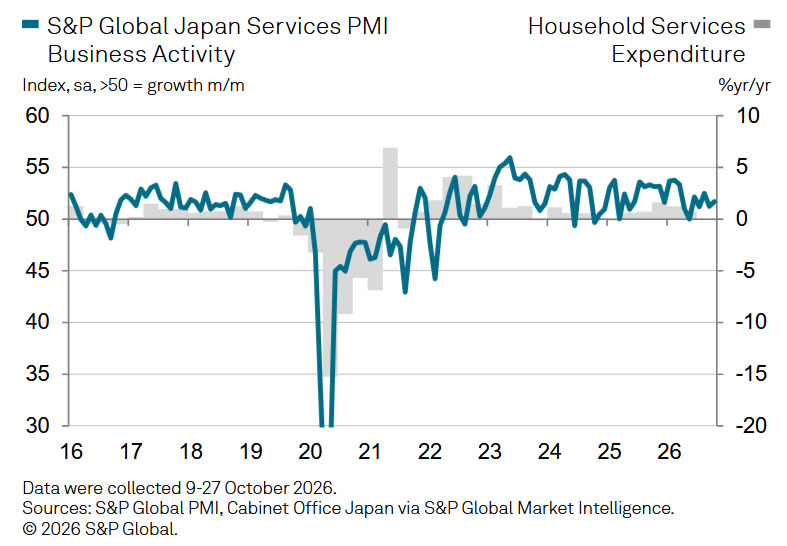
Japan’s private-sector expansion moderated in October, with PMI Composite declining from 52.3 to 52.1, its lowest level in five months, as slower manufacturing production outweighed a modest improvement in services activity. PMI Services rose from 51.3 to 51.7, marking a fifth consecutive month of expansion, although growth remained below its average for 2026. Services new orders increased at a slightly faster but still modest pace, supported by firmer domestic demand and increased customer enquiries. New export business continued contracting, albeit at its slowest pace in six months. At the composite level, new-order growth was unchanged from September, while export sales expanded more slowly.
Employment growth weakened despite the improvement in services activity. Services hiring slowed to its softest pace in the current 14-month period of job creation, as recruitment to support business expansion was partly offset by resignations and retirements. Outstanding business continued accumulating, suggesting that capacity pressures persisted even as hiring moderated. Across the broader private sector, employment growth slipped to a one-year low, while business confidence weakened to a three-month low. Services firms were particularly cautious about the year ahead, with optimism falling to its lowest level since March amid concerns over persistent inflation, population ageing and labour shortages.
Inflation pressures eased further but remained historically elevated. Services input cost inflation slowed to an eight-month low, while selling-price increases also moderated, although both continued exceeding their long-run averages. At the composite level, input costs rose at a historically sharp pace, while output price inflation eased to a four-month low. S&P Global’s Annabel Fiddes noted that persistent price pressures could keep consumer inflation elevated in the months ahead, even as business growth loses momentum. Overall, the survey suggests that Japan’s private-sector economy continues expanding, but softer manufacturing growth, weaker hiring and declining confidence point to increasingly uneven momentum, while elevated costs remain a constraint on the outlook.
Data Summary
Japan PMI — October 2026 Final
| Indicator | September | October |
|---|---|---|
| PMI Services | 51.3 | 51.7 |
| PMI Composite | 52.3 | 52.1 |
PMI Services expanded for the fifth consecutive month, while PMI Composite recorded its 19th consecutive month of expansion. Composite growth slowed to its weakest pace since May.
PMI Services — Key Components
| Component | October Trend |
|---|---|
| Business activity | Growth accelerated slightly |
| New orders | Modestly faster expansion |
| Export orders | Contracted at slower pace |
| Employment | Growth slowed to 14-month low |
| Outstanding business | Continued increasing |
| Input costs | Inflation at eight-month low |
| Output prices | Inflation moderated |
| Business confidence | Weakest since March |
PMI Composite — Key Components
| Component | October Trend |
|---|---|
| Private-sector output | Growth slowed to five-month low |
| Manufacturing production | Expansion moderated |
| New orders | Growth unchanged from September |
| Export orders | Growth slowed to four-month low |
| Employment | Growth slowed to one-year low |
| Business confidence | Three-month low |
| Input costs | Historically sharp inflation persisted |
| Output prices | Inflation eased to four-month low |
Key Takeaways
- Private-sector growth slowed despite firmer services activity: PMI Composite declined from 52.3 to 52.1, its lowest level in five months, as slower manufacturing production outweighed a modest improvement in services.
- Services growth strengthened slightly: PMI Services increased from 51.3 to 51.7, marking a fifth consecutive month of expansion. However, the pace remained modest and below the average recorded during 2026.
- Domestic demand supported new business: Services new orders grew slightly faster, helped by stronger domestic demand and increased customer enquiries. Export orders continued declining, although the contraction eased to its slowest pace in six months.
- Employment growth weakened noticeably: Services hiring slowed to its weakest pace in the current 14-month expansion period, while composite employment growth fell to a one-year low. Outstanding work continued accumulating despite softer recruitment.
- Business confidence deteriorated: Services optimism about the coming year declined to its lowest level since March, while composite confidence slipped to a three-month low. Inflation, labour shortages and demographic pressures weighed on expectations.
- Inflation pressures moderated but remained elevated: Services input cost inflation eased to an eight-month low, while selling-price increases also slowed. However, both measures remained above their historical averages, and composite input costs continued rising sharply.
- The overall expansion remains uneven: Japan’s private sector continued growing, but weaker manufacturing momentum, cautious hiring and declining confidence suggest that the recovery has yet to establish stronger underlying momentum.