USD/JPY rose to 157.85 on Friday, with the Japanese yen retreating from a one-week high and snapping a two-day decline. However, further upside appears limited: ahead of the key US employment report, market participants are reluctant to increase directional positions.
The main event of the day will be the Nonfarm Payrolls (NFP) report, which could shape expectations for future Fed policy and influence dollar demand. The current recovery in USD/JPY is largely driven by a rebound ahead of the data, as the fundamental backdrop does not yet support a sustained rise in the pair.
Additional pressure on the dollar comes from lower US Treasury yields and reduced inflation risks. The Democrats’ strengthened position following the midterm election results has reduced fears of a possible resumption of US strikes on Iran, leading to a notable drop in oil prices. Against this backdrop, markets have scaled back expectations of a Fed rate hike in December. At the same time, the Wall Street sell-off has increased demand for safe-haven bonds, pushing Treasury yields to their lowest levels in nearly two months.
By contrast, the yen is drawing support from expectations of tighter BoJ policy. The minutes of the September meeting showed that the BoJ considers it appropriate to continue raising rates and gradually reduce monetary stimulus. This maintains expectations of another rate hike as early as December and may limit the potential for a USD/JPY recovery, even amid short-term dollar strength.
Technical Analysis
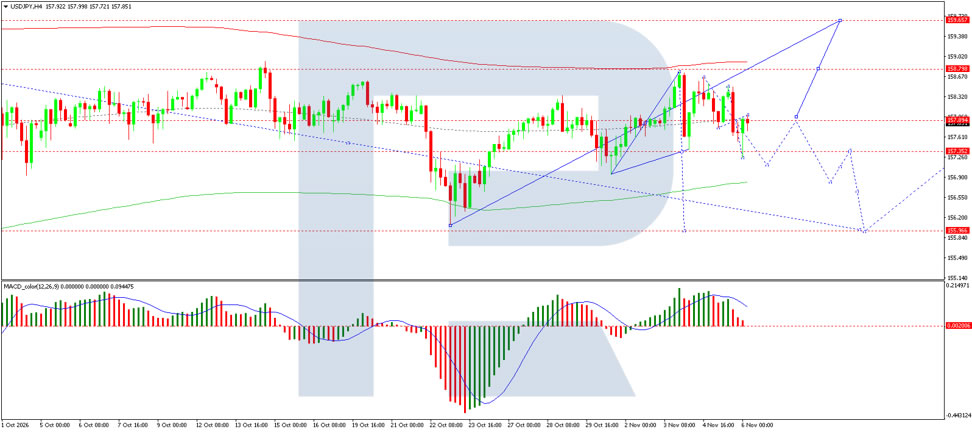
On the H4 USD/JPY chart, a downward correction is developing after the recovery from the October low to 158.75. The medium-term upward structure remains intact, but the sequence of lower local highs indicates weakening buying activity. After testing support at 157.25, the price recovered to 157.85, remaining below resistance at 158.00. For the trading session on 6 November 2026, the baseline scenario envisages consolidation followed by a resumption of the decline. The nearest support is at 157.35, followed by 157.24. A close below this area would open the way towards 156.72. The MACD line is above zero and turning downwards, while the positive histogram is shrinking. This configuration reflects weakening upward momentum but does not yet confirm a sustained downtrend.
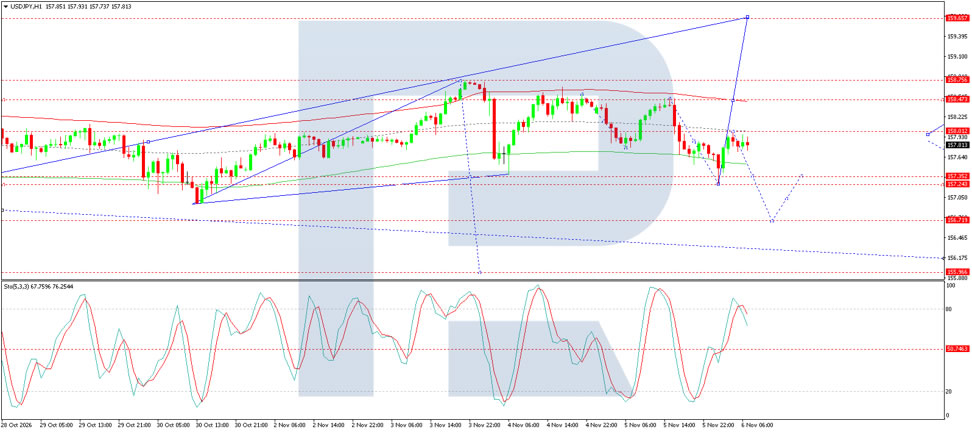
On the H1 USD/JPY chart, the recovery from the decline to 157.24 has stalled below 158.01. As long as the price remains below this resistance, the priority remains a retest of the 157.35 and 157.24 levels. A break below this area would increase the likelihood of the correction continuing towards 156.72. The Stochastic lines have fallen below 80 and are pointing downwards, with the fast line below the signal line. This supports the short-term downside scenario. An alternative scenario envisages a close above 158.01, followed by a recovery towards 158.47 and a test of 158.76. A decisive break above that level would shift focus back to 159.66, though reaching it in a single session remains less likely. Before the price leaves the current range, the directional scenario requires confirmation from an hourly candle closing outside the relevant boundary.
Conclusion
USD/JPY has edged higher as the yen retreats from a one-week high, though the upside appears limited ahead of the key US Nonfarm Payrolls report. The dollar is under pressure from lower Treasury yields and reduced inflation risks following the Democrats’ strengthened position in the midterm elections, which has eased fears of renewed US strikes on Iran and driven oil prices lower. Markets have consequently pared back expectations of a December Fed rate hike. Conversely, the yen finds support from BoJ meeting minutes indicating that further rate hikes remain appropriate, with a December hike still in play. Technically, the pair remains in a corrective phase below resistance at 158.00, with support at 157.35 and 157.24. A break below this support area would increase the likelihood of a move towards 156.72. A break above 158.01 would open the way towards 158.47 and 158.76, though upside potential appears limited in the near term.