TL;DR: The US midterms set off sharp swings across stocks, oil, Treasury yields and the Dollar last week, but they did not settle any of the four trends, which were already forming before the vote. With AI investment concerns, Iran-related risk and Fed expectations all pulling in different directions, each market ended the week at a technical decision point.
Why Did the Midterms Fail to Settle the Trends in Stocks, Oil, Yields and the Dollar?
The US midterm elections triggered sharp cross-market swings last week, but failed to settle the underlying trends in stocks, oil, Treasury yields and the Dollar. Wednesday’s relief rally gave way to a severe equity selloff on Thursday, while Friday’s stronger-than-expected US employment report revived expectations for further Fed tightening. By the weekly close, all four markets were approaching important technical decision points, with their next moves potentially determined by different combinations of geopolitical risk, AI investment concerns and monetary policy expectations.
The contrasting weekly performances underline the uncertainty. The Nasdaq Composite lost 3.37%, the S&P 500 declined 2.68%, and the Dow fell a relatively modest 0.93%. Brent crude plunged 13.6% on a CFD basis, while the US 10-year Treasury yield declined 7.4bps to 4.859%. The Dollar Index, meanwhile, edged up just 0.31% to 102.279, with virtually all of its net weekly gain coming from Friday’s post-payroll rally.
- Nasdaq Composite: −3.37%; S&P 500: −2.68%; Dow: −0.93%.
- Brent crude: −13.6% (CFD basis).
- US 10-year Treasury yield: −7.4bps to 4.859%.
- Dollar Index: +0.31% to 102.279, almost all from Friday’s post-payroll rally.
Yet these figures conceal three distinct market reactions. Wednesday brought falling oil and Treasury yields alongside rising equities and a softer Dollar. Thursday saw stocks collapse and yields fall further even as oil rebounded. Friday’s strong employment data then lifted yields and the Dollar, while technology shares recovered only part of their losses.
The midterms were a common catalyst for these swings, particularly Wednesday’s relief moves, but the forces driving the markets were already developing before the election. Nasdaq had weakened during the preceding week, while Brent’s steep retreat began on Monday, ahead of Tuesday’s vote.
Follow the next moves in stocks, oil, yields and the Dollar on the ActionForex Telegram channel.
AI Concerns Turn Midterm Relief Into a Technology-Led Selloff
The Democratic victory in both chambers of Congress initially supported a sharp equity rebound. The Dow surged 3.03% on Wednesday, outperforming the S&P 500 and Nasdaq as investors reassessed political and economic risks.
But the recovery proved short-lived.
Thursday’s selloff was particularly severe for technology shares. Nasdaq plunged 5.52%, while the Philadelphia Semiconductor Index collapsed 12.2%. The Magnificent Seven collectively lost more than $1 trillion in market capitalization.
Friday’s 1.09% Nasdaq rebound recovered only a small portion of the previous session’s decline. The Dow fell another 0.46%, highlighting the absence of a broad recovery in risk appetite.
The underlying concerns extend beyond the election itself.
Democrats are reportedly preparing legislation addressing data-center electricity costs, independent testing of advanced AI systems and liability for AI-related harms. Their control of congressional committees could increase scrutiny of the industry, although major legislative changes face significant obstacles under President Donald Trump.
More immediate concerns involve the financial sustainability of the AI investment boom. Investors are questioning whether the enormous capital committed to computing infrastructure can generate sufficient returns, particularly as financing requirements continue to expand.
Credit-market developments have added to those concerns. Reuters reported that CoreWeave’s five-year credit-default-swap spread reached a record, while SoftBank’s rose to a four-year high, suggesting that investors were reassessing AI-related credit exposure alongside equity valuations.
The selloff therefore reflects overlapping valuation, financing and political risks rather than a single catalyst.
The critical question is whether the pressure remains concentrated in AI-related investments or begins undermining broader equity-market confidence. The sharp increase in the VIX to 25.63 by Friday, compared with 19.41 a week earlier, suggests that investors have not yet regained confidence despite the partial recovery.
Oil’s War Premium Retreats, but Hormuz Normalization Remains Distant
Oil experienced an even more dramatic adjustment.
Brent fell from 113.41 to 97.98 over the week on the TradingView CFD series, a decline of 13.6%. WTI lost 12.2% to 90.35.
Wednesday’s plunge was closely associated with expectations that the Democratic election victory could increase pressure for a negotiated settlement with Iran. However, Monday’s 8% Brent decline had already shown that the repricing of geopolitical risk began before the vote.
The market’s fundamental dilemma remains unchanged.
Washington and Tehran have yet to bridge their differences over Iran’s nuclear programme, while maritime security incidents continue to threaten shipping through the Strait of Hormuz. The unresolved conflict leaves open the possibility of renewed escalation.
At the same time, Iran reportedly transmitted a nuclear proposal to Washington through Qatar, indicating that diplomatic channels remain active.
The opposing developments help explain why oil has fallen sharply without establishing a sustained move toward pre-conflict conditions.
The broader $70–$120 framework remains useful for assessing the geopolitical premium. Movement toward $70 would be consistent with progress toward normalizing Hormuz, while renewed escalation into full-scale military conflict could bring the upper end of the range back into focus.
These are conditional scenarios rather than fixed price targets.
Brent’s retreat below $100 suggests that markets have reduced their assessment of escalation risk, but not that they have identified a credible path toward normalization. That distinction is central to both the oil outlook and its potential influence on inflation expectations.
Treasury Yields Reflect Competing Oil, Growth and Fed Influences
The Treasury market showed how different risks can produce similar movements in yields.
Wednesday’s decline was consistent with lower oil prices easing inflation concerns. The 10-year yield fell 7.6bps, while the two-year declined 5.2bps.
Thursday was more revealing. Despite Brent rebounding approximately 5%, the two-year yield dropped another 11.2bps as the equity selloff intensified. The front-end move coincided with a reduction in December Fed hike expectations, suggesting that financial-market stress and concerns about the economic outlook were becoming more influential.
Friday’s employment report reversed part of that repricing.
US nonfarm payrolls increased 165K in October, exceeding the ActionForex consensus of 56K. Unemployment declined from 4.2% to 4.1%, while monthly wage growth accelerated to 0.4%. Upward revisions added another 84K jobs to August and September, strengthening the recent employment picture.
CME FedWatch subsequently showed the probability of a December 9 hike rising to 76.3% at Friday’s final observed reading, compared with 66.9% on Thursday.
- October nonfarm payrolls: +165K versus the ActionForex consensus of 56K.
- Unemployment: down from 4.2% to 4.1%; monthly wage growth: 0.4%.
- Revisions: +84K jobs added to August and September.
- December 9 hike probability: 76.3% on Friday, versus 66.9% on Thursday.
However, the rise in Treasury yields on Friday did not fully reverse the preceding declines.
The Fed’s longer-term policy path also remains uncertain. While the payroll report strengthened expectations for December, available pricing still showed somewhat fewer expected hikes by March 2027 than at the earlier reference point.
The week therefore ended with competing influences rather than a clear monetary-policy conclusion. Stronger employment supports further tightening, while lower oil prices and equity-market stress can work in the opposite direction.
Whether the next sustained yield move is driven by renewed inflation concerns or weakening risk appetite will be important for the broader market outlook.
Dollar’s Recovery Gains Support From More Than One Direction
The Dollar Index ended the week only modestly higher, but its performance was increasingly constructive toward Friday’s close.
DXY had fallen 0.39% through Thursday before surging 0.70% on Friday, as the employment surprise revived Fed hike expectations.
The advance was broad-based, with AUD and NZD among the weakest major currencies. USD/JPY closed around 158.508, showing that the Yen had not attracted a decisive safe-haven bid despite the equity selloff.
The relationship between the Dollar and Treasury yields also changed during the week.
Thursday’s relative Dollar resilience despite sharply falling short-term yields was consistent with defensive demand offsetting the pressure from lower US rates.
Friday’s simultaneous rise in the Dollar and yields provided a clearer interest-rate explanation.
That leaves the Dollar with two potential sources of support: a more restrictive Fed outlook if inflation risks intensify, and defensive demand if the AI-driven equity selloff spreads.
Neither relationship is guaranteed, and the weekly gain was too small to establish a powerful new Dollar advance.
Nevertheless, the Dollar’s technical structure appears more advanced than the stabilization attempts in stocks, oil or Treasury yields.
ActionForex’s Technical View: Four Markets Approach Their Decision Points
US Equities — Uptrends Threatened, but Not Broken
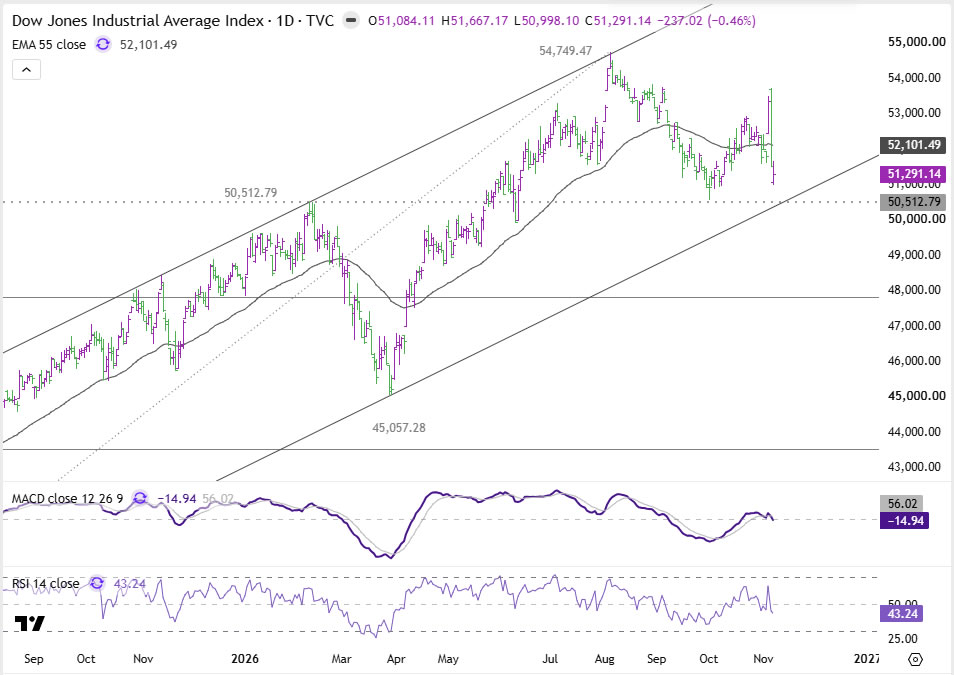
Despite the sharp reversal during the week, the Dow continued to hold within its established range and above 50,512.79 resistance-turned-support, as well as the medium-term rising channel floor.
The favored interpretation remains that price action from 54,749.47 is forming a sideways consolidation of the advance from 45,057.28, with the longer-term uptrend intact.
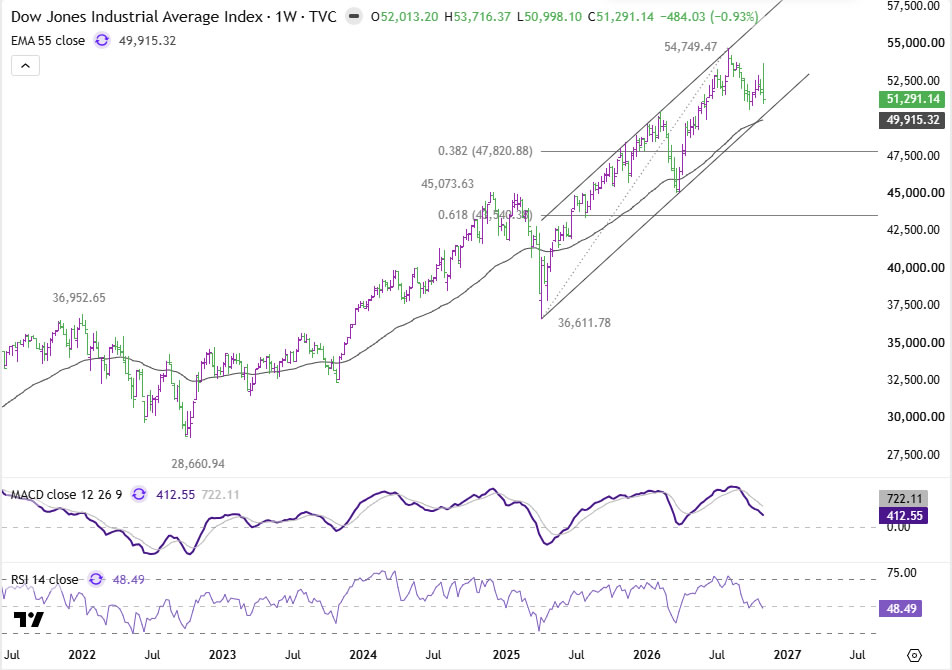
A rebound above the daily 55 EMA, currently at 52,101.49, would reinforce this consolidation scenario and favor an eventual upside breakout.
However, a decisive break of 50,512.79 would increase the risk of a deeper correction of the rise from 36,611.78, targeting the 38.2% retracement at 47,820.88.
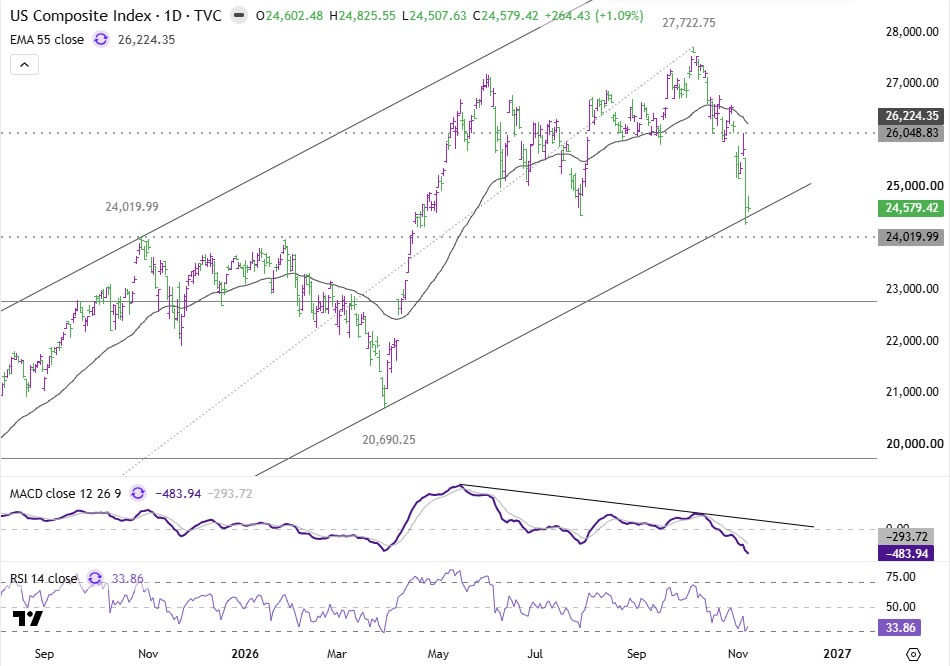
Nasdaq faces a more immediate test.
Despite last week’s steep decline, the index is still defending its medium-term rising channel floor and holding above 24,019.99 resistance-turned-support.
The fall from 27,722.75 could therefore remain a correction of the rise from 20,690.25, rather than the beginning of a larger-scale decline.
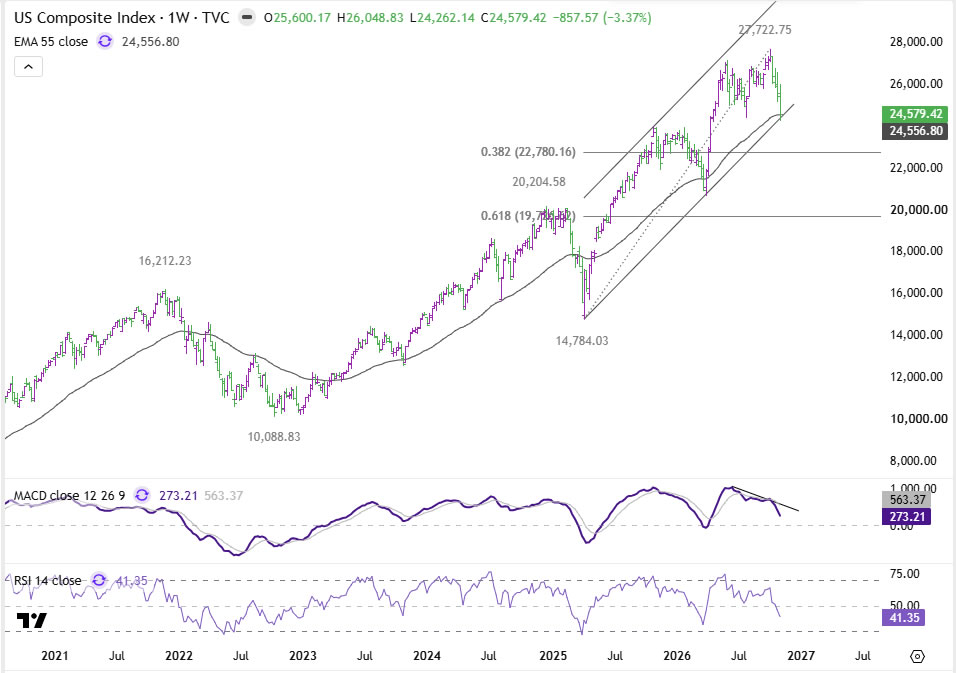
A strong rebound followed by a break of 26,048.83 resistance would solidify this interpretation and favor an eventual resumption of the uptrend through 27,722.75.
Conversely, a decisive break of 24,019.99 would suggest that Nasdaq is correcting the broader advance from 14,784.03, opening the way toward the 38.2% retracement at 22,780.16.
Overall, US equity uptrends are threatened but not yet broken. Nasdaq remains under greater pressure, while the Dow provides a comparatively stronger cushion.
US 10-Year Yield — 4.815% Support Preserves the Uptrend
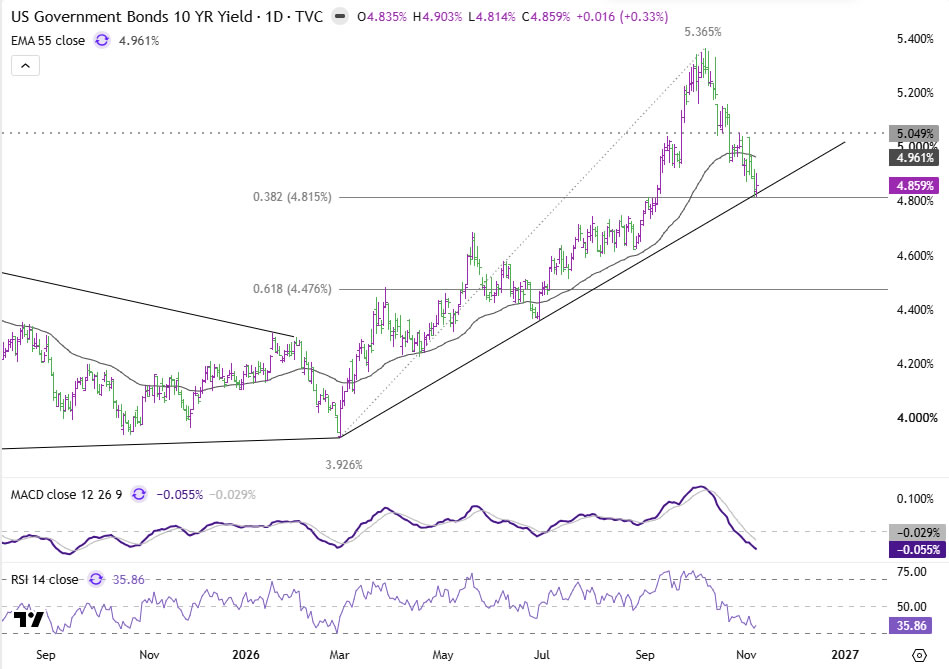
The decline from 5.365% extended to 4.814% last week, marginally penetrating the 38.2% retracement of 3.926% to 5.365% at 4.815%.
However, yields closed back above that level, with additional support from the medium-term rising trend line.
The fall from 5.365% could therefore still be correcting only the rise from 3.926%.
A rebound followed by a break of 5.049% resistance would support the case that the correction has completed and bring a retest of 5.365% into focus.
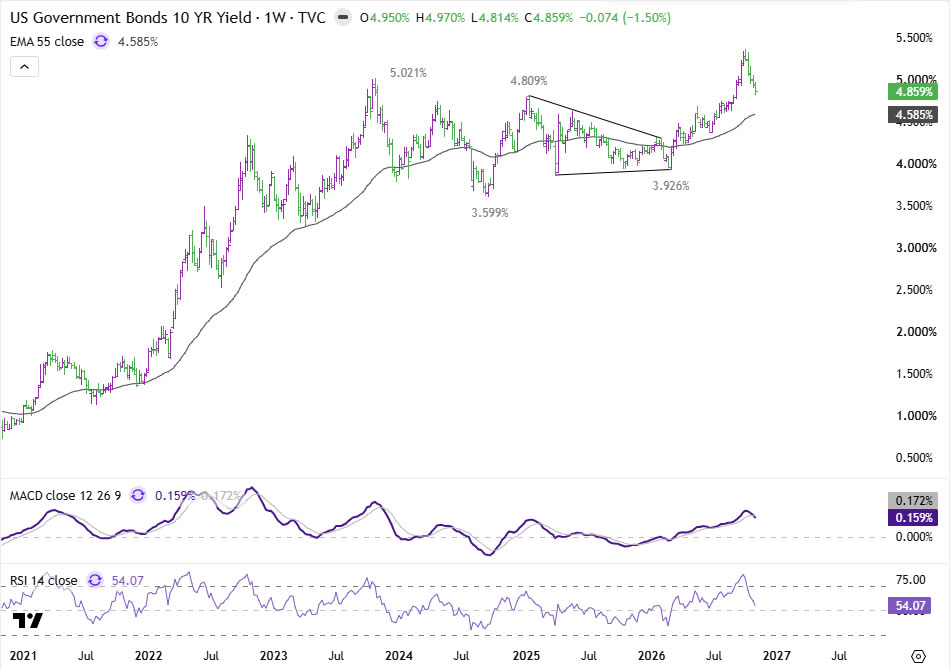
Conversely, a decisive break of 4.815% would increase the likelihood of a larger correction toward the weekly 55 EMA, currently around 4.585%, and potentially the 61.8% retracement at 4.476%.
The 10-year yield uptrend remains intact, although it is under pressure and still requires confirmation of renewed upward momentum.
Brent Crude — The $94 Area Separates Correction From Deeper Reversal
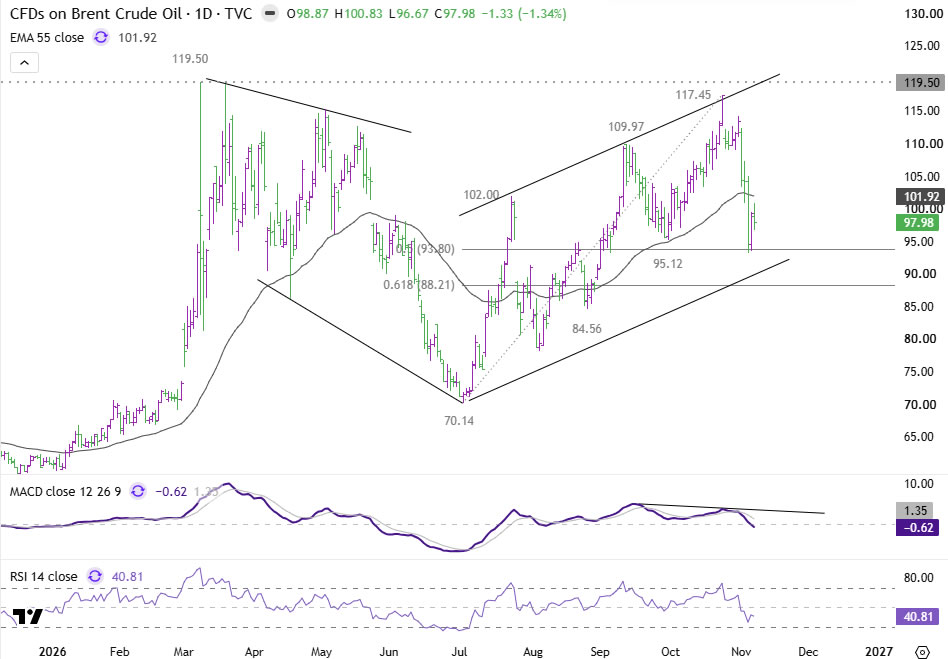
Brent’s decline from 117.45 was considerably steeper than the corresponding corrections in equities and yields.
Nevertheless, the market continued to hold on a closing basis above the 50% retracement of 70.14 to 117.45 at 93.80.
That level has additional significance because it lies near the midpoint of the broader $70–$120 geopolitical scenario range.
A rebound followed by sustained trading above the daily 55 EMA, currently at 101.92, would indicate that the pullback from 117.45 has completed. Such a recovery would be consistent with renewed pricing of escalation risk.
Alternatively, a sustained break of 93.80 would suggest that expectations for eventual Hormuz normalization are gaining influence.
A further break of the 61.8% retracement at 88.21 would confirm that Brent is reversing the broader rise from 70.14 to 117.45, rather than merely correcting it.
Oil’s outlook remains unsettled. The retreat in prices has reduced the war premium, but the continuing risk of escalation leaves room for another rebound.
Dollar Index — Bullish Recovery Approaches Confirmation
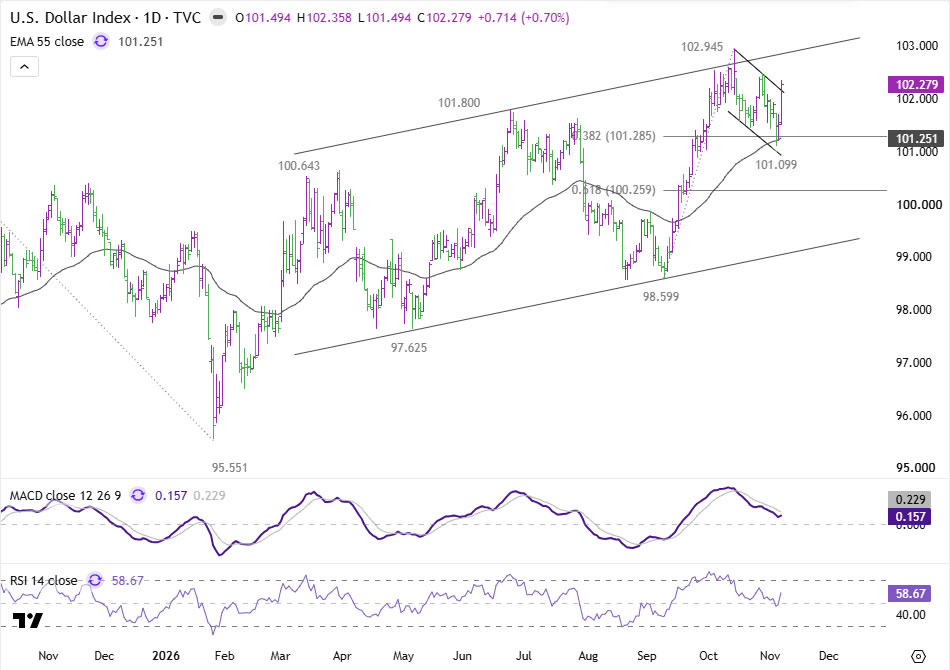
The Dollar Index’s extended rebound and break of near-term falling channel resistance suggest that the correction from 102.94 has completed with three waves down to 101.09.
The rebound followed support from the 38.2% retracement of 98.59 to 102.94 at 101.28, reinforced by the daily 55 EMA, currently around 101.25.
The immediate focus is now on 102.49 resistance.
A firm break there would solidify the bullish interpretation, while a further break of 102.94 would confirm resumption of the larger uptrend from 95.55.
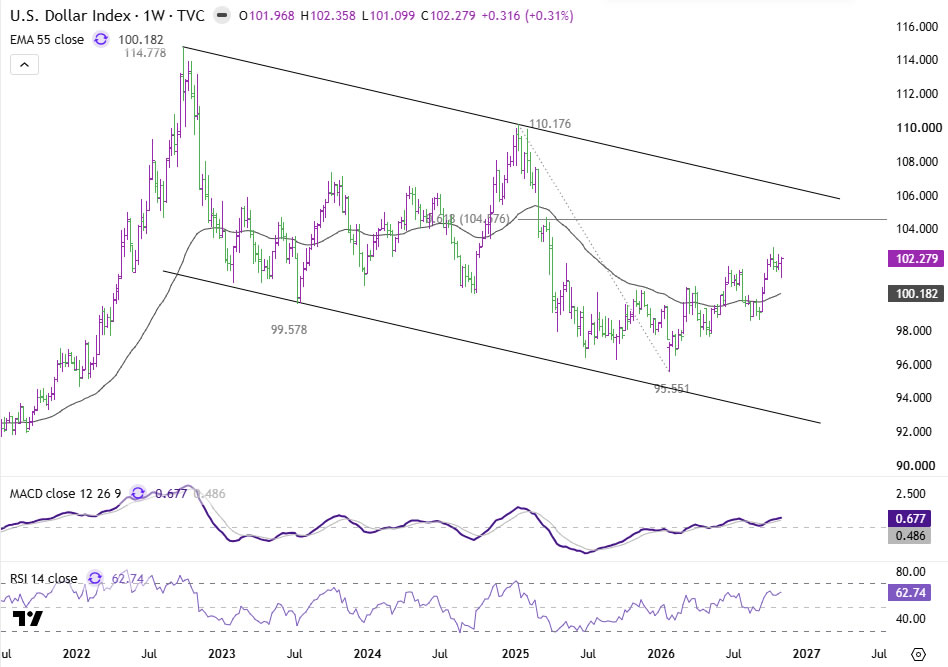
On resumption, the Dollar Index could target the 61.8% retracement of 110.17 to 95.55 at 104.57.
However, a break of 101.09 would dampen this bullish view.
The Dollar’s bullish outlook remains comparatively solid, although the force driving its next advance is uncertain. Renewed Fed tightening expectations, defensive demand arising from deeper equity weakness, or renewed oil-driven inflation concerns could each contribute.
Outlook: Different Risks, Similar Pressure on Equities
The week demonstrated that oil, Treasury yields, equities and the Dollar do not respond to a single dominant influence.
A renewed escalation in the Iran conflict could lift Brent, revive inflation concerns and strengthen expectations for additional Fed tightening. Higher yields and a firmer Dollar would then present renewed challenges for technology valuations.
Alternatively, a deeper selloff in AI-related equities and credit could increase defensive demand, pushing Treasury yields lower while supporting the Dollar through a different channel.
A credible diplomatic breakthrough could produce another configuration, with lower oil prices easing inflation concerns and supporting risk appetite.
These outcomes are conditional, and the relationships between markets need not be mechanical.
For the coming week, the immediate technical tests are Nasdaq at 24,019.99, Dow at 50,512.79, the US 10-year yield at 4.815%, Brent around 93.80 and Dollar Index resistance at 102.49.
The broader conclusion is that the midterms triggered major market swings without resolving the existing trends. US equities and Treasury yields are still defending their uptrends, oil remains caught between reduced war-premium pricing and renewed escalation risks, while the Dollar has the stronger bullish technical setup.
The next sustained move will depend less on the election result itself than on whether geopolitical developments, Fed repricing or further deterioration in AI-related investments becomes the dominant market influence.
Key Takeaways
- Last week Nasdaq fell 3.37%, the S&P 500 2.68% and Brent 13.6% (to 97.98), while the US 10-year yield eased 7.4bps to 4.859% and the Dollar Index rose 0.31% to 102.279.
- Thursday’s tech rout (Nasdaq −5.52%, Philadelphia Semiconductor Index −12.2%) lifted the VIX to 25.63, while Friday’s NFP of +165K (vs 56K consensus) lifted December hike odds to 76.3%.
- Brent has held above 93.80 on a closing basis; a break there would point to 88.21 and a reversal of the rise from 70.14, while a move above the 55 EMA near 101.92 would suggest the pullback is complete.
- Nasdaq must hold 24,019.99 and the Dow 50,512.79 for the uptrends to survive, and the 10-year yield needs to defend 4.815%.
- The Dollar Index has the strongest bullish setup, with 102.49 as the immediate resistance and 101.09 as the level that would dampen the view.
Stay ahead of the next moves in stocks, oil, Treasury yields and the Dollar—join the ActionForex Telegram channel for regular market updates and analysis.