Canadian Highlights
- Markets got bad news this week that Canada’s job market has lost jobs for three consecutive months as of October.
- This week’s federal budget showed that Ottawa received a windfall and spent it. The deficit outlook improved but longer-term borrowing has increased, raising the debt servicing burden.
- For the Bank of Canada, the budget doesn’t shift the policy calculus, but the weak jobs report casts doubt on their stronger economic outlook.
U.S. Highlights
- Democrats won majorities in both chambers of Congress, leading to a sell-off in equity markets, a drop in Treasury yields and oil prices as markets repriced political and AI-related risks.
- The sell-off was mitigated somewhat by a very constructive payrolls report on Friday.
- ISM business surveys also pointed to continued expansion, but with persistent price pressures. All in, the case for a December Fed hike was strengthened this week.
Canada – The Devil is in the Fiscal Details
There was plenty for markets to digest this week: a disappointing jobs report and a federal budget that delivered a better near-term deficit but a weaker long-run fiscal picture. Markets took the fiscal outlook in stride, but the softer-than-expected jobs report raised markets’ worries, with the S&P TSX falling at the opening.
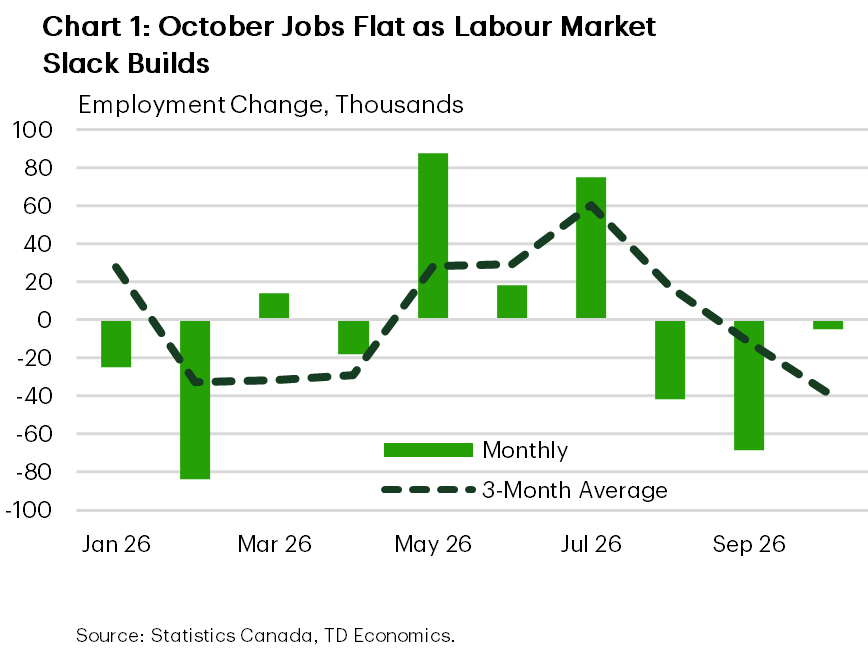
Canada’s job market chalked up its third consecutive weak result in October (Chart 1). On a three-month and the year-to-date basis, the Canadian economy has shed jobs. The details offered no silver linings either. The unemployment rate rose 0.2 percentage points to 6.7%, average hourly wage growth slowed, and the job-finding rate remained well below its pre-pandemic norm. This supports our view that growing labour market weakness will constrain households’ ability to spend, supporting a moderate growth outlook.
Digging deeper into employment figures, the private sector lost jobs, while the public sector added positions, but both remained down on the year. The weakness in the private sector is particularly discouraging, highlighting the cumulative effects of uncertainty over the Canada-U.S. trade relationship, and lackluster growth in the Canadian economy over the past year. Meanwhile, the decline in public-sector jobs over the year partly reflects Ottawa’s commitment to reduce its workforce by 10% over five years as part of broader operational savings outlined last year.
This week’s federal budget offered another chance to assess government’s fiscal commitment. In short, Ottawa received a windfall, and spent it. Stronger growth and higher energy prices improved the fiscal outlook by $175 billion through 2030-31. Left alone, that would have cut the 2030-31 deficit but instead, $142 billion in net new measures absorbed most of it.
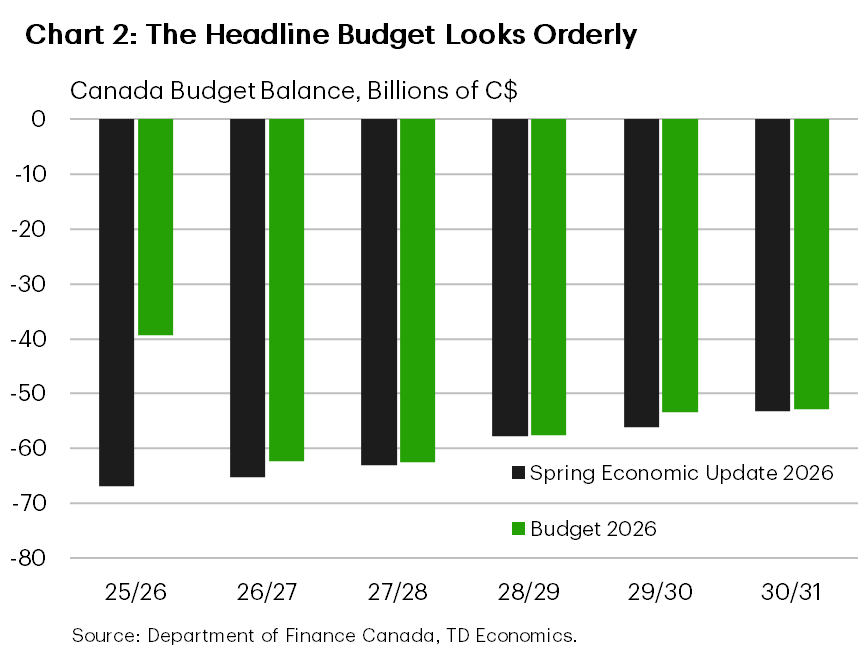
The headline deficit for the outgoing fiscal year looks orderly: it came in at $39.3 billion (1.2% of GDP) in 2025-26, well below the $66.9 billion penciled in at the spring update (Chart 2). It is expected to increase to 1.8% of GDP this year, and ease to 1.3% by 2030-31. However, there is no escaping that the debt and borrowing picture has deteriorated. As pointed out in our commentary, the borrowing requirement is larger than the deficit suggests, due to the government’s large capital outlays. This higher borrowing and higher interest rates mean debt servicing costs eat up a larger share of the fiscal pie going forward. Debt servicing costs are not as bad as they were in the 1990s, and Canada remains better positioned than its G7 peers. But the strategy of tax breaks and direct investment to lure private capital is a bet on an investment supercycle. If the returns in economic growth don’t materialize, the cost will show up as even wider deficits.
For the Bank of Canada, the budget’s fiscal picture doesn’t change the calculus much, but the weak employment report does. Increased labour market slack raises the odds that the BoC’s inflation forecast is too high, which weakens the case for further interest rate hikes. The market agrees, and has lowered the amount of tightening priced in relative to a week ago.
U.S. – Midterm’s Blue Wave Hits Markets
It was an eventful week. Tuesday’s midterms delivered a decisive “blue wave” as Democrats won both chambers, ushering in divided government and narrowing the administration’s legislative runway. Republican tax and spending initiatives will be harder to advance, while Democratic priorities face a presidential veto and the Senate’s 60-vote filibuster threshold (report).
Markets rallied on Wednesday before reversing on Thursday as investors reassessed the implications of a Democratic Congress and key gubernatorial gains for AI infrastructure and data-centre investment. AI-related stocks led the sell-off, with the Nasdaq plunging nearly into correction territory. Markets were up on Friday on a strong jobs report, but remained on track to end the week lower. Oil prices plunged by over $10/barrel to about $90/barrel for the WTI benchmark on expectations of an earlier end to the Iran conflict.
The equity sell-off likely tightened financial conditions, although lower Treasury yields mitigated the impact. As this week’s report notes, conditions remain accommodative historically, with tightening driven mainly by market volatility from repricing of near-term rate expectations and concerns about AI valuations rather than broad credit restrictions. This week’s Fed’s Senior Loan Officer Opinion Survey showed slight tightening in business-loan standards, but nothing concerning.
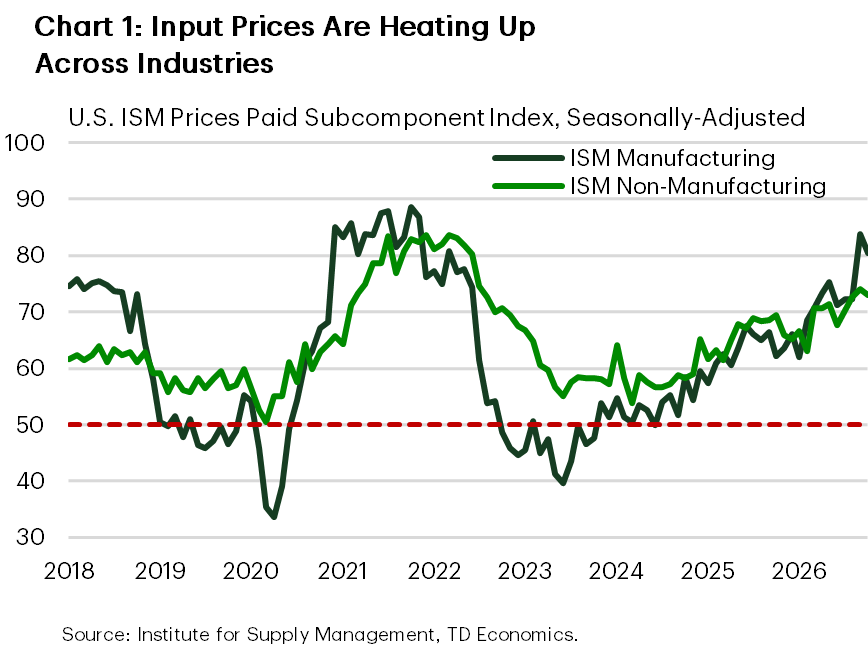
Tighter financial conditions have yet to meaningfully slow the economy. The new Congress inherits a resilient economy with growth likely to accelerate to 2.5% Q4/Q4 this year from 2.0% in 2025. The downside is higher inflation. This week’s ISM surveys highlighted that tension. October’s services index edged lower, while manufacturing counterpart continued to rise, with both remaining above 50 and signalling expansion. But, their prices-paid components have remained elevated, nearing pandemic-era readings and raising the risk of persistent cost pressures (Chart 1).
Higher interest rates and months of elevated gas prices may be starting to weigh on consumer spending, particularly on big-ticket items. Vehicle sales fell to an annualized 15.5 million units in October. Higher tax refunds, financial-market wealth gains and job growth have supported consumer spending and debt payments despite inflation, but resilience could weaken if these supports falter. Our report shows rising 30-day mortgage delinquencies among prime and super-prime borrowers and a growing share of consumers devoting more than 40% of income to debt payments.
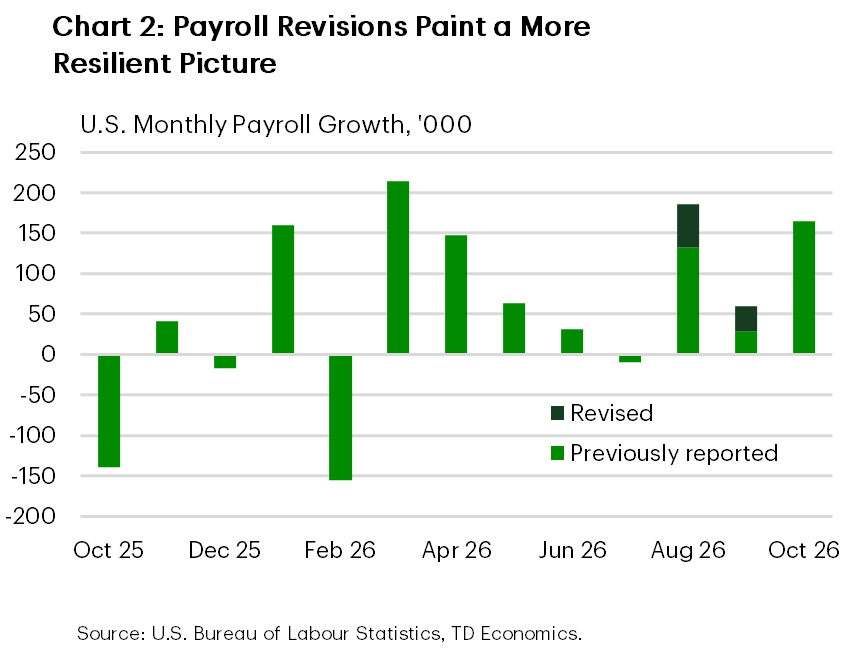
Against this backdrop, Friday’s payroll report offered reassurance. Payroll gains handily beat expectations, rising 165k in October (Chart 2). Upward revisions added to the report’s strength, with August and September revised up 84k in total. The unemployment rate edged down to 4.1% from 4.2%. Attention now turns to next week’s CPI inflation report, likely to show inflation remains too hot amid a resilient economy and labour market, leaving the runway open for another Fed rate hike in December. Markets agree, pricing about 75% odds of a December hike, up from 70% a week ago.