Yen Gained Against All Seven Peers and Australian Dollar Weakened Across the Board as an AI-Led Equity Selloff Spread Through Global Markets, With Treasuries Offering Little Shelter
What’s happening: Yen gained against all seven major peers on Monday and Australian Dollar weakened across the board as an AI-led equity selloff spread, with South Korea’s KOSPI down 3.59% and Japan’s Nikkei 225 down 2.42%, while European equities were broadly stable and US Dow futures lost only 0.10%. Treasuries offered little shelter, with the two-year yield down just 1.4bps to 4.838% and the 10-year yield down 1.0bp to 5.129%.
Why it matters: Persistent Fed tightening expectations, with CME FedWatch at 93.7% for a 25bps December hike, limit the usual flight into government bonds, so elevated yields could amplify pressure on AI valuations and investment plans. The US cash open, Nvidia’s earnings on Tuesday and Wednesday’s Fed minutes are the next tests of whether the selling broadens.
Yen emerged as the strongest major currency on Monday, gaining against all seven peers, while Australian Dollar weakened across the board as an AI-led equity selloff spread through global markets. Dollar and Swiss Franc also occupied the stronger end of the currency spectrum, while Canadian and New Zealand Dollars lagged, reflecting a broader shift toward defensive positioning. The currency moves accompanied sharp declines in Asian technology shares, with South Korea’s KOSPI plunging 3.59% and Japan’s Nikkei 225 falling 2.42%. Yet the selling remained concentrated in technology-related assets, with European equities broadly stable and US Dow futures showing only modest losses. More concerning was the limited response from government bonds, as Treasury yields declined only marginally despite mounting equity-market pressure.
Follow the AI-led selloff, Yen strength and the Treasury response on the ActionForex Telegram channel.
Nvidia Turmoil Sends Shockwaves Through AI Stocks
The latest wave of selling followed Nvidia’s leadership upheaval, with Jensen Huang stepping down as CEO and Chief Financial Officer Colette Kress assuming the role on an interim basis. The disruption has heightened uncertainty surrounding the world’s leading AI chipmaker ahead of its earnings announcement on Tuesday. Nvidia shares were down around 2.7% in premarket trading, while its market capitalization had fallen to approximately $3.9 trillion by Friday from about $5.8 trillion in early October. US Treasury Secretary Scott Bessent added to the uncertainty over the weekend, calling for a substantial management shakeup and greater scrutiny of compliance with export controls.
The pressure has spread particularly strongly through Asian semiconductor stocks. South Korea’s SK Hynix fell more than 5.6% during the session, while Samsung Electronics and Taiwan’s TSMC were also under pressure. In Japan, semiconductor equipment maker Advantest dropped almost 10%, Tokyo Electron lost 5.2% and SoftBank declined 4.2%, according to intraday reports. The broader selloff pushed KOSPI down 3.59% and Nikkei 225 lower by 2.42%, although Hong Kong’s Hang Seng managed a 0.49% gain.
European markets showed considerably greater resilience. Around midday, FTSE 100 was up 0.32%, CAC 40 gained 0.23% and DAX slipped just 0.10%, although semiconductor-related shares remained under pressure. US futures pointed to a similarly concentrated pattern, with Nasdaq-100 futures down 1.41%, compared with losses of 0.64% for S&P 500 futures and just 0.10% for Dow futures.
Equity Moves at a Glance
- South Korea’s KOSPI: down 3.59%
- Japan’s Nikkei 225: down 2.42%
- SK Hynix: down more than 5.6%
- Advantest: down almost 10% (intraday)
- Tokyo Electron: down 5.2% (intraday)
- SoftBank: down 4.2% (intraday)
- Hong Kong’s Hang Seng: up 0.49%
- FTSE 100: up 0.32% around midday
- CAC 40: up 0.23% around midday
- DAX: down 0.10% around midday
- Nasdaq-100 futures: down 1.41%
- S&P 500 futures: down 0.64%
- Dow futures: down 0.10%
The defensive shift was also visible beyond equities. Yen strengthened against every other major currency in the ActionForex daily heat map, while Swiss Franc and Dollar were relatively firm. Australian Dollar was the weakest, with Canadian and New Zealand Dollars also lagging. Bitcoin fell 1.77%, Ether lost 1.99%, and silver declined 2.08%, substantially more than gold’s 0.36% drop.
Currency Heat Map: Stronger vs Weaker
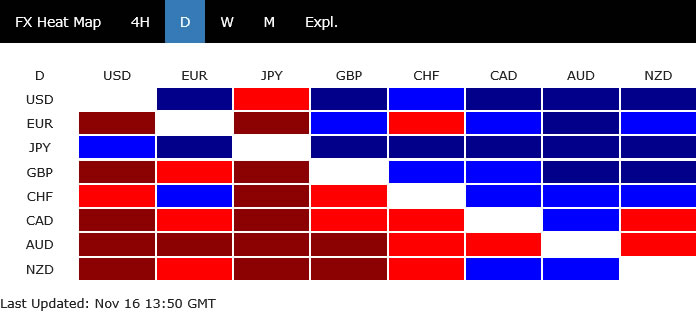
| Stronger currencies | Weaker currencies |
|---|---|
| Yen: strongest, gaining against all seven peers | Australian Dollar: weakest, falling across the board |
| Swiss Franc: relatively firm | Canadian Dollar: lagging |
| Dollar: at the stronger end of the spectrum | New Zealand Dollar: lagging |
The movements suggest that risk aversion is spreading across asset classes, although the scale of losses outside technology remains comparatively limited. Weakness in commodity currencies also reflects other pressures, including falling oil prices and disappointing Chinese economic data, rather than the AI selloff alone.
AI-Dependent Growth Faces Rising Borrowing Costs, but Treasuries Offer Little Relief
The broader significance of the technology selloff lies in the growing dependence of global economic activity on AI-related investment. IMF Managing Director Kristalina Georgieva warned on Monday that the world economy has become increasingly reliant on AI as a source of growth, creating potential financial stability risks if investment confidence deteriorates.
According to media reports of her remarks, the IMF estimates circular financing arrangements among AI-related companies at slightly more than $1 trillion, with roughly two-thirds funded through debt. Although Georgieva described recent market movements as orderly, the rapid expansion of interconnected financing raises concerns about how a sustained correction in AI valuations could affect corporate investment and broader economic activity.
The vulnerability is heightened by rising borrowing costs. US Treasury yields surged last week as investors aggressively repriced Fed tightening expectations, with the two-year yield climbing 34bps and the 10-year yield rising 28bps. The Dollar also strengthened to a 2026 high. CME FedWatch pricing on Monday showed a 93.7% probability of a 25bps Fed hike in December, with the remaining 6.3% assigned to a larger 50bps increase.
Despite Monday’s equity losses, Treasuries provided little protection. The two-year yield edged down just 1.4bps to 4.838%, while the 10-year yield slipped only 1.0bp to 5.129%. The muted response suggests that persistent tightening expectations are limiting the scope for a conventional flight into government bonds.
Treasuries and Fed Pricing at a Glance
- US two-year yield on Monday: down 1.4bps to 4.838%
- US 10-year yield on Monday: down 1.0bp to 5.129%
- Last week: two-year yield up 34bps and 10-year yield up 28bps
- December Fed hike: 93.7% probability of 25bps, 6.3% of 50bps
- Dollar: strengthened to a 2026 high last week
This creates an uncomfortable combination for risk assets. AI investment has become an important driver of corporate spending and global growth, much of it supported by borrowing, while the cost of financing that expansion is rising. If investor confidence weakens further, elevated yields could amplify the pressure on technology valuations and investment plans rather than cushion the adjustment.
Asian Economies Exposed as AI Growth Masks Domestic Weakness
The dependence on AI-related investment is particularly significant for Asian economies, where semiconductor production, technology exports and capital expenditure have become important sources of growth.
China’s latest October data highlighted the divergence between advanced manufacturing strength and weak domestic demand. Industrial production growth slowed from 5.5% to 4.8% yoy, retail sales growth weakened from 1.1% to just 0.4%, and fixed-asset investment contracted 8.1% over January–October. These figures contrasted with strong exports and continued expansion in high-tech manufacturing, illustrating the economy’s growing reliance on external demand and technology-oriented industries.
That dependence leaves China vulnerable if a prolonged correction in AI investment reduces demand for technology equipment and related products. However, the Hang Seng’s positive performance on Monday suggests that the equity selloff was not uniformly distributed across the region.
Japan faces a different but related challenge. Its economy contracted 0.1% annualized in Q3, missing expectations for 0.3% growth, as weak household consumption and net exports outweighed stronger business investment. The Nikkei initially fell around 0.6% following the GDP release before extending its decline to 2.42%, suggesting that technology-related selling added to the pressure from disappointing domestic growth.
China and Japan Data at a Glance
- China industrial production: 4.8% yoy, down from 5.5%
- China retail sales: 0.4% yoy, down from 1.1%
- China fixed-asset investment: contracted 8.1% over January–October
- Japan Q3 GDP: down 0.1% annualized, against expectations for 0.3% growth
- Nikkei after the GDP release: initially down around 0.6%, extending to 2.42%
The contrasting performance of Asian markets reinforces the central vulnerability: AI-linked production and investment have helped offset weakness elsewhere in several economies. A prolonged technology downturn could therefore affect not only equity valuations but also some of the growth drivers supporting regional economic activity.
Concentrated Technology Weakness Meets High Financing Costs
The immediate test comes with Monday’s US cash market opening. If weakness spreads from Nasdaq into the S&P 500 and Dow, the argument that losses remain concentrated in technology would become less convincing. Conversely, stabilization in technology stocks, accompanied by fading Yen and Swiss Franc strength, would suggest that the broader risk-off adjustment is easing.
US Cash Open: Two Outcomes
| Scenario | Implication |
|---|---|
| Weakness spreads from Nasdaq into the S&P 500 and Dow | The argument that losses remain concentrated in technology becomes less convincing |
| Technology stocks stabilize, with Yen and Swiss Franc strength fading | Suggests the broader risk-off adjustment is easing |
Attention will then turn to Nvidia’s earnings announcement on Tuesday after the US close. Investors will assess whether the company’s financial performance and outlook can restore confidence following its leadership disruption. The reaction will be particularly important for Asian semiconductor stocks when regional trading resumes on Wednesday.
Wednesday’s Fed minutes provide another potential catalyst. Markets will look for indications of how policymakers assess inflation risks and whether support is building for a more aggressive tightening pace. Any further hawkish repricing could keep Treasury yields elevated, limiting the protection normally offered by government bonds during equity-market declines.
Anthropic’s planned market debut on Thursday will provide an additional test of investor appetite for AI-related assets.
For now, the market picture is one of concentrated technology weakness accompanied by broader, but relatively modest, defensive positioning. Yen and Swiss Franc strength show that risk aversion is extending into currencies, while the limited Treasury rally highlights the constraints imposed by elevated interest rates. The critical question is whether Nvidia can stabilize confidence before the combination of weakening AI valuations and high financing costs begins to affect broader markets and economic growth.
Related Coverage
Fed and BoJ Policy
- Fed’s Inflation Fight Shifts to Pace as Schmid Rejects Excuses, Collins Backs Gradual Hikes: The Fed’s inflation fight is increasingly focused on the pace of further tightening. Kansas City Fed President Jeff Schmid rejected arguments that supply shocks and AI-driven demand are beyond monetary policy’s control, insisting the central bank has the tools and responsibility to restore price stability. Boston Fed President Susan Collins supported gradual rate increases, acknowledging stronger inflation and labor data while warning that higher market yields may already be restraining demand. Their comments reinforce the tightening outlook without endorsing the full rate path priced by markets.
- BoJ’s Takata Urges Faster Rate Hikes as Weak Yen and Low Real Rates Threaten Inflation: BoJ board member Hajime Takata is calling for a fundamental shift in Japan’s monetary policy, urging faster and more flexible rate hikes now that underlying inflation has effectively reached 2%. He wants the policy rate moved closer to a neutral level, warning that exceptionally low real interest rates could weaken the Yen and intensify imported inflation. Takata sees resilient corporate earnings, stronger balance sheets and AI-related investment as supporting further tightening. However, Japan’s Q3 GDP contraction highlights the tension between rising inflation risks and fragile household demand, leaving the timing of another BoJ hike uncertain.
Silver and Currencies
- Silver Sinks Toward $42 as Risk Aversion Adds to Dollar and Yield Pressure: Silver extended its selloff on Monday, falling nearly 3% to around $47.34 as weakness across Asian equities added to pressure from last week’s sharp rise in Treasury yields and the Dollar. Silver declined more than three times as much as gold, while the gold/silver ratio broke above 80.11 toward its next target at 84.48. With yields and the Dollar largely unchanged on Monday, the latest underperformance appears more closely associated with deteriorating risk sentiment. Technically, $46.48 is the immediate support, with a decisive break exposing $42.01 and potentially extending the larger downtrend.
- Canada CPI Holds at 3.1%, but Softer Core Inflation Challenges Further BoC Tightening: Canada’s inflation held at 3.1% yoy in October, below expectations for an increase to 3.2%, while monthly CPI rose a softer-than-expected 0.2%. Underlying inflation was relatively contained, with CPI-median unchanged at 2.0% and CPI-trim easing to 1.8%, although CPI-common edged higher to 2.5%. Gasoline inflation accelerated to 30.9% yoy, while grocery and clothing prices also strengthened, but slower rent inflation and falling cellular service prices provided offsets. The divergence between elevated headline inflation and moderate underlying pressures challenges the urgency of another near-term BoC rate hike.
- Canada CPI Today, UK CPI Wednesday: Can Inflation Finally Break GBP/CAD’s Range?: GBP/CAD faced a potentially decisive week, with Canada releasing October CPI on Monday and UK inflation following on Wednesday. Both the BoC and BoE have recently raised interest rates, but broadly parallel tightening expectations have kept the cross between 1.8604 and 1.9042. OIS markets price approximately 79bps of additional BoC tightening and 91bps for the BoE over roughly the next year. Canada’s inflation report had greater potential to reshape immediate rate expectations, while UK CPI will test the more extensive tightening already priced, and a meaningful divergence could finally challenge GBP/CAD’s consolidation.
Eurozone and Asia-Pacific Data
- Eurozone Industrial Production Rises 0.2%, but Deeper Annual Decline Clouds Outlook: Eurozone industrial production returned to growth in September, rising 0.2% mom after a 0.5% decline in August, but missed expectations for a 0.3% increase. The modest rebound ended three consecutive monthly contractions, although annual output deteriorated further, falling 1.5% yoy. Intermediate goods and durable consumer goods recovered, while energy production declined sharply and capital goods stagnated. Germany and Italy posted stronger output, but France and Ireland continued to struggle, suggesting tentative stabilization rather than a sustained industrial recovery.
- China Industrial Output Slows to 4.8%, Retail Sales Growth Falls to 0.4%: China’s October economic data revealed further weakness in domestic demand as industrial production, retail sales and fixed-asset investment all missed forecasts. Industrial output growth slowed from 5.5% to 4.8% yoy, while retail sales growth weakened from 1.1% to just 0.4%. Fixed-asset investment contracted 8.1% over January–October, with declines extending beyond property into manufacturing and infrastructure. High-tech manufacturing continued to outperform, expanding 17.6%, while strong exports provided external support, reinforcing concerns about China’s dependence on technology-driven production and overseas demand.
- Japan GDP Contracts as Consumer Spending Falters, Business Investment Offers Rare Bright Spot: Japan’s economy contracted for the first time in four quarters, with real GDP falling 0.1% annualized in Q3 after growing 1.4% in Q2. Private consumption declined 0.3% for a second consecutive quarter, while net exports subtracted 0.6 percentage point from growth. Business investment provided a rare bright spot, rising 1.6% on demand for automation, digitalization and AI-related technologies. However, final sales of domestic product fell 2.1% annualized, exposing deeper weakness beneath the modest headline contraction.
- NZ BNZ Services Hits Highest Since 2023 as Stronger Activity Outpaces Hiring: New Zealand’s services sector strengthened in October, with the BNZ–BusinessNZ Performance of Services Index rising from 50.9 to 51.7, its highest since 2023. Activity/Sales climbed from 50.4 to 52.6, while New Orders improved to 53.0, suggesting earlier demand gains are translating into stronger business activity. However, employment remained just below the expansion threshold at 49.9, and discretionary consumer services continued to struggle. The GDP-weighted composite index also rose to 52.2, pointing to broader economic improvement, although stronger activity has yet to generate meaningful hiring growth.
FAQ
Why did the Yen strengthen and the Australian Dollar weaken on Monday?
Yen gained against all seven peers and Australian Dollar weakened across the board as an AI-led equity selloff spread and investors shifted toward defensive positioning, with Swiss Franc and Dollar also firm. Weakness in commodity currencies, including Australian, Canadian and New Zealand Dollars, also reflects other pressures such as falling oil prices and disappointing Chinese economic data, so the AI selloff is not the only driver.
Why aren’t US Treasuries providing shelter from the AI selloff?
Persistent Fed tightening expectations are limiting the scope for a conventional flight into government bonds. The two-year yield edged down just 1.4bps to 4.838% and the 10-year slipped only 1.0bp to 5.129% on Monday, after rising 34bps and 28bps last week, while CME FedWatch showed a 93.7% probability of a 25bps December hike and 6.3% for 50bps. If investor confidence weakens further, elevated yields could amplify pressure on technology valuations and investment plans rather than cushion the adjustment.
Why is the AI selloff a concern beyond technology stocks?
The IMF’s Kristalina Georgieva warned that the world economy has become increasingly reliant on AI as a source of growth, with circular financing arrangements among AI-related companies estimated at slightly more than $1 trillion, roughly two-thirds funded through debt. Asian economies are particularly exposed: China’s October data showed strong high-tech output alongside weak retail sales and investment, and Japan’s economy contracted 0.1% annualized in Q3. A prolonged technology downturn could therefore affect growth drivers as well as equity valuations.
Key Takeaways
- Yen gained against all seven major peers on Monday while Australian Dollar weakened across the board, with Dollar and Swiss Franc also at the stronger end and Canadian and New Zealand Dollars lagging.
- Nvidia’s leadership upheaval, with Huang stepping down and Kress interim CEO, drove the latest selling, and its market capitalization fell to approximately $3.9 trillion by Friday from about $5.8 trillion in early October ahead of Tuesday’s earnings.
- Asian technology shares fell sharply, with KOSPI down 3.59% and Nikkei 225 down 2.42%, while FTSE 100 and CAC 40 were up and DAX slipped just 0.10%, and Dow futures lost only 0.10%.
- Weakness in commodity currencies also reflects falling oil prices and disappointing Chinese economic data, rather than the AI selloff alone.
- IMF Managing Director Georgieva warned the world economy is increasingly reliant on AI, with circular financing arrangements estimated at slightly more than $1 trillion, roughly two-thirds funded through debt.
- Treasuries provided little protection, with the two-year yield down 1.4bps to 4.838% and the 10-year down 1.0bp to 5.129% after last week’s 34bps and 28bps rises, while FedWatch showed 93.7% for a 25bps December hike and 6.3% for 50bps.
- China’s October data and Japan’s Q3 GDP contraction show Asian growth leaning on AI-linked production, and Nvidia’s Tuesday earnings and Wednesday’s Fed minutes are the next tests of whether selling broadens.
What to Watch Next
The first test is the US cash market opening: weakness spreading from Nasdaq into the S&P 500 and Dow would undermine the view that losses are concentrated in technology, while stabilization with fading Yen and Swiss Franc strength would suggest the risk-off adjustment is easing.
Nvidia’s earnings on Tuesday after the US close will show whether its financial performance and outlook can restore confidence, with Asian semiconductor stocks reacting when trading resumes on Wednesday. Wednesday’s Fed minutes could show whether support is building for a more aggressive tightening pace, and Anthropic’s planned market debut on Thursday will test investor appetite for AI-related assets.
Stay ahead of Nvidia’s earnings, Wednesday’s Fed minutes and the pressure that high borrowing costs put on AI stocks—join the ActionForex Telegram channel for regular market updates and analysis.