Dollar Firmed After Stronger Underlying US Retail Sales Ahead of Two Major Event Risks: Nvidia’s Earnings Tonight and Trump’s Thursday Meetings With Xi and Putin
Today’s themes:
- Dollar strengthened after October US retail sales, which slowed from 0.8% to 0.2% mom as expected, while sales excluding autos rose 0.6% against consensus of 0.4%.
- Nvidia reports tonight after Monday’s selloff, in which Nasdaq Composite fell 2.49% and S&P 500 lost 1.92%, with KOSPI down 2.59%, Nikkei down 1.34% and Hang Seng down 1.03% on Tuesday.
- Trump meets Xi and Vladimir Putin in Shenzhen on Thursday, with Iran and Strait of Hormuz energy supplies in focus, while Brent traded around USD 93.57, within its USD 89–97 range.
- The European Commission forecast Eurozone growth of 1.2% in both 2026 and 2027, with OIS pricing continuing to indicate approximately 24bps of ECB tightening on December 17.
Dollar strengthened following stronger-than-expected underlying US retail sales data on Tuesday, while global markets continued to digest Monday’s Wall Street selloff ahead of two major event risks: Nvidia’s earnings tonight and US President Donald Trump’s meetings with Xi Jinping and Vladimir Putin on Thursday. US Treasury yields remained relatively stable, while oil continued trading within its established range despite renewed volatility surrounding the Strait of Hormuz. Asian and European equities stayed under pressure, but the broader picture was one of consolidation rather than another decisive repricing across asset classes.
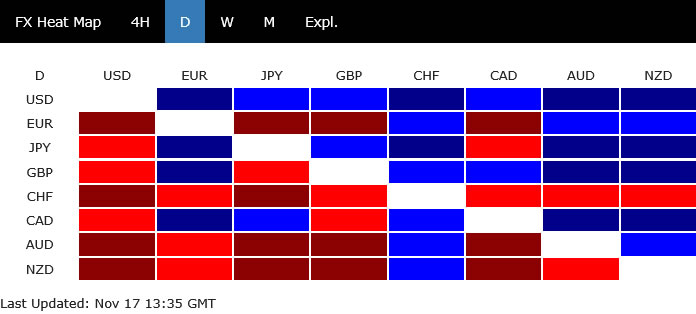
October US retail sales slowed from 0.8% to 0.2% mom, matching expectations, but sales excluding autos rose 0.6%, above consensus of 0.4%. Excluding both autos and gasoline, sales increased 0.5%, maintaining September’s pace. The underlying resilience provided a plausible catalyst for Dollar’s subsequent advance, with the latest currency heat map showing USD strengthening against most major counterparts. However, the broader spending picture remained mixed, as motor vehicle sales contracted 1.6% while nonstore retailers posted a 1.2% gain.
US Retail Sales: Softer vs Resilient
| Softer signals | Resilient signals |
|---|---|
| Headline sales slowed from 0.8% to 0.2% mom, matching expectations | Sales excluding autos rose 0.6%, above consensus of 0.4% |
| Motor vehicle sales contracted 1.6% | Nonstore retailers posted a 1.2% gain, and sales excluding autos and gasoline rose 0.5%, maintaining September’s pace |
The Dollar Index had been little changed around 103.666 before the release, while US 10-year Treasury yield stood near 5.125%, down just 0.4bps. The yield had fluctuated within approximately 1bp for much of the session, indicating limited movement in rate expectations ahead of the upcoming events. In equities, Monday’s selloff saw Nasdaq Composite plunge 2.49%, S&P 500 lose 1.92%, and Dow Jones Industrial Average decline 1.41%. The weakness carried into Tuesday, with KOSPI falling 2.59%, Nikkei 1.34%, and Hang Seng 1.03%. European markets also declined, with FTSE 100, DAX and CAC 40 each losing around 1%.
Markets at a Glance
- Dollar Index: little changed around 103.666 before the retail sales release
- US 10-year Treasury yield: near 5.125%, down 0.4bps
- Nasdaq Composite on Monday: down 2.49%
- S&P 500 on Monday: down 1.92%
- Dow Jones Industrial Average on Monday: down 1.41%
- KOSPI on Tuesday: down 2.59%, closing at 4,968.49
- Nikkei on Tuesday: down 1.34%, ending at 58,860.21
- Hang Seng on Tuesday: down 1.03%
- FTSE 100, DAX and CAC 40: each down around 1%
Follow Nvidia’s earnings, the Trump–Xi–Putin talks and Dollar’s post-retail-sales strength on the ActionForex Telegram channel.
Nvidia Earnings Set to Test Confidence in AI Trade
Nvidia’s earnings tonight represent the most immediate test of market confidence following the technology-led selloff. Shares of the AI chipmaker fell 4.12% on Monday, adding to concerns over the sustainability of technology valuations and the concentration of market exposure to AI-related investment. The results also arrive amid heightened scrutiny of the company’s governance and export-control arrangements, following Jensen Huang’s departure as CEO and the announcement of a new National Security and Export Control Oversight Committee.
Asian semiconductor-sensitive markets reflected the pressure, although neither KOSPI nor Nikkei broke below its recent lows going into Nvidia’s results. KOSPI closed at 4,968.49, remaining above last week’s trough despite recording the sharpest decline among the major Asian indices. Nikkei ended at 58,860.21, staying within its recent trading range.
The distinction matters because the selling has been substantial without yet triggering fresh technical breakdowns in these benchmarks. Nvidia’s results could therefore become an important test of whether the AI-related decline stabilizes or extends further. KOSPI’s response in the following Asian session will be particularly relevant given its exposure to semiconductor shares. With the earnings announcement still pending, the immediate direction of the technology trade remains unresolved.
Trump–Xi–Putin Meetings Bring Geopolitical Risks Into Focus
Beyond Nvidia, attention is turning to Thursday’s meetings involving Trump, Xi and Putin in Shenzhen, particularly their potential implications for the conflict with Iran and energy supplies through the Strait of Hormuz. The diplomatic discussions come against a backdrop of conflicting reports about shipping conditions in the Gulf, leaving uncertainty over whether tensions are moving toward resolution or further escalation.
Recent reports suggested that shipping flows through Hormuz had nearly recovered, but subsequent Iranian statements described continued closure of the US-backed southern route. Regional reports also cited tanker incidents, including a vessel struck by a projectile and Iranian claims that several tankers had encountered mines. Meanwhile, Trump said his administration was “very close to getting it done” on Iran, suggesting diplomatic efforts remained active despite the conflicting signals from the region.
Hormuz: Conflicting Signals
| Easing signals | Escalation signals |
|---|---|
| Recent reports suggested that shipping flows through Hormuz had nearly recovered | Iranian statements described continued closure of the US-backed southern route |
| Trump said his administration was “very close to getting it done” on Iran | Regional reports cited tanker incidents, including a vessel struck by a projectile and Iranian claims that several tankers had encountered mines |
Oil prices have nevertheless remained within a relatively established range. Brent CFD was trading around USD 93.57, up 1.99%, while WTI stood near USD 86.62, up 1.85%. Brent has fluctuated broadly between USD 89 and USD 97 since retreating from above USD 100 earlier this month. The latest rise therefore represents movement within that range rather than a confirmed shift in the underlying trend, making it difficult to attribute the price change to any single geopolitical headline.
Oil at a Glance
- Brent CFD: around USD 93.57, up 1.99%
- WTI: near USD 86.62, up 1.85%
- Brent range since retreating from above USD 100 earlier this month: broadly USD 89–97
Thursday’s discussions introduce a more consequential potential catalyst. Xi’s relationship with Iran gives the meetings particular relevance to the Gulf situation, although the extent of China’s influence on the negotiations remains uncertain. Progress toward de-escalation could ease concerns over energy supply disruptions, while unsuccessful discussions could prolong or intensify those risks. Until the outcome becomes clearer, oil’s established range provides a more useful indication of market conditions than individual intraday fluctuations.
Thursday’s Talks: Two Outcomes
| Scenario | Implication |
|---|---|
| Progress toward de-escalation | Could ease concerns over energy supply disruptions |
| Unsuccessful discussions | Could prolong or intensify those risks |
European Commission Forecast Reinforces Existing ECB Outlook
In Europe, the European Commission’s autumn economic forecast offered little fresh direction for markets already focused on global equity weakness and geopolitical uncertainty. The Commission projected Eurozone GDP growth of 1.2% in both 2026 and 2027, followed by 1.3% in 2028. Inflation was forecast at 3.2%, 3.1% and 2.1%, respectively, pointing to persistent price pressures alongside subdued economic growth.
The outlook also highlighted differences between major economies. Germany’s 2026 growth forecast was raised from 0.6% to 1.3%, while France’s was lowered from 0.8% to 0.4%. However, these revisions did not coincide with a meaningful change in near-term ECB rate expectations. OIS-implied pricing continued to indicate approximately 24bps of tightening at the December 17 meeting, little changed from the previous reading of around 25bps. Around 44bps was priced by March and 69bps by October 2027.
European Commission Forecast and ECB Pricing at a Glance
- Eurozone GDP growth: 1.2% in 2026, 1.2% in 2027 and 1.3% in 2028
- Eurozone inflation: 3.2% in 2026, 3.1% in 2027 and 2.1% in 2028
- Germany’s 2026 growth forecast: raised from 0.6% to 1.3%
- France’s 2026 growth forecast: lowered from 0.8% to 0.4%
- ECB tightening priced for the December 17 meeting: approximately 24bps, against around 25bps previously
- ECB tightening priced by March: around 44bps
- ECB tightening priced by October 2027: 69bps
The limited repricing suggests the forecast largely reinforced an existing market outlook rather than introducing a new catalyst. European equities remained under pressure, but their declines were more consistent with the broader selloff following Wall Street’s losses than with a distinct reaction to the Commission’s projections.
The immediate market focus therefore remains on whether Nvidia can stabilize confidence in the AI trade, followed by whether Thursday’s diplomacy changes the risk outlook for Iran and oil. Dollar’s post-retail-sales strength adds a near-term currency development, while subdued Treasury yield movement and range-bound Brent suggest other markets have yet to establish a decisive direction ahead of those events.
Related Coverage
US Data and Fed Policy
- US Retail Sales Slow to 0.2%, but Ex-Auto Spending Shows Resilience: US retail sales growth slowed from 0.8% to 0.2% in October, matching expectations, but the underlying figures were more resilient than the headline suggested. Sales excluding autos increased 0.6%, beating forecasts of 0.4%, while sales excluding both autos and gasoline maintained 0.5% growth. Motor vehicle sales contracted 1.6% and several discretionary categories weakened, but nonstore retailers posted another solid 1.2% gain. The report points to moderating and uneven consumer demand rather than a broad-based spending contraction.
- Fed’s Musalem Calls for Several Rate Hikes by Spring as Inflation Risks Persist: St. Louis Fed President Alberto Musalem warned that the Federal Reserve may need several interest rate hikes before spring 2027 to bring inflation back to its 2% target. With the federal funds rate currently at 3.75–4.00%, he estimates policy could be as much as 100bps below the level required to restore price stability. Musalem sees inflation remaining above 3% without further action and argues that current rates are not sufficiently restrictive. He favors acting sooner while inflation expectations remain anchored, potentially extending tightening well beyond the expected December hike.
- Fed’s Hammack Sees Continued Tightening Need, Warsh Highlights AI Uncertainty: Cleveland Fed President Beth Hammack reiterated her preference for gradual interest rate hikes but warned that broadening inflation pressures and emerging labour market tightness could require greater monetary restraint. She argued that financial conditions are not yet sufficiently restrictive and attributed higher Treasury yields primarily to strong growth and Fed tightening expectations rather than AI-related corporate borrowing. Separately, Fed Chair Kevin Warsh highlighted AI’s potential to boost productivity and growth, alongside risks of employment disruption and disappointing investment returns, without offering near-term monetary policy guidance.
Europe and UK Data
- Germany ZEW Sentiment Jumps to 35.6, but Recovery Remains Uneven: Germany’s ZEW Economic Sentiment Index jumped from 28.1 to 35.6 in November, comfortably beating expectations of 28.3. However, the Current Situation Index remained deeply negative at -33.2, highlighting the gap between improving optimism and weak present conditions. ZEW President Achim Wambach pointed to increasing manufacturing orders and falling oil prices as potential supports for recovery, while warning that government expenditure remains its principal driver, raising concerns about public debt sustainability. With industry expectations also diverging, the survey points to improving economic prospects rather than a convincing acceleration in activity.
- UK Unemployment Falls to 4.6%, but Payroll Losses and Weaker Hiring Tell Different Story: UK unemployment unexpectedly fell from 4.7% to 4.6% in the three months to September, but ONS cautioned that changes in the Labour Force Survey sample partly explained the improvement. Other indicators painted a weaker picture, with October payroll employment declining by 34,000 and job vacancies falling to 690,000, their lowest non-pandemic level since 2014. Regular earnings growth also slowed from 3.7% to 3.5%, below expectations. The combination suggests that hiring demand and wage pressures are easing despite the better unemployment headline.
Australia and New Zealand Policy
- RBA Minutes Reveal Hawkish Majority, but Three Dissenters Warn of Sharper Downturn: RBA minutes revealed a 6–3 decision to raise the cash rate to 4.85% in November, with the majority judging that existing monetary restraint was insufficient to address persistent inflation risks. Headline and underlying inflation are now expected to remain above 3% until late 2027, while stronger domestic capacity pressures, elevated oil prices and AI-related investment add to inflation concerns. However, three dissenting members favored waiting for the effects of previous tightening, warning that rising unemployment and the housing downturn could trigger a materially sharper economic slowdown.
- RBA’s Bullock Flags Triple Inflation Threat from AI Spending, Oil and Expectations: RBA Governor Michele Bullock identified three major upside risks to Australia’s inflation outlook: accelerating AI and data centre investment, persistently elevated oil prices, and inflation expectations becoming entrenched above the central bank’s 2–3% target. She warned that AI-related spending is increasing demand for resources when the economy has limited spare capacity, while high energy costs could delay the expected easing in headline inflation. Early signs that businesses may regard 3–3.5% inflation as normal add to concerns about persistent price pressures, although Bullock also acknowledged downside risks from falling home prices and economic uncertainty.
- RBNZ Survey Shows Near-Term Inflation Fears Rising, but Long-Term Expectations Ease: New Zealand’s one-year inflation expectations jumped from 2.60% to 2.92% in RBNZ’s November survey, while two-year expectations edged up to 2.36%. However, five- and ten-year expectations declined to 2.17% and 2.13%, suggesting longer-term inflation expectations remain relatively anchored. Respondents also raised their expected OCR to 3.05% at end-2026 and 3.40% over one year, indicating anticipation of further monetary tightening. GDP growth expectations improved, but the one-year house price inflation forecast dropped sharply to 0.51%, highlighting continued housing weakness.
- RBNZ Sees Rising Global Financial Risks, but New Zealand Banks Remain Resilient: RBNZ warned in its November Financial Stability Report that global risks are increasing as geopolitical tensions, elevated government bond yields and stretched AI-related equity valuations leave markets vulnerable to further shocks. A correction could weaken New Zealand’s export demand, increase import costs and tighten offshore funding conditions. Nevertheless, banks maintain strong capital and liquidity buffers, while stress tests indicate that financial institutions can withstand severe disruptions. Domestic financial stress has eased but remains uneven, particularly among smaller businesses and sectors dependent on discretionary household spending.
NZD and AUD Crosses
- NZD/USD Nears 2020 Low Despite Rising RBNZ Rate Hike Expectations: NZD/USD has fallen to its lowest level since 2020, approaching critical support at 0.5467, even as markets rebuild expectations for further RBNZ tightening. OIS-implied pricing has shifted higher over the past week, while the latest RBNZ survey shows rising near-term inflation expectations and a stronger anticipated policy-rate path. Yet global equity weakness and defensive currency demand appear to be outweighing that support. With NZD/USD approaching a major technical decision point, a decisive breakdown could expose 0.5286 and potentially revive the longer-term decline toward 0.4815.
- AUD/JPY Targets 105.22 as Risk Aversion Favors Yen, RBA–BoJ Rate Gap Set to Narrow: AUD/JPY extended its decline toward 107.33 as global risk aversion supported Yen and weighed on Australian Dollar. The cross broke below the 107.63 Fibonacci projection, opening the way toward 105.22, with 103.90 a potential larger correction target. Meanwhile, OIS-implied expectations point to the RBA–BoJ policy-rate gap narrowing by approximately 72bps over the next 12 months, reducing Australia’s interest rate advantage. However, that convergence is already reflected in market pricing, leaving equity sentiment and defensive Yen demand as the more immediate drivers.
FAQ
Why did Dollar strengthen after US retail sales?
October retail sales slowed from 0.8% to 0.2% mom, matching expectations, but sales excluding autos rose 0.6% against consensus of 0.4%, and sales excluding both autos and gasoline increased 0.5%. That underlying resilience provided a plausible catalyst for Dollar’s advance, with the currency heat map showing USD strengthening against most major counterparts. The broader spending picture remained mixed, with motor vehicle sales down 1.6% and nonstore retailers up 1.2%.
Why does Nvidia’s earnings report matter for markets tonight?
Nvidia’s results are the most immediate test of confidence after the technology-led selloff, with its shares down 4.12% on Monday and concerns over AI valuations and market concentration. The report also comes amid scrutiny of governance and export controls following Jensen Huang’s departure and a new National Security and Export Control Oversight Committee. Neither KOSPI nor Nikkei had broken below its recent lows going into the results, so they could show whether the AI-related decline stabilizes or extends.
Could Thursday’s Trump–Xi–Putin meetings move oil prices?
They are a more consequential potential catalyst than recent headlines. Brent traded around USD 93.57, within its broad USD 89–97 range, so the latest rise is not a confirmed shift in trend. Progress toward de-escalation could ease concerns over energy supply disruptions through Hormuz, while unsuccessful discussions could prolong or intensify those risks, although China’s influence on the negotiations remains uncertain.
Key Takeaways
- Dollar strengthened after October US retail sales, with sales excluding autos up 0.6% against consensus of 0.4% and sales excluding autos and gasoline up 0.5%, even as headline sales slowed from 0.8% to 0.2% as expected.
- The Dollar Index had been little changed around 103.666 before the release, and the US 10-year yield stayed near 5.125%, within approximately 1bp for much of the session.
- Monday’s selloff saw Nasdaq Composite fall 2.49%, S&P 500 1.92% and Dow 1.41%, with KOSPI down 2.59%, Nikkei 1.34% and Hang Seng 1.03% on Tuesday, and European indices each losing around 1%.
- Nvidia’s earnings tonight are the most immediate test of confidence in the AI trade, after its shares fell 4.12% on Monday amid scrutiny of governance and export controls following Huang’s departure.
- KOSPI at 4,968.49 and Nikkei at 58,860.21 had not broken below their recent lows going into the results, so the selling has not yet triggered fresh technical breakdowns.
- Brent traded around USD 93.57 and WTI near USD 86.62 within Brent’s USD 89–97 range, making it difficult to attribute moves to any single Hormuz headline, with Thursday’s Trump–Xi–Putin meetings a more consequential catalyst.
- The European Commission forecast Eurozone growth of 1.2% in 2026 and 2027 and inflation of 3.2% and 3.1%, with ECB OIS pricing little changed at approximately 24bps for December 17, so the forecast reinforced an existing outlook.
What to Watch Next
The immediate focus is Nvidia’s earnings tonight and whether they stabilize confidence in the AI trade, with KOSPI’s response in the following Asian session particularly relevant given its exposure to semiconductor shares.
Next come Thursday’s Trump–Xi–Putin meetings in Shenzhen and their implications for Iran and Hormuz, with Brent’s USD 89–97 range the reference for whether the outlook shifts. Dollar’s post-retail-sales strength adds a near-term currency development, while subdued Treasury yield movement suggests other markets have yet to establish a decisive direction.
Stay ahead of Nvidia’s results, Thursday’s Shenzhen talks and their impact on the AI trade, oil and Dollar—join the ActionForex Telegram channel for regular market updates and analysis.