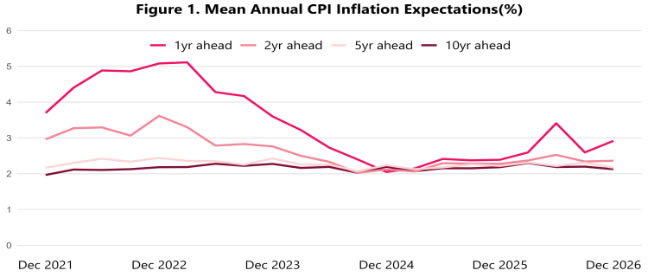
New Zealand’s one-year-ahead inflation expectations rose sharply from 2.60% to 2.92% in RBNZ’s November Survey of Expectations, approaching the upper boundary of the central bank’s 1–3% inflation target range. However, longer-term expectations remained relatively well anchored, suggesting that respondents anticipate more persistent near-term inflation without expecting price pressures to become permanently entrenched. Two-year-ahead expectations edged up from 2.34% to 2.36%, while five-year expectations declined from 2.31% to 2.17% and ten-year expectations eased from 2.20% to 2.13%. The divergence emerged despite annual CPI inflation slowing from 4.1% to 3.7% in Q3, indicating that respondents have become less confident about the pace of disinflation over the coming year.
Interest rate expectations also shifted higher. The mean expectation for the Official Cash Rate at the end of 2026 increased to 3.05%, compared with the current OCR of 2.75%, while the one-year-ahead expectation rose from 3.21% to 3.40%. The combination of higher near-term inflation and OCR expectations points to growing anticipation of additional monetary tightening, even as longer-term inflation expectations remain close to 2%. However, the figures represent survey forecasts from business leaders and professional forecasters rather than market-implied probabilities or RBNZ policy guidance. The central bank’s next Monetary Policy Statement is scheduled for December 9.
The broader economic outlook was mixed. One-year-ahead GDP growth expectations increased from 2.16% to 2.34%, while two-year expectations rose from 2.43% to 2.59%. Expected unemployment was unchanged at 5.24% over one year and eased from 4.90% to 4.85% over two years, while wage inflation expectations rose to 2.90% over one year but declined to 2.85% over two years. Meanwhile, housing expectations weakened substantially, with anticipated house price growth falling from 1.47% to 0.51% over one year and from 3.27% to 2.43% over two years. The survey therefore presents an economy expected to regain growth momentum while inflation concerns persist and the housing market remains subdued. The responses were collected between October 23 and 30, before the latest labour market release showed unemployment rising to 5.7%.
Data Summary — RBNZ Survey of Expectations (November 2026)
Inflation and Interest Rate Expectations
| Indicator | Current | Previous | Change |
|---|---|---|---|
| CPI inflation — 1 year | 2.92% | 2.60% | +32bps |
| CPI inflation — 2 years | 2.36% | 2.34% | +2bps |
| CPI inflation — 5 years | 2.17% | 2.31% | -14bps |
| CPI inflation — 10 years | 2.13% | 2.20% | -7bps |
| OCR — End-2026 | 3.05% | 2.73% | +32bps |
| OCR — 1 year | 3.40% | 3.21% | +19bps |
Economic and Housing Expectations
| Indicator | Current | Previous | Change |
|---|---|---|---|
| GDP growth — 1 year | 2.34% | 2.16% | +18bps |
| GDP growth — 2 years | 2.59% | 2.43% | +16bps |
| Unemployment — 1 year | 5.24% | 5.24% | 0bps |
| Unemployment — 2 years | 4.85% | 4.90% | -5bps |
| Wage inflation — 1 year | 2.90% | 2.78% | +12bps |
| Wage inflation — 2 years | 2.85% | 2.93% | -8bps |
| House price inflation — 1 year | 0.51% | 1.47% | -96bps |
| House price inflation — 2 years | 2.43% | 3.27% | -84bps |
Note: Expectations are survey means from 44 business leaders and professional forecasters, collected October 23–30, 2026. OCR figures represent respondents’ forecasts, not market-implied probabilities.
Key Takeaways
- Near-term inflation expectations jump: One-year expectations rose from 2.60% to 2.92%, while two-year expectations barely changed at 2.36%. Five- and ten-year expectations declined, indicating that longer-term inflation expectations remain relatively well anchored.
- Respondents anticipate further RBNZ tightening: The expected OCR at end-2026 increased to 3.05%, while the one-year outlook rose to 3.40%, compared with the current rate of 2.75%.
- Growth outlook improves, but housing weakens: One-year GDP growth expectations increased to 2.34%, while expected house price growth fell sharply to 0.51%, reflecting continued weakness in housing confidence.