


USD/JPY consolidated at 159.22 on Wednesday after rising modestly over the previous two sessions. The market has developed a balance of opposing factors: expectations of a Bank of Japan rate hike support the yen, while the prospect of further Fed policy tightening prevents the dollar from falling. Ahead of the US inflation release, no one is rushing to open new positions.
Inflationary pressure in Japan is growing. The producer price index for services rose 4.2% year-on-year in October after rising 3.8% a month earlier—the highest growth rate since 1990. Such dynamics add to the arguments in favour of a BoJ rate hike in December. An additional constraint on USD/JPY’s upside remains the likelihood of currency intervention by the Japanese authorities.
However, Japan’s monetary policy outlook for 2027 is not yet clear enough. A significant interest rate differential between the United States and Japan keeps carry trade operations attractive and limits the yen’s strengthening potential. In the US, markets are already fully pricing in a 25 basis point Fed rate hike in December and allowing the tightening cycle to continue early next year.
Another factor supporting the dollar is the deterioration in the geopolitical situation. Negotiations to resolve the US-Iran conflict have paused once again, and growing risks to shipping in the Strait of Hormuz and the Red Sea are drawing investors’ attention back to the prospect of energy-driven inflation.
Wednesday’s key event will be the release of the PCE index in the United States. Inflation figures above expectations could support the dollar, but the approach of USD/JPY towards the psychological 160.00 mark will simultaneously increase the risks of currency intervention. Under these conditions, room for steady upward growth remains limited.
Technical Analysis
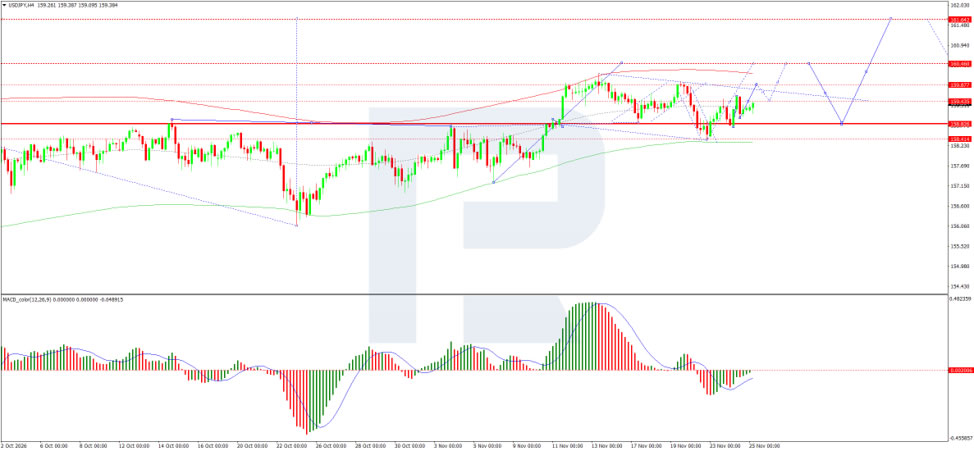
On the four-hour H4 chart of USD/JPY, the market formed a growth impulse to 159.57 and completed a correction to 159.00. The upward structure is currently developing with the formation of a consolidation range. The main scenario assumes continued growth following the completion of the local correction. In the event of an upside breakout of the 159.44 level, potential for the development of another growth wave towards 159.88 would open. Overcoming this resistance would allow for a continuation of the upward trend towards 160.46 as a local target. Technically, this scenario is confirmed by the MACD indicator, whose signal line is below zero and confidently pointing upwards. The reduction in the histogram’s negative values indicates a weakening of downward momentum and a gradual recovery in buying activity.
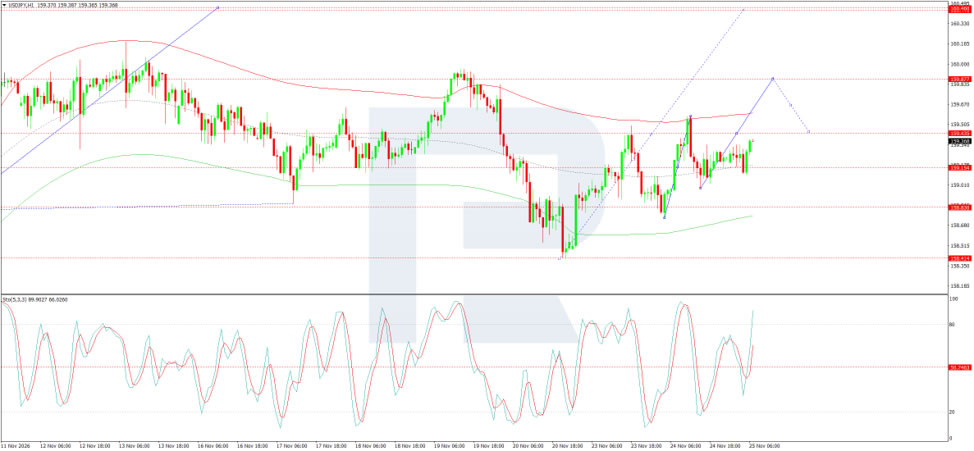
On the hourly H1 USD/JPY chart, the market is forming a compact consolidation range just below the 159.44 level. Today, an attempt to break the upper boundary of the range is expected, with the subsequent development of an upward wave towards 159.88. After reaching this mark, a corrective decline with a retest of 159.44 from above is possible. Holding this support would create the technical preconditions for continued growth towards 160.46. The Stochastic oscillator confirms the buyers’ advantage: its signal lines are above the 50 level and pointing upwards. At the same time, the fast line’s approach to the overbought zone allows for a short-term correction before the upward movement continues. The main condition for maintaining the positive scenario in the upcoming trading session is to hold support at 159.15 and consistently overcome the nearest resistance.
Conclusion
USD/JPY is consolidating near 159.22 as markets await the US PCE release, with opposing forces keeping the pair in balance. On one side, accelerating Japanese services inflation and expectations of a December BoJ hike support the yen, alongside the ever-present risk of intervention as the pair approaches 160.00. On the other, the wide US-Japan rate differential, fully priced-in December Fed tightening, and renewed geopolitical tensions in the Middle East continue to underpin the dollar. The PCE data will be the key catalyst: a strong reading could support the dollar but simultaneously heighten intervention risks near the psychological 160.00 level, limiting upside potential. Technically, the pair maintains an upward bias above support at 159.15, with resistance at 159.44 and targets at 159.88 and 160.46 if the breakout is confirmed. A short-term correction is possible given the Stochastic’s approach to overbought territory, but the broader structure remains constructive as long as key support holds.