


TL;DR: US equities rebounded sharply on Nvidia’s surge, but Fed expectations and Treasury yields have barely moved while Dollar keeps strengthening, so the rally looks more like a relief bounce than a confirmed end to the correction. S&P 500 needs to clear 7,350.34 to change that view, while Dollar Index’s channel breakout points higher.
Is the Nvidia-Led Rebound a Relief Rally or the End of the Equity Correction?
US equities staged a powerful rebound on Monday, led by Nvidia’s extraordinary recovery and a broader rally across technology shares. However, the improvement in equity sentiment has not been matched by a comparable reversal in Federal Reserve expectations or Treasury yields, while Dollar has continued strengthening. The divergence raises questions about how much has fundamentally changed following last week’s global selloff. For now, the rebound looks more like a relief rally than a confirmed end to the equity correction, even as Dollar’s technical outlook becomes more bullish.
S&P 500 surged 4.73%, recovering more than half of last week’s losses, while Nasdaq jumped 6.51% in its strongest session since April 2025. Dow also gained around 3%. The immediate catalyst was Nvidia’s reinstatement of Jensen Huang as CEO, sending its shares soaring 31.48% and triggering exceptional gains across semiconductor and memory stocks. The recovery extended beyond technology, with financials, miners and commodities also advancing, while VIX plunged nearly 26% to 26.61.
- S&P 500 +4.73%; Nasdaq +6.51% (strongest since April 2025); Dow about +3%
- Nvidia +31.48% after Jensen Huang’s reinstatement as CEO
- VIX down nearly 26% to 26.61
Follow the equity rebound, Fed pricing and Dollar on the ActionForex Telegram channel.
Nvidia Sparks Broad Rally, but S&P 500 Struggles to Extend Opening Gains
The scale of Monday’s advance was impressive, but its intraday structure offers a more cautious interpretation.
S&P 500 opened with a gap of approximately 4.6% above Friday’s close, accounting for almost its entire daily gain. After the initial surge, the index fluctuated widely but finished only marginally above its opening level.
The absence of sustained follow-through suggests the rebound was driven primarily by the initial reassessment of risk rather than an uninterrupted return of buying conviction throughout the session.
The recovery nevertheless had meaningful breadth. Semiconductor shares rallied sharply alongside Nvidia, while gains spread into financials, mining stocks and industrial commodities. The sharp retreat in volatility also indicated that immediate market stress had eased.
The improvement has continued into Tuesday’s Asian session, with South Korean and Japanese equities rebounding strongly. These developments strengthen the case that last week’s intense selling pressure is moderating, even if they do not yet confirm a durable market bottom.
The fundamental concerns behind the correction have also not disappeared. Questions surrounding technology valuations, AI investment returns and financing arrangements remain relevant despite Nvidia’s rebound. A single strong session cannot establish whether investors have completed the broader reassessment of equity risk.
Fed Base Case Holds Despite Shifting Policy Tail Risks
The monetary policy backdrop offers less evidence of a fundamental reversal.
Throughout last week’s equity selloff and Monday’s initial rebound, markets continued to regard a 25bps increase at Fed’s December 9 meeting as the overwhelmingly likely outcome.
The available CME FedWatch snapshot showed a 95.1% probability of a 25bps hike, compared with 88.6% in Friday’s comparison. At the same time, the probability of leaving rates unchanged fell from 11.4% to zero, while the possibility of a larger 50bps increase reappeared at 4.9%.
- 25bps hike: 95.1%, up from 88.6% in Friday’s comparison
- No change: 0%, down from 11.4%
- 50bps hike: 4.9%, reappearing after being absent
The important distinction is that the expected base-case decision has remained broadly intact, while probabilities attached to alternative outcomes have shifted more substantially.
Treasury yields tell a similarly restrained story.
US two-year yield recovered modestly on Monday but regained only a fraction of its decline during the previous week’s selloff. The 10-year yield also rose slightly, leaving the broader bond-market adjustment much smaller than the recovery in equities.
This contrast suggests that the sharp rebound in stock prices has not been accompanied by an equally substantial reassessment of the expected interest rate path.
While the modest recovery in short-term yields is consistent with firmer policy expectations, the available evidence does not support treating Monday’s equity rally as the beginning of a comprehensive reversal in monetary policy pricing.
Dollar Strength Persists Through Both Risk Aversion and Equity Recovery
Dollar presents an even more interesting divergence.
Dollar Index advanced during Monday’s equity rebound, closing around 104.32 after gaining ground throughout the US session. This followed its appreciation during the previous week’s severe equity correction.
Dollar has therefore strengthened through two contrasting market environments: falling equities accompanied by heightened risk aversion, and a powerful rebound accompanied by sharply lower volatility.
There are two plausible explanations, although the available evidence does not clearly establish which is dominant.
The first is the persistence of Fed tightening expectations. The reappearance of a larger December hike probability and the modest rise in two-year Treasury yields are consistent with some additional interest rate support for Dollar.
However, the relatively limited yield recovery makes it difficult to attribute the currency’s entire advance to monetary policy repricing.
The second possibility is that underlying demand for defensive Dollar exposure has persisted despite the equity rebound. Although VIX fell sharply on Monday, it remained elevated, and the previous week’s market turmoil may have left investors reluctant to abandon defensive positioning immediately.
Yet broad gains across equities and commodities, together with the substantial decline in volatility, weaken the case for describing Monday’s Dollar advance simply as another expression of risk aversion.
Neither explanation can be established from the latest session alone. The next few trading days should provide more useful evidence.
If Dollar continues strengthening alongside rising short-term Treasury yields and firmer Fed expectations, the interest rate explanation would gain support. Conversely, renewed Dollar gains during equity weakness, accompanied by rising volatility but stable or falling yields, would be more consistent with defensive demand.
A Dollar that holds firm even as volatility continues declining would also challenge the argument that its strength depends primarily on immediate risk aversion.
ActionForex’s Technical View: S&P 500, Rebound Capped Below 7,350.34
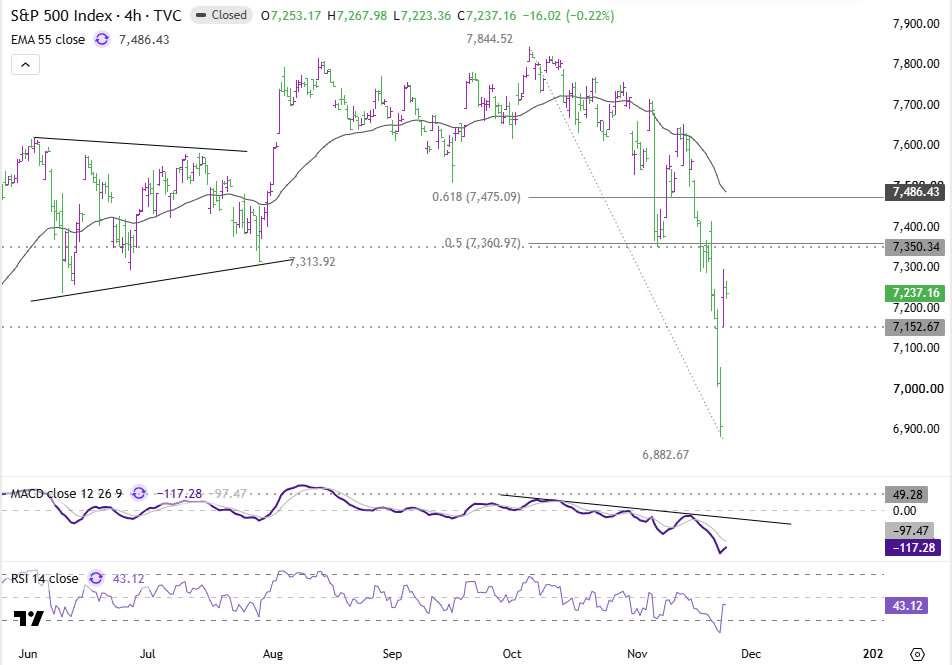
While the rebound from 6,882.67 was strong, upside is still capped below 7,350.34 support-turned-resistance. There was also no follow-through strength after the initial opening surge. The bounce is therefore tentatively seen as part of a consolidation pattern within the fall from 7,844.52.
A break below Monday’s low at 7,152.67 would solidify this interpretation and bring a retest of 6,882.67 into focus first.
Nevertheless, a firm break above 7,350.34 would begin to argue that the decline from 7,844.52 has completed. A further break of the 55-period EMA on the 4-hour chart would open the way toward retesting the 7,844.52 high.
The immediate technical question is whether Monday’s strong rebound can develop into a sustained recovery through resistance, or whether renewed selling will confirm that the broader corrective structure remains intact.
ActionForex’s Technical View: Dollar Index, Channel Break Targets 105.44
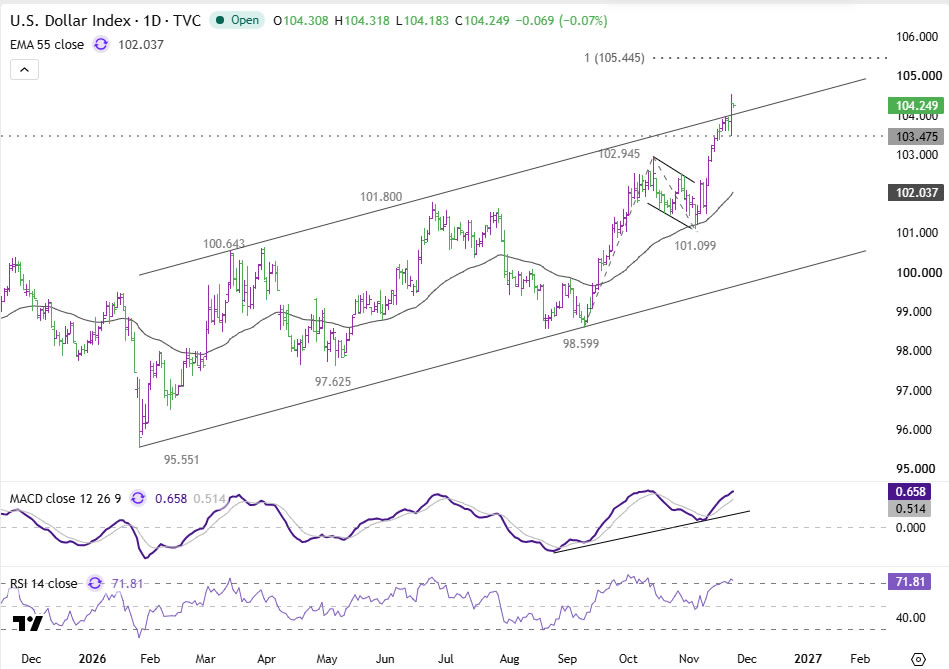
Dollar Index’s break above the medium-term rising channel ceiling on Monday suggests that the uptrend from the 95.55 low may be accelerating.
Further rise is expected toward the 100% projection of 98.59 to 102.94 from 101.09 at 105.44.
On the downside, a break below 103.47 support would bring consolidation first. However, the near-term outlook will remain bullish as long as 102.94 resistance-turned-support holds, even in the event of a retreat.
The technical contrast with S&P 500 is significant. While the equity index has yet to break the resistance needed to confirm that its decline has ended, Dollar Index has already moved above its medium-term rising channel.
Tuesday’s German ifo survey and US consumer confidence data could provide further evidence about economic conditions, while subsequent changes in Fed pricing and Treasury yields will help clarify the forces supporting Dollar.
The next decisive test is whether equities can extend their rebound through resistance while Dollar sustains its bullish breakout. If stocks falter but Dollar remains firm, the broader correction may still be shaping currency behavior. If both continue rising, attention will increasingly turn toward whether persistent Fed tightening expectations can explain Dollar’s strength independently of equity-market sentiment.
Key Takeaways
- S&P 500 gained 4.73% and Nasdaq 6.51% on Nvidia’s 31.48% surge, with VIX falling nearly 26% to 26.61, but S&P 500 finished only marginally above its roughly 4.6% opening gap.
- CME FedWatch showed a 95.1% chance of a 25bps hike on December 9 (88.6% on Friday), with a 4.9% chance of 50bps, while Treasury yields recovered only a fraction of last week’s decline.
- Dollar Index closed around 104.32 after strengthening through both the selloff and the rebound, so neither Fed expectations nor defensive demand alone clearly explains it.
- S&P 500 stays capped below 7,350.34, with 7,152.67 and 6,882.67 as downside levels, while Dollar Index targets 105.44 and stays bullish above 102.94.
- Tuesday’s German ifo survey and US consumer confidence, together with Fed pricing and Treasury yields, are the next tests.
Stay ahead of the equity rebound and Dollar’s breakout—join the ActionForex Telegram channel for regular market updates and analysis.