

TL;DR: Silver’s 15% plunge has left it lagging Gold badly. Restrictive Fed expectations weigh on both metals, but two pressures are specific to Silver: its sensitivity to the equity selloff and weakening demand. The key test is whether Silver can outperform Gold in the next sustained equity rebound, and the Gold/Silver ratio holding above 80.11 would show those pressures are still winning.
Why Is Silver Falling Faster Than Gold, and Will the Underperformance Continue?
Silver suffered another severe selloff last week, plunging 15.35% compared with Gold’s 8.91% decline, as the global equity correction intensified. The divergence pushed the Gold/Silver ratio from 79.67 to around 85.8, above its 2020–2025 average of approximately 82. Silver’s underperformance reflects three overlapping pressures: restrictive US interest rate expectations, greater sensitivity to deteriorating risk sentiment, and weakening demand that has eroded some of the fundamental support behind its earlier rally.
The metal is rebounding on Monday, rising 2.37% to around 42.20, compared with Gold’s 1.86% gain to 3,603.50. However, the advance follows a particularly damaging week that left Silver approximately 65% below its January record of 121.65, against a decline of around 36% for Gold from its own record.
The immediate question is whether improving risk appetite can help Silver stabilize, or whether persistent rate and demand pressures will continue limiting its recovery. Silver’s performance relative to Gold during the next sustained equity rebound could provide an important test of which forces are dominating.
Follow Silver, Gold and the Gold/Silver ratio on the ActionForex Telegram channel.
Restrictive Fed Expectations Weigh on Both Metals
The first pressure comes from US monetary policy. Elevated interest rates increase the opportunity cost of holding non-yielding precious metals, while expectations for further tightening can reinforce Dollar strength and constrain investment demand.
Markets continue to price another Fed rate increase at the December 9 meeting. CME FedWatch showed a 96.2% probability of a hike on Monday, up from 88.6% on Friday. Meanwhile, US two-year Treasury yield stood at 4.687% and the 10-year yield at 4.964%, while Dollar Index traded around 103.69.
- December 9 Fed hike probability: 96.2% (Monday), up from 88.6% (Friday)
- US 2-year yield: 4.687%; US 10-year yield: 4.964%
- Dollar Index: around 103.69
This restrictive monetary backdrop has weighed on both Gold and Silver. Yet interest rates alone cannot explain Silver’s much sharper recent losses.
Friday provided a clear example. Silver fell 3.84% despite a 10bps decline in the US 10-year Treasury yield and an 11.9bps fall in the two-year yield. Gold also weakened, but by a smaller 2.41%. Conversely, both metals are recovering on Monday even as Treasury yields edge higher.
These divergences suggest that rate expectations remain an underlying headwind rather than the sole driver of short-term price movements. A sustained decline in yields or a reduction in expected Fed tightening could improve the environment for both metals, but would not necessarily eliminate the factors specifically weighing on Silver.
Equity Selloff Amplifies Silver’s Vulnerability
Silver’s greater sensitivity to risk sentiment appears to have played an important role in the latest acceleration lower.
Friday’s Wall Street selloff saw Nasdaq plunge 5.28% and S&P 500 lose 3.70%, while VIX surged to 35.90. Industrially sensitive metals also came under pressure, with Copper declining 2.13% and Platinum falling 3.69%, alongside Silver’s 3.84% drop.
The divergence was even more pronounced over the full week. Nasdaq lost 10.02% and S&P 500 fell 8.61%, while Silver’s 15.35% decline substantially exceeded Gold’s 8.91% loss.
- Friday: Nasdaq −5.28%, S&P 500 −3.70%, VIX 35.90; Silver −3.84%, Copper −2.13%, Platinum −3.69%
- Week: Nasdaq −10.02%, S&P 500 −8.61%; Silver −15.35%, Gold −8.91%
Silver occupies a different position from Gold because of its significant industrial applications. Expectations for weaker economic growth can therefore weigh on its demand outlook at the same time that deteriorating risk appetite pressures commodity prices more broadly.
This combination makes Silver potentially more vulnerable than Gold when equity markets experience sharp corrections. The recent price movements are consistent with that interpretation, although they do not establish whether forced selling, positioning adjustments or particular investment flows drove the decline.
Monday’s market performance offers an early counterpoint. South Korea’s KOSPI is down 3.31% and Hong Kong’s Hang Seng has edged lower, while major European indexes are posting modest gains. Silver is also outperforming Gold during the rebound.
The next sustained move in equities will therefore be revealing. If risk sentiment improves and Silver consistently outperforms Gold, the recent divergence would look more consistent with an amplified reaction to the equity selloff. If Silver continues lagging even as equities stabilize, the more persistent pressures from interest rates, investment flows and physical demand would warrant greater attention.
Weakening Demand Creates a Longer-Running Headwind
Beyond financial-market volatility, Silver is also facing a deterioration in underlying demand that began well before the latest equity selloff.
According to Metals Focus estimates prepared for the Silver Institute and reported by Reuters on November 13, global Silver demand is expected to decline 5% in 2026 to approximately 1.08 billion ounces.
Industrial demand is projected to fall 3%, while jewellery consumption is expected to plunge 22% and silverware demand to decline 17%. Bar and coin investment is also estimated to decrease 2%.
- Total demand: −5% to about 1.08 billion ounces in 2026
- Industrial: −3%; jewellery: −22%; silverware: −17%; bar and coin investment: −2%
The weakness reflects different forces across end-use markets.
In jewellery and silverware, exceptionally high prices have discouraged purchases, particularly in India, where weaker rural spending has compounded affordability pressures. Consumers have increasingly shifted toward smaller and lighter products, while demand in China and the US has also been subdued.
These pressures are largely cyclical. With Silver now substantially below its January peak, improving affordability could eventually support a recovery in price-sensitive consumption. The magnitude and timing of any rebound, however, remain uncertain.
Industrial demand presents a different challenge. Solar installations have fallen short of earlier expectations, particularly in China, while January’s record Silver prices accelerated efforts to reduce the metal’s use through substitution. Unlike weaker jewellery consumption, some substitution in solar manufacturing could persist even after prices decline, potentially limiting the extent of future demand recovery.
Investment flows have also become less supportive. Silver exchange-traded products are estimated to have recorded net outflows of around 45 million ounces in 2026, following inflows of approximately 278 million ounces in 2025. Holdings stood near 1.25 billion ounces in early November, while US retail investment demand was reportedly at its weakest since 2010.
- Silver ETPs: net outflows of about 45 million ounces in 2026, after inflows of about 278 million ounces in 2025
- Holdings: near 1.25 billion ounces in early November
- US retail investment demand: reportedly weakest since 2010
At the same time, ETP selling, stock movements and a smaller physical-market deficit have helped ease the tightness that previously supported Silver prices.
The distinction between cyclical consumption weakness and more persistent industrial substitution is important for the outlook. Lower prices could revive some demand, but a durable recovery would also need to contend with changing industrial usage and investment appetite.
The 2026 estimates establish the direction of demand deterioration during the year. They do not, by themselves, demonstrate that consumption will continue falling in 2027.
What Could Reverse Silver’s Underperformance?
The next phase will depend on how the three pressures interact rather than whether any single factor changes.
A sustained improvement in equity markets, accompanied by easing volatility, could provide the most immediate support for Silver. Its larger recent losses also leave room for a relatively strong rebound if risk appetite recovers.
However, a rebound in Silver’s absolute price would not necessarily signal an end to its underperformance against Gold.
If equities recover but the Gold/Silver ratio continues rising, it would suggest that improving risk sentiment is insufficient to offset the remaining headwinds. Conversely, sustained Silver outperformance and a declining ratio would indicate that some of the pressure associated with the equity correction is easing.
US flash PMI data later Monday and Wednesday’s core PCE inflation release could influence the broader growth and interest rate outlook. The US equity session will provide a more immediate test of risk appetite after Friday’s severe selloff.
The interaction between these developments matters. Weaker economic data could support precious metals through lower yields, while simultaneously raising concerns about Silver’s industrial demand. Similarly, an equity rebound could improve Silver’s relative performance even if expectations for restrictive Fed policy remain intact.
ActionForex’s Technical View: Gold/Silver Ratio, Bullish Above 80.11 With 92.05 Next
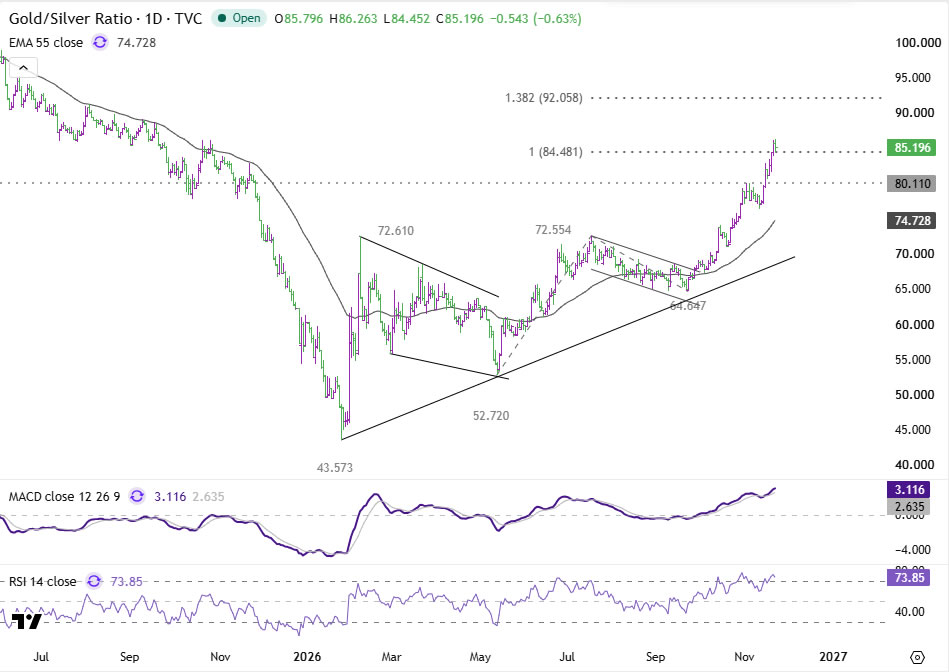
Gold/Silver ratio’s uptrend continued last week and broke through the 100% projection of 52.72 to 72.55 from 64.64 at 84.48.
Despite overbought conditions in daily RSI, there is no clear sign of topping yet. Even in case of consolidation, the outlook will remain bullish as long as 80.11 resistance-turned-support holds.
The next target is the 138.2% projection at 92.05.
This suggests Silver’s underperformance relative to Gold is likely to continue and could intensify if risk sentiment deteriorates further.
The ratio also provides a useful test during any equity-market recovery. A sustained retreat would indicate improving relative performance for Silver, but a break below 80.11 would be needed to weaken the immediate bullish outlook.
ActionForex’s Technical View: Silver, Downtrend Could Extend Toward 36.56
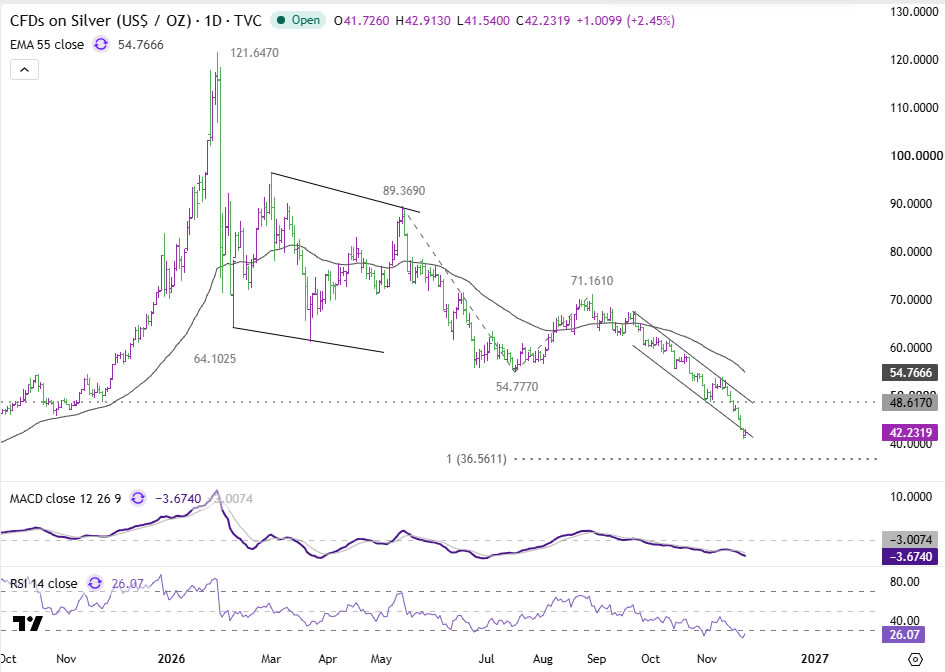
Silver’s medium-term downtrend continued last week and briefly breached the floor of its falling channel.
Oversold conditions in daily RSI, currently around 26, might stabilize the selloff temporarily. The immediate question is whether Silver can consolidate around the channel boundary or whether selling pressure will accelerate through that support decisively.
However, even in case of recovery, the outlook will remain bearish as long as 48.61 support-turned-resistance holds.
The next downside target is the 100% projection of 89.36 to 54.77 from 71.16 at 36.56. The principal uncertainty is how quickly Silver might reach this objective, rather than whether the current decline has already established a durable bottom.
Taken together, the two technical structures reinforce the broader macro assessment. Silver could stage a substantial oversold rebound if equity sentiment improves, but a sustained recovery would need to overcome both its own bearish price structure and the continuing relative strength of Gold.
The most revealing test may come during the next sustained equity recovery. If Silver still struggles to outperform Gold when risk appetite improves, restrictive rate expectations and weaker demand would become more prominent obstacles to a durable turnaround.
Silver’s next sustained rebound may therefore prove more informative than another selloff. If improving equity sentiment is accompanied by persistent Silver weakness relative to Gold, the combination of restrictive interest rate expectations and weaker demand would remain a substantial obstacle to a durable recovery.
Key Takeaways
- Silver fell 15.35% last week against Gold’s 8.91%, lifting the Gold/Silver ratio from 79.67 to about 85.8, above its 2020–2025 average of roughly 82.
- Three pressures are at work: a 96.2% chance of a December 9 Fed hike, Silver’s sensitivity to the equity selloff (Nasdaq −10.02%, VIX 35.90), and 2026 demand forecast to fall 5% to about 1.08 billion ounces.
- Silver’s Monday rebound of 2.37% to around 42.20 still leaves it about 65% below its January record of 121.65.
- The Gold/Silver ratio stays bullish above 80.11, with 92.05 as the next target; Silver stays bearish below 48.61, with 36.56 as the next downside target.
- US flash PMI data, Wednesday’s core PCE release and a sustained equity rebound are the next tests of whether Silver can outperform Gold.
Stay ahead of Silver’s next move against Gold—join the ActionForex Telegram channel for regular market updates and analysis.