


Eurozone Economic Sentiment Indicator (ESI) fell from 96.5 to 95.8 in November, missing market expectations of 97.2, according to the European Commission’s latest business and consumer survey. The decline reflected worsening industrial confidence, while services and consumer sentiment remained broadly stable. More concerningly, employment expectations deteriorated sharply, suggesting that businesses are becoming increasingly cautious about hiring as the economic outlook weakens. The ESI remained below its long-term average of 100, pointing to continued subdued confidence across the region.
Industrial confidence deteriorated from -3.6 to -5.1, significantly below expectations of -3.3, as manufacturers reported weaker production expectations and less favorable assessments of finished-goods inventories. Export-order assessments and recent production trends also worsened, reinforcing concerns about industrial activity. Services confidence was unchanged at 4.8, slightly below the 5.0 forecast, while consumer confidence held at -16.9. Across the broader EU, sentiment declined from 96.5 to 96.0, driven mainly by weakness in industry and construction. Among major economies, confidence deteriorated notably in Italy (-3.1 points) and France (-2.3), while Germany registered a modest improvement (+0.4).
The deterioration extended to employment expectations, with the Eurozone Employment Expectations Indicator falling from 98.1 to 96.8, a sharper decline than the broader EU’s drop from 98.5 to 97.9. EU-wide hiring plans weakened in industry and services, partially offset by improvements in retail trade and construction. Meanwhile, consumers’ inflation expectations for the coming year fell sharply, although business selling-price expectations remained significantly above historical averages across all surveyed sectors. The combination of softer hiring intentions, persistent industrial weakness and uneven price expectations suggests that the Eurozone economy is struggling to regain momentum, with limited evidence of a broad-based improvement in business confidence.
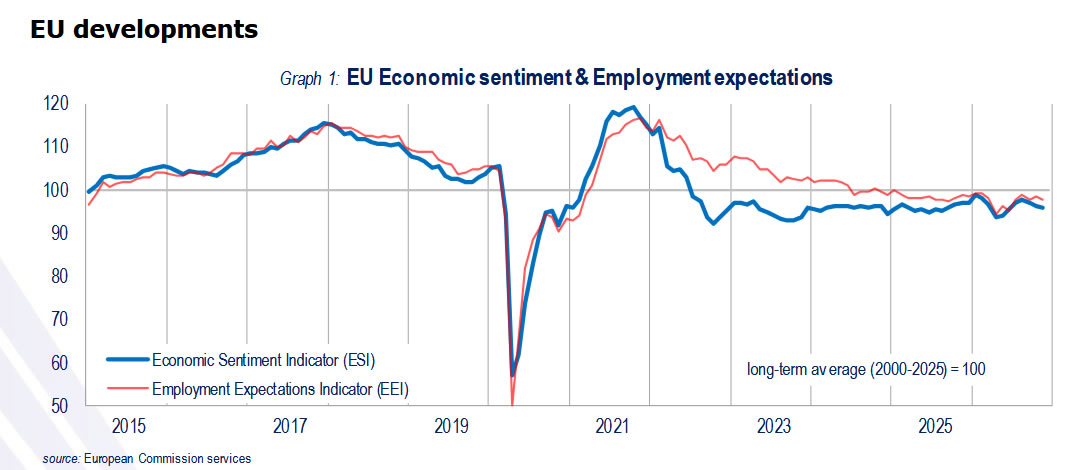
Data Summary — Eurozone and EU Sentiment, November 2026
Eurozone Sentiment Indicators
| Indicator | Nov | Exp. | Oct |
|---|---|---|---|
| Economic Sentiment Indicator | 95.8 | 97.2 | 96.5 |
| Industrial Confidence | -5.1 | -3.3 | -3.6 |
| Services Confidence | 4.8 | 5.0 | 4.8 |
| Consumer Confidence | -16.9 | -16.9 | -16.9 |
| Employment Expectations Indicator | 96.8 | — | 98.1 |
EU-Wide Indicators
| Indicator | Nov | Oct |
|---|---|---|
| Economic Sentiment Indicator | 96.0 | 96.5 |
| Employment Expectations Indicator | 97.9 | 98.5 |
Major EU Economies — Monthly ESI Changes
| Country | Change |
|---|---|
| Netherlands | +2.6 |
| Germany | +0.4 |
| Spain | -0.3 |
| Poland | -0.7 |
| France | -2.3 |
| Italy | -3.1 |
Source: European Commission, Business and Consumer Surveys, November 27, 2026. Both ESI and Employment Expectations Indicator have a long-term average of 100.
Key Takeaways
- Eurozone Economic Sentiment fell from 96.5 to 95.8 in November, missing expectations of 97.2, as industrial confidence deteriorated sharply from -3.6 to -5.1.
- Employment expectations weakened across both the Eurozone and EU, with the Eurozone indicator dropping from 98.1 to 96.8, signaling growing caution over future hiring.
- Services and consumer confidence remained broadly stable, while France and Italy recorded notable sentiment declines. Elevated business selling-price expectations added to the mixed economic outlook.