TL;DR: The US-Canada trade dispute has escalated from tariffs to import bans and procurement exclusions, yet USD/CAD is sitting near 1.38 rather than breaking sharply higher — because the new measures are economically modest and well-telegraphed, while Brent near $100 is giving the Canadian Dollar a far larger, more immediate counterweight.
The Trade War Is Getting Nastier. USD/CAD Is Not.
The US-Canada confrontation crossed another line this week. Tariffs have been joined by planned import bans, Canadian products face exclusion from major US government contracts, and senior officials are increasingly trading rhetoric that sounds political and personal rather than merely commercial. Yet USD/CAD is sitting near 1.38 rather than breaking sharply higher.
That disconnect is the real story. The escalation is genuine, but markets have specific reasons not to treat it as a new currency regime. The latest restrictions are economically modest, don’t begin for several weeks, and arrive after months of well-telegraphed tit-for-tat measures. More importantly, Brent near $100 is giving the Canadian Dollar a much larger and more immediate counterweight.
Tuesday Took the Dispute Beyond Tariffs
Canada moved first on Tuesday, implementing retaliatory tariffs of 15%, 25%, and 50% across C$27.6bn of US goods. Steel and aluminum duties were doubled to 50%, while a broad range of agricultural, industrial, and consumer products was also targeted. Ottawa backed the measures with C$5.42bn in support for affected firms and workers.
Washington answered with three separate moves. Selected Canadian imports will be banned from September 29, parts of the tariff list were adjusted, and the US government was directed to exclude Canadian products from large, long-term procurement contracts until Washington sees greater reciprocity.
That’s qualitatively more serious than another tariff increase. A tariff raises the price of trade; a ban says some trade shouldn’t occur at all.
But the scale matters just as much as the symbolism. A senior White House official put the targeted imports at only single-digit billions of dollars annually and indicated the categories were chosen where domestic US supply or alternatives were readily available. In other words, Washington designed a measure capable of looking forceful without necessarily creating a correspondingly large immediate economic shock.
The Rhetoric Is Escalating Faster Than the Trade Flows
Politics is moving faster than the underlying numbers. US Treasury Secretary Scott Bessent’s description of Canada as a “little yippy dog,” USTR Jamieson Greer’s earlier comparison with China as another country willing to retaliate, and increasingly provocative official messaging all point to a dispute becoming more personal. That matters because compromise can become harder politically once leaders and officials frame the confrontation around sovereignty and national standing rather than tariff schedules alone.
Prime Minister Mark Carney is doing exactly that from the Canadian side. He has said Canada can “pivot and prosper” and should build an economy in which no other country can “hold us hostage.” A Canadian official went further, saying Ottawa’s strategy would survive even a US “nuclear response.”
Yet this hardening doesn’t automatically translate into a weaker Canadian Dollar. Carney’s domestic approval has risen sharply, while US polling shows little enthusiasm for tariffs on Canada. That may give Ottawa more political room to stand firm and place greater eventual pressure on Washington to reconsider, but for FX this remains background rather than an immediate directional catalyst.
Markets Aren’t Ignoring the Trade War. They’re Ranking It.
USD/CAD’s muted response becomes much easier to understand when the latest measures are put in context. The first reason is economic scale — the new US bans affect single-digit billions of dollars in trade, much smaller than the wider packages already imposed. The second is timing: September 29 leaves plenty of room for negotiation before anything is actually prohibited. The third is that the market has seen months of threats, retaliation, and advance warnings. Additional escalation therefore carries less surprise than it once would have.
Then there’s oil. Brent has spent this week around the $100 area as Middle East supply risks intensified. For the Canadian Dollar, that’s a much larger immediate macro variable than a new trade restriction affecting several billion dollars of goods three weeks from now.
Tuesday provided a useful demonstration. CAD became the strongest major currency while Brent surged — even as Canada’s own retaliatory tariffs formally took effect. On Wednesday it surrendered some of those gains despite oil remaining elevated. The relationship isn’t mechanical, but the daily pattern still points to a currency trading energy more actively than trade-war headlines.
The market isn’t ignoring Ottawa and Washington. It’s simply ranking oil above them.
ActionForex’s Technical View on USD/CAD: The Chart Isn’t Showing a Trade-War Breakout Either
USD/CAD’s technical structure tells essentially the same story. The pair is holding in a tight range close to the 1.3776 temporary low for now.
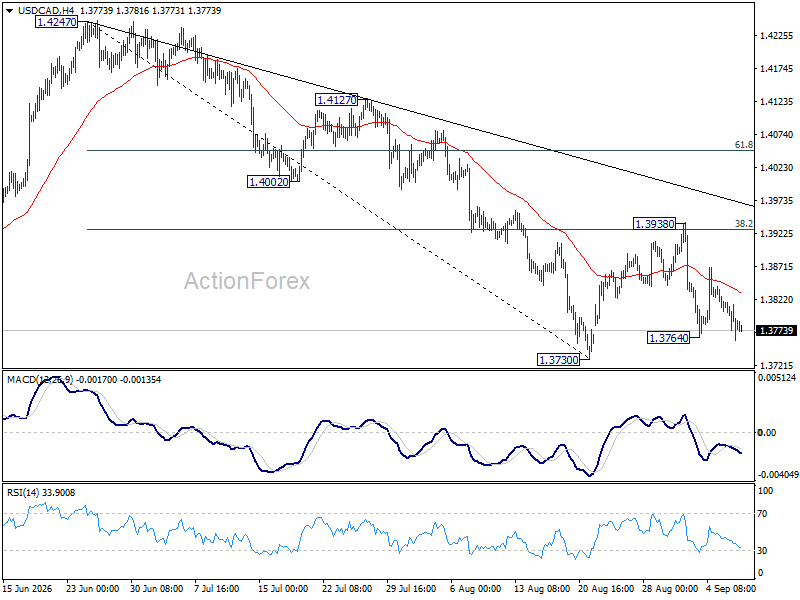
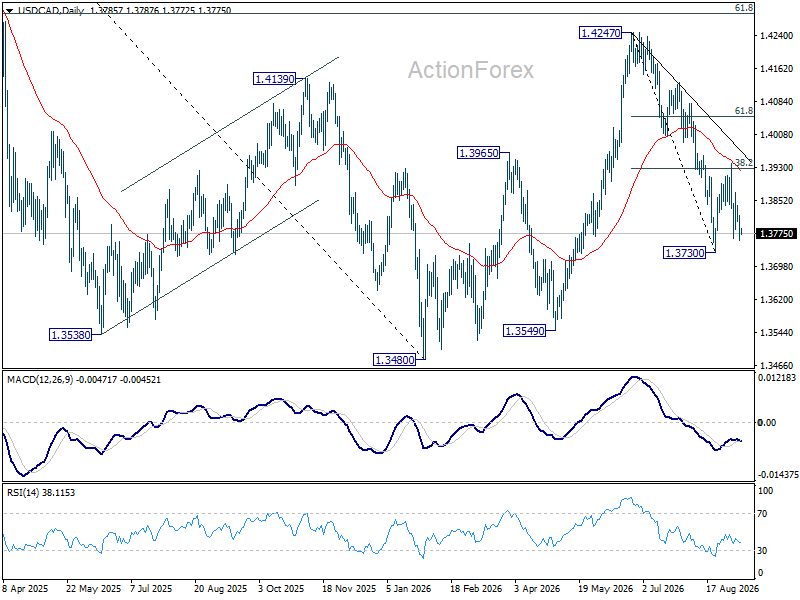
The pair previously rebounded from 1.3730 but was rejected at 1.3938, right on top of a significant resistance cluster. The 55-day EMA currently sits near 1.3920, while the 38.2% retracement of 1.4247 to 1.3730 is at 1.3927. That rejection matters because it leaves the entire decline from 1.4247 intact.
The four-hour picture has since turned lower again. Price is approaching 1.3764, followed by the 1.3730 low, while the MACD remains negative and RSI is around 34. Momentum therefore favors another test of 1.3730, although proximity to the previous low means the next break still needs confirmation rather than assumption.
The near-term bearish view would change first on a firm break above 1.3938 resistance. Such a move would clear not only the recent rebound high but also the 55-day EMA and 38.2% retracement cluster, raising the possibility the decline from 1.4247 has already run its course.
Breaking 1.3730 Would Be Bearish, but Not Yet a Bigger Trend Signal
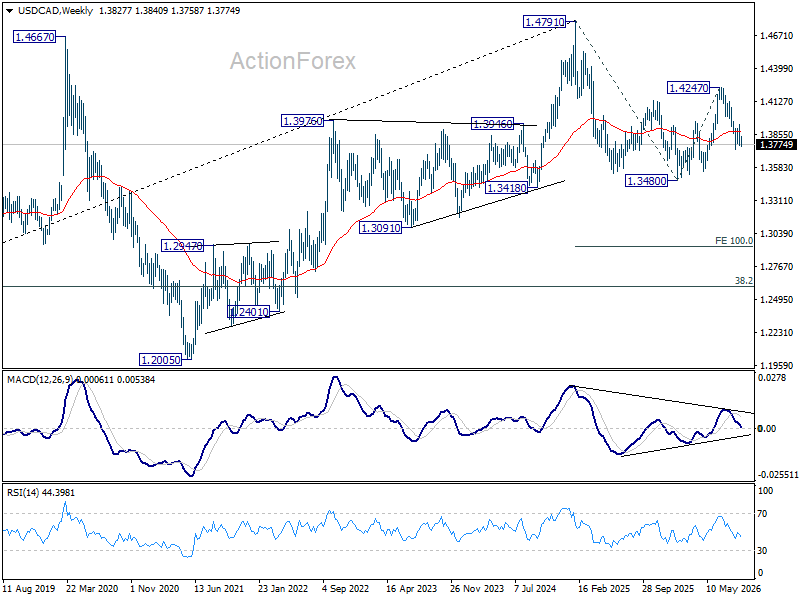
A firm break below 1.3730 would extend the decline from 1.4247 and bring 1.3480 back into focus. But that wouldn’t automatically mean the long-term decline from the 1.4791 (2025 high) is resuming.
The rebound from 1.3480 to 1.4247 unfolded as a three-wave move. Based on the current momentum and weekly structure, the preferred interpretation is that the subsequent decline from 1.4247 is another leg within the larger corrective pattern that began at 1.3480.
That makes 1.3480 much more important than 1.3730 from a medium-term perspective. The former is expected to provide substantial support and potentially set the stage for a durable rebound.
September 29 Is the First Real Test
The trade conflict still has plenty of capacity to become more important for CAD. September 29 will show whether the new US bans actually take effect or become bargaining chips in renewed negotiations. If they’re implemented unchanged, the dispute will have moved another step from announcements toward actual disruption.
A much larger test sits further out. Trump’s threatened 50% tariff on Canadian cars, trucks, auto parts, and steel from January 1, 2027 remains on the table. Formalizing that threat would dramatically increase the economic stakes compared with the narrowly targeted bans announced this week.
Oil may determine how strongly CAD responds if that happens. Elevated Brent is currently cushioning the currency against deteriorating bilateral relations. If oil falls sharply while the trade conflict continues to intensify, that protection disappears.
For now, though, USD/CAD is sending a clear message. The US-Canada relationship has worsened much faster than the currency pair has moved. Until the economic scale of the dispute increases — or oil stops providing CAD with an offset — the trade war may remain much louder politically than it is in FX.
Key Takeaways
- The US-Canada dispute escalated from tariffs to import bans and procurement exclusions this week, but the new measures affect only single-digit billions in trade, not a broad economic shock.
- USD/CAD’s muted reaction reflects markets ranking the trade war below oil, since Brent near $100 is a much larger immediate variable for the Canadian Dollar.
- USD/CAD was rejected at 1.3938 resistance (the 55-day EMA and 38.2% retracement cluster), keeping the decline from 1.4247 intact and favoring another test of 1.3730.
- A break below 1.3730 would extend the decline toward 1.3480, but that level, not 1.3730, is the more important medium-term support given the broader corrective structure since 2025.
- September 29 tests whether the new US bans take effect as planned, while Trump’s threatened 2027 auto-and-steel tariff represents a far larger stake still on the table.