


TL;DR: USD/JPY is testing 157.11 as one widening policy differential, not two separate stories—the Fed is accelerating into a new tightening phase while the BoJ’s divided vote reduced the odds of a back-to-back hike, both reinforcing the same Dollar-favorable repricing.
USD/JPY’s rise this week is best understood as one widening policy differential with two reinforcing legs. The Federal Reserve is accelerating into a new tightening phase, while the Bank of Japan’s divided rate decision reduced the already-small probability of another increase at its next meeting. The pair is now testing 157.11, the precise technical level where the market must decide whether that combined repricing has enough force to extend toward the politically sensitive 160 area.
Fed Follow-Up Risk Continues to Rise
The Fed side of the differential remains active. Wednesday’s unanimous rate increase was accompanied by a hawkish set of projections, while the Dollar Index subsequently completed a double-bottom reversal. The full FOMC and SEP implications are covered in Dollar Index Completes Double Bottom, Targets 100.59 as Markets Look Beyond Fed’s 4.1% 2027 Median.
The fresh development is that the probability of another Fed increase on October 28 has climbed to 53% from 27.2% one week ago. Markets are therefore not treating Wednesday’s move as an isolated adjustment. The US side of the USD/JPY differential continues to widen as investors assign greater weight to consecutive tightening.
BoJ Delivers a Hike but Reveals a Three-Way Split
The BoJ raised its short-term policy rate by 25bp to 1.25%, its highest since 1995, effective September 24. The decision passed by a 7–2 vote, while the statement retained a tightening bias. The Bank said underlying CPI inflation was approaching 2%, warned it could overshoot the target, and pledged to continue raising rates as economic activity, prices, and financial conditions evolved.
The composition of the vote was more important than the headline increase. Policy Board members Toichiro Asada and Ayano Sato, both reflationist appointees of Prime Minister Sanae Takaichi’s administration, opposed the hike. Asada pointed to core inflation below 2% and questioned whether the economy was strong enough to absorb another increase. Sato argued economic and price conditions hadn’t accelerated sufficiently to justify tightening.
The board wasn’t divided along a simple hawk-versus-center line. Policy Board members Hajime Takata and Naoki Tamura supported the hike but objected to the BoJ’s inflation description because they believed underlying inflation had already reached a level consistent with the 2% target. The result was a genuine three-way split: two members opposed tightening, a central majority supported the official assessment, and two supporters considered that assessment insufficiently hawkish.
Immediate Follow-Up Risk Fades, but Normalization Continues
Before the decision, the possibility of another hike at the October 30 meeting was already only a tail risk, reportedly carrying around 10–15% probability. The two dovish dissents further reduced that possibility rather than reversing an established expectation for consecutive tightening.
The distinction matters. The BoJ hasn’t abandoned normalization. September’s hike came only three months after June’s move, compared with the six-month interval before that. The realized pace has already accelerated to approximately one hike per quarter. What markets downgraded was the possibility of an even faster, back-to-back move at the next meeting.
The statement also identified AI-related demand, alongside high oil prices and Yen depreciation, as a source of inflation pressure. Rising semiconductor and goods costs are expected to help push core inflation clearly above 2% from the second half of fiscal 2026, echoing broader concerns raised by other central banks about the near-term inflationary effects of the AI investment boom.
Yen and JGBs Reflect the Market’s Interpretation
Yen weakened after the decision, while the 10-year Japanese government bond yield fell 4.9bp to 2.947%. Both reactions showed markets treated the divided board and reduced risk of an immediate follow-up hike as more informative than the delivered 25bp increase.
That reaction reinforced the same direction of travel as the Fed repricing. Rising odds of another US hike and fading risk of consecutive BoJ tightening both widened the near-term policy differential in the Dollar’s favor. USD/JPY’s rebound is therefore not two central-bank stories coincidentally landing in the same week. It’s one relative-rate trade expressed through two policy developments.
ActionForex’s Technical View on USD/JPY: First 157.11, Then the Road Toward 160
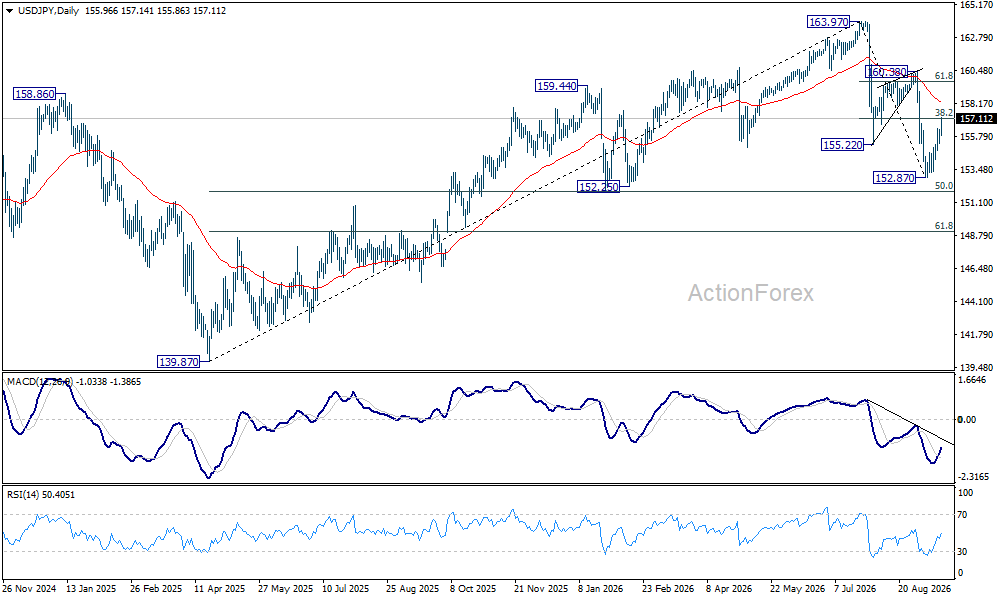
USD/JPY has reached 157.11, the 38.2% retracement of the decline from 163.97 to 152.87. A decisive break would suggest the fall from 163.97 has completed as a three-wave corrective move to 152.87, on a bullish divergence condition in the 4H MACD.
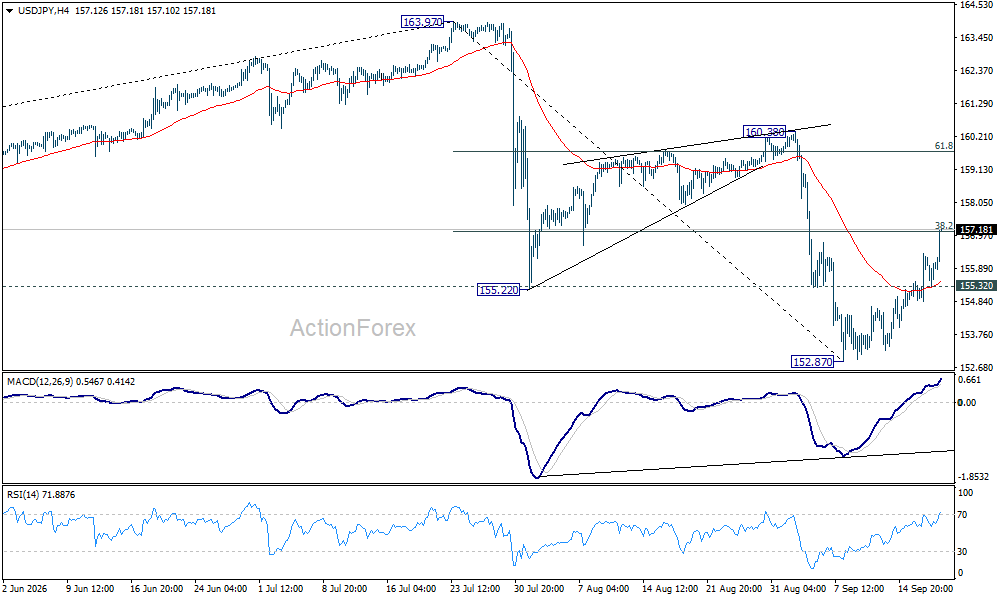
That came after finding support slightly above a key confluence level, the 152.25 structural support and 50% retracement of 139.87 to 163.97 at 151.92.
In this case, the next target will be the 55-day EMA, now at 158.72. A break there would put the 61.8% retracement of 163.97 to 152.87 at 159.72 in focus—that is, the 160 intervention zone.
Though rejection by 157.11, followed by a break of 155.32 support, would bring a deeper fall back to the 152.87 low instead.
Key Takeaways
- USD/JPY’s rise reflects one widening policy differential, not two separate stories: rising Fed hike odds and fading risk of a back-to-back BoJ hike both point the same direction.
- October Fed hike odds jumped from 27.2% to 53% in a week, confirming markets see Wednesday’s hike as the start of consecutive tightening, not an isolated move.
- The BoJ’s 7-2 vote revealed a genuine three-way split: two reflationist dissenters opposed the hike, while two hawkish supporters wanted an even more explicit inflation warning.
- The BoJ’s realized pace has already accelerated to roughly one hike per quarter; what faded was only the tail risk of an immediate follow-up hike in October, not normalization itself.
- USD/JPY faces 157.11 as the first test; a break opens 158.72 and then 159.72 (the 160 intervention zone), while rejection and a break of 155.32 would instead point back toward 152.87.





