China’s Caixin PMI services rises to 52.1, composite falls to 51.2

    China’s Caixin PMI Services increased from 51.2 to 52.1 in July, surpassing the expected 51.4 and remaining in expansionary territory for the 19th consecutive month. Meanwhile, PMI Composite fell from 52.8 to 51.2, but still marking the ninth consecutive month of expansion.

    Wang Zhe, Senior Economist at Caixin Insight Group, noted that while the services sector saw improvement, manufacturing faced greater pressure. “The former outperformed the latter in terms of supply, demand and employment,” Wang said. Despite this, composite prices remained weak, especially on the sales front, which further squeezed company profit margins. Market optimism improved, although it remained at a low level.

    The latest data revealed that China’s real GDP growth in Q2 slowed to 4.7% yoy, significantly lower than market expectations. This slowdown suggests that it will be challenging for the country to meet its annual growth target of around 5%. Wang said the primary issues remain insufficient effective domestic demand and weak market optimism.

    Full China Caixin PMI services release here.

    Japan’s PMI services finalized at 53.7, concerns on sustained inflationary pressure

      Japan’s PMI Services was finalized at 53.7 in July, up from June’s 49.4. PMI Composite was finalized at 52.5, up from June’s 49.7.

      Usamah Bhatti, Economist at S&P Global Market Intelligence, highlighted a “renewed upswing” in the services sector at the start of Q3, driven by “improved demand conditions and stronger customer numbers.” This growth was largely domestic, as new export business declined for the first time this year. The outlook for the service sector remains positive, with outstanding business levels increasing and strong confidence in the 12-month outlook.

      While the combined output of the manufacturing and services sectors expanded at a “moderate pace,” the growth was primarily driven by the service sector, with manufacturing experiencing a slight contraction. Private sector companies reported that input price inflation remained “stubbornly high,” affecting total output. There are concerns that “sustained inflationary pressure” could pose a downside risk to the economy in the coming months.

      Full Japan PMI services final release here.

      US non-farm payrolls grow 114k in Jul, unemployment rate rises to 4.3%

        US non-farm payroll employment grew only 114k in July, well below expectation of 176k. That’s all well below average monthly gain of 215k over the prior 12 months.

        Unemployment rate jumped from 4.1% to 4.3%, above expectation of 4.1%. Participation rate ticked up by 0.1% to 62.7%.

        Average hourly earnings rose 0.2% mom, below expectation of 0.3% mom. Annual wages growth slowed from 3.8% yoy to 3.6% yoy, below expectation of 3.7% yoy.

        Full US non-farm payroll release here.

        Swiss CPI at -0.2% mom, 1.3% yoy in Jul, matches expectations

          Swiss CPI fell -0.2% mom in July, matched expectations. Core CPI (excluding fresh and seasonal products, energy and fuel) fell -0.3% mom. Domestic product prices rose 0.2% mom. Imported products prices fell -1.3% mom.

          For the 12-month period, CPI was unchanged at 1.3% yoy, matched expectations. Core CPI was unchanged at 2.0% yoy. Domestic product prices growth was unchanged at 2.0% yoy. Import product prices growth deepened from -0.8% yoy to -1.0% yoy.

          Full Swiss CPI release here.

          Market anxiety drives US 10-year yield under 4%, eyes on crucial NFP

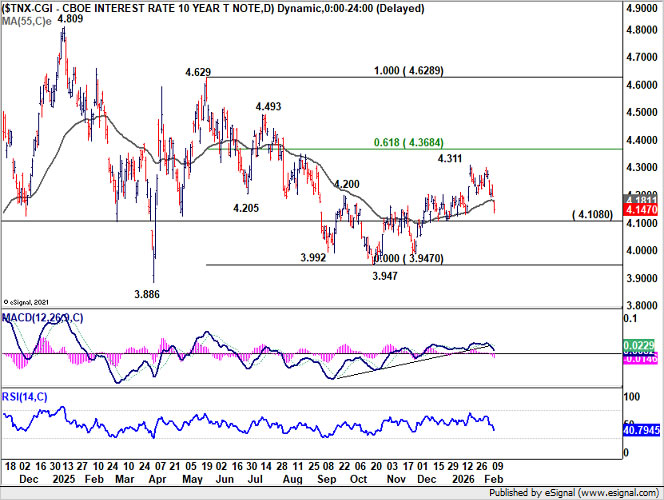
            US benchmark 10-year yield plummeted overnight, breaking below 4% mark for the first time since February, signaling heightened investor anxiety. This sharp decline came amidst a broad market sell-off, with DOW dropping nearly -500 points, or -1.21%, and even the small-cap Russell 2000 index plunging -3%.

            The rise in initial jobless claims to their highest level since August last year contributed to the risk-off sentiment. However, the more pressing concern for investors was the dismal ISM manufacturing report, with PMI falling deeper into contraction, and production and employment falling to their lowest levels since mid-2020.

            The market’s reaction to these reports has shifted expectations towards more aggressive monetary easing. Investors are now starting to bet on a 50bps rate cut by Fed in September, with the probability of such a cut now around 30%. However, rather than cheering the potential for fast monetary easing, investors seem more concerned about a looming recession.

            This development heightens the importance of today’s non-farm payroll report. Headline jobs are expected to grow by 176k in July, with the unemployment rate remaining unchanged at 4.1%. Meanwhile, average hourly earnings are anticipated to grow by 0.3% month-over-month.

            Given the current sentiment, markets may react more strongly to any significant miss in the headline job growth number, which could signal a worse-than-expected slowdown in the employment market. In comparison, the unemployment rate and wage growth, which are more indicative of inflationary pressure, might take a back seat.

            Technically, 10-year yield’s (TNX) strong break of near term falling channel indicates downside acceleration. More importantly, the bearish case is strengthening that fall from 4.737 is the third leg of the pattern from 4.997 top. Near term outlook will stay bearish as long as 4.292 resistance holds. Next target is 3.785 low. Break there will target 100% projection of 4.997 to 3.785 from 4.737 at 3.525.

            As for Russell 2000, yesterday’s steep fall and breach of 2176.47 support suggests that a short term top is already in place at 2299.99. This came after just missing 61.8% projection of 1633.66 to 2135.45 from 1993.22 at 2303.32. Sustained break of 2176.47 would set the stage for deeper correction to 55 D EMA (now at 2116.13) and possibly further to 38.2% retracement of 1633.66 to 2299.99 at 2045.45.

            US ISM manufacturing drops to 46.8, reflecting deepening contraction

              US ISM Manufacturing PMI dropped from 48.5 to 46.8 in July, falling below the expected 48.8. This marks the fourth consecutive month of contraction for the manufacturing sector, with the decline accelerating.

              New orders fell from 49.3 to 47.4, indicating that demand has not seen consistent growth since May 2022. Production also decreased significantly, dropping from 48.5 to 45.9, the lowest performance since May 2020. Employment saw a sharp decline from 49.3 to 43.4, reaching its lowest level since June 2020. Prices, however, rose slightly from 52.1 to 52.9.

              Timothy Fiore, Chair of the ISM Manufacturing Business Survey Committee, commented, “After breaking a 16-month streak of contraction by expanding in March, the manufacturing sector has contracted the last four months, and at a faster rate in July.” Notably, none of the six biggest manufacturing industries registered growth in July.

              Historically, the relationship between the Manufacturing PMI and the overall economy suggests that the July reading of 46.8 corresponds to a change of plus-1.2 percent in real GDP on an annualized basis.

              Full US ISM manufacturing release here.

              BoE cuts Bank Rate by 25bps to 5.00% in 5-4 tight vote

                BoE cut the Bank Rate by 25 bps to 5.00% today, in a closely contested 5-4 vote. Governor Andrew Bailey, Deputy Sarah Breeden, new Deputy Clare Lombardelli, known dove Swati Dhingra, and Dave Ramsden voted in favor of the cut. Chief Economist Huw Pill, Megan Greene, Jonathan Haskel, and Catherine Mann voted against the change.

                In the accompanying statement, BoE stated it is now “appropriate to reduce slightly the degree of policy restrictiveness.” The central bank noted that the impact of past external shocks “has abated” and there has been “some progress” in moderating inflation risks.

                Despite the cut, BoE emphasized that restrictive policy will continue to weigh on economic activity, leading to a looser labor market and reducing inflationary pressures.

                Full BoE statement here.

                UK manufacturing PMI finalized at 52.1, inflation pressure moving to manufacturing sector

                  UK PMI Manufacturing was finalized at 52.1 in July, up from June’s 50.9. Production growth was the fastest since February 2022, while input price inflation hit an 18-month high.

                  Rob Dobson, Director at S&P Global Market Intelligence, noted that UK manufacturing has started the H2 on an “encouragingly solid footing.” July saw increased production and new orders, with staffing levels rising for the first time since September 2022. Confidence reached its highest level in two-and-a-half years, with 60% of companies expecting output to rise over the next 12 months.

                  However, inflationary pressures are a “blot on the copybook”, with input costs rising at the highest rate in 18 months. The ongoing Red Sea crisis and related freight issues are driving up prices. Selling prices also increased at the fastest rate since mid-2023. BoE is likely to remain cautious about loosening monetary policy due to these inflationary pressures “pivoting away from services and towards manufacturing.”

                  Full UK PMI manufacturing final release here.

                  Eurozone PMI manufacturing finalized at 45.8, recovering taking a hit

                    Eurozone’s PMI Manufacturing was finalized at 45.8 in July, unchanged from June, indicating ongoing contraction. PMI Manufacturing Output fell from 46.1 to 45.6, a 7-month low. Input costs increased at the fastest rate in a year and a half.

                    Among countries, Greece led with a PMI of 53.2, a 7-month low. Spain recorded 51.0, a 6-month low. Ireland reached a 5-month high at 50.1, but the Netherlands fell to 49.2, a 6-month low. Italy showed a 4-month high at 47.4, France hit a 6-month low at 44.0, Germany a 3-month low at 43.2, and Austria a 4-month low at 43.1.

                    Cyrus de la Rubia, Chief Economist at Hamburg Commercial Bank, noted that the belief in the Eurozone’s recovery “is taking a hit.” He emphasized that the decline in production has “intensified” doubts, prompting a likely downgrade in GDP growth forecast from 0.8%. Industrial activity weakened broadly, with only Greece and Spain seeing meaningful growth, though momentum there also slowed. Austria and Germany displayed the greatest weakness.

                    Full Eurozone PMI manufacturing final release here.

                    BoE faces uncertainty over first rate cut decision amid divided MPC

                      Today’s focus is squarely on BoE’s rate decision, with significant uncertainty surrounding whether the first rate cut will be initiated to kick-start the policy easing cycle.

                      Communications from various MPC members have shown no clear consensus. Known dove Swati Dhingra is expected to continue pushing for a rate reduction, urging BoE to stop squeezing living standards. Conversely, hawkish members like Catherine Mann are likely to guard against resurgence of inflation pressures, viewing the dip to 2% as “touch and go.”

                      Chief Economist Huw Pill has stated that it’s still an “open question” on whether rate cuts should start now. Adding to the uncertainty, Deputy Governor Clare Lombardelli, who is voting for the first time, remains a big unknown factor in today’s decision.

                      Markets are currently pricing in around a 60% chance of a quarter-point cut today.

                      GBP/USD has been in steady but slow downward spiral since hitting 1.3043 in mid-July. For now, risk will stay on the downside as long as 1.2936 resistance holds. Sustained trading below 55 D EMA (now at 1.2783) as well as near term channel support (now at 1.2781) will argue that whole rally from 1.2298 might be over. Deeper fall would then be seen back to 1.2612 support. Nevertheless, break of 1.2936 will suggest that the pull back from 1.3043 has completed, and rise from 1.2998 is ready to resume. We’ll know very soon.

                      China’s Caixin PMI manufacturing drops to 49.8, below expectations

                        China’s Caixin PMI Manufacturing dropped from 51.8 to 49.8 in July, falling below the expected 51.6. S&P Global noted that output expanded at the slowest pace in nine months, average selling prices declined, and input cost inflation eased. However, business confidence showed improvement.

                        Wang Zhe, Senior Economist at Caixin Insight Group, commented, “Overall, the manufacturing sector largely stabilized in July. Supply expanded slightly, while domestic demand declined and external demand was steady. The reduction in business purchases was coupled with decreases in raw material stocks. The job market contraction was steady. Price levels faced pressure while market optimism improved slightly.”

                        Full China Caixin PMI manufacturing release here.

                        Japan’s PMI manufacturing finalized at 49.1 in Jul, back in contraction

                          Japan’s PMI Manufacturing was finalized at 49.1 in July, down from June’s 50.0, indicating that the sector is back in contraction streak since early 2023.

                          Usamah Bhatti of S&P Global Market Intelligence described the sector’s performance as “downbeat” at the start of Q3. The decline was driven by a stronger reduction in new orders, leading to a renewed fall in production levels.

                          Inflationary pressures remained high, with input price inflation reaching a 15-month peak. Despite this, firms raised their selling prices more cautiously to stay competitive.

                          The near-term outlook appears “muted” due to the lack of new order inflows, allowing firms to clear outstanding business at the fastest rate since March. However, firms are optimistic that this period will pass within the coming year, expecting business expansion and new product launches to coincide with a broader economic recovery.

                          Full Japan PMI manufacturing final release here.

                          Japan confirms JPY5.53T intervention, AUD/JPY slide persists

                            Japan confirmed its intervention in the currency market last month following Yen’s drop to a 38-year low against Dollar. This intervention marked the turning point for Yen’s massive month-long rally, which continues this week following BoJ’s second interest rate hike this year. Governor Kazuo Ueda has indicated that further tightening remains a possibility.

                            The Japanese Ministry of Finance disclosed on Wednesday that authorities spent JPY 5.53T, or USD 36.8B, on market intervention between June 27 and July 29. This amount aligns with market expectations and underscores the significant effort to stabilize the yen.

                            The AUD/JPY pair has been one of the biggest losers, dropping more than 3% this week alone. Technically, the near-term outlook remains bearish as long as the 101.76 resistance holds, even if there is a rebound. The fall from 109.36 is viewed as a correction to the uptrend that started from the 2020 low of 59.85. A deeper decline is anticipated towards the 38.2% retracement level of 59.85 to 109.36 at 90.44. Strong support is likely at this level, considering its proximity to the 55-month EMA (currently at 90.83) and the psychological 90 level, which could provide a floor to the downside on the first attempt.

                            Fed’s Powell opens door to Sep rate cut, markets price In 75% chance of three cuts by year-end

                              US stocks closed higher overnight as investors cheered Fed Chair Jerome Powell’s suggestion that a September rate cut is “on the table.” Nevertheless, he emphasized that any decision would hinge on the “totality” of incoming economic data.

                              In the post-FOMC meeting press conference, Powell highlighted that recent Q2 inflation data has “added to our confidence,” and continued positive data would further solidify this confidence that inflation is moving towards the 2% target.

                              He explained that the committee’s “broad sense” is that the economy is nearing a point where reducing the policy rate could be appropriate. The decision will depend on whether the overall data, evolving economic outlook, and balance of risks align with increased confidence in controlling inflation while maintaining a robust labor market.

                              “If that test is met, a reduction in our policy rate could be on the table for as soon as the next meeting in September,” Powell stated. Meanwhile, he clarified that a 50bps rate cut is “not something we’re thinking about right now.”

                              Market reactions were immediate. Fed funds futures are now pricing in over a 100% probability of a 25bps cut in September. More strikingly, the likelihood of three rate cuts by the end of this year has surged to over 75%, up from less than 60% a week ago.

                              Technically, it appears that 55 D EMA is providing enough support for S&P 500 for now. Focus is back on 5585.34 resistance. Break there will argue that correction from 5669.67 has already completed at 5390.95. Larger up trend would then be ready to resume for new record highs.


                              Fed holds steady at 5.25-5.50%, keeps rate cut plans unclear

                                Fed kept interest rates unchanged at 5.25-5.50%, as widely anticipated, with a unanimous vote. The accompanying statement closely mirrored June’s guidance for future decisions, maintaining that the Fed is “prepared to adjust the stance of monetary policy as appropriate.”

                                Fed emphasized that its assessments will consider a “wide range of information,” indicating that it is keeping its plans for potential rate cuts close to the chest for now.

                                On the economic front, Fed acknowledged that job gains have “moderated” and the unemployment rate has “moved up.” Additionally, the statement noted “some further progress” in reducing inflation towards the target. Fed also mentioned that risks to inflation and employment are continuing to “move into better balance.”

                                Full FOMC statement here.


                                Canadian GDP grows by 0.2% mom in May, exceeds expectations

                                  Canada’s GDP grew by 0.2% mom in May, surpassing the expected 0.1% mom growth. The primary driver of this growth was the goods-producing industries, which saw a 0.4% increase with four out of five sectors expanding. The services-producing industries also contributed, albeit modestly, with a 0.1% rise. Overall, 15 out of 20 sectors experienced growth.

                                  Advance information suggests that real GDP increased by 0.1% mom in June. Gains in construction, real estate and rental and leasing, and finance and insurance were partially offset by declines in manufacturing and wholesale trade.

                                  Full Canada GDP release here.

                                  US ADP employment grows only 122k, wages growth slows further

                                    In July, US ADP private employment grew by 122k, significantly below the expected 166k. Breaking it down by sector, goods-producing jobs increased by 37k, while service-providing jobs rose by 85k. By establishment size, small companies lost -7,000k, medium-sized companies added 70k jobs, and large companies added 62k jobs.

                                    Annual pay gains for job-stayers slowed to 4.8% yoy, the lowest rate in three years. Annual pay growth for job-changers also dropped significantly from 7.7% yoy to 5.2% yoy.

                                    Nela Richardson, chief economist at ADP, commented, “With wage growth abating, the labor market is playing along with the Federal Reserve’s effort to slow inflation. If inflation goes back up, it won’t be because of labor.”

                                    Full US ADP release here.

                                    Eurozone CPI rises to 2.6% yoy in Jul, core CPI unchanged at 2.9% yoy

                                      Eurozone CPI rose from 2.5% yoy to 2.6% yoy in July, above expectation of 2.4% yoy. Core CPI (ex-energy, food, alcohol & tobacco) was unchanged at 2.9% yoy, above expectation of 2.8% yoy.

                                      Looking at the main components, services is expected to have the highest annual rate in July (4.0%, compared with 4.1% in June), followed by food, alcohol & tobacco (2.3%, compared with 2.4% in June), energy (1.3%, compared with 0.2% in June) and non-energy industrial goods (0.8%, compared with 0.7% in June).

                                      Full Eurozone CPI release here.

                                      BoJ hikes to 0.25%, signals more increases if outlook realizes

                                        BoJ raised the uncollateralized overnight call rate from 0-0.10% to around 0.25% today. The decision was made by a 7-2 vote, with dissenting votes from Toyoaki Nakamura and Asahi Noguchi, who preferred to gather more information and conduct a careful assessment before adjusting the interest rate.

                                        Regarding JGB purchases, there was a unanimous decision to reduce the amount of monthly outright purchases to about JPY 3T by Q1 2026. The amount will be cut by JPY 400B each calendar quarter.

                                        BoJ stated that economic activity and prices have been “developing generally in line with the Bank’s outlook.” Moves to raise wages have been spreading, and the annual rate of import price growth has “turned positive again,” with upside risks to prices requiring attention.

                                        It also noted if the outlook presented in the July Outlook Report is realized, BoJ will continue to raise the policy interest rate and adjust the degree of monetary accommodation accordingly.

                                        In the new economic projections, the BoJ made several adjustments:

                                        • Fiscal 2024 growth forecast was lowered from 0.8% to 0.6%.
                                        • Fiscal 2025 growth forecast remains unchanged at 1.0%.
                                        • Fiscal 2026 growth forecast remains unchanged at 1.0%.

                                        For inflation projections:

                                        • Fiscal 2024 CPI core forecast was lowered from 2.8% to 2.5%.
                                        • Fiscal 2025 CPI core forecast was raised from 1.9% to 2.1%.
                                        • Fiscal 2026 CPI core forecast remains unchanged at 1.9%.
                                        • Fiscal 2024 CPI core-core forecast remains unchanged at 1.9%.
                                        • Fiscal 2025 CPI core-core forecast remains unchanged at 1.9%.
                                        • Fiscal 2026 CPI core-core forecast remains unchanged at 2.1%.

                                        Full BoJ statement here.

                                        Full Outlook for Economic Activity and Prices here.

                                        BoJ’s reference summary here.

                                        China’s NBS PMI manufacturing falls to 49.4 in amid weak demand and extreme weather

                                          China’s official NBS PMI Manufacturing index fell slightly from 49.5 to 49.4 in July, just above the expected 49.3. This index has remained below the 50-mark, which separates growth from contraction, for all but three months since April 2023.

                                          NBS analyst Zhao Qinghe attributed the decline in manufacturing activity to the typical off-season for production in July, insufficient market demand, and extreme weather conditions such as high temperatures and floods in some areas.

                                          PMI Non-Manufacturing index also fell, dropping from 50.5 to 50.2, in line with expectations, but still indicating expansion for the 19th consecutive month. Within this category, construction subindex decreased from 52.3 to 51.2, while services subindex slipped from 50.2 to 50e.

                                          Overall, the official PMI Composite, which combines both manufacturing and non-manufacturing sectors, declined from 50.5 to 50.2.