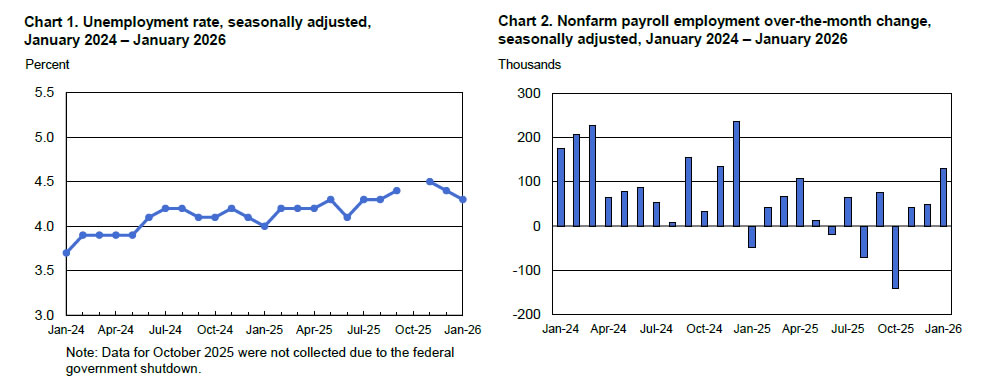
US NFP grows 303k in Mar, unemployment rate ticks down to 3.8%

    US non-farm payroll employment grew 303k in March, well above expectation of 205k. That’s also much higher than the average monthly gains of 231k over the prior 12 months.

    Unemployment rate ticked down from 3.9% to 3.8%, below expectation of 3.9%. Participation rate rose from 62.5% to 62.7%.

    Average hourly earnings rose 0.3% mom, matched expectations. Over the past 12 months, average hourly earnings have increased by 4.1 yoy.

    Full US non-farm payrolls release here.

    Eurozone retail sales falls -0.5% mom in Feb, EU down -0.4% mom

      Eurozone retail sales volume fell -0.5% mom in February, worse than expectation of -0.3% mom. Volume of retail trade decreased for food, drinks, tobacco by -0.4% mom, non-food products (except automotive fuel) by -0.2% mom, automotive fuel in specialised stores by -1.4% mom.

      EU retail sales fell volume -0.4% mom. Among Member States for which data are available, the largest monthly decreases in the total retail trade volume were recorded in Germany (-1.9%), Belgium (-1.8%) and Cyprus (-1.1%). The highest increases were observed in Poland (+1.4%), Croatia (+1.2%) and Estonia (+1.0%).

      Full Eurozone retail sales release here.

      Dow registers steepest decline in a year pre-NFP, a medium-term top established already?

        DOW tumbled sharply overnight, shedding -530 points or -1.35%, marking its most pronounced session drop since March 2023 and its fourth consecutive day of losses. This sharp decline seems a natural reaction after the index’s robust bullish run since last November, which propelled it to new record highs, lost steam. It’s also a logical area for some profit-taking and consolidations, just ahead of 40k psychological level.

        The strong rally was largely fueled by anticipations of forthcoming interest rate cuts, even with delays. Nevertheless, there is little, but growing skepticism among investors on whether the policy easing cycle would really start this year. The recent surge in commodity prices has also served as a stark reminder of the challenges in curbing inflation.

        The selloff also come just ahead of the crucial non-farm payroll report from the US today. Markets are expecting 205k job growth in March. Unemployment rate is expected to be unchanged at 3.9% while average hourly earnings are expected to rise 0.3% mom. Any upside surprises in today’s report, in particular wages growth, could prompt further shift in Fed expectations, and hut overall risk sentiment in the stock markets.

        Technically, considering bearish divergence condition in D MACD, 39899.05 could be a medium term top in DOW already, just ahead of 40k psychological level, and 61.8% projection of 18213.65 to 35962.65 from 28660.94 at 40241.64.

        Decisive break of 38483.23 support should confirm this bearish case, and bring deeper correction back to 38.2% retracement of 32327.20 to 39889.05 at 37000.42.

        Nevertheless, strong rebound from the current level would push DOW for another take on 40k before topping.

        BoJ’s Ueda: Excessive Yen weakness could prompt monetary policy response

          In an interview with The Asahi Shimbun newspaper, BoJ Governor Kazuo Ueda highlighted extended Yen weakness could prompt further rate hikes by the central bank.

          “If exchange rate trends have an effect on the cycle between wages and prices that cannot be ignored, that would become a reason for responding to the situation through monetary policy,” he explained.

          Ueda also outlined other conditions under which BoJ might consider additional rate hikes, after the landmark shift in March which exited negative interest rates.

          The decision to end negative interest rates was made with a certain level of confidence, quantified by Ueda as “75 percent.” He indicated that an increase in this confidence level to “80 percent or 85 percent” could prompt further adjustments

          Governor also touched on factors likely to boost personal consumption, including the government’s planned income tax cut in June, expected wage increases, and a slowdown in consumer price inflation. These developments, if they materialize as anticipated, could pave the way for a higher interest rate as early as between summer to autumn.

          Moreover, Ueda acknowledged the impact of a “excessively weak yen” on Japan’s economy and consumer prices, suggesting that significant currency weakness could influence future decisions regarding interest rate hikes.

          Fed officials want more evidence before considering rate cuts

            A wave of comments from several Fed officials overnight highlighted a consensus on the need for patience before initiating interest rate reductions. While the higher than expected inflation readings in January and February were “concerning”, they’re not seen as derailing the broader disinflation process yet. Nevertheless, the sentiment is clear: more evidence is required to confirm inflation’s downward path towards 2% target before any policy easing is initiated.

            Cleveland Fed President Loretta Mester emphasized the necessity of observing “a couple more months of data” to verify if the recent inflationary trends are indeed reversing. Mester pointed out the need for “more evidence” that supports the continuation of inflation’s decline. Meanwhile, Fed is in a “policy position” to adjust policy “more swiftly and sooner” if labor markets were to “deteriorate significantly”

            Minneapolis Fed President Neel Kashkari on penciled in two “rate cuts” this year back in March, predicated on inflation’s decline towards target.” Yet, if inflation is “moving sideways”, he would question “whether we needed to do those rate cuts at all.”

            Chicago Fed President Austan Goolsbee said the inflation in the first two months of the year “should not knock us off the path back to target”. He views housing inflation as the “most valuable indicator” now. “If it does not come down, we will have a very difficult time getting overall inflation back to the 2% target.”

            Richmond Fed President Thomas Barkin emphasized the strategic patience afforded by a “strong labor market,” suggesting that Fed has the time needed for the economic “clouds to clear” before commencing with rate adjustments.

            ECB March meeting accounts: Consensus against immediate rate cut, eyes on June for Data

              ECB’s March meeting accounts unveiled a unified stance among Governing Council members against discussing rate cuts at that time, citing it as “premature.” However, the narrative within the ECB is evolving, with increasing acknowledgment that “the case for considering rate cuts was strengthening,” pointing towards a strategic shift contingent on forthcoming economic data.

              The meeting underscored a collective patience to assess more comprehensive data before making decisive moves on interest rates. Specifically, the council highlighted the importance of the June meeting, which will benefit from new staff projections and a broader array of data, particularly concerning “wage dynamics.” This contrasts with the April meeting, where available data would be “much more limited,” thus making it harder to be sufficiently confidenct in the ongoing disinflation process’s durability.

              ECB’s deliberations reflect caution over the sustainability of disinflation, especially concerning “services and domestic inflation.” The uncertain prospects for wage growth, productivity, and profit margins are central to these concerns. For ECB to consider rate reductions with greater confidence, incoming data must align with March’s ECB staff projections, affirming that disinflation will consistently head towards the ECB’s target.

              Full ECB meeting accounts here.

              UK PMI Services finalized at 53.1, inflation pressures persist

                UK PMI Services was finalized at 53.1 in March, down from February’s 53.8. PMI Composite was finalized at 52.8, down from prior month’s 53.0.

                Tim Moore, Economics Director at S&P Global Market Intelligence, said, “The solid growth rate achieved in March reinforces the view that a rebound in service sector performance is helping the UK economy to pull out of last year’s shallow recession.”

                Meanwhile, Input prices have continued to rise sharply, with inflation rates only slightly below their six-month average. The primary factors contributing to the uptick in input costs include higher salary payments and increased transportation bills.

                The rate at which prices charged by service providers have increased slowed to its lowest point since September 2023. Despite this deceleration, the index remains well above its long-term trend, signaling enduring inflationary pressures within the UK’s domestic economy.

                Full UK PMI Services release here.

                Eurozone PMI services finalized at 51.5, gradually finding its footing

                  Eurozone PMI Services was finalized at 51.5 in March, up from February’s 50.2, a 9-month high. PMI Composite was finalized at 50.3, up from prior month’s 49.2, a 10-month high.

                  Cyrus de la Rubia, Chief Economist at Hamburg Commercial Bank, said the service sector is “gradually finding its footing.” He further highlighted the importance of wage growth outpacing inflation, enhancing households’ purchasing power and supporting the service sector’s revival. However, he tempered expectations by noting, “a full-fledged boom is not on the horizon.”

                  Despite economic challenges, service providers have continued to expand their workforce. Moreover, business expectations within the service industry have soared to their highest in over two years, surpassing the long-term average.

                  Meanwhile, March witnessed a slight deceleration in inflation regarding both costs and sales prices, a development likely to be viewed favorably by ECB. Despite this positive sign, de la Rubia cautioned against premature conclusions about a turning trend in inflation, maintaining the forecast that interest rate cuts are more likely in June than in April.

                  Full Eurozone PMI services final release here.

                  Swiss CPI falls to 1% yoy in Mar, misses expectations

                    Swiss CPI was flat month-over-month in March, below expectation of 0.3% mom. Core CPI (excluding fresh and seasonal products, energy and fuel) rose 0.1% mom. Domestic products prices fell -0.2% mom. Imported products pries rose 0.7% mom.

                    Over the 12-month period, CPI slowed from 1.2% yoy to 1.0% yoy, below expectation of 1.4% yoy. Core CPI slowed from 1.1% yoy to 1.0% yoy. Domestic products prices slowed from 1.9% yoy to 1.8% yoy. Imported products prices fell from -1.0% yoy to -1.3% yoy.

                    Full Swiss CPI release here.

                    Copper hits yearly high on global growth optimism

                      Copper soars to the highest levels in over a year this year, driven by renewed optimism regarding global economic growth and expectations of monetary easing from the world’s major central banks. This surge reflects growing confidence among investors that the downturn in manufacturing, including even China, may have past its worst. The prospect of interest rate cuts this year further fuels this positive mood for commodities like copper.

                      Technically, Copper’s rally from 3.5021 resumed this week and it’s now on track to 161.8% projection of 3.5021 to 3.9346 from 3.6324 at 4.3322, which is close to 4.3556 (2023 high). In any case, outlook will stay bullish as long as 3.9380 support holds. The bigger question is whether Copper is indeed resuming the rise from 3.1314 (2022 low) too. Let’s see.

                      Fed’s Kugler expects rate cut this year amid cooling demand

                        Fed Governor Adriana Kugler said overnight that if the disinflation process and labor market conditions evolve in line with her current expectations, a policy rate reduction within the year could be warranted.

                        “With demand growth cooling, given the backdrop of solid supply, my baseline expectation is that further disinflation can be accomplished without a significant rise in unemployment,” Kugler stated

                        “If disinflation and labor market conditions proceed as I am currently expecting, then some lowering of the policy rate this year would be appropriate,” she remarked.


                        Fed Powell downplays significance of recent strong labor market and inflation data

                          Fed Chair Jerome Powell downplayed the significance of recent labor market and inflation data that surpassed expectations, he noted that these developments do not significantly alter the Fed’s overall economic outlook.

                          “Recent readings on both job gains and inflation have come in higher than expected,” Powell said at a forum at Stanford University overnight. However, he was quick to clarify that these developments do not fundamentally shift the broader economic narrative, which he described as “one of solid growth, a strong but rebalancing labor market, and inflation moving down toward 2 percent on a sometimes bumpy path.”

                          In discussing the Federal Reserve’s approach to monetary policy easing, Powell affirmed the “meeting by meeting” decision-making process and acknowledged that rate cuts are “likely to be appropriate at some point this year.”

                          Yet, he stressed the prerequisite of having “greater confidence” in inflation’s downward path towards 2% target before any interest rate red reduction would be considered.

                          “Given the strength of the economy and progress on inflation so far, we have time to let the incoming data guide our decisions on policy,” he remarked.


                          US ISM services falls to 51.4, prices down sharply to 53.4

                            US ISM Services PMI fell from 52.6 to 51.4 in March, below expectation of 52.8. Business activity/production ticked up from 57.2 to 57.4. New orders fell from 56.1 to 54.4. Employment rose slightly from 48.0 to 48.5. Prices fell sharply from 58.6 to 53.4.

                            ISM said: “The past relationship between the Services PMI and the overall economy indicates that the Services PMI for March (51.4 percent) corresponds to a 0.8-percent increase in real gross domestic product (GDP) on an annualized basis.”

                            Full US ISM services release here.

                            Fed’s Bostic eyes first rate cut in Q4, citing sluggish inflation decline

                              In a CNBC interview today, Atlanta Fed President suggested that rate cuts could be on the horizon by the end of 2024, contingent on the economy’s performance. Bostic outlined a scenario where “continued robustness in GDP, unemployment, and a slow decline of inflation through the course of the year” could warrant a policy adjustment in the fourth quarter.

                              He also acknowledged the persistence of inflationary pressure into the current year, “hasn’t moved very much relative to” levels observed at the end of 2023. “There are some secondary measures in the inflation numbers that have gotten me a bit concerned that things may move even slower,” he warned.

                              “Those are much higher now than they were before and they’re starting to trend back to what we saw in the high inflation period,” Bostic added. “They’re moving away from what we’d like to see. So I’ve got to make sure that those aren’t hiding some extra upward pressure and pricing pressure before I’m going to want to move our policy rate.”

                              US ADP jobs rises 184k, pay growth heating up

                                US ADP private employment grew 184k in March, above expectation of 150k. By sector, goods-producing jobs increased 42k while service-providing jobs increased 142k. By establishment size, small companies added 16k jobs, medium companies added 93k, large companies added 87k.

                                For job-stayers, year-over-year pay gains was unchanged at 5.1%. Annual pay growth for job changes accelerated sharply from 7.6% to 10.0%.

                                Nela Richardson, Chief Economist at ADP, said: “March was surprising not just for the pay gains, but the sectors that recorded them. The three biggest increases for job-changers were in construction, financial services, and manufacturing. Inflation has been cooling, but our data shows pay is heating up in both goods and services.”

                                Full US ADP release here.

                                Eurozone CPI slows to 2.4% in Mar, core down to 2.9%, below expectations

                                  Eurozone headline CPI slowed from 2.6% yoy to 2.4% yoy in March, below expectation of 2.5% yoy. CPI core (ex energy, food, alcohol & tobacco) slowed from 3.1% yoy to 2.9% yoy, below expectation of 3.0% yoy.

                                  Looking at the main components services is expected to have the highest annual rate in March (4.0%, stable compared with February), followed by food, alcohol & tobacco (2.7%, down from 3.9%), non-energy industrial goods (1.1%, down from 1.6%) and energy (-1.8%, up from -3.7%).

                                  Full Eurozone CPI flash release here.

                                  ECB’s Holzmann: No fundamental objection to rate cut in Jun

                                    In an interview with Reuters, ECB Governing Council member Robert Holzmann said that an interest rate cut in April is “not on my radar”. Instead, he highlighted June as a critical time for evaluating the bank’s next steps, emphasizing a commitment to data-driven decision-making regarding monetary easing.

                                    “If the data allows it, a decision will be made,” he noted. “I don’t have an in-principle objection to easing in June, but I’d like to see the data first and I want to stay data-dependent.”

                                    An intriguing aspect of Holzmann’s perspective is his consideration of Fed’s actions in relation to ECB’s. He mentioned, “If by June the data supports a strong case for a cut, and we’re a week before the Fed makes its decision, then it’s quite likely we’ll proceed, hoping the Fed follows suit.” However, if Fed doesn’t come along, “then it may reduce the economic impact of our move.”

                                    Notably, Holzmann’s remarks signal a significant shift, especially considering his reputation as one of the more conservative voices within ECB, typically resistant to premature discussions of rate reductions. For him, the shift appears to be influenced by an increasingly benign inflation outlook. Also there were signs of economic fragility within Eurozone, which has been hovering on the brink of recession for multiple quarters.

                                    China’s Caixin PMI services edges up to 52.7, matches expectations

                                      China’s Caixin PMI Services edged up slightly from 52.5 to 52.7 in March, matched expectations. PMI Composite, which tracks both manufacturing and service sectors, also increased from 52.5 to 52.7, indicating the most pronounced expansion of overall business activity since May 2023.

                                      Wang Zhe, Senior Economist at Caixin Insight Group, highlighted the favorable economic performance in the early months of the year and the manufacturing sector’s five-month run in expansionary territory. He stated, “This indicates a generally stable and positive economic recovery”.

                                      Despite these optimistic signs, the economist pointed out several challenges facing the Chinese economy. Wang Zhe identified persistent downward economic pressures, subdued employment levels, low prices, and insufficient effective demand as critical issues that have yet to be fully addressed.

                                      Full China Caixin PMI services release here.

                                      Japan’s PMI services finalized at 54.1, marked increase in cost burdens

                                        Japan’s PMI Services was finalized at 54.1 in March, a notable improvement from February’s 52.9 and marking the most significant growth for the past seven months. PMI Composite also rose to 51.7 from the previous month’s 50.6.

                                        Usamah Bhatti, economist at S&P Global Market Intelligence, noted that near-term outlook for the service sector appears “robust”, as outstanding business, a key indicator of future work, continues to rise at “near-record rates”. Confidence regarding the 12-month future also remains strong among service providers.

                                        However, the sector is not without its challenges, particularly on the price front. Businesses signaled “another marked increase in cost burdens,” underlining ongoing inflationary pressures. These pressures are mirrored in the broader Japanese private sector, where cost inflation has hit a “five-month high”.

                                        Bhatti added that inflationary pressures, alongside BoJ’s recent shift away from negative interest rates, “will likely remain a downside risk to the Japanese private sector economy in the coming months.”

                                        Full Japan PMI services final release here.

                                        Fed’s Daly: Three rate cuts very reasonable, but not guaranteed

                                          San Francisco Fed President Mary Daly offered described three rate cuts this year as a “very reasonable baseline.” However, she was careful to clarify that such a projection should not be interpreted as a commitment, stating, “not a promise.”

                                          Daly highlighted the current state of economic growth as a factor tempering the immediacy for policy adjustments, noting, “Growth is going strong, so there’s really no urgency to adjust the rate.”

                                          Furthermore, Daly voiced concerns over the risks associated with prematurely lowering interest rates. She warned of the “real risk” that too early a cut could entrench the “toxic tax” of persistently high inflation.