France’s PMI Composite dips to 44.2: Signals Q1 stagnation with downside risks

    France PMI Manufacturing rose from 42.1 to 43.2 in January. PMI Services fell from 45.7 to 45.0. PMI Composite fell from 44.8 to 44.2.

    Norman Liebke, Economist at Hamburg Commercial Bank, said the PMIs show a “depressing picture overall”. According to the bank’s nowcast model, the economy is likely to “stagnate” in Q1, and “risks are to the downside.

    Liebke added that “most probably, the ECB won’t start cutting rates in the next few months amid surging wages” He further explained that rising input prices, particularly due to higher wages, support the ECB’s cautious stance on reducing interest rates. Businesses in France have been largely successful in transferring these increased costs to consumers, as evidenced by the rise in selling prices, especially in the labor-intensive service sector.

    Full France PMI release here.

    Japan’s exports exceed JPY 1T in 2023, US reclaims top export destination

      Japan’s exports rose 9.8% yoy to JPY 9648B in December, marking the biggest increase in a year. This boost was largely driven by 20.4% yoy jump in exports to US, predominantly from the automotive sector, while exports to Europe climbed by 10.3% yoy. Notably, shipments to China saw 9.6% yoy rise, registering their first growth in 13 months, primarily led by chip-making equipment. In contrast, imports declined -6.8% yoy to JPY 9586B. Consequently, trade balance turned positive, recording JPY 62.1B surplus.

      Analyzing the whole year, Japan’s trade deficit in 2023 more than halved to JPY -9.29T from the previous year. The country’s total exports rose by 2.8% to reach JPY 100.89T , surpassing the JPY 100T mark for the first time ever. Meanwhile, total imports saw -7.0% decrease to JPY 110.18T.

      A significant shift was observed in Japan’s export destinations in 2023. US reclaimed its position as the largest recipient of Japanese exports by value for the first time in four years, surpassing China. Exports to US reached JPY 20.27T, showing 11.0% increase, while exports to China decreased by -6.5% to JPY 17.76T.

      Japan’s PMI shows modest growth, manufacturing still in contraction

        Japan’s PMI Manufacturing rose fractionally from 47.9 to 48.0 in January, below expectation of 48.2. Manufacturing remained in contraction for the eighth consecutive months. PMI Services rose from 5.15 to 52.7. PMI Composite rose from 50.0 to 51.1.

        Usamah Bhatti, Economist at S&P Global Market Intelligence, noted that while “modest” the private sector is having the strongest growth since September. However, there was disparity between the sectors, with services reaching a four-month high, while manufacturing marked its eighth consecutive month of contraction.

        Regarding inflation, Bhatti said input price inflation “remains high historically”. But output inflation eased to its “lowest since February 2022”. This indicates that while input costs are still elevated, businesses are not passing these costs fully onto consumers.

        Full Japan PMI release here.

        Australia’s PMI manufacturing Hits 11-month high, services Lagging

          Australia PMI Manufacturing rose from 47.6 to 50.3 in January, back in expansion, and a 11-month high. PMI Services rose slightly from 47.1 to 47.9, a 3-month high. PMI Composite rose from 46.9 to 48.1, a 4-month high, but still in contraction.

          Warren Hogan, Chief Economic Advisor at Judo Bank noted the PMI data indicates a that the economy remains on RBA’s “narrow path” for soft landing. He highlights the manufacturing sector’s rebound as a key factor in mitigating broader economic downturn risks.

          Despite the general economic slowdown, Hogan observes that labor demand remains unexpectedly robust, differing from past economic cycles. However, he cautions that inflation pressures are still high, pointing out, “Input and output price indexes remain at levels suggesting CPI inflation is above the RBA’s target range.”

          Full Australia PMI release here.

          New Zealand CPI slows to 0.5% qoq, 4.7% yoy in Q4

            New Zealand CPI rose 0.5% qoq in Q4, down from 1.8% qoq in Q3, matched expectations. Tradeable inflation turned negative to -0.2% qoq, from 1.8% qoq. Non-tradeable inflation slowed to 1.1% qoq, down from 1.7% qoq.

            Annually, CPI slowed from 5.6% yoy to 4.7% yoy, matched expectations. Tradeable inflation slowed from 4.7% yoy to 3.0% yoy. non-tradeable inflation also slowed from 6.3% yoy to 5.9% yoy.

            “While this is the smallest annual rise in the CPI in over two years, it remains above the Reserve Bank of New Zealand’s target range of 1 to 3 percent,” consumers prices senior manager Nicola Growden said.

            Full NZ CPI release here.

            SNB’s Jordan: Real Franc appreciation hurts, yet no recession in sight

              SNB Chairman Thomas Jordan, in his overnight address at an event, acknowledged the impact of the Franc’s nominal appreciation on lowering inflation. However, he warned, the “Franc has also appreciated in real terms in 2023. And that hurts, companies feel that.”

              Despite the challenges posed by Franc’s appreciation, Jordan expressed confidence in the Swiss economy’s resilience. “Economists are confident that there won’t be a recession — and we are also confident, otherwise we would forecast one,” he commented, adding “So no recession, just weak growth.”

              Looking ahead, Jordan reiterated SNB’s inflation expectations, stating that they anticipate Swiss inflation to approach but not exceed the 2% ceiling of their target range this year. The central bank does not foresee inflation breaching this mark until 2026.


              NZD/USD losing downside momentum as NZ CPI awaited

                One of the spotlights will turn to New Zealand’s inflation data in the upcoming Asian session. Market are expecting quarterly CPI to rise 0.5% qoq in Q4, slowed from Q3’s 1.8% qoq. Annually, CPI is expected to fall from 5.6% yoy to 4.7% yoy.

                Should these predictions materialize, the results would fall significantly below RBNZ’s forecast from the November Monetary Policy Statement, which projected 0.8% qoq and 5.0% yoy, although the annual rate remains well above 1-3% target band.

                There is a divergence of opinions regarding RBNZ’s interest rate path this year. While some economists hold the view that OCR will remain at 5.50% through 2024, 2-year swap market is fully pricing in an OCR cut as early as May. Therefore, the inflation data set to be released tomorrow is poised to play a critical role in reshaping these rate cut expectations.

                NZD/USD’s fall from 0.6368 lost much momentum after breaching 0.6083 support, but there is no sign of a rebound yet. Sustained break of 0.6083 will strengthen the case that this decline is the third leg of the corrective pattern from 0.6537, and target 0.5771 support next. Nevertheless, break of 0.6138 minor resistance will neutralize immediate bearishness, and bring recovery first.


                BoJ’s Ueda elaborates on inflation and wages, hinting at future policy shifts

                  During his post-meeting news conference, BoJ Governor Kazuo Ueda confirmed that the economy is aligning with the central bank’s inflation projections, adding “our core-core inflation forecast is at 1.9%, very close to our 2% target”. This closeness, he explained, significantly contributes to BoJ’s growing confidence in sustainably achieving its price target.

                  However, Ueda acknowledged the challenges in quantifying the exact progress towards this goal. He pointed out that recent movements in service prices have been influenced by several one-off factors and that consumption weakness is impacting these prices. BoJ is analyzing these trends by separating such factors, and Ueda believes that, despite these complexities, “service inflation is gradually accelerating as a trend.”

                  Ueda also addressed the timing of monetary policy adjustments in relation to wage negotiations. He suggested that waiting for the outcome of wage talks across all firms, including smaller ones, would be impractical due to the extended timeframe this would require. BoJ, therefore, intends to use various economic indicators and data from hearings to predict wage trends. Ueda emphasized the influence of larger firms’ wage negotiations on smaller firms and the availability of data on smaller firms’ profit outlooks as potential early indicators.

                  BoJ holds steady, with CPI core-core projected at 1.9% in next two fiscal years

                    BoJ left monetary policy unchanged as widely expected. The forecast for fiscal 2024 CPI core was downgraded, whereas fiscal 2025 CPI core forecast saw a slight upgrade. Notably, CPI core-core forecasts for fiscal 2024 and 2025 were left unchanged at 1.9%, indicating a steady path towards achieving Japan’s 2% inflation target sustainably.

                    Under Yield Curve Control, BoJ kept short-term policy interest rate unchanged at -0.1%. Additionally, target for 10-year JGB yield remains around 0%, with an allowance for fluctuation below 1.0% upper bound. These decisions were made by unanimous vote.

                    BoJ noted, “Consumer inflation is likely to increase gradually toward the BoJ’s target as the output gap turns positive, and as medium- to long-term inflation expectations and wage growth heighten.” The central bank also acknowledged the growing “likelihood” of realizing this outlook, albeit with an emphasis on the continued “high uncertainties” surrounding future developments.

                    In the median economic projections:

                    • Fiscal 2023 GDP growth at 1.8% (down from October’s 2.0%).
                    • Fiscal 2024 GDP growth at 1.2% (up from 1.0%).
                    • Fiscal 2025 GDP growth at 1.0% (unchanged).

                    On the inflation front:

                    • Fiscal 2023 CPI core at 2.8% (unchanged).
                    • Fiscal 2024 CPI core at 2.4% (down from 2.8%).
                    • Fiscal 2025 CPI core at 1.8% (up from 1.7%).
                    • Fiscal 2023 CPI core-core at 3.8% (unchanged).
                    • Fiscal 2024 CPI core-core at 1.9% (unchanged).
                    • Fiscal 2025 CPI core-core at 1.9% (unchanged).

                    Full BoJ statement here.

                    Full BoJ Outlook for Economic Activity and Prices here.

                    Australia’s NAB business confidence rises to -1 amidst slowing price growth

                      Australia NAB Business Confidence fell rose from -8 to -1 in December. However, Business Conditions fell from 9 to 7. The decline was observed across several key areas: Trading conditions dropped from 13 to 10, while Employment conditions also decreased slightly from 8 to 7. Profitability conditions remained steady at 6.

                      NAB Chief Economist Alan Oster noted that “confidence and conditions are softest in manufacturing, retail and wholesale,” attributing this to consumers cutting back on spending over time. Although there was a pickup in confidence within the retail sector in December, Oster expressed caution, stating that “it remains to be seen if this will be maintained.”

                      Another significant development was the sharp decline in price and cost growth. Labor cost growth eased to 1.8% in quarterly equivalent terms, down from 2.3%. Purchase cost growth also declined from 2.5% to 1.6%. Overall price growth slowed from 1.2% to 0.9%, with notable decrease in retail price growth from 1.8% to 0.6%.

                      Oster highlighted the significance of this decline in retail price growth, attributing it in part to the sales periods around Black Friday and Christmas. He remarked, “The marked fall in retail price growth in December… is nonetheless an encouraging sign that inflation may have eased at the end of the quarter.”

                      Full Australia NAB business confidence release here.

                      New Zealand BNZ services falls to 48.8, back in contraction

                        New Zealand BusinessNZ Performance of Services Index fell from 51.1 to 48.8 in December, back into contraction territory. This downturn also brings the index below long-term average of 53.4. The increase in negative sentiment is evident, with the proportion of negative comments rising from 54.0% to 58.7%. The primary concerns expressed by businesses revolve around seasonal factors, increasing costs of living, and an overall economic slowdown.

                        Breaking down the PSI, several key components showed declines. Activity and sales dropped from 48.7 to 47.1, employment fell from 50.6 to 47.5, and new orders/business dipped from 52.2 to 51.2. Additionally, stocks and inventories decreased from 55.0 to 51.5, while supplier deliveries also saw a reduction from 52.8 to 50.5.

                        Stephen Toplis, BNZ’s Head of Research noted that the softening in PSI, combined with the previously reported weakness in Performance of Manufacturing Index, paints a concerning picture for New Zealand’s near-term economic growth and employment. While tourism has been a critical driver for the services sector and is expected to continue supporting the economy, Toplis emphasized that it cannot solely bear the burden of economic revitalization.

                        Full NZ BNZ PSI release here.

                        Silver tumbles amid rate cut expectation adjustments

                          Silver falls steeply today as the decline from 25.91 resumes. This steep selloff in the precious metal is interpreted, at least partly, as a reaction to the recent market adjustments in global central bank rate cut expectations. With the anticipation of prolonged high interest rates, the opportunity cost of holding precious metals like Gold and Silver remains elevated, putting additional pressure on their prices.

                          Technically, near term outlook in Silver will stay bearish as long as 22.83 resistance holds. Next target is 100% projection of 25.91 to 22.50 from 24.59 at 21.18.

                          Price actions from 26.12 are seen as a sideway consolidation pattern from with decline 25.91 as the third leg. While break of 20.67 cannot be ruled out, strong support should be seen 19.88 and 20.67 to conclude the fall from 25.91, as well as the sideway pattern.

                          PBoC holds 1-yr and 5-yr LPR steady

                            People’s Bank of China announced today that it would maintain one-year loan prime rate at 3.45%, a level unchanged since August last year. Similarly, five-year rate, critical for mortgage financing, remains steady at 4.2%, consistent since its last reduction in June. This decision follows PBoC’s unexpected move last week to keep its medium-term lending facility rate stable.

                            PBoC’s decision to hold rates steady comes amid a sluggish economic environment in China, coupled with increasing deflationary pressures. Despite these challenges, the central bank appears reluctant to employ interest rate reductions as a tool to stimulate the economy, primarily due to concerns over the depreciating Yuan. PBoC might continue to avoid further rate cuts until Yuan regains some stability, to prevent exacerbating the currency’s depreciation.

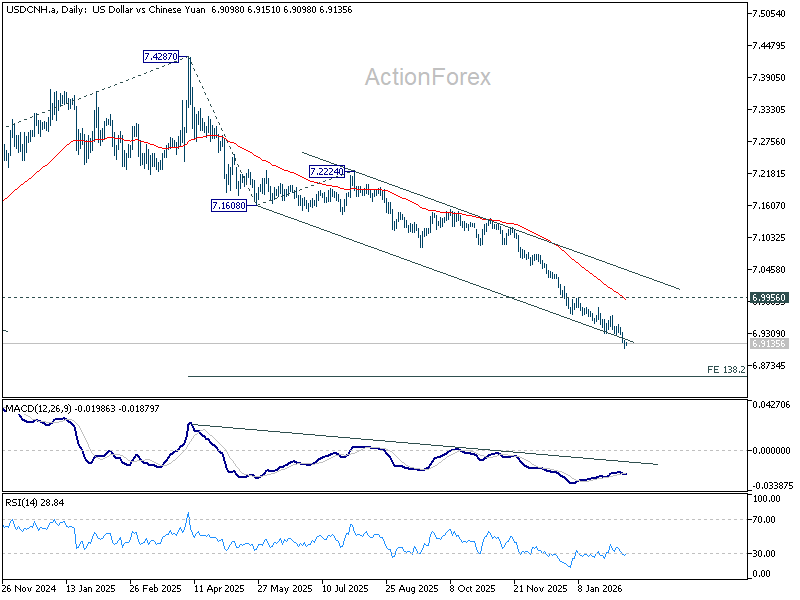
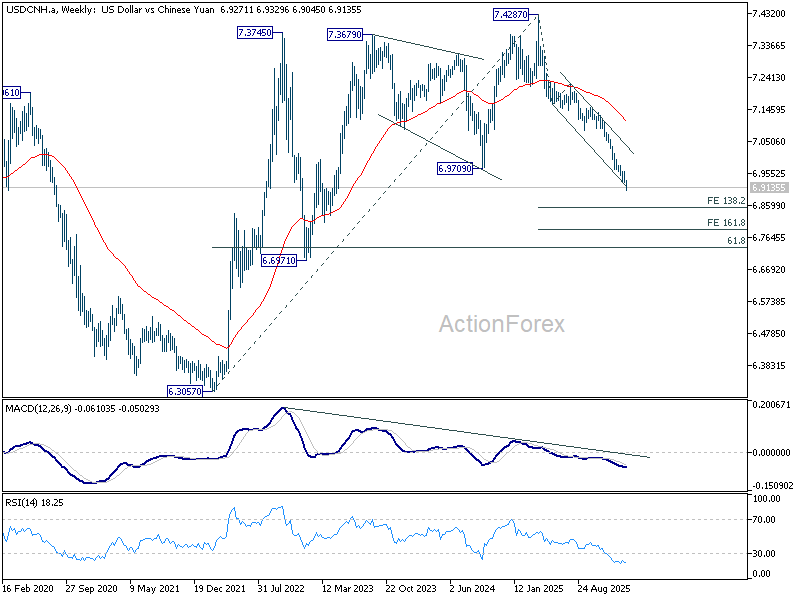
                            USD/CNH’s break of 55 D EMA last week suggests that the corrective pull back from 7.3679 has completed at 7.0870 already. That came after drawing support from 38.2% retracement of 6.6971 to 7.3679 at 7.1117. Further rise is now mildly in favor as long as 7.1589 minor support holds, back to retest 7.3679 high.

                            Canada’s retail sales falls -0.2% mom in Nov, ex-auto sales down -0.5% mom

                              Canada’s retail sales fell -0.2% mom to CAD 66.6B in November, worse than expectation of 0.0% mom. Sales declined in four of nine subsectors, led by contraction in food and beverage at -1.4% mom. Excluding autos, sales were down -0.5% mom, much worse than expectation of -0.1% mom.

                              Advance estimate suggests that sales rose 0.8% mom in December.

                              Full Canada retail sales release here.

                              UK retail sales volume down -3.2% mom in Dec, sales value falls -3.6% mom

                                UK retail sales volume fell -3.2% mom in December, much worse than expectation of -0.5% mom. That’s also the largest monthly fall since January 2021. Excluding fuel, sales volume fell -3.3% mom. Automotive fuel sales volumes fell by -1.9% mom. On an annual basis, sales volumes fell by 2.8% in 2023 and were their lowest level since 2018.

                                In value term, Retail sales value fell -3.6% mom. Ex-fuel sales value fell -3.6% mom.

                                Full UK retail sales release here.


                                NZ BNZ manufacturing falls to 43.1, 10th month of contraction

                                  New Zealand’s BusinessNZ Performance of Manufacturing Index fell from 46.5 to 43.1 in December. This latest figure marks a continued contraction in the manufacturing sector, which has now been shrinking for ten consecutive months.

                                  The index components reveal a widespread decline across various manufacturing activities. Production fell from 43.5 to 40.5. Employment decreased from 47.9 to 46.7. New orders dropped from 47.4 to 44.0. Similarly, finished stocks and deliveries both saw declines, from 50.4 to 45.9 and 47.8 to 43.4, respectively.

                                  Manufacturers’ feedback further underscored the industry’s challenges, with 61% of the comments in December being negative. This is a slight increase from 58.7% in November, though an improvement from 65.1% in October. The predominant concerns revolved around a lack of demand and sales, which have been significant hurdles for many manufacturers.

                                  Stephen Toplis, BNZ’s Head of Research, echoed these sentiments in his assessment of the PMI data. “The December PMI reaffirms our view that economic conditions remain very difficult,” he stated. Toplis anticipates that while the economy and the manufacturing sector might gain some momentum by the end of 2024, the immediate future appears challenging, particularly with pressures in retail spending and construction activity.

                                  Full NZ BNZ PMI release here.

                                  Japan’s CPI core dips to 2.3%, remains above BoJ’s target for 21st month

                                    Japan’s CPI core, excluding fresh food, decelerated slightly in December, moving from 2.5% yoy to 2.3% yoy, aligning with market expectations. This slowdown brings core inflation rate to its lowest since June 2022, yet it notably remains above BoJ’s 2% target for the 21st consecutive month.

                                    Overall headline CPI also showed a slowdown, decreasing from 2.8% yoy to 2.6% yoy. Additionally, CPI core-core, which excludes both food and energy, saw a modest decline, moving from 3.8% yoy to 3.7% yoy.

                                    A notable aspect of CPI data is the stability of services prices, which rose by 2.3% yoy, maintaining the pace from the previous month. This rate marks the fastest increase in services prices in three decades when periods affected by sales tax hikes are excluded.

                                    A significant factor contributing to the slowdown in inflation was the substantial drop in energy prices, which decreased by -11.6% yoy. This decline was driven by reductions in electricity and city gas prices, which fell by -20.5% yoy and -20.6% yoy, respectively, largely due to government subsidies.

                                    Fed’s Bostic foresees rate cuts in Q3, sets high bar for earlier action

                                      Atlanta Fed Raphael Bostic said overnight that he now projects Fed to begin cutting interest rates in the third quarter of this year, a shift in timing from his previous expectation of the fourth quarter.

                                      This adjustment is a response to the recent economic data, as he explained, “Because I’m data dependent, I have incorporated the unexpected progress on inflation and economic activity into my outlook, and thus moved up my projected time to begin normalizing the federal funds rate to the third quarter of this year from the fourth quarter.”

                                      While Bostic does not entirely dismiss the possibility of an earlier rate cut, potentially as soon as July, he emphasizes that the criteria for such a decision would be stringent. “The bar will be high,” he stated, indicating that any move to cut rates before the third quarter would require substantial and convincing evidence.

                                      He elaborated on this point, saying, “If we continue to see a further accumulation of downside surprises in the data, it’s possible for me to get comfortable enough to advocate normalization sooner than the third quarter.” However, he stresses that the evidence supporting such a decision would need to be compelling.

                                      US initial jobless claims fell to 187k, lowest since Sep 2022

                                        US initial jobless claims fell -16k to 187k in the week ending January 13, below expectation of 207k, marking the lowest level since September 24, 2022. Four-week moving average of initial claims fell -5k to 203k.

                                        Continuing claims fell -26k to 1806k in the week ending January 6. Four-week moving average of continuing claims fell -14k to 1848k.

                                        Full US jobless claims release here.

                                        ECB minutes reveal growing confidence in inflation control, but clear wage turnaround awaited

                                          ECB’s meeting minutes for the December 13-14 session indicate that officials believe monetary policy is “working as intended”, with disinflationary processes “proceeding well and probably more strongly than had been anticipated”. The decline in November’s inflation was described as “encouraging” and “broad-based,” encompassing core inflation components, which bolstered confidence in bringing inflation back to target in a timely manner.

                                          One significant observation was that services inflation had begun to ease, suggesting that inflationary pressures across various components were diminishing. This trend was attributed in part to weak demand influenced by monetary policy measures.

                                          However, ECB officials highlighted the uncertainty surrounding future wage dynamics, noting that “convincing evidence of a sustained turnaround in wages had yet to emerge.” This is a crucial factor for ECB, as a more definitive shift in wage trends is necessary to ensure confidence in inflation’s return to the 2% target.

                                          In their decision-making, ECB officials chose to keep the three key interest rates unchanged, emphasizing the importance of their data-dependent approach. This approach focuses on the three elements of ECB’s reaction function, providing a structured framework for monetary policy decision-making and communication. The meeting minutes underscored that this approach is central to the Governing Council’s meeting-by-meeting orientation, allowing for the flexibility required in the current economic context.

                                          Full ECB accounts here.