Fed’s Kashkari signals preference for stronger policy action to tame inflation target

    Minneapolis Federal Reserve President Neel Kashkari expressed concern over the consequences of insufficient tightening in a WSJ interview, saying, “Under-tightening will not get us back to 2% in a reasonable time.” He favored a stance that leans toward an aggressive policy rather than a cautious one.

    In a subsequent conversation with Fox News, Kashkari drew attention to the economy’s endurance despite Fed’s recent rounds of rate increases. “The economy has proved to be really resilient even though we’ve raised interest rates a lot over the past couple of years. That’s good news,” he said. This resilience suggests that the economy might be better positioned to handle further rate hikes, should they be deemed necessary.

    However, Kashkari was clear that the Fed’s job is far from over, as inflation remains a critical challenge. “We need to let the data keep coming to us to see if we really have got the inflation genie back in the bottle so to speak,” he conveyed, emphasizing the need for ongoing vigilance. He added, “We haven’t completely solved the inflation problem. We still have more work ahead of us to get it done.”

    Eurozone Sentix rose to -18.6 as inflation worries ease

      Eurozone’s Sentix Investor Confidence Index rose from -21.90 to -18.6 in November, marking the highest level since June and surpassing analysts’ expectations of -22.5.

      The details of the report are also encouraging, with Current Situation Index marginally improving from -27.0 to -26.8. Expectations Index leaped towards optimism, reaching the highest point since February at -10.0, up from -16.8.

      However, it is critical to acknowledge that expectations remain in negative terrain. “The decrease in negative momentum is an initial sign of improvement,” according to the Sentix report, “but the all-clear can only be given if expectations turn positive.”O

      ne notable development is the rise in the Sentix “Inflation” theme index, which has crossed into positive territory for the first time since early 2020, suggesting that inflation may be diminishing as a key concern. The index now stands at +6.5 points, a development that could potentially reduce ECB’s urgency to act.

      Full Eurozone Sentix release here.

      Eurozone PMI services finalized at 47.8, stagflation concerns mount

        Eurozone PMI Services slumped to 47.8 (final reading) from September’s 48.7. PMI Composite index, which tracks both manufacturing and services, descended to a 35-month low of 46.5 from 47.2. The rate at which new business is falling has reached levels not seen since 2012, with the exception of the pandemic period.

        This downturn is evident across key Eurozone economies, with member states reporting troubling metrics. Spain hit a 2-month low at the brink of stagnation with PMI Composite of 50.0, while Ireland descended to an 11-month low at 49.7. Italy and Germany both reported figures suggesting continuing contraction in service sector activity, with PMIs at 47.0 and 45.9 respectively. France, although at a 2-month high, still sits in a contractionary phase at 44.6.

        Cyrus de la Rubia of HCOB offers a stark analysis: “The Eurozone service sector appears to be struggling at the onset of Q4, continuing a three-month trend of decline. A steep decrease in new business intake is a worrying harbinger for future activity. Although there is a slight uptick in future expectations, they still linger well below the historical average.”

        The economic situation seems paradoxical, with prices rising without the typical accompanying demand, pointing to a condition of “stagflation”. De la Rubia questions how long this “odd stagflation zone” will persist, a query that also plagues ECB. With PMI data suggesting no quick exit from these conditions, it appears ECB is not in a position to lower interest rates just yet, as it balances the dual threats of sluggish growth and persistent inflation.

        Full Eurozone PMI Services release here.

        BoJ Governor Ueda affirms commitment to easing amid uncertain inflation-wage dynamics

          BoJ Governor Kazuo Ueda reaffirmed today the central bank’s commitment to its accommodative stance.

          “We’re seeing more positive signs than before in corporate wage and price-setting behavior,” Ueda stated, acknowledging the nascent signs of a healthier inflation-wage cycle. However, he also underscored the prevailing uncertainties, admitting, “there’s still uncertainty on whether the positive cycle will strengthen, as we predict.”

          With an eye on supporting economic activity, Ueda emphasized the central bank’s resolve, “We will patiently maintain monetary easing,” indicating no immediate shift from BoJ’s long-standing dovish position.

          Last week’s decision to relax the 1% cap on 10-year JGB yield, allowing greater movement in long-term borrowing costs, was a nod to flexibility in BoJ’s approach. Today, Ueda elaborated, “We will conduct nimble market operations when interest rates rise, depending on the level and speed of moves of long-term rates.”

          Ueda also sought to temper market expectations regarding the potential for sharp rises in long-term yields. “Even if long-term rates come under upward pressure, don’t expect the 10-year JGB yield to sharply exceed 1%,” he stated.

          The Governor’s comments reflect a deep consideration of the “real” interest rate, which factors in inflation expectations. He explained, “Long-term rates may rise somewhat but what’s important is to look at the real interest rate that takes into account inflation expectations.”

          He reassured markets, “Even if long-term rates rise, real interest rates will move in negative territory so monetary conditions will be sufficiently accommodative.”

          Japan’s PMI services finalized at 51.6, growth is on the wane

            Japan’s PMI Services was finalized at 51.6 in October, down from previous month’s 53.8. PMI Composite figure similarly declined to 50.5 from September’s 52.1.

            Andrew Harker of S&P Global Market Intelligence highlighted the subdued performance: “While the PMI data continue to make positive reading for the Japanese service sector, the recent trends suggest that growth is on the wane.”

            He elaborates that the slowdown is notably marked by the softest increases in activity and new orders witnessed since the year’s inception, which could herald a persistent deceleration as we edge closer to the year’s end.

            This softening expansion has raised concerns regarding the service sector’s capacity to buoy the broader economy, particularly as manufacturing continues to lag. Harker notes the stagnation of new orders in October, halting an eight-month stretch of growth and presenting a cautionary backdrop for the upcoming months.

            Full Japan PMI Services release here.

            ECB’s Lagarde determined to bring inflation down to 2%

              In an interview with Kathimerini, ECB President Christine Lagarde enunciated the bank’s determined path: “We are determined to bring inflation down to 2%. According to our projections, we will get there in 2025.”

              This determination comes against a backdrop of soaring prices affecting economies worldwide, with ECB focusing not just on the broader inflationary metric but also on its constituent parts. “When we measure inflation, we pay attention to the headline rate,”

              Delving into the specifics, Lagarde acknowledged the significant volatility in food prices, a primary concern for policy-makers and consumers alike. She highlighted a future clouded by environmental uncertainty: “Is the price of food going to be higher in the future? That’s a possibility if you look at the impact of climate change.”

              Lagarde also touched on the societal impact of inflation, particularly the strain on the vulnerable populations. “Let me say that our mandate is to ensure price stability, and this is the best contribution we can make to social peace and to society, to the most vulnerable of its members in particular.”

              Full interview of ECB Lagarde here.

              US ISM services fell to 51.8, corresponds to 0.7% annualized GDP growth

                US ISM Services fell from 53.6 to 51.8 in October, below expectation of 53.2. Business activity/production fell from 58.8 to 54.1. New orders rose from 51.8 to 55.5. Employment dropped from 53.4 to 50.2. Prices ticked down from 58.9 to 58.6.

                ISM said: “The past relationship between the Services PMI and the overall economy indicates that the Services PMI for October (51.8 percent) corresponds to a 0.7-percent increase in real gross domestic product (GDP) on an annualized basis.”

                Full US ISM Services release here.

                Canada’s employment grew 17.5k, unemployment rate rose to 5.9%

                  Canada’s employment grew 17.5k in October, below expectation of 25.7.

                  Employment was up in construction (+23,000; +1.5%) and information, culture and recreation (+21,000; +2.5%) in October. This was offset by decreases in wholesale and retail trade (-22,000; -0.7%) and manufacturing (-19,000; -1.0%).

                  Unemployment rate rose from 5.7% to 5.9%, above expectation of 5.8%.

                  On a year-over-year basis, average hourly wages rose 4.8% yoy in October, following an increase of 5.0% yoy in September.

                  Full Canada employment release here.

                  US NFP grows 150k, unemployment rate rose to 3.9%

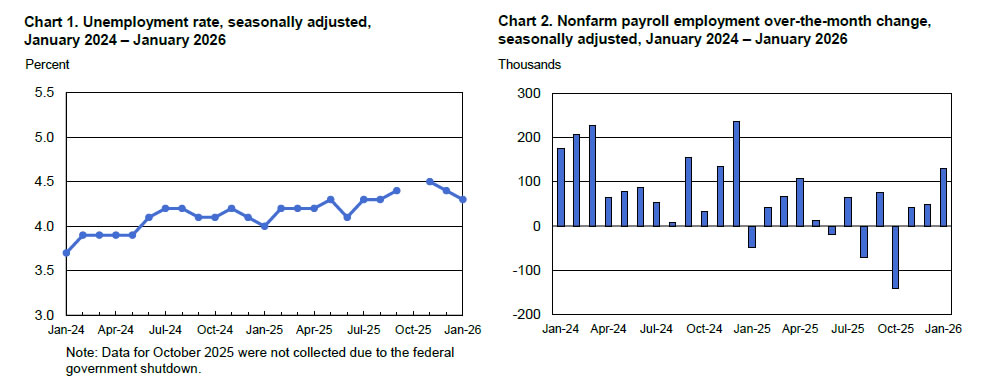
                    US non-farm payroll employment grew 150k in October, below expectation of 172k. That’s well below average monthly gain of 258k over the prior 12 months.

                    Unemployment rate rose from 3.8% to 3.9%, above expectation of being unchanged at 3.8%. Participation rate dropped from 62.8% to 62.7%.

                    Average hourly earnings rose 0.2% mom, below expectation of 0.3% mom. Over the 12 months, average hourly earnings rose 4.1% yoy.

                    Full US non-farm payroll release here.

                    Eurozone unemployment rate rose to 6.5%, EU unchanged at 6.0%

                      Unemployment rate in Eurozone ticked up in September, rising to 6.5% from the previous month’s 6.4%. This uptick defied market expectations that the unemployment rate would hold steady.

                      Despite the month-over-month increase, the broader picture shows a labor market that has seen a significant year-over-year improvement, with Eurozone unemployment shrinking by -212k compared to September 2022. However, the monthly rise in unemployment, with 69k more individuals without work in the Eurozone, suggests that the region’s labor market might be facing new challenges as it enters the final quarter of the year.

                      The EU-wide unemployment rate remained constant at 6.0%, underscoring a more stable job market situation across the broader European Union. Nevertheless, the total number of unemployed persons in the EU rose by 95k month-over-month, bringing the number to approximately 13.026m, of which 11.017m are within the Eurozone.

                      Full Eurozone unemployment rate release here.

                      UK PMI services finalized at 49.5, shallow downturn persists

                        UK PMI Services index was finalized at to 49.5 in October up fractionally from 49.3 in September, lingering in contraction territory for the third consecutive month. PMI Composite showed a minor improvement to 48.7 from an 8-month nadir of 48.5

                        Economics Director at S&P Global Market Intelligence, Tim Moore, highlighted, “A shallow downturn in UK service sector activity persisted in October as businesses struggled to make headway against a backdrop of worsening domestic economic conditions and stretched household budgets.”

                        The outlook remains cautious at best. “Forward-looking survey indicators suggested that service providers will continue to skirt with recession,” said Moore, noting that business optimism has dipped to its lowest point of the year.

                        On the brighter side, there was a silver lining with a slight uptick in new export sales. Furthermore, input cost inflation showed signs of easing, reaching its softest point in over two years due to reduced raw material prices and supplier discounting.

                        Nevertheless, this hasn’t stopped businesses from hiking prices. “Higher wages and fuel bills were still passed on to clients, which resulted in the strongest increase in average prices charged inflation for three months,” Moore explained.

                        Full UK PMI services release here.

                        NFP to test stock market optimism

                          The upcoming US non-farm payroll report is set to capture the market’s full attention today, with investors seeking signs that could affirm Fed’s interest rate has already peaked. In light of Fed Chair Jerome Powell’s comments this week emphasizing the need for “some slower growth and some softening in the labor market” to stabilize prices, the details of the job data, particularly wage growth, will be under intense scrutiny.

                          The market consensus pegs the headline growth of employment at 172k for October, a significant decrease from September’s robust 336,000 figure. Unemployment rate is projected to hold steady at 3.8%, with average hourly earnings expected to notch up by 0.3% mom.

                          Preceding indicators present a mixed picture: ISM Manufacturing employment showed a notable decline 51.2 to 46.8, ADP reported a modest private employment increase of 113k that fell short of expectations, and initial unemployment claims hovered around the 210k mark on a four-week moving average, indicating stability.

                          Wage growth emerges as the unpredictable factor in the equation, with the potential to sway Fed’s monetary policy direction. This data point has been particularly scrutinized for inflationary signals and the possibility of triggering another rate hike.

                          Equity markets have reflected a sense of optimism this week, with strong rebound in DOW and other major indexes. DOW’s correction from August high at 35679.13 could have already concluded at 32327.20. To further strengthen the case, DOW will need to break through 34147.63 resistance decisively. However, rejection by 34147.63 will retain near term bearishness for another decline through 32327.20.

                          The impending non-farm payroll report could be a critical determinant of the market’s direction in the closing months of the year.


                          China Caixin PMI services ticks to 50.4, composite fell to 50

                            China’s service sector showed a glimmer of resilience in October, with Caixin PMI Services edging up marginally from 50.2 to 50.4, meeting expectations. However, this slight uptick could not buoy the overall PMI Composite, which leveled at the neutral 50.0 threshold, down from 50.9 in the previous month.

                            The slight uptick in the services sector was overshadowed by a dip in manufacturing (which fell from 50.6 to 49.5). The details reveal a mixed scenario: composite new business inched forward at its weakest pace in ten months. Service providers and goods producers alike witnessed decelerated growth in sales.

                            Employment trends also painted a picture of caution. There was a small overall decline in jobs, with manufacturing bearing the brunt through more pronounced job losses, while employment in the service sector hit a plateau.

                            On the pricing front, inflationary pressures were somewhat contained. Input costs across the combined sectors rose modestly, maintaining a muted pattern of cost escalation. Despite this, firms nudged their selling prices upwards, continuing a trend that could suggest confidence in passing on costs, albeit the rate of charge inflation was just marginally lower than the 18-month peak seen in September.

                            Full China Caixin PMI services release here.

                            ECB’s Schnabel: We cannot close the door to further rate hikes

                              ECB Executive Board member Isabel Schnabel warned in a speech that the “last mile” in disinflation process is the hardest, more uncertain, slower and bumpier. Inflation expectations are fragile, and ECB cannot close the door for further rate hikes.

                              In a candid analogy, Schnabel compared the disinflation process to a marathon, signifying the strenuous and prolonged effort required to bring inflation back to target levels.

                              “Disinflation really does seem like a long-distance race,” Schnabel stated, “When the runner enters the last mile, the hardest work begins” which requires “perseverance and vigilance”. She added, “The same is true for our fight against inflation.”

                              Schnabel’s words paint a picture of cautious optimism mixed with a stern warning against premature relaxation in monetary policy. “With our current monetary policy stance, we expect inflation to return to our target by 2025,” she affirmed.

                              However, she was quick to temper optimism with a dose of reality about the road ahead. “The disinflation process during the last mile will be more uncertain, slower and bumpier”.

                              “Continued vigilance is therefore needed,” Schnabel cautioned. “After a long period of high inflation, inflation expectations are fragile and renewed supply-side shocks can destabilise them, threatening medium-term price stability.”

                              “This also means that we cannot close the door to further rate hikes,” she added.

                              Full speech of ECB Schnabel here.

                              US initial jobless claims rose to 217k, above exp 210k

                                US initial jobless claims rose 5k to 217k in the week ending October 28, above expectation of 210k. Four-week moving average of initial claims rose 2k to 210k.

                                Continuing claims rose 35k to 1818k in the week ending October 21. Four-week moving average of continuing claims rose 37k to 1758k.

                                Full US jobless claims release here.

                                BoE stands pat, adopts lower rate path for economic forecasts

                                  BoE held its Bank Rate steady at 5.25%, aligning with broad market anticipations. The decision came with a 6-3 split, with Megan Greene, Jonathan Haskel, and Catherine Mann opting for a 25 basis points increase. The bank emphasized the necessity of maintaining a restrictive monetary stance for an extended period to steer inflation back to its target. They also signaled that should more enduring inflation signs surface, the option for further rate hikes is still on the table.

                                  Four-quarter GDP growth:

                                  • Lowered from 0.9% to 0.6% in Q4 2023.
                                  • Lowered from 0.1% to 0.0% in Q4 2024.
                                  • Lowered from 0.5% to 0.4% in Q4 2025.
                                  • At 1.1% in Q4 2026 (new).

                                  Modal CPI inflation:

                                  • Lowered from 4.9% to 4.6% in Q4 2023.
                                  • Raised from 2.5% to 3.1% in Q4 2024.
                                  • Raised from 1.6% to 1.9% in Q4 2025.
                                  • Slow to 1.5% in Q4 2026. (new).

                                  These projections are based on a market-implied path for the Bank Rate that hovers around 5.25% until Q3 2024, and then gradually decreases to 4.25% by the end of 2026.

                                  This represents a lower trajectory compared to the projections in August, which anticipated a Bank Rate of 5.8% by the end of 2023, 5.9% by the end of 2024, and 5% by the end of 2025.

                                  Full BoE statement here.

                                  Full Monetary Policy Report here.

                                  Eurozone PMI manufacturing finalized at 43.1, woes deepen

                                    Eurozone’s PMI Manufacturing reading for October was finalized at 43.1, a slight decline from September’s 43.4.

                                    A closer look at individual countries, notably, Germany, Europe’s largest economy, posted a five-month high, though it still lurks in the downturn territory with a reading of 40.8. France hits a 41-month low at 42.8.

                                    Amidst the broader decline, Greece displayed resilience with a two-month high of 50.8. In contrast, countries such as Ireland, Spain, and Italy presented figures pointing towards continued economic pressure with readings of 48.2, 45.1, and 44.9, respectively.

                                    Cyrus de la Rubia, Chief Economist at Hamburg Commercial Bank, likened the ongoing trend in Eurozone manufacturing to a “bumpy sleigh ride.” While the slight stability in recent PMI figures might hint at approaching the low point of this downturn, the critical indicators like the new orders index remain in the red.

                                    The stagnation of these vital indices, as history suggests, could potentially set the stage for a recovery. However, de la Rubia anticipates this turnaround to materialize in the first half of the upcoming year.

                                    Furthermore, he pointed out the synchronized decline among the eurozone nations. With key players like France, Italy, Spain, and Germany showcasing dipping PMIs, it’s evident that a sectoral contraction might be imminent for these nations in the current quarter.

                                    Full Eurozone PMI Manufacturing release here.

                                    Swiss CPI unchanged at 1.7% yoy in Oct, core CPI rises to 1.5% yoy

                                      Swiss CPI rose 0.1% mom in October, matched expectations. Core CPI (excluding fresh and seasonal products, energy and fuel) rose 0.1% mom. Domestic products prices was flat at 0.0% mom. Imported products prices rose 0.3% mom.

                                      Annually CPI was unchanged at 1.7% yoy, matched expectations. Core CPI accelerated from 1.3% yoy to 1.5% yoy. Domestic products price growth quickened from 2.1% yoy to 2.2% yoy. Imported products price growth slowed from 0.5% yoy to 0.4% yoy.

                                      Full Swiss CPI release here.

                                      BoE likely to hold to for the second straight meeting

                                        BoE stands at a critical juncture as it is expected to maintain its policy interest rate at 5.25% today, marking the second consecutive pause in tightening. This decision comes in the wake of September’s UK CPI remaining steady at 6.7%, defying market expectations and signaling a halt in the disinflation process. Conversely, the prevailing weak growth data underscore increasing risks of recession, placing the BoE in a challenging policy dilemma.

                                        Today’s meeting is set to highlight the existing divides within the nine-member MPC. September’s decision, which resulted in no change, saw a tight vote, with 5 members in favour and 4 against. Given the nuanced economic picture, a shift in this balance, although unexpected, is still within the realm of possibility.

                                        The central bank will also unveil its new economic forecasts. Given the recent string of subdued data, BoE is anticipated to downgrade its short-term projections for growth. Yet, looking further out, the bank might elevate its growth expectations for the two- and three-year marks, influenced by factors such as lower interest rates and a depreciated sterling.

                                        One of the prevailing discussions in financial circles revolves around which major central bank will be the first to reduce interest rates. As it stands, market consensus suggests that BoE may trail its counterparts, ECB and Fed. Current projections don’t anticipate a rate cut by BoE with over a 50% likelihood until August 2024. However, should BoE’s upcoming forecasts reflect a significant downward adjustment in inflation outlook, this timeline and market sentiment could be poised for a change.

                                        Some suggested readings on BoE:

                                        While GBP/CHF’s rebound in the last two week has been strong, it’s capped by 1.1053 support turned resistance, as well as 55 D EMA. Risk stays on the downside for larger decline from 1.1502 to continue. Break of 1.0937 minor support will retain near term bearishness, and bring retest of 1.0779 first. However, sustained break of 1.1058 will raise the chance of bullish reversal, and target 1.1212 structural resistance for confirmation.

                                        Australia’s trade surplus narrows sharply to AUD 6.79B in Sep

                                          Australia’s economic outlook has taken a concerning turn as the trade surplus for September contracted significantly, recording its lowest monthly surplus since March 2021. The data released indicates a shrinkage from prior month’s AUD 10.16B to AUD 6.79B, falling short of the anticipated AUD 9.58B surplus. This sharp decline in trade surplus is fueling concerns that the Australian economy may have slipped into recession in the third quarter.

                                          The primary factor contributing to the reduced surplus is a noticeable -1.4% yoy drop in goods exports, which totaled AUD 45.62B. This decline was primarily driven by a substantial -39.2% reduction in the shipment of metals and non-monetary gold, a critical export commodity for the Australian economy.

                                          On the import side, there was a 7.5% yoy increase to AUD 38.84B. This surge in imports is attributed to a 23.3% jump in import of capital goods. Additionally, there was a noticeable spike in the demand for recreational items.

                                          Full Australia goods trade balance release here.