BoE’s Mann highlights concerns over extended inflation duration

    BoE MPC Catherine Mann emphasized the significance of the duration of inflation in guiding her future policy decisions.

    Mann pointedly remarked, “Going forward, a very important ingredient for my decision-making is the duration of inflation, and how long it is exceeding target.”

    The MPC member expressed concerns that prolonged inflation above the target could lead to a “drift” in medium-term expectations. Monetary policy “has to be more aggressive, because it has to address both a drift in expectations as well as the actual inflation above target,” Mann further elaborated.

    Mann also warned of the challenges that could arise if inflation remains persistently above the target. “If inflation gets embedded for longer above target, then getting it to target is going to require more policy action for longer and that I’d rather not have to do because people become backward looking,” she said.

    In the context of future economic shocks, Mann anticipates an “upward bias” in inflation, suggesting that a higher neutral rate of interest is “a very plausible outcome.”

    Fed’s Jefferson on the balance between rising yields and monetary policy

      Fed Vice Chair Philip Jefferson shared in a speech overnight the insights onchallenges posed by rising real long-term Treasury yields. He pointed out the complexities faced by policymakers when determining the direction of monetary policy amidst such changes.

      Jefferson stated, “In part, the upward movement in real yields may reflect investors’ assessment that the underlying momentum of the economy is stronger than previously recognized and, as a result, a restrictive stance of monetary policy may be needed for longer than previously thought.”

      However, he was quick to add a caveat, underscoring the nuances associated with interpreting yield movements. Jefferson added, “But I am also mindful that increases in real yields can arise from changes in investor’s attitudes toward risk and uncertainty.”

      Jefferson assured his approach would be comprehensive and adaptive. “I will remain cognizant of the tightening in financial conditions through higher bond yields and will keep that in mind as I assess the future path of policy,” he noted.

      Vice Chair’s will weight the “totality of incoming data in assessing the economic outlook and the risks surrounding the outlook”.

      Highlighting the delicate equilibrium that is to be maintained, Jefferson encapsulated the current scenario as a “sensitive period of risk management.” Here, the dichotomy lies in “balance the risk of not having tightened enough, against the risk of policy being too restrictive.”

      Fed Jefferson’s full speech here.

      Fed’s Logan suggests elevated term premiums might ease pressure on tigthening

        Dallas Fed President Lorie Logan pointed out the role of higher term premiums, noting their impact on term interest rates. “Higher term premiums result in higher term interest rates for the same setting of the fed funds rate, all else equal”.

        Logan elaborated on this delicate interplay, stating, “If long-term interest rates remain elevated because of higher term premiums, there may be less need to raise the fed funds rate.”

        Further expanding on this, Logan remarked, “Thus, if term premiums rise, they could do some of the work of cooling the economy for us, leaving less need for additional monetary policy tightening.”

        This suggests a potential offsetting force; should term premiums rise, the economy could experience a natural cooling, thereby alleviating some of the pressure on Fed to intervene.

        However, Logan also emphasized the importance of understanding the root causes behind shifts in long-term interest rates. “To the extent that strength in the economy is behind the increase in long-term interest rates, the FOMC may need to do more.”

        Inflation, as has been the case for many months, remains a focal point of concern. Logan made it abundantly clear that inflation hovering above comfort levels is a significant risk. “Inflation remains too high, the labor market is still very strong, and output, spending, and job growth are beating expectations,” she acknowledged.

        High inflation, according to Logan, is the predominant risk that requires meticulous attention. “We cannot allow it to become entrenched or reignite,” she warned.

        Logan’s remarks also encapsulated a vigilant and adaptive approach to monetary policy. “I will be carefully evaluating both economic and financial developments to assess the extent of additional policy firming that may be appropriate to deliver on the FOMC’s mandate,” she affirmed.


        ECB’s de Guindos urges caution on oil prices amid enormous geopolitical uncertainties

          ECB Vice-President Luis de Guindos highlighting the “enormous uncertainty” that geopolitical tensions are injecting into the financial markets and the broader economy, in light of the heightened conflicts between Israeli and Hamas forces in Gaza.

          “The macroeconomic environment is subject to enormous uncertainty.” He further stressed the heightened unpredictability by noting, “Nobody knows what is going to happen in the future,” particularly in light of the recent events over the weekend.

          De Guindos still anticipates a downturn in both headline and core inflation. However, he urged stakeholders to remain vigilant. His concerns stemmed mainly from “the evolution of oil prices, the depreciation of the euro and the evolution of unit labor costs”.

          Eurozone Sentix fell to -21.9, current situation hits rock bottom in a year

            Investor confidence in Eurozone appears to be staying on shaky ground, as evidenced by the dip in Sentix Investor Confidence from -21.5 to -21.9 for October. While this decline was milder than the anticipated drop to -24.0, it still casts a shadow on the economic climate of the region.

            The more granular aspects of the report offer a mixed picture. Current Situation Index slipped from -22.0 to a low of -28.0, a trough not seen since November 2022. Conversely, Expectations Index, which forecasts sentiments for the coming six months, exhibited a rally, climbing from -21.0 to -16.8, marking its zenith since April.

            Sentix noted, “The economic situation in the Eurozone remains difficult.” While the uptick in Expectations Index could provide a glimmer of hope, Sentix tempers this optimism by clarifying that it “does not yet indicate a turnaround.” Instead, it might simply imply a slowing down in the waning momentum.

            Additionally, Sentix noted investors perceive ECB as somewhat hamstrung in its ability to intervene. The bank’s typical proactive stance in assisting a faltering economy is “not yet discernible.”

            Shifting focus to Germany, the data presents a narrative akin to Eurozone. The Overall Investor Confidence experienced a minor lift, moving from -33.1 to -31.1. Yet, this was counterbalanced by Current Situation Index, which not only fell from -38.3 to -39.5 but also reached its nadir since July 2020. On a positive note, Expectations Index saw a boost, rising from -27.8 to -22.3.

            Full Eurozone Sentix release here.

            Gold, Oil, and Franc surge: Safe-haven assets respond to Israeli crisis

              As geopolitical tensions escalate, markets are swiftly reacting, with notable rises observed in Gold, Oil, and Swiss Franc at the beginning of the week. The eruption of hostilities between Israel and Hamas following a sweeping incursion by the Palestinian group into Israeli towns has sounded alarms worldwide, drawing unequivocal condemnation from Western nations, introducing a fresh element of uncertainty into the global financial markets.

              The immediate impact of these developments is most palpable in Gold. The precious metal’s resurgence marks short-term bottoming at 1810.26, just above 1804.48 medium-term support. If the ongoing geopolitical crises further deteriorate, we might see a continued upswing in the precious metal’s price. However, a significant barrier awaits at the 1900 handle, slightly above the 1892.76 support turned resistance. Return to normalized sentiment will inevitably refocus market attention on the anticipation of persistently high Fed interest rates and towering benchmark treasury yields, potentially exerting downward pressure on gold again.

              In tandem with gold, WTI crude oil has also responded to the geopolitical shockwaves, posting robust gains. With 77.95 support remains unbreached, there’s an absence of concrete confirmation pointing towards reversal of the rally initiating at 63.67. However, it’s worth noting a marked attenuation in upside momentum recently, as seen in D MACD. Even though a more substantial rise isn’t off the table in the short term, the ceiling is likely to be established below 95.50 resistance, for an extended phase of range trading.

              The currency markets are not immune to these developments either. EUR/CHF pair is emblematic of the shifts underway, with a decisive break of 55 D EMA arguing that that recovery from 0.9513 has completed at 0.9691. This comes on the heels a rejection by medium-term falling trend line resistance. If the pair fails to recapture ground above 55 D EMA in the coming days, deeper descent is likely on the cards, potentially surpassing the 0.9513 low to resume the broader downtrend originating from 1.0095.

              ECB’s Lagarde not pessimistic about short term outlook

                In an interview with La Tribune Dimanche, fielding the topic of a possible recession risk in Europe, ECB President Christine Lagarde didn’t offer a direct response but instead focused on the preparations and countermeasures Europe has adopted. She highlighted, “This allows us to look towards the coming winter, if not calmly, then at least with a lot more confidence,” emphasizing the role of the Next Generation EU program, structural reforms, and the replenishment of over 90% of gas reserves.

                Germany, a powerhouse of the European economy, was also discussed. Lagarde candidly noted that Germany’s previously successful economic model, which leveraged cheap energy supplies and significant export opportunities, especially to China, is undergoing transformation. She admitted that Germany is “one of the factors that is indeed weighing on the outlook for European growth.”

                In addressing concerns about whether the ECB harbors a pessimistic view on the short-term economic horizon for Europe, Lagarde was clear, stating, “There are three reasons why we are not pessimistic.” She pointed to an expected rise in growth figures next year, a significant reduction in inflation, and a historically high employment rate in Europe that seems to be holding steady.

                However, one of the challenges the European businesses face revolves around salary negotiations and wage structures. Lagarde posed, “The big question right now concerns businesses. Will they accept absorbing part of the salary increases that will be negotiated this year and next in their margins – which didn’t change much in 2022?”

                Full interview of ECB Lagarde here.

                Fed’s Bowman: Rate hike needed amid inflation, solid growth

                  Fed Governor Michelle Bowman emphasized her ongoing concerns about inflationary pressures, underscoring the need for sustained vigilance. Speaking on Saturday, she reiterated that, despite notable progress in curbing inflation, the levels remain worryingly high.

                  She highlighted the necessity for further rate hikes, stating, “it will likely be appropriate for the Committee to raise rates further and hold them at a restrictive level for some time to return inflation to our 2 percent goal in a timely way.”

                  Bowman pointed to the recent rise in the PCE index as a tangible indication of inflationary pressures. This increase, she believes, is partly attributed to climbing oil prices, which, if they persist or grow, could derail some of the achievements in inflation control observed over the past few months.

                  On a brighter note, Bowman acknowledged the overall positive health of the US economy. “Real gross domestic product has been growing at a solid pace,” she remarked, signifying a robust economic backdrop. This growth is supported by strong consumer spending, a rejuvenating housing sector, and encouraging labor market data that reflects consistent job gains.

                  However, Bowman concluded by emphasizing flexibility in the Fed’s approach, suggesting that monetary policy remains adaptable to the evolving economic landscape. “It is important to note that monetary policy is not on a pre-set course,” she clarified, ensuring that she and her colleagues will make informed decisions rooted in the most recent economic data and the broader implications for the economic future.

                  Full remark of Fed Bowman here.

                  Canada employment grew 64k in Sep, unemployment rate unchanged at 5.5%

                    Canada employment grew 64k in September, well above expectation of 28.0k. On average, employment has grown by 30,000 per month since the beginning of the year.

                    Unemployment rate was unchanged at 5.5% for the third consecutive month. Employment rate rose 0.1% to 62.0%, offsetting the decline recorded in August.

                    On a year-over-year basis, average hourly wages rose 5.0% yoy, up from 4.9% yoy in August, same as July’s figure.

                    Full Canada employment release here.

                    US NFP soars 336k in Sep, double of expectations

                      US non-farm payroll employment rose 336k in September, well above expectation of 168k. That’s also well above the average monthly growth of 267k over the prior 12 months. Prior month’s figure was also revised up from 187k to 227k.

                      Unemployment rate was unchanged at 3.8%, versus expectation of a drop to 3.7%. Labor force participation rate was unchanged at 62.8%.

                      Average hourly earnings rose 0.2% mom to USD 33.88, below expectation of 0.3% mom. Over the past 12 months, average hourly earnings have increased by 4.2% yoy.

                      Full US non-farm payroll release here.

                      ECB’s Schnabel warns against complacency, “last kilometre” the most difficult

                        In an interview with Jutarnji List, ECB Executive Board Isabel Schnabel underlined the unpredictability surrounding the current inflation trajectory, cautioning against premature optimism despite recent encouraging data.

                        Schnabel stated, “We cannot say that we are at the peak (interest rates) or for how long rates will need to be kept at restrictive levels.”

                        She emphasized the importance of closely monitoring three key metrics to make future monetary policy decisions: inflation outlook, dynamics of underlying inflation, the efficacy of monetary policy transmission. Encouragingly, she noted that “all of them are moving in the right direction.”

                        However, the Board member didn’t shy away from highlighting possible headwinds. She pointed out, “I still see upside risks to inflation,” flagging potential supply-side shocks and stronger-than-anticipated wage growth, which could be offset by lower productivity growth. Firms might also face difficulty in absorbing these increased costs, which, if realized, could necessitate further hikes in interest rates.

                        While Schnabel acknowledged the downward trend in inflation as “encouraging,” she emphasized that it still remains considerably above the ECB’s 2% target. The aim, she said, should be to hit this target by 2025 to ensure inflation expectations “firmly anchored”. However, she cautioned about the challenges in reaching this goal, noting that the “last kilometre” may be the most challenging.

                        The recent surge in oil prices was another point of concern for Schnabel, suggesting that inflation could face upward pressures from unforeseen supply shocks, especially in sectors like energy and food. She added a call for vigilance, urging that “we must not be complacent, and we should not declare victory over inflation prematurely.”

                        Full interview of ECB Schnabel here.

                        US markets in anticipation: Non-Farm Payrolls to dictate direction

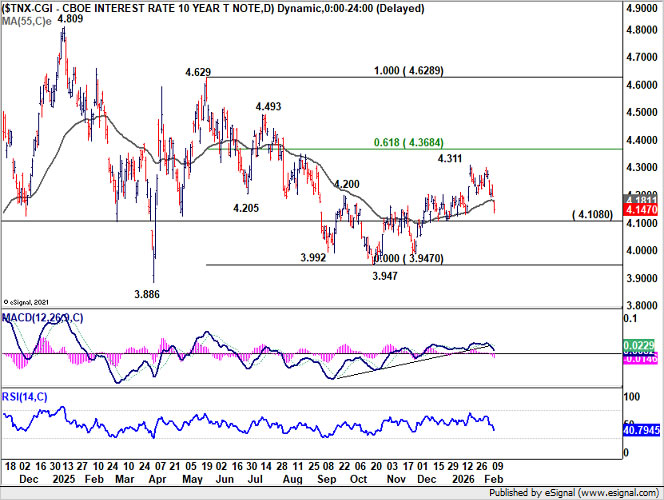
                          The global financial community is poised at the edge, eagerly awaiting US non-farm payroll data due today. This palpable sense of anticipation is evident as Dow is ensnared in sideways motion after crossing the crucial 33,000 psychological mark. Additionally, Dollar Index is retracing steps after touching its highest level in almost a year, and 10-year Treasury yield is cooling off from its pinnacle since 2007.

                          The upcoming data’s multifaceted nature, covering job growth, unemployment rates, and wage growth, complicates the prediction of market reactions. If these metrics present a disjointed picture, deciphering the market’s response becomes even trickier. Robust employment figures could potentially reinforce the prospect of an additional Fed rate hike before year’s end. However, a spike in Treasury yields, a byproduct of strong data, could, paradoxically, reduce the necessity for another move due to tightened financial conditions. Nevertheless, both scenarios would likely dampen stocks, and in a climate of risk aversion, bolster Dollar.

                          Today’s market expectations hinge on a 168k increase in headline non-farm payrolls growth for September, with an anticipated decline in the unemployment rate from 3.8% to 3.7%. Predictions also point towards a 0.3% mom rise in average hourly earnings, keeping the annual rate steady at 4.3% yoy.

                          However, other employment-related metrics present a mixed picture, notably the disappointing 89k growth shown by ADP private employment. On the brighter side, ISM Manufacturing employment index showed improvement 48.5 to 51.2, even as its services counterpart registered a dip from 54.7 to 53.4. The four-week average of initial jobless claims also saw a decrease from 229k to 209k.

                          Technically, NASDAQ has been in range trading since falling to 12963.16 late last month. Sustained break of 38.2% retracement of 10088.82 to 14446.55 at 12781.89 will strengthen the case that rise from 10088.82 has completed. That would also mean that the long term pattern from 16212.22 has already started third leg. Deeper fall would be seen to 61.8% retracement at 11753.47 next in the near term.

                          Nevertheless, strong rebound from current level, followed by sustained break of 55 D EMA (now at 13524.91) would argue that rise from 10088.82 is still intact. Another rally through 14446.55 would likely be seen before NASDAQ tops.

                          Japanese wages growth underwhelm as real income sinks for 17th mth

                            Subdued wage growth data in Japan is raising eyebrows, particularly at BoJ. An essential element for the central bank’s policy normalization is the establishment of a harmonious cycle between wage growth and prices. The recent figures, however, indicate that this equilibrium remains elusive.

                            In August, labor cash earnings in Japan rose by a meager 1.1% yoy. This increase, while consistent with the prior month, fell short of the anticipated 1.5% growth. Furthermore, base salary growth, although increasing to 1.6% yoy from the preceding month’s 1.4%, has yet to manifest signals of a robust and sustainable upward momentum.

                            The bright spot, perhaps, is the increase in overtime pay, which is often used as an indicator of business vibrancy, as 1.0% yoy ascent was observed, rebounding from July’s flat growth.

                            However, inflation-adjusted real wages continued their downward spiral for the 17th consecutive month. August’s real wages declined by -2.5% yoy, surpassing the projected -2.1% yoy dip. This trend starkly reveals that despite any increments, wages are struggling to keep up with the consistent price surges, placing added strain on the average consumer’s pocket.

                            Also released, household spending, a critical driver of economic activity, contracted by -2.5% yoy, a figure that, while better than the anticipated -4.3% yoy decline and an improvement from July’s -5.0% yoy reduction, still underscores constrained consumer expenditure.

                            Fed’s Barkin links yield surge to robust data, abundant supply

                              Richmond Fed President Thomas Barkin expressed a cautious stance yesterday, indicating it’s “too early to know if another rate increase would be needed this year.”

                              He further elaborated on the need for a wait-and-see approach, suggesting, “We have time to see if we’ve done enough or whether there’s more work to do.”

                              “The path forward depends on whether we can convince ourselves inflationary pressures are behind us or whether we see them persistent.” Alongside inflation, Barkin pinpointed the labor market as a pivotal area of focus.

                              Addressing the recent surge in Treasury yields, Barkin attributed it to an abundant fiscal issuance, indicating, “There’s a lot of fiscal issuance out there. That’s creating a lot of supply.” He also acknowledged the role of recent strong economic data in pushing the yields higher.

                              Fed’s Daly points to rising yields and diminishing need for rate hike

                                San Francisco Fed President Mary Daly weighed in on the implications of the recent spike in the benchmark 10-year Treasury note yield, which marked a 16-year peak at 4.8%.

                                “If financial conditions… remain tight, the need for us to take further action is diminished,” she said yesterday, adding that the role of the financial markets in this scenario, suggesting that “they’ve done the work.”

                                On the market’s response to rising bond yields, she observed a dip in probabilities for another hike at the upcoming November meeting. “To me, that says the markets are understanding how we think about things and they do have the reaction function in mind,” she elaborated.

                                Daly reiterated that continual observation of economic indicators, specifically a “cooling labor market” and inflation gravitating towards target, could justify steadiness in interest rates.

                                She elaborated that maintaining rates isn’t a passive stance but an “active policy action,” especially as declining inflation augments the restrictive impact of existing policy measures.

                                However, she also emphasized adaptability, hinting that should economic indicators such as growth and inflation not decelerate as expected, or if financial conditions become overly relaxed, Fed is prepared to raise rates until monetary policy achieves its desired restrictiveness. “We need to keep an open mind, and have optionality,” she underscored.

                                ECB’s Villeroy points to plateau in rates; dismisses need for rate hike

                                  ECB Governing Council member Francois Villeroy de Galhau, in an interview with the German newspaper Handelsblatt published yesterday, weighed in on the current debate surrounding ECB’s interest rates. Stating his view clearly, Villeroy remarked, “Today, I think there’s no justification for an additional increase in the ECB rates.”

                                  Rather than focusing on the peak in rates, Villeroy believes the dialogue should shift towards the concept of a rate “plateau.” In his words, “we’ll remain on this plateau as long as necessary.”

                                  Villeroy also provided reassurance regarding the economic outlook of the eurozone. Contrary to the hard landing fears that loomed last winter, he noted, “We are not facing the worst-case scenario.” Elaborating further, he added, “I believe our monetary policy can and should now aim for a soft landing for the euro zone: We’ll exit inflation, and we’ll probably do so without a recession.”

                                  Commenting on the broader market sentiments, Villeroy observed that expectations, both in Europe and US, have historically been “a little too optimistic regarding a future rate cut.”

                                  US initial jobless claims rose to 207k, below expectations

                                    US initial jobless claims rose 2k to 207k in the week ending September 30, below expectation of 211k. Four-week moving average of initial claims dropped 2.5k to 209k.

                                    Continuing claims dropped -1k to 1664k in the week ending September 23. Four-week moving average of continuing claims fell -5k to 1668k.

                                    Full US jobless claims release here.

                                    Canada records unexpected trade surplus in Aug as exports surge

                                      Canada reported merchandise trade surplus of CAD 718m in August, marking its first monthly trade surplus since April. This comes after a deficit of CAD 437m in July and defies market expectations of a CAD -1.4B deficit.

                                      Driving this positive turnaround, exports in August jumped by 5.7% mom, marking the most robust growth since October 2021. This surge was widespread, with gains registered in 7 of the 11 product sections.

                                      Meanwhile, imports also witnessed a 3.8% mom uptick, with increments seen in 9 of the 11 product sections.

                                      Full Canada trade release here.


                                      BoE survey shows business inflation expectations cool

                                        BoE’s Decision Maker Panel survey for September indicating an anticipated ease in output price inflation, slowly easing CPI inflation expectation, and subtle nuances in wage growth predictions

                                        A notable takeaway from the survey is the anticipated decline in output price inflation over the next year. Businesses foresee their year-ahead own-price inflation at 4.8%, a slight moderation from the 5.0% noted in the preceding three months to August. This decline hints at an expectation of easing price pressures, offering a counter-narrative to prevalent inflation concerns.

                                        On the consumer front, one-year ahead CPI inflation expectations inched higher to 4.9% in September from 4.8% in August. However, a broader perspective reveals a decline, with the three-month moving average dipping by 0.3 percentage points to 5%. Looking further ahead, three-year CPI inflation expectations held steady at 3.2% in September, unaltered from August.

                                        In the realm of wages, the anticipated year-ahead wage growth was static at 5.1% on a three-month moving average basis. September’s single-month reading did register a slight uptick to 5.2%, a 0.2 percentage point increment from August. However, these expectations are notably subdued compared to realised wage growth.

                                        Full BoE DMP release here.

                                        ECB’s Kazimir strongly believe that latest hike was last

                                          ECB Governing Council member Peter Kazimir said today, “I strongly believe that our rate hike at the last meeting was the last one” The focus, he outlined, now shifts to the upcoming December and March forecasts, as “only real data can persuade us that we’re at the peak.”

                                          Kazimir addressed inflation concerns, observing that, “We see the overall inflation and also core inflation on a downward trend, though this is lasting a bit longer than we’d wanted.” He further highlighted the ripple effects of past rate hikes, pointing out that they “have an increasingly significant impact on the real economy.”

                                          Shedding light on the broader economic repercussions, he mentioned that “Financing conditions are tightening and are weakening demand for investments, in production and affecting overall economic growth.” With this context, Kazimir emphasized the urgency to manage inflation effectively and swiftly.

                                          On the topic of ECB’s PPEP reinvestments, Kazimir treaded cautiously, suggesting the bank was “ready for debate” but reiterated the importance of maintaining balance. The topic of altering the balance sheet’s reduction pace will be broached only when the Council is confident further rate hikes won’t be necessary.