NIESR forecasts UK GDP to contract -0.1% in Q1, outlook continues to improve

    NIESR forecasts UK GDP to contract -0.1% in Q1, a shallower contraction of -0.2% in prior forecast.

    Paula Bejarano Carbo, Associate Economist, NIESR, said “The outlook for the first quarter of 2023 continues to improve as higher-frequency data, including the services and construction February PMIs, indicate that activity will continue to pick-up in February, suggesting that any contraction we might see over Q1 is likely to be shallow.”

    Full release here.

    CHF/JPY powers through channel resistance on strong Franc

      Swiss Franc is surprisingly the strongest one for the week for now, ahead of NFP. In the background, expectations for another 50bps rate hike by SNB on March 23 solidified after data earlier this week showed consumer inflation reaccelerated in February. Tightening could also continue in June if high inflation persists.

      Additional boost was seen as on safe haven flow after the US stock markets tumbled overnight while risk off sentiment carried on today. Besides, steep decline in US and European benchmark treasury yields also helped.

      On the other hand, Yen is pressured after BoJ left monetary policy unchanged, and indicated it’s in no rush to alter the ultra-loose stance.

      CHF/JPY finally break through the medium term channel resistance with some conviction today, and hit as high as 145.69. The development affirms the case that correction from 151.43 has completed at 137.40 already after drawing support from 55 week EMA. , Larger up trend is probably ready to resume. For the near term, outlook will stay bullish as long as 144.95 support holds. Retest of 151.43 high should be seen next.

      UK GDP grew 0.3% mom in Jan as services rose 0.5%

        UK GDP grew 0.3% mom in January, better than expectation of 0.1% mom. Services rose 0.5% mom. Production declined -0.3% mom. Construction fell by -1.7% mom.

        For the three months to January, however, GDP was flat. Services was flat. Production grew by 0.3% while construction contracted -0.7%.

        Full GDP release here.

        Also published, manufacturing production came in at -0.4% mom, -5.2% yoy in January, versus expectation of -0.1% mom, -5.0% yoy. Industrial production was at -0.3% mom, -4.3% yoy, versus expectation of -0.1% mom, -4.0% yoy. Goods trade deficit narrowed from GBP -19.3B to GBP -17.9B, versus expectation of GBP -17.5B.

        DOW broke key support as focus turns to NFP

          DOW suffered a sharp decline overnight, losing -543.5 points or -1.66%, and broke an important near term support level. The banking sector led the sell-off, with the S&P 500’s bank index finishing down -6.6%. Investor caution was also evident ahead of today’s job data release. If the data shows strength, it would back up Fed Chair Jerome Powell’s indications of a 50bps rate hike, which could lead to higher rates that remain for longer. Good news could become bad news again, as investors remain wary of the potential consequences of higher interest rates on the market.

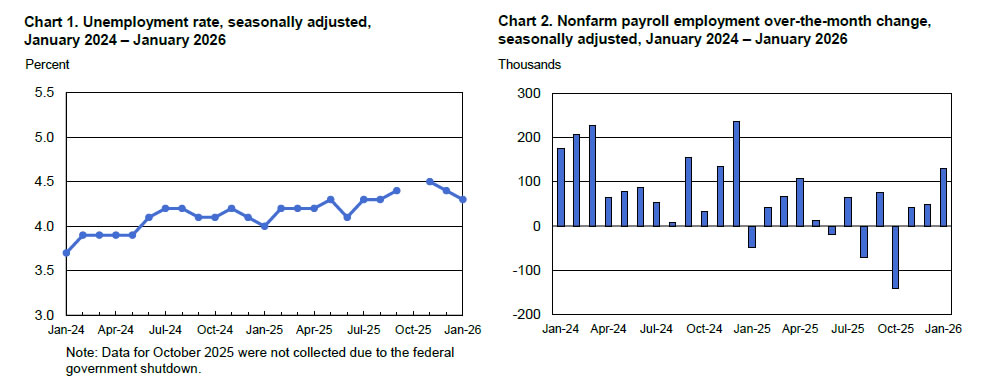
          The non-farm payroll report is expected to show a growth of 200k jobs for February. Investors will also be closely monitoring any revisions made to January’s stellar 517k job growth. Unemployment rate is predicted to remain steady at 3.4%, while wage growth is expected to continue its momentum with a 0.3% mom rise.

          Related data includes ADP private job report, which demonstrated a 242k increase in jobs for the same month, mostly driven by a 190k rise in the services sector. Meanwhile, ISM manufacturing employment index dropped from 50.6 to 49.1, while the ISM services employment index rose sharply from 50.0 to 54.0. The four-week moving average of initial jobless claims remained relatively stable at 197k. Overall, the data indicated a strong employment market, led by services.

          Technically, the close below 38.2% retracement of 28660.94 to 34712.28 at 32400.66 suggests fall from 34712.28 is going to be a deep correction at least, with potential of being bearish reversal. Prior rejection by the 55 day EMA is also not a positive sign. Deeper decline is now in favor back to 61.8% retracement at 30972.55, if DOW couldn’t rebound in the coming days. Reactions from 30972 would reveal whether DOW is heading back through 28660.94 low to resume the down trend from last year’s high at 36952.65.

          BoJ stands pat and maintains easing bias

            As anticipated, BoJ left its monetary policy unchanged today, maintaining its easing bias. Despite a rise in inflation expectations, CPI is projected to slow down during the current fiscal year before experiencing a moderate increase once again.

            Under yield curve control, short-term policy rate was held at -0.10%. Long-term interest rate will remain at around 0% with necessary purchase of JGBs without an upper limit. The band for 10-year JGB yield to fluctuate stayed at plus and minus 0.5%.

            BoJ maintained the pledge to continue with QQE with YCC for “as long as it is necessary”. It “will not hesitate to take additional easing measures if necessary”. It also expects “short- and long-term policy interest rates to remain at their present or lower levels”.

            BoJ said the economy “has picked up” with exports and industrial production “more or less flat”. The economy is projected to “continue growing at a pace above its potential growth rate” as a virtuous cycle form income to spending intensifies gradually.

            Inflation expectations “have risen”. But, CPI is “likely to decelerate toward the middle of fiscal 2023”, then “accelerate moderately” on the back of improvement in output gap, rises in medium- to long-term inflation expectations in wage growth, and waning down of energy prices measures.”

            The meeting was the last one to be chaired by Governor Haruhiko Kuroda. Kazuo Ueda was approved by both houses of the parliament this week as the next BoJ Governor.

            Full statement here.

            New Zealand BNZ manufacturing rose to 52, gearshift but not strong

              New Zealand BusinessNZ Performance of Manufacturing Index rose from 51.2 to 52.0 in February, signalling further increase in expansion. But the reading was still below its long-term average of 53.0.

              Looking at some details, production dropped from 52.0 to 49.4. Employment rose from 51.6 to 54.0. New orders rose from 49.2 to 52.0. Finished stocks rose from 52.7 to 55.8. Deliveries was unchanged at 51.8.

              BNZ Senior Economist, Craig Ebert stated that “it’s been a New Year gearshift, out of reverse. However, these are not what you’d call strong results – in total, and especially when delving into the details. That said, February’s PMI, like January’s, did denote expansion, overall, and is not all that far shy of its long-term average of 53.0”.

              Full release here.

              BoC Rogers: More evidence needed to decide whether policy is restrictive enough

                BoC Senior Deputy Governor Carolyn Rogers reiterated in a speech yesterday that tightening is in a “conditional pause”. More evidence is needed to decide whether policy is restrictive enough. Services price inflation will need to cool further.

                The decisive to leave policy rate unchanged at 4.50% on Wednesday was a “conditional pause”. “If economic developments unfold as we projected and inflation comes down as quickly as we forecast in the January Monetary Policy Report (MPR), then we shouldn’t need to raise rates further,” she said. “But if evidence accumulates suggesting inflation may not decline in line with our forecast, we’re prepared to do more.”

                Economic data since January showed a “mixed picture”. While “things are unfolding broadly in line with our outlook,” she added, ” We’ll need to see more evidence to fully assess whether monetary policy is restrictive enough to return inflation to 2%.”

                Rogers also noted that inflation is “coming down largely as expected” with a “clear momentum shift in goods prices”. However, “services price inflation needs to cool further”. Companies need to “return to more normal pricing behavior”.

                “Year-over-year and three-month rates of core inflation will both need to come down more than they have for inflation to return sustainably to 2%, as will short-term inflation expectations,” she said.

                Full speech here.

                US initial jobless claims rose to 211k, above expectations

                  US initial jobless claims rose 21k to 211k in the week ending March 4, above expectation of 195k. Four-week moving average of initial claims rose 4k to 197k.

                  Continuing claims rose 69k to 1718k in the week ending February 25. Four-week moving average of continuing claims rose 10k to 1680k.

                  Full release here.

                  AUD/JPY and NZD/JPY break support ahead of Kuroda’s last BoJ meeting

                    Yen is seeing a broad recovery today as investors anticipate Haruhiko Kuroda’s last BoJ monetary policy meeting tomorrow. As with four of his predecessors, Kuroda is unlikely to make any changes to policy during this last meeting, with his comments expected to echo what has been said numerous times before. Specifically, he is likely to reiterate that the current ultra-loose monetary policy is still appropriate until there is sustained inflation above the 2% target led by wage growth.

                    Meanwhile, the government’s nominees for the next BoJ Governor and Deputy Governors have been approved by the lower house of parliament today. The upper house will vote on the nominees tomorrow. Kazuo Ueda will officially replace Kuroda on April 8, and chair his first monetary policy meeting on April 27-28. The two deputy governor nominees, Shinichi Ueda and Ryozo Himino, will take office from March 20.

                    Yen is making progress today by breaking through near term resistance levels against commodity currencies. AUD/JPY’s break of 90.21 support argues that corrective rise from 87.00 has completed at 93.02. Sustained trading below channel support (now at 89.91) will affirm this bearish case and target 87.00/88.10 support zone.

                    NZD/JPY’s break of 83.59 support also argue that corrective pattern from 81.02 has completed at 85.20. Sustained trading below trend line support (now at 83.44) will bring deeper fall to 82.31 support first, and then 81.02 low.

                    ECB Villeroy: Inflation will halve by year end

                      ECB Governing Council member Francois Villeroy de Galhau said “what is very important is the inflation expectations”.

                      “The peak will come this semester, and then inflation will halve by the end of the year,” he added.

                      The Bank of France head also expect France’s inflation to peak in first half of the year.

                      Bitcoin extends pull back after voluntary liquidation of crypto-friendly bank

                        Bitcoin has continued to experience a near-term pullback this week due to a decline in risk appetite following hawkish comments by Fed Chair Jerome Powell. Additionally, the voluntary liquidation of Silvergate Bank, a major player in cryptocurrency markets, has weighed down the digital currency, marking a setback for wider adoption of cryptocurrencies in the economy.

                        From a technical perspective, Bitcoin’s rebound from 15452 could have ended at 25242 in February, after being rejected by 25198 resistance. The daily MACD shows a bearish divergence, and the 55 Day EMA was broken this week.

                        However, confirmation of a near-term reversal would require a firm break of 21357 support. Otherwise, outlook remains neutral. Alternatively, a firm break of 21357 would signal a deeper decline back to the 15452 low.

                        Fed Beige Book: Economy in slight growth, inflation to moderate

                          According to the Fed’s recent Beige Book report, US economy experienced slight growth at the beginning of the year. However, consumers’ purchasing power and discretionary income have been affected by high inflation and higher interest rates. The labor market conditions were solid, with moderate wage increases expected in the coming year. Inflationary pressures persisted throughout various districts, but the rate of price increases has moderated, with many contacts anticipating this trend to continue.

                          Overall economic activity “increased slightly” in early 2023 with six of twelve districts reported that activity ” expanded at modest pace”. Several districts said “high inflation and higher interest rates continued to reduce consumers’ discretionary income and purchasing power”. Manufacturing activity “stabilized following a period of contraction”.

                          Labor market conditions “remained solid” while ages “generally increased at a moderate pace”. Wages increases are expected to “moderate further in the coming year”.

                          Inflationary pressures “remained wide spread” but price increased “moderated” in many districts. Looking ahead, “contacts expected price increases to continue to moderate over the year.”

                          Full Beige Book here.

                          BoC stands pat as conditional pause starts

                            BoC kept overnight rate unchanged at 4.50% as widely expected. It reiterated the stance to hold policy rate at current level, “conditional on economic developments evolving broadly in line with the MPR outlook”. Nevertheless, BoC is “prepared to increase the policy rate further if needed.”

                            In the accompanying statement, BoC noted, “the latest data remains in line with the Bank’s expectation that CPI inflation will come down to around 3% in the middle of this year.”

                            Full statement here.

                            US ADP jobs grew 242k in Feb, pay growth still quite elevated

                              US ADP private sector employment grew 242k in February, above expectation of 200k. By sector, goods-producing jobs rose 52k and service-providing jobs rose 190k. By size, small companies lost -61k jobs, but medium companies added 148k and large companies added 160k. Pay growth for job stays slowed to 7.2% yoy, slowest in 12 months.

                              “There is a tradeoff in the labor market right now,” said Nela Richardson, chief economist, ADP.  “We’re seeing robust hiring, which is good for the economy and workers, but pay growth is still quite elevated. The modest slowdown in pay increases, on its own, is unlikely to drive down inflation rapidly in the near-term.”

                              Full release here.

                              BoE Dhingra: Prudent to hold rates steady because of material overtightening risk

                                BoE dove Swati Dhingra warned in a speech that overtightening posses a more material risk now. She called for holding interest rate unchanged.

                                “Overtightening poses a more material risk at this point, through potential negative impacts from increased borrowing costs and reduced supply capacity going forwards,” she explained. “It risks unnecessarily denting output at a time when the economy is weak and deepening the pain for households when budgets are already squeezed through energy and housing costs.”

                                “In my view, a prudent strategy would hold policy steady amidst growing signs external price pressures are easing, and be prepared to respond to developments in price evolution. This would avoid overtightening and return the economy sustainably to our 2% inflation target in the medium-term.”

                                “Overall, the evidence does not point to persistent cost-push inflation becoming embedded in wages and margins,” she said. “Even after a year and a half of above-target inflation, there is little evidence for such cost-push inflation beyond what might be expected following an unprecedented terms of trade shock.”

                                “Consumption remains weak and many of the tightening effects of monetary policy are yet to fully take hold,” she added.

                                Full speech here.

                                BoC to stand pat, CAD/JPY staying bullish in range

                                  BoC is widely expected to stand pat today, and keep the benchmark overnight rate unchanged at 4.50%. Governor Tiff Macklem has explicitly indicated that in inflation comes down as predicted, there is no need to raise interest rates further. But of course, he’s prepared to act if that doesn’t happen as expected. For now, markets are pricing in around 80% chance of another hike within this year. But it’s too early for BoC to shift its evidence for now.

                                  Some previews on BoC:

                                  Canadian Dollar’s performance this week is not too bad, as it’s just down against the strong Dollar, Euro and Swiss Franc. For example, CAD/JPY is just holding in range below 100.85 temporary top, with the shallow retreat contained above 99.02 support, as well as 55 day EMA. Further rally remains in favor.

                                  Firm break of 38.2% retracement of 110.87 to 94.61 at 110.82 will argue that the down trend from 110.87 to 94.61 is reversal. That would bring stronger rally to 61.8% retracement at 104.65. (USD/JPY has taken out equivalent level of 38.2% retracement of 151.93 to 127.20 at 136.64 already).

                                  Markets raise bets on 50bps Fed hike, a look at DOW and DXY

                                    The markets were rocked by the “clear-cut” hawkish remarks by Fed Chair Jerome Powell overnight. In short, “he indicated that ultimate level of interests is “likely to be higher than previously anticipated”. Fed is also “prepared to increase the pace of rate hikes”. He also warned against “prematurely loosening policy. More here.

                                    As a result, Fed fund futures are now pricing in 73% chance of a 50bps rate hike to 5.00-5.25% on March 22, comparing to just 31% a day ago.

                                    The stock markets were sold off deeper, with DOW losing -1.72% or -574.98 pts to close at 32856.46. Technically, it isn’t the end of the world for DOW… yet, as it’s staying in familiar range despite the selloff The rejection of 55 day EMA is a bearish sign though.

                                    So, near term focus is now back on 38.2% retracement of 28660.94 to 34712.28 at 32400.66. As long as this level holds, DOW is just in a sideway consolidation pattern.

                                    However, sustained break there will suggest bearish reversal and at least bring deeper fall to 61.8% retracement at 30972.55.

                                    Dollar index closed sharply higher on expectation of more aggressive Fed and risk aversion The support from 55 day EMA is a near term bullish sign. But DXY will still need to overcome 38.2% retracement of 114.77 to 100.82 at 106.14 to confirm underlying momentum.

                                    Rejection by 106.14 will keep the rise from 100.82 as a corrective move and maintains medium term bearishness for another fall through 100.82 at a later stage. However, sustained break of 106.14 will indicate trend reversal and bring stronger rally to 109.44, and possibly above.

                                    RBA Lowe: Further tightening required, but closer to a pause

                                      RBA Governor Philip Lowe said in a speech that further rate hike is still necessary. But the central bank is now closer to the point of a pause.

                                      The board’s judgment remained that “further tightening of monetary policy is likely to be required to bring inflation back to target within a reasonable timeframe”, Lowe said.

                                      “Inflation is still too high and while it looks to be on a declining path it is likely to remain higher than target for a few years,” he added. “If we don’t get inflation down fairly soon, the end result will be even higher interest rates and more unemployment.

                                      Meanwhile, ” with monetary policy now in restrictive territory, we are closer to the point where it will be appropriate to pause interest rate increases to allow more time to assess the state of the economy,” he noted.

                                      “At what point it will be appropriate to pause will be determined by the data and our assessment of the outlook”.

                                      Full speech here.

                                      SNB Jordan: Monetary policy is still too loose

                                        SNB Chairman Thomas Jordan, stated that the current monetary policy is too loose to bring inflation back to price stability in the medium term, and further tightening cannot be ruled out. The comment came after recent data showed that consumer inflation reaccelerated to 3.4% in February, staying well above SNB’s 0-2% target.

                                        “The SNB’s monetary policy is still too loose to return inflation back to price stability in the medium term,” Jordan yesterday at Zurich University. “We cannot exclude that we have to tighten further.”

                                        “The SNB has to act to reach price stability in the medium term again,” he said. “The barren Swiss labor market can lead to second- and third-round effects happening more easily.”

                                        Meanwhile Jordan also pointed out that the central bank has more than one option, as “we can raise rates, but also sell foreign currency — and we have sold foreign currency in the past.”

                                        SNB will meet on March 23 to decide on monetary policy.

                                        Fed Powell: Higher ultimate rate, ready to hike faster, no premature loosening

                                          Dollar soars on hawkish comments from Fed Chair Jerome Powell. He indicated that ultimate level of interests is “likely to be higher than previously anticipated”. Fed is also “prepared to increase the pace of rate hikes”. He also warned against “prematurely loosening policy.

                                          “The latest economic data have come in stronger than expected, which suggests that the ultimate level of interest rates is likely to be higher than previously anticipated,” Powell said in the prepared remarks for the semi-annual testimony to Congress.

                                          Additionally, “if the totality of the data were to indicate that faster tightening is warranted, we would be prepared to increase the pace of rate hikes,” he added.

                                          “Our overarching focus is using our tools to bring inflation back down to our 2 percent goal and to keep longer-term inflation expectations well anchored,” Powell emphasized. “Restoring price stability is essential to set the stage for achieving maximum employment and stable prices over the longer run.”

                                          “The historical record cautions strongly against prematurely loosening policy. We will stay the course until the job is done,” he said.

                                          Full remarks here.