BoE Bailey: Labor force shrinkage the major risk to UK inflation

    BoE Governor Andrew Bailey told a parliamentary committee yesterday that inflation could fall back substantially this year. Still, there are risks from labor shortage and China.

    “The biggest single reason inflation has risen to that level is the war in Ukraine. It is also the most likely reason that we’re going to see a rapid fall in inflation in the year ahead, because we are not seeing energy prices rising further. In fact, they’re coming down,” he said.

    “Going forwards, the major risk to inflation coming down in the way that it will is the supply side,” Bailey said. “In this country particularly the question of the shrinkage of the labor force,” which has pushed up wages.

    “First of all in the economic outlook it think it’s quite likely we will see a negative impact in the short run in China from what’s going on at the moment from the release of the Covid restrictions and the impact that’s having,” Bailey said. “I’m not sure that would be very long lasting.”

    WEF: 63% chief economists expect global recession in 2023

      In the Chief Economists Outlook of the World Economic Forum, 63% of survey respondents said a global recession is likely this year, with 18% saying that it’s “extremely likely”.

      Prospect for growth was also bleak, all respondents expecting weak growth in Europe, (68% very weak and 32% weak). 91% expect weak growth in the US (9% very weak, and 82% weak. Even for China, 48% expect weak growth (10% very weak, 38% weak).

      Inflation expectations saw significant variation across regions. All respondents expect high inflation in Europe (43% high, 57% very high). Also, all respondents expect high inflation in the US (76% high, 24% very high). But only 53% expect high inflation in China (48% high, 5% very high).

      Full release here.

      Canada manufacturing sales flat at CAD 72.3B in Nov

        Canada manufacturing sales were flat at CAD 72.3B in November, below expectation of 2.3% mom growth. higher sales of durable goods (+1.8%), led by motor vehicles (+12.7%) and fabricated metal products (+2.7%), were offset by lower sales of non-durable goods (-1.7%), led by the chemical (-4.4%) and petroleum and coal product (-2.1%) industries.

        Full release here.

        Japan yield curve distortion worsens, Nikkei down

          Japanese stocks, bonds and currency market remain rather nervous today, as traders are eyeing BoJ policy decision on Wednesday. The yield curve “distortion”, as described by the central bank, was getting more serious after 8- and 9-year yield surged past 0.6% handle last week. At the same time, 10-year JGB yield, closed at 0.514, is still firmly tied to the 0.5% cap. Both 8- and 9-year yield closed down but stayed above 10-year’s level at 0.624 and 0.632.

          As speculation on a YCC tweak to rectify the distortion intensified , Nikkei declined -1.14% to close at 25822.32. Technically speaking, while deeper decline is possibly for the near term, strong support should be seen around 24681.74 to contain downside. The level is close to 55 month EMA, which stands at 24754.15. Nikkei has been continuously supported by the EMA, as well as the long term channel, for a decade, barring the initial two months of the pandemic. But a firm break of 24681.74 will indicate something rather substantial is happening.

          Japan PPI up 10.2% yoy in Dec, second highest on record

            Japan PPI rose 10.2% yoy in December, accelerated from 9.7% yoy, above expectation of 9.5% yoy. The reading topped 10% handle for the second time in 2022, marking the second-largest gains on record, following the 10.3% yoy jump in September.

            For 2022, wholesale prices rose 9.7% on average, hitting a new record high since comparable data became available in 1981. It’s also twice as fast as in 2021 when a 4.6% increase was reported.

            Full release here.

            AUD/CAD extending near term rally, to target 0.96 next

              While risk on-sentiment is supporting commodity currencies in general, Aussie has been outperforming others recently. Reacceleration in Australian consumer inflation as shown in last week’s November monthly CPI data suggests little room for RBA to pause for now. Additionally, there is optimism over China’s reopening, as well as resumption of coal purchases.

              AUD/CAD opened the week with solid buying. the development should confirm resumption of whole rise from 0.8596 low. Near term outlook will stay bullish as long as 0.9142 support holds, even in case of retreat. Next target is 61.8% projection of 0.8596 to 0.9328 from 0.9142 at 0.9594.

              During the move, AUD/CAD should also take out 0.9514 resistance to confirm completion of the three-wave corrective decline from 0.9991 (2021 high). That would set the stage for further rally through 0.9991 to resume the rise from 0.8058 (2020 low) in the medium term.

              Bitcoin pressing resistance after regaining 20k

                Bitcoin started the year strongly and regained 20k handle last week. Total market cap also surged past USD 400B level. The move followed overall risk-on sentiment, on expectations that Fed is ready to further slow down the tightening pace. While it’s still early to call for a sustainable trend reversal, the worst looks increasingly likely behind.

                Technically, considering bullish convergence condition in daily and week MACD, 15452 should be a medium term bottom at least. Immediate focus is now on 21460 resistance. Firm break there will confirm this case and bring further rise back to 25198 resistance.

                Nevertheless, to secure a trend reversal, Bitcoin will need to break through 55 week EMA (now at 25677) in rather decisive manner. Otherwise, it’s probably just setting up the range for some medium term sideway trading instead. So, 25k would be the next level to pay attention to.

                NIESR expects 0.1% UK GDP growth in Q4, Q1 risk on the downside

                  After today’s UK GDP release, NIESR forecasts that GDP in December will fall relative to November. But overall, service-driven GDP growth of 0.1% in Q4 is estimated.

                  Paula Bejarano Carbo, Associate Economist, NIESR, said: “Given that PMIs for services, manufacturing and construction all posted below the neutral 50 for December, we expect to see a slight fall in GDP in December relative to November; but this means a rise in quarterly GDP, possibly a sign that households are enjoying a last hurrah before they tighten their belts in 2023.

                  ” Looking towards the first quarter of 2023, the risks to GDP seem to remain on the downside, driven by anaemic growth in the major sectors, fragile consumer and business confidence and a widespread fall in real incomes.”

                  Full release here.

                  Eurozone exports rose 17.2% yoy, imports up 20.2% yoy in Nov

                    Eurozone export of goods to the world rose 17.2% yoy to EUR 264.7B in November. Imports rose 20.2% yoy to EUR 276.3B. Trade deficit came in at EUR -11.7B. Intra-Eurozone trade rose 16.8% yoy to EUR 241.5B.

                    In seasonally adjusted term, exports rose 1.0% mom to EUR 251.5B. Imports dropped -3.8% mom to EUR 266.7B. Trade deficit narrowed from October’s EUR -28.1B to EUR -15.2B, versus expectation of EUR -20.0B. Intraday Eurozone trade dropped from October’s EUR 233.4B to EUR 232.2B.

                    Full release here.

                    Eurozone industrial production rose 1.0% mom in Nov, EU up 0.9% mom

                      Eurozone industrial production rose 1.0% mom in November, above expectation of 0.6% mom. Production of capital goods grew by 1.0%, intermediate goods by 0.8% and durable consumer goods by 0.4%, while production of energy fell by -0.9% and non-durable consumer goods by -1.3%.

                      EU industrial production rose 0.9% mom. Among Member States for which data are available, the highest monthly increases were registered in Ireland (+6.4%), Luxembourg (+5.0%) and Malta (+4.6%). The largest decreases were observed in Estonia (-3.7%), Sweden (-3.3%) and Croatia (-1.9%).

                      Full release here.

                      ECB Kazaks: Core inflation currently a key gauge for inflation persistence

                        ECB Governing Council member Martins Kazaks pushed back on talks that the central bank would cut interest rates by the end of this year. He said he failed to see a “rationale” for that.

                        “It would take a deep recession with a sizeable jump in unemployment for inflation to sink and thus push for rate cuts,” the Latvian central bank governor said. “But that is not likely, given the current macro outlook.”

                        “It is possible for core inflation to continue trending up even as headline inflation is coming down, for instance, due to swings in energy prices,” he said. “In my view, core inflation currently is a key gauge for inflation persistence and policy decisions.”

                        He expects interest rate to rise “well into restrictive territory” but declined to estimate the terminal rate. “Uncertainty is too high, and we shall find it step-by-step,” he said.

                        UK GDP grew 0.1% mom in Nov, avoided contraction

                          UK real GDP grew 0.1% mom in November, much better than expectation of -0.3% mom contraction. Services grew 0.2% mom. Production declined -0.2% mom. Construction was flat. Overall monthly GDP is -0.3% below its pre-pandemic levels.

                          In the three months to November, GDP fell -0.3% 3mo3mo. there was a -0.1% decline in Services, -1.4% decline in production, with the only growth coming from 0.3% in construction.

                          Full GDP release here.

                          Also published, manufacturing production was down -0.5% mom, -5.9% yoy in November, versus expectation of -0.2% mom, -5.2% yoy. Industrial production was down -0.2% mom, -5.1% yoy, versus expectation of -0.1% mom, -2.8% yoy. Goods trade deficit widened to GBP -15.6B, versus expectation of GBP -14.9B.

                          China export plunged -9.9% yoy in Dec, imports dropped -7.5% yoy

                            China exports plunged -9.9% yoy in December in USD terms, worst drop since February 2020, but slightly better than expectation of -10.0% yoy. Imports fell -7.5% yoy, better than expectation of -9.8% yoy. Trade surplus widened from USD 69.8B to USD 78.0B, slightly above expectation of USD 77.9B.

                            In CNY term, exports declined -0.5% yoy while imports rose 2.2% yoy. Trade surplus widened from CNY 494B to CNY 550B, above expectation of USD 533B.

                            For 2022 as a whole, in US term, exports rose 7.2%, much worse than 2021’s 29.6%. Imports rose 1.1%, down sharply from 2021’xs 30.0%.

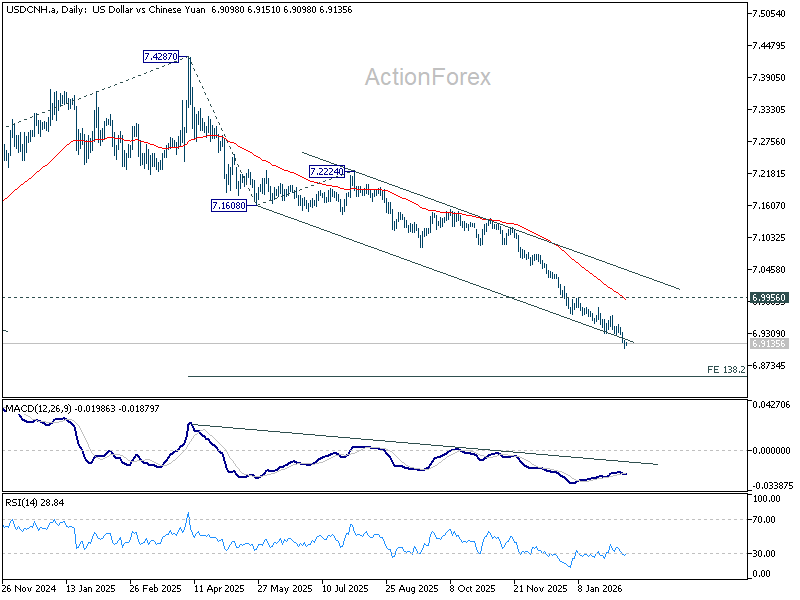
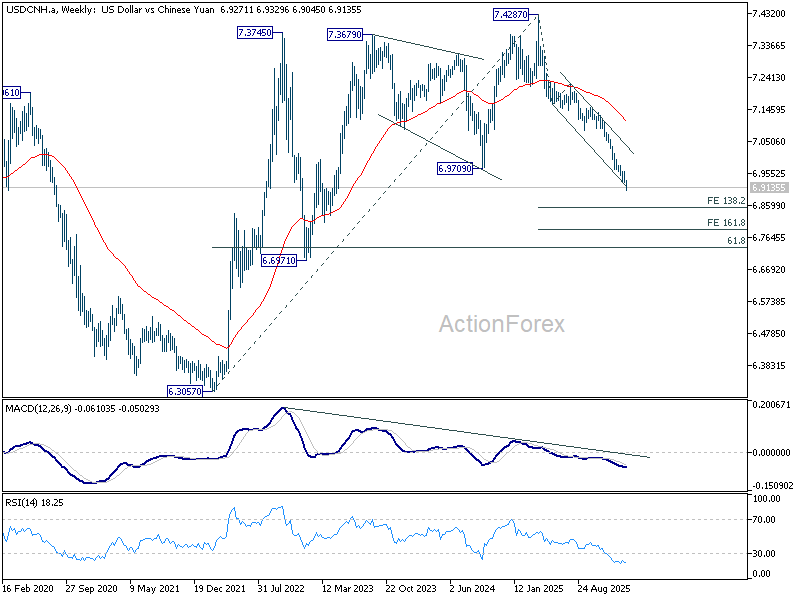
                            USD/CNH extended the decline from 7.3745 this week on Dollar’s broad based selloff. Nevertheless, it’s sitting close to an important support zone around 6.7159 (61.8% retracement of 6.3057 to 7.3745 at 6.7140). Considering oversold condition in daily RSI, a rebound should be due. Break of 6.7989 resistance will indicate short term bottoming, and bring rebound. But considering that the falling 55 day is now at around 6.9768, there is little prospect for the rebound to break through 7 handle for now.

                            BoE Mann: Bringing inflation down may require a significant recession

                              BoE MPC member Catherine Mann said yesterday that she’s “worrying about… underlying inflation dynamic looks pretty robust right now.” She explained that past rises in energy prices and other inflationary pressures are getting passed through higher prices of other goods and services.

                              “Our job is to bring that back to 2%.” She added that may require a “significant recession”. But, “getting inflation expectations under control, keeping them under control, is important.”

                              “Nobody likes to have higher interest rates. but nobody likes to have double digit inflation either,” Mann said.

                              Fed Barkin: Inflation to be more persistent than a simple drop to 2%

                                Richmond Fed president Tom Barkin said he was “in concept supportive of a path that is slower but longer and potentially higher” depending on how inflation behaves.

                                But he cautioned that while the average inflation dropped, “the median stayed high. He said. “That’s because the average was distorted by declining prices for goods like used cars that escalated unsustainably during the pandemic.”

                                Regarding the median inflation rate, “if the center of the distribution remains above our target, then I think we should continue to move rates,” he said. “Inflation is going to be more persistent than a simple drop down to 2%.”

                                Fed Bullard prefers getting rates above 5% asap

                                  St. Louis Fed President James Bullard said yesterday that it’s “encouraging” that inflation “went in the right direction.” “So far, so good. My bottom line for 2023 is that it will be a year of disinflation,” he said”. Yet, he emphasized his preference is still to get interest rate to above 5% “as soon as possible”.

                                  “There’s probably too much optimism inflation is going to easily come back to 2%. That is not the history of inflation,” Bullard said, “We are really moving into an era of higher nominal interest rates for quite a while going forward as we try to continue to put downward pressure.”

                                  US initial jobless claims dropped to 205k

                                    US initial jobless claims dropped -1k to 205k in the week ending January 7, below expectation of 210k. Four-week moving average of initial claims dropped -2k to 213k.

                                    Continuing claims dropped -63k to 1634k in the week ending December 31. Four-week moving average of initial claims dropped -9k to 1680k.

                                    Full release here.

                                    US CPI slowed to 6.5% yoy in Dec, core CPI down to 5.7% yoy

                                      US CPI declined -0.1% mom in December, below expectation of 0.0% mom. CPI core (ex food and energy) rose 0.3% mom, matched expectations. Food index rose 0.3% mom. Energy index dropped -4.5% mom.

                                      Over the last 12 months, CPI slowed from 7.1% yoy to 6.5% yoy, matched expectations. That’s also the lowest level since October 2021. CPI core slowed from 6.0% yoy to 5.7% yoy, matched expectations. Energy interest was at 7.3% yoy while food was at 10.4% yoy.

                                      Full release here.

                                      ECB Survey: Consumer inflation expectations reversed in Nov

                                        In ECB’s November Consumer Expectations Survey, mean inflation expectations for the 12 months ahead dropped back to 7.3%, comparing to October’s 8.1% and September’s 7.3%.

                                        Median inflation expectations for the 12 months ahead dropped to 5.0%, comparing to October’s 5.4% and September’s 5.1%.

                                        Mean inflation expectations for the 3 years ahead dropped to 4.6%, comparing to October’s 4.9%, and September’s 4.8%.

                                        Median inflation expectations for the 3 years ahead dropped to 2.9%, comparing to October’s 3.0%, and September’s 3.0%.

                                        Full release here.

                                        ECB Bulletin: Headline inflation to stay above target until mid-2025

                                          In the monthly Economic Bulletin, ECB said, “evidence from surveys and markets shows that forecasters continue to expect inflation to peak soon, with longer-term expectations remaining at around the ECB 2.0% target.” Still, “close monitoring is warranted given the further above-target revisions of some indicators”.

                                          In the December Eurosystem staff macroeconomic projections, headline inflation in Eurozone ill fall from average 8.4% in 2022 to 6.3% in 2023, 3.4% in 2024, and then 2.3% in 2025. Headline inflation is expected to remain above the ECB’s target of 2.0% until mid-2025

                                          Full economic bulletin here.