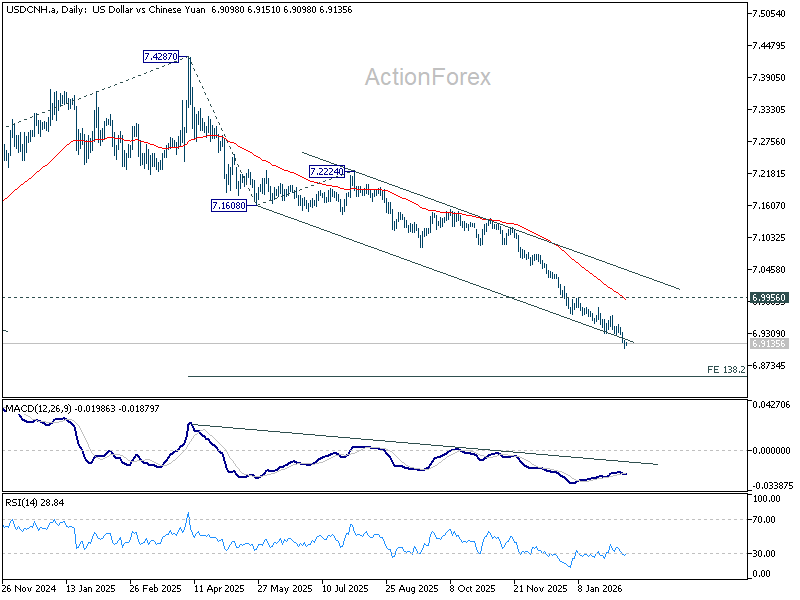
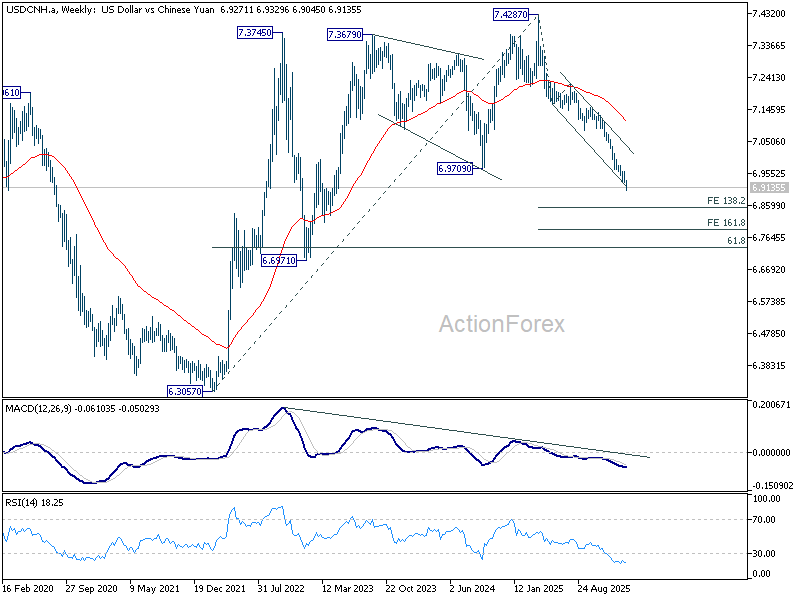
China PBoC cuts RRR, USD/CNH range bound

    China’s central bank PBoC announced to lower the reserve requirement ratio (RRR) by 0.25%, effect December 5. That’s the second cut this year, last being in April. The move is expected to released around CNY 500B in long-term liquidity to support the economy.

    PBoC sad in a statement the the cut is aimed at “keeping liquidity reasonably ample” and “increasing the support for the real economy.” It will also help banks support industries troubled by the pandemic.

    USD/CNH is staying in tight range after the announcement. Current development suggests that correction from 7.3745 might have completed at 7.0191 already, ahead of 7.0000 psychological level. Sustained break of 7.1714 support turned resistance will affirm this case, and bring stronger rise back to retest 7.3745 high.

    Germany Gfk consumer sentiment rose slightly to -40.2, but situation remains tense

      Germany Gfk Consumer Sentiment for December rose slightly from -41.9 to -40.2, better than expectation of -45.3. In November, economic expectations rose from -22.2 to -17.9. Income expectations rose from -60.5 to -54.3. Propensity to buy dropped from -17.5 to -18.6.

      “Consumers’ long-standing fear of skyrocketing energy prices has currently eased somewhat, which is having a slightly positive impact on consumer sentiment. On the one hand, some energy prices have recently recovered a bit, and on the other hand, consumers apparently assume that the measures adopted to cap energy prices can help curb inflation, even if this may turn out to be rather modest,” explains Rolf Bürkl, GfK consumer expert. “Despite the slight improvements, however, the situation remains tense.”

      Full release here.

      NZ retail sales volume rose 0.4% qoq in Q3, value rose 2.5% qoq

        New Zealand retail sales volume rose 0.4% qoq to NZD 26B in Q3, slightly below expectation of 0.5% qoq. Sale value rose 2.5% qoq to NZD 30B. Comparing with Q3 2021, sales volume rose 4.9% yoy and sales value rose 15% yoy.

        StatsNZ said, “The volume of sales in the food and beverage services industry (which includes cafes, restaurants, bars, and takeaways), increased 30 percent in the September 2022 quarter compared with the September 2021 quarter, helping to drive the rise in total retail sales.”

        Full release here.

        ECB accounts: Clear that rates would need to be raised further

          In the accounts of ECB’s October 26-27 meeting, it’s noted that the 75bps rate hike was “supported by a very large majority of members” with “a few members expressed a preference” for just 50bps.

          Still, with a 75bps hike, it was also “clear that rates would need to be raised further to reach a level that would deliver on the ECB’s 2% medium-term target”. In light of “prevailing uncertainties”, there was broad support for a “meeting-by-meeting, data-dependent approach” to taking monetary policy decisions.

          Full meeting accounts here.

          BoE Ramsden: Further increases in Bank rate are going to be required

            BoE Governor Dave Ramsden said in a speech that regarding the immediate outlook for the economy and policy, “some near term sources of uncertainty have eased but others remain.”

            “Because of the Government’s Energy Price Guarantee there is more certainty about the outlook for energy prices and Government policy more broadly is on a more stable and predictable footing…. The labour market remains tight and services inflation has hit 30-year highs and is contributing more to overall inflation”.

            “I am not yet confident that domestically generated inflationary pressures from increased costs and firms’ pricing pressures are starting to ease. Encouragingly survey and market based medium term inflation expectations have fallen back from their peak, though they remain elevated.”

            “Assuming that in the near term the economy evolves broadly in line with the latest MPR projections and given my assessment of the balance of risks, then I expect that further increases in Bank rate are going to be required to ensure a sustainable return of inflation to target.”

            Full speech here.

            Germany Ifo rose to 86.3, recession could prove less severe than expected

              Germany Ifo Business Climate rose from 84.5 to 86.3 in November, above expectation of 85.0. Current Assessment Index rose from 84.2 to 93.1, below expectation of 93.6. Expectations Index rose from 75.9 to 80.0, above expectation of 77.0.

              By sector, manufacturing rose from -15.4 to -11.7. Service rose from -8.5 to -5.4. Trade rose from -31.9 to -26.9. Construction rose from -24.0 to -21.6.

              Ifo said, “While companies were somewhat less satisfied with their current business, pessimism regarding the coming months reduced sharply. The recession could prove less severe than many had expected.”

              Full release here.

              Japan PMI manufacturing dropped to 49.4, services down to 50

                Japan PMI Manufacturing dropped from 50.7 to 49.4 in November, below expectation of 50.7. That’s the first contraction reading since January 2021. PMI Services dropped from 53.2 to 50.0. PMI Composite dropped from 51.8 to 48.9.

                Laura Denman, Economist at S&P Global Market Intelligence, said:

                “Activity at Japanese private sector firms declined for the first time in three months, according to November flash PMI data. Central to the latest downturn was a poor performance at Japanese manufacturing firms. Cooling demand conditions and acute inflationary pressures reportedly continued to hamper output and new orders… Meanwhile, services firms signalled no change in activity levels from the month prior.”

                Full release here.

                RBNZ Orr: We are officially contractionary with monetary policy

                  RBNZ Governor Adrian Orr told a parliamentary committee, “We can all put our hands on our hearts across the committee and say we are officially contractionary with our monetary policy at this point.”

                  “We need to get actual and expected inflation down,” Orr said. “The committee agreed that we need to reach a higher level Official Cash Rate sooner than previously anticipated.”

                  “It is the misery of inflation that is the problem here and that is the problem we are working to resolve,” Orr said.

                  “Our biggest surprises since August has been the persistence of global inflation… and domestically we are seeing price pressure everywhere,” said Orr.

                  BoC Macklem: We’re getting closer on rates, but not there yet

                    BoC Governor Tiff Macklem told a parliamentary committee yesterday that the central bank is “still far from its goal” of ensuring “low, stable, predictable” inflation.

                    “Inflation has come down in recent months, but we have yet to see a generalized decline in price pressures,” Macklem said. “This tightening phase will draw to a close. We are getting closer, but we are not there yet.”

                    “We anticipate that (inflation) will stay quite high for the rest of this year. It will start to decline next year,” he noted.

                    FOMC Minutes: A substantial majority judged slowing rate hikes soon appropriate

                      The minutes of FOMC November 1-2 meeting noted, the considerations that would influence the pace of future rate hikes include “the cumulative tightening of monetary policy to date, the lags between monetary policy actions and the behavior of economic activity and inflation, and economic and financial developments”.

                      “A number of participants” observed that, as monetary policy approached a stance that was “sufficiently restrictive”, it would become appropriate to slow the pace of rates increase.

                      Also, “a substantial majority of participants judged that a slowing in the pace of increase would likely soon be appropriate”.

                      Full minutes here.

                      US durable goods orders rose 1.0% mom in Oct, ex-transport orders up 0.5% mom

                        US durable goods orders rose 1.0% mom to USD 277.4B in October, above expectation of 0.4% mom. New orders were up seven of the last eight months. Ex-transport orders rose 0.5% mom to USD 179.6B, above expectation of 0.1% mom. Ex-defense orders rose 0.8 mom to USD 260.8B. Transportation equipment, up six of the last seven months, rose 2.1% mom to USD 97.8B.

                        Full release here.

                        US initial jobless claims rose to 240k, above expectation

                          US initial jobless claims rose 17k to 240k in the week ending November 19, above expectation of 224k. Four-week moving average of initial claims rose 4.4k to 227k.

                          Continuing claims rose 48k to 1551k in the week ending November 12. Four-week moving average of continuing claims rose 28k to 1510k.

                          Full release here.

                          Bundesbank: Inflation rate in double digits beyond turn of the year

                            In the monthly report, Bundesbank said “all in all, despite the higher than expected economic activity in the summer quarter, a recession in the German economy is to be expected in the winter half-year.” Downward forces should “clearly predominate in the coming months”. Weaker global economy will weigh on exports while high inflation is dampening private consumption.

                            “The inflation rate could remain in the double digits beyond the turn of the year,” it noted. There is still strong cost pressure, especially for industrial products on the upstream stages. Energy prices have recently been declining but are still at a very high level. Passing of raw material prices is not yet complete.

                            Full release here.

                            ECB de Guindos: We will continue to raise interest rates

                              ECB Vice-President Luis de Guindos said at a finance event, “we will continue to raise interest rates to a level that allows us to ensure that inflation converges towards our definition of price stability.”

                              “It is very important to look at the evolution of underlying inflation and possible second round effects because they will determine the response of monetary policy,” De Guindos said.

                              While he expect inflation to slow in Q1 or H1 of next year, “we also believe core inflation will be high in coming months.” Also, he noted, “it is very possible that in the fourth quarter and the first quarter of next year we will have negative growth rates.”

                              UK PMI composite ticked up to 48.3, downturn will deepen into new year

                                UK PMI Manufacturing was unchanged at 46.2 in November. PMI services was also unchanged at 48.8. PMI Composite ticked up from 48.2 to 48.3.

                                Chris Williamson, Chief Business Economist at S&P Global Market Intelligence said:

                                “A further steep fall in business activity in November adds to growing signs that the UK is in recession, with GDP likely to fall for a second consecutive quarter in the closing months of 2022.

                                “If pandemic lockdown months are excluded, the PMI for the fourth quarter so far is signalling the steepest economic contraction since the height of the global financial crisis in the first quarter of 2009, consistent with the economy contracting at a quarterly rate of 0.4%. ”

                                Forward-looking indicators, notably an increasingly steep drop in demand for goods and services, suggest the downturn will deepen as we head into the new year.”

                                Full release here.

                                Eurozone PMI composite ticked up to 47.8, consistent with -0.2% GDP contraction in Q4

                                  Eurozone PMI Manufacturing rose from 46.4 to 47.3 in November. PMI Services was unchanged at 48.6. PMI Composite rose from 47.3 to 47.8.

                                  Chris Williamson, Chief Business Economist at S&P Global Market Intelligence said:

                                  “A further fall in business activity in November adds to the chances of the eurozone economy slipping into recession. So far, the data for the fourth quarter are consistent with GDP contracting at a quarterly rate of just over 0.2%.

                                  “However, the November PMI data also bring some tentative good news. In particular, the overall rate of decline has eased compared to October. Most encouragingly, supply constraints are showing signs of easing, with supplier performance even improving in the region’s manufacturing heartland of Germany. Warm weather has also allayed some of the fears over energy shortages in the winter months.

                                  “Price pressures, the recent surge of which has prompted further policy tightening from the ECB, are also now showing signs of cooling, most noticeably in the manufacturing sector. Not only should this help contain the cost of living crisis to some extent, but the brighter inflation outlook should take some pressure off the need for further aggressive policy tightening.

                                  “However, it’s clear that manufacturing remains in a worryingly severe downturn, and service sector activity is also still under intense pressure, both largely as a result of the cost of living crisis and recent tightening of financial conditions. A recession therefore looks likely, though the latest data provide hope that the scale of the downturn may not be as severe as previously feared.”

                                  Full release here.

                                  Germany PMI composite rose to 46.6, contraction maybe shallower than first feared

                                    Germany PMI Manufacturing improved from 45.1 o 46.7 in November. PMI Services dropped from 46.5 to 46.4. PMI Composite also recovered slightly from 45.1 to 46.4.

                                    Phil Smith, Economics Associate Director at S&P Global Market Intelligence said:

                                    “November’s flash PMI survey doesn’t alter the narrative that Germany is likely heading for a recession, but it does offer some hope that the contraction in the economy will perhaps be shallower than first feared. The headline PMI surprised on the upside, coming in above consensus at 46.4 and signalling the slowest rate of decline in business activity for three months.

                                    “Positively, data showed a reduction in the downward pressure on factory production, as manufacturers reported an improvement in material availability and an overall shortening of supplier delivery times for the first time in almost two-and-a-half years.

                                    “Not to get too carried away, however, underlying demand continues to weaken rapidly, linked to sharp price increases and hesitancy among customers, with the downturn in service sector new business even gathering pace to the quickest since May 2020.”

                                    Full release here.

                                    France PMI composite dropped to 48.8, vital support from services ended

                                      France PMI Manufacturing improved from 47.2 to 49.1 in November. But PMI Services dropped from 51.7 to 49.4, a 20-month low. PMI Composite dropped from 50.2 to 48.8, a 21-month low.

                                      Joe Hayes, Senior Economist at S&P Global Market Intelligence said:

                                      “Although France’s manufacturing sector has been in a downturn since the start of the second half of 2022, overall economic activity levels throughout this period had been propped up by continued growth in services. This vital support for the economy looks to have ended as service sector output fell for the first time in just over a year-and-a-half in November. As a consequence, ‘flash’ PMI data pointed to the first reduction in French economic activity since February 2021.

                                      Full release here.

                                      AUD/NZD extending decline after RBNZ

                                        AUD/NZD is extending the decline from 1.1489 after RBNZ’s rate hike today. For the near term, outlook will stay bearish as long as 1.1043 resistance holds, even in case of recovery.

                                        In the bigger picture, whole up trend from 0.9992 (2020 low) should have completed with three waves up to 1.1489. Current down side momentum argues that fall from 1.1489 is an impulsive move. But at this point, it’s viewed as a leg inside the long term sideway pattern that started in 2015. Even in such case, AUD/NZD would try to hit 61.8% retracement of 0.9992 to 1.1489 at 1.0560 before forming a bottoming.

                                        Australia PMI composite dropped to 47.7, deteriorating demand and worsening price pressures

                                          Australia PMI Manufacturing dropped from 52.7 to 51.5 in November, a 29-month low. PMI Services dropped from 49.3 to 47.2, a 10-month low. PMI Composite also dropped from 49.8 to 47.7, a 10-month low.

                                          Jingyi Pan, Economics Associate Director at S&P Global Market Intelligence said:

                                          “The latest S&P Global Flash Australia Composite PMI data revealed that the private sector economy further contracted midway into the fourth quarter, faced with deteriorating demand conditions. In particular, the service sector continued to be affected by higher interest rates and capacity constraints, leading to a sharper fall in business activity.

                                          “That said, with price inflation further climbing in November, the pressure remains on the central bank to keep tightening monetary policy to rein in prices. This is also amid indications of solid employment growth from the PMI data.

                                          “The mix of deteriorating demand and worsening price pressures does not bode well for the near-term outlook, and this has also been reinforced by the decline in private sector confidence in November.”

                                          Full release here.