ECB Panetta: Aggressive tightening is not advisable now

    ECB Executive Board member Fabio Panetta said in a speech, “after the progress we have already done in adjusting our policy stance, an aggressive tightening is not advisable, for two main reasons.”

    First, “current macroeconomic policies should be designed to avoid unnecessarily heightening the risk that the increasingly likely contraction in coming months becomes a severe and protracted one, which would scar the economy… it also requires that monetary policy does not ignore the risks of overtightening,” he said”.

    Second, “even in the face of lasting consequences of supply shocks on potential output, the implications for the output gap, inflation dynamics and optimal policy calibration can only be derived over time. And this reinforces the case that, for as long as inflation expectations remain anchored, monetary policy should adjust but not overreact”.

    Full speech here.

    Eurozone industrial production rose 0.9% mom, EU up 0.9% mom

      Eurozone industrial production rose 0.9% mom in September, well above expectation of 0.1% mom. Production of non-durable consumer goods rose by 3.6% and capital goods by 1.5%, while production of intermediate goods as well as durable consumer goods fell by -0.9% and energy by -1.1%.

      EU industrial production also rose 0.9% mom. Among Member States for which data are available, the highest monthly increases were registered in Ireland (+11.9%), Belgium (+7.1%) as well as in Hungary and the Netherlands (both +1.6%). The largest decreases were observed in Lithuania (-8.2%), Greece (-4.5%) and Estonia (-3.6%).

      Full release here.

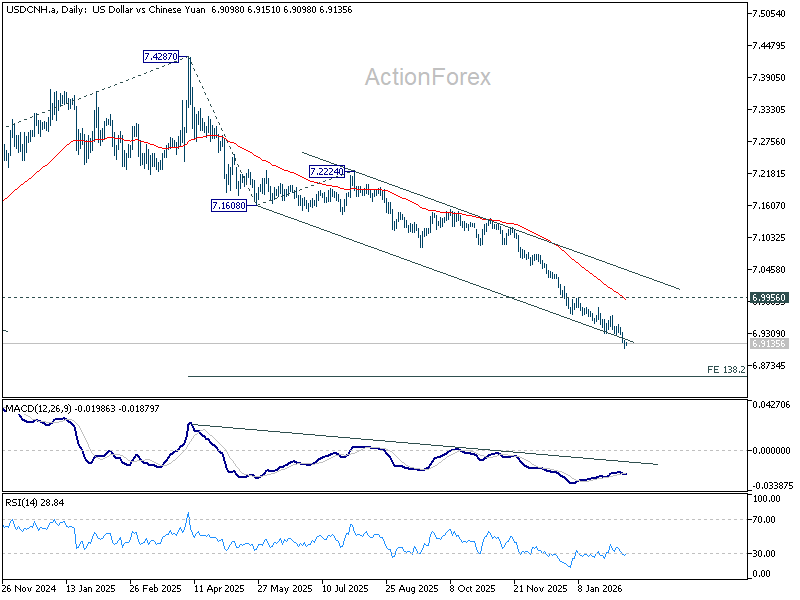
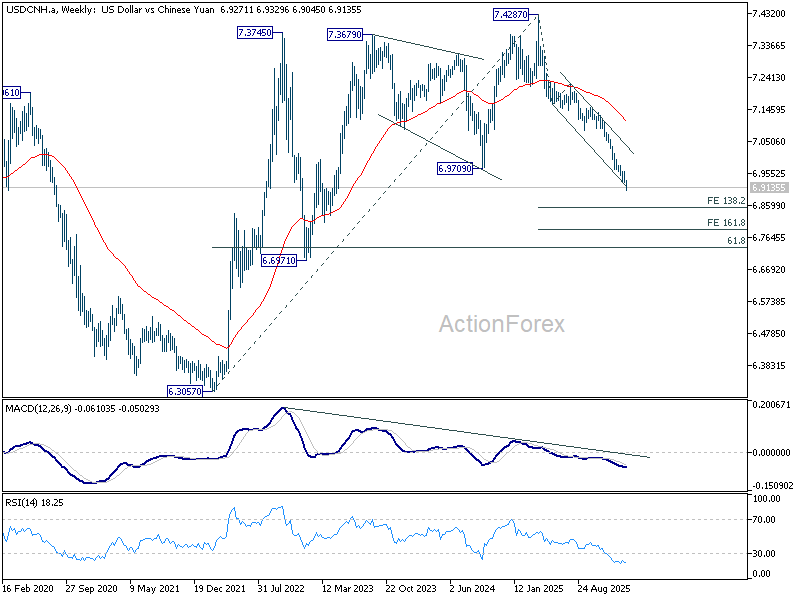
      USD/CNH falling towards 7.000, but shouldn’t break there for long

        Chinese Yuan surges today and hits the highest level against Dollar since early October. The rally was fueled by growing optimism that China is going to relax is strict zero-COVID policy, even as outbreaks worsen with highest infections in six months. At the same time, of course, decline in USD/CNH happened with global selloff in Dollar, after last week’s lower than expected CPI data solidified the case for Fed to start to slow its tightening pace in December.

        Technically speaking, there is room for more pull back in USD/CNH, towards 7.000 psychological level. However, there’s an important cluster support, with 61.8% retracement of 6.7159 to 7.3475 at 6.9675 and 38.2% retracement of 6.3057 to 7.3745 at 6.9662 just nearby. Downside should be contained by this 6.9662/75 support zone to bring rebound, unless there are some fundamental changes, in China, or the US, or their diplomatic relations, or any combinations of these factors.

        Fed Waller: Start paying attention to the endpoint, not the pace

          Fed Governor Christopher Waller said over the weekend, “we’re at a point we can start thinking maybe of going to a slower pace,” but “we’re not softening”.

          “Quit paying attention to the pace and start paying attention to where the endpoint is going to be,” he urged. “Until we get inflation down, that endpoint is still a ways out there.”

          Last week’s CPI report was “good, finally, that we saw some evidence of inflation starting to come down, but I just cannot stress [enough] this is one data point. We’re going to need to see a continued run of this kind of behavior and inflation slowly starting to come down, before we really start thinking about taking our foot off the brakes here,” he said.

          BoJ Kuroda: Should continue with monetary easing

            BoJ Governor Haruhiko Kuroda said in a speech that Japan’s situation “differs” from both the US and the Eurozone. The country is still “on its way to recovery”. Output gap has “remained in negative territory”, but projected to “turn positive” as some point in H2 of this fiscal year. Inflation rate “has not risen from the demand side”. Current rise in inflation was “led by rise in import prices”, and the rate is projected to decline back to below 2% from fiscal 2023.

            He reiterated that BoJ “deems that it should continue with monetary easing and thereby firmly support economic activity”. By doing so, “it aims to provide a favorable environment for firms to raise wages and to achieve the price stability target in a sustainable and stable manner, accompanied by wage increases.”

            Regarding exchange rates, Kuroda said the “abnormally one-sided, sharp yen weakening appears to have paused, thanks partly to government’s FX intervention.” He emphasized it is “important for forex rates to move stably reflecting economic fundamentals”.

            Full speech here.

            BoE Tenreyro expects rate to be steady at 3% over 2023

              BoE MPC member Silvana Tenreyro said, “I would expect that Bank Rate held at 3% over 2023 would reduce output further below potential, given the effects of lower real incomes and the lagged impact of the tightening to date.”

              “Policy would then have to loosen, perhaps in 2024, to try to prevent inflation falling below target,” she added.

              “Monetary policy has tightened significantly this year, but most of its effects on demand have yet to occur,” she said. “Too high a path for Bank Rate therefore risks over-steering inflation below target in the medium term.”

              Tenreyro is a known dove, who voted for just a 25bps hike at last meeting, while the majority voted for a 75bps hike.

              UK NIESR: GDP growth to be flat in Q4, but contraction risk elevated

                UK NIESR said, today’s data confirmed a “production-driven contraction in GDP in Q3. It’s expectation GDP growth to be flat in Q4.

                However, “given that October PMIs recorded figures below the neutral 50 for both the services and manufacturing sectors, consumer and business confidence is plummeting, and higher-than-expected inflation and interest rates continue to squeeze budgets, the risk of a contraction in GDP in the fourth quarter of this year remains elevated, NIESR said.

                “Whether the Chancellor’s upcoming Autumn Statement will alleviate or aggravate current recessionary risks will become clearer next week.”

                Full release here.

                BoE Bailey: Takes 18 to 24 months to bring inflation under control

                  BoE Governor Andrew Bailey said that inflation was “way above where we (want) it to be”. He added, “inflation is bad for the least well-off generally and this inflation is particularly bad.”

                  Bailey noted that further rate hikes were likely in the coming months. Meanwhile, efforts to bring inflation under control are likely to take between 18 months and two years.

                  UK GDP contracted -0.6% mom in Sep, worse than expectation

                    UK GDP contracted -0.6% mom in September, worse than expectation of -0.4% mom. Services dropped -0.8% mom. Production grew 0.2% mom while construction rose 0.4% mom. GDP was then -0.2% below its pre-coronavirus levels in February 2020.

                    Q3 GDP contracted -0.2% qoq in Q3, versus expectation of -0.5% qoq. Quarterly GDP was -0.4% below pre-coronavirus level in Q4 2019. There was no growth in services during the quarter, while production dropped -1.5%, construction rose 0.6%.

                    Full monthly GDP release here.

                    Also released, industrial production came in at 0.2% mom, -3.1% yoy in September, versus expectation of -0.3% mom, -4.3% yoy. Manufacturing production came in at 0.0% mom, -5.8% yoy, versus expectation of -0.4% mom, -6.6% yoy. Goods trade deficit narrowed from GBP -17.2B to GBP -15.7B, smaller than expectation of GBP -18.6B.

                    SNB Maechler: Further rate hikes may be necessary

                      SNB board member Andrea Maechler said an in interview, “it is not out of the question that, based on new figures and developments, further rate hikes may be necessary to ensure price stability in the medium term.”

                      “So it is really important to make an overall assessment with the figures we will have in December,” she said.

                      Regarding inflation, “on the one hand, a single figure will never allow us to claim victory, and on the other hand, it is still 3%, far from the range that we associate with price stability,” Maechler said.”We will claim victory when inflation settles below 2% on a sustainable basis.”

                      BoC Macklem: We need to rebalance the labor market

                        BoC Governor Tiff Macklem said yesterday, “We need to rebalance the labour market… This will be a difficult adjustment. We want to do this in the best way possible for Canadian workers and businesses.”

                        “The unemployment rate in June hit a record low [of 4.9%] – and while that seems like a good thing, it is not sustainable,” he explained. “The tightness in the labour market is a symptom of the general imbalance between demand and supply that is fuelling inflation and hurting all Canadians.”

                        Fed George urges steady and deliberate approach to raising policy rate

                          Kansas City Fed President Esther George said yesterday, “I continue to see several advantages for a steady and deliberate approach to raising the policy rate.”

                          “Without question, monetary policy must respond decisively to high inflation to avoid embedding expectations of future inflation,” she said. “A more measured approached to rate increases may be particularly useful as policymakers judge the economy’s response to higher rates”.

                          “As the tightening cycle continues, now is a particularly important time to avoid unduly contributing to financial market volatility, especially as volatility stresses market liquidity with the potential to complicate balance sheet run-off plans,” George said.

                          “The degree of tightening necessary will only be determined by observing the dynamics of the economy and inflation and cannot be predetermined by theory or pre-pandemic benchmarks,” George said.

                          Fed Mester: There continue to be some upside risks to inflation forecast

                            Cleveland Fed President Loretta Mester yesterday’s October CPI report “suggests some easing in overall and core inflation.” However, “there continue to be some upside risks to the inflation forecast.” She expects to see a “meaningful” decrease in inflationary pressures next year and after, with CPI back to 2% target by 2025.

                            “Given the current level of inflation, its broad-based nature, and its persistence, I believe monetary policy will need to become more restrictive and remain restrictive for a while in order to put inflation on a sustainable downward path to 2%,” she said.

                            “Despite the moves we have made so far, given that inflation has consistently proven to be more persistent than expected and there are significant costs of continued high inflation, I currently view the larger risks as coming from tightening too little.”

                            Fed Daly: One month does not a victory make

                              San Francisco Fed President Mary Daly said yesterday that the slowdown in inflation was “goods news”. Yet, “one month does not a victory make.”

                              “We have to be resolute to bring inflation down; we’re united in that commitment,” she said. “It’s raising the rate and then holding it for a length of time that is sufficient to bring inflation reliably back to 2%.”

                              “I would rather move a little bit higher and have to come back then to move a little bit less high and to then tell people we’re going to go higher, because at some point it does seep into inflation expectations,” Daly said.

                              At the same time, she said, “I don’t want to be over tightening to the point where we throw the economy into a sharp recession, but if we are talking about a rate hike on either side, I want to fully get inflation sustainably down to 2% on average.”

                              Gold completes double bottom, 1788 next

                                Gold’s rally accelerates higher today, as reaction to Dollar’s post-CPI sell-off. Break of 179.28 resistance confirmed completion of a double bottom pattern (1614.60; 1616.51), which raises the chance of trend reversal.

                                Further rise is now expected as long as 1701.99 support holds. Next target is 38.2% retracement of 2070.06 to 1614.60 at 1788.58. Sustained break of 1788.58 will pave the wave to 61.8% retracement at 1896.07.

                                Fed Logan: CPI data were a welcome relief

                                  Dallas Fed President Lorie Logan said “This morning’s CPI data were a welcome relief, but there is still a long way to go.”

                                  “I believe it may soon be appropriate to slow the pace of rate increases so we can better assess how financial and economic conditions are evolving,” she added.

                                  Fed Harker: In the upcoming months, we will slow the pace of our rate hikes

                                    Philadelphia Fed President Patrick Harker said, “In the upcoming months, in light of the cumulative tightening we have achieved, I expect we will slow the pace of our rate hikes as we approach a sufficiently restrictive stance.”

                                    He added, “at some point next year, I expect we will hold at a restrictive rate for a while to let monetary policy do its work”. What happened after there will be driven by data. “If we have to, we can always tighten further, based on the data.”

                                    “What we really need to see is a sustained decline in a number of inflation indicators before we let up on tightening monetary policy,” he said, adding “we need to make sure inflation expectations don’t become unanchored.”

                                    ECB Schnabel: No time for monetary policy to pause

                                      ECB Executive Board member Isabel Schnabel said in a speech, “there is no time for monetary policy to pause… We will need to raise rates further, probably into restrictive territory.”

                                      “Only a deep recession with a sharp rise in unemployment could be expected to significantly dampen inflation pressure,” Schnabel said. “This is currently unlikely, not least due to the robust labour market, large excess savings and the massive fiscal support.”


                                      US initial jobless claims rose 7k to 225k

                                        US initial jobless claims rose 7k to 225k in the week ending November 5. Four-week moving average of initial claims rose 250 to 218.75k.

                                        Continuing claims rose 6k to 1493k in the week ending October 29. Four-week moving average of continuing claims rose 32k to 1450k.

                                        Full release here.

                                        US CPI slowed to 7.7% yoy, CPI core slowed to 6.3% yoy, below expectations

                                          US CPI rose 0.4% mom in October, below expectation of 0.7% mom. Core CPI rose 0.3% mom, below expectation of 0.5% mom. Energy rose 1.8% mom while food rose 0.6% mom.

                                          Over the last 12 months, CPI slowed from 8.2% yoy to 7.7% yoy, below expectation of 8.0% yoy. That’s the lowest rate since January this year. Core CPI slowed from 6.6% yoy to 6.3% yoy, below expectation of 6.5% yoy. Energy index was up 17.6% yoy while food was up 10.9% yoy.

                                          Full release here.