BoJ Uchida: Important to continue with powerful monetary easing

    BoJ Executive Director Shinichi Uchida told the parliament today, “Japan’s economy is still in the midst of recovering from the pandemic’s impact. It is recently under pressure from rising commodity prices… It’s therefore important for the BOJ to continue supporting economic activity with powerful monetary easing.” He also said BoJ has no plan to adjust the 50bps band allowed for 10-year JGB yield to fluctuate around 0%.

    Separately, Finance Minister Shunichi Suzuki said after a cabinet meeting, “stability is important and rapid moves as seen recently are undesirable,” referring to Yen’s exchange rate. But he emphasized that any actions would follow the practice agreed with G7 partners.

    BoE Saunders: My preference to move relatively quickly to a more neutral stance

      BoE MPC member Michael Saunders said in a speech, “I put considerable weight on risks that, unless checked by monetary policy, domestic capacity and inflation pressures would probably be greater and more persistent than the central forecast.”

      “As a result, my preference has been to move relatively quickly to a more neutral monetary policy stance,” he added.

      “The strength of external costs is eroding real incomes and is likely to cap real spending,” he explained. “But, by creating a long period of above-target inflation, these external cost increases also may exacerbate the rise in inflation expectations and hence, with the tight labour market, could make it harder to ensure domestic inflation pressures return to a target-consistent pace.”

      Full speech here.

      Fed Bostic: No need to be moving more aggressively than 50bps

        Atlanta Fed President Raphael Bostic told Bloomberg today that last week’s 50bps rate hike was “already a pretty aggressive move”. He added, “I don’t think we need to be moving even more aggressively.”

        “I think we can stay at this pace and this cadence and really see how the markets evolve … We are going to move a couple times, maybe two, maybe three times, see how the economy responds, see if inflation continues to move closer to our 2% target, then we can take a pause and see how things are going,” he said.

        Fed Kashkari: Virtually all of that news is in the wrong direction

          Minneapolis Fed President Neel Kashkari said in a CNBC interview, “I’m confident we are going to get inflation back down to our 2% target, but I am not yet confident on how much of that burden we’re gonna have to carry versus getting help from the supply side.”

          He added that “virtually all of that news is in the wrong direction,” pointing to Ukraine war and lockdowns in China.

          He also emphasized that Fed is focused on its dual mandate, price stability and full employment. If data comes in different from expectations, Fed will change its policy approach.

          Yuan selloff accelerates as China tightens up Shanghai lockdown again

            The selloff in Chinese Yuan accelerates again today as the Chinese government tightened up city-wide lockdown in Shanghai again. The decision came after President Xi Jinping’s pledge last week to double down on the “battle” against the coronavirus.

            USD/CNH (offshore Yuan) hits as high as 6.7763 so far today, highest level since late 2020. Technically, Current rise is at least in the same degree as the down trend from 7.1961 (2020 high). Further rise is expected as long as 6.6111 support holds. Next target is 61.8% retracement of 7.1961 to 6.3057 at 6.8560.

            Also, released from China earlier today, exports rose 3.9% yoy in April, above expectation of 3.2% yoy. Imports dropped -2.0% yoy, versus expectation of -3.0% yoy. Trade surplus widened from USD 47.4B to USD 51.1B, basically in-line with expectations.

            Eurozone Sentix investor confidence dropped to -22.6, war only knows victims

              Eurozone Sentix Investor Confidence dropped from -18.0 to -22.6 in May, worse than expectation of -20.8. The’s the third decline in a row, and the lowest reading since June 2020. Current Situation index dropped from -5.5 to -10.5, worst since March 2021. Expectations index dropped from -29.8 to -34.0, worst since December 2008.

              Germany Sentix Investor Confidence dropped from -17.1 to -20.5, lowest since May 2020. Current Situation index dropped from -4.8 to -7.3, lowest since March 2021. Expectations index dropped from -28.8 to -32.8, all-time low.

              Sentix said: “War only knows victims. The traces of the Ukraine conflict are also becoming increasingly visible in the economy. The sanctions against Russia are having an effect, on enemies and friends alike. Last month, the “first mover” economic index clearly pointed the way towards recession. At the beginning of May, the downturn deepened further. Europe is hit particularly hard. The overall Eurozone index drops to -22.6 points. And for Germany we report an all-time low in economic expectations. In other words: it’s coming thick and fast.”

              Full release here.

              Bitcoin to break through 33k low, ethereum to follow

                Bitcoin is extending last week’s decline and it’s now close to making a new low for the year. The move is part of the broad based risk-off selling, which sees Nikkei down over -2.2% in Asia.

                Immediate focus is now on 33000 low in bitcoin. Firm break there will resume whole down trend from 68986. In this case, there might be further downside acceleration through 30k handle to 61.8% projection of 68986 to 33000 from 48226 at 25986. Nevertheless, break of 36118 resistance will be a sign of stabilization and bring recovery first.


                Ethereum also follows by breaking 2390 support today. The development should confirm that corrective recovery from 2157 has completed with three waves up to 3577. Deeper fall should be seen through 2157 to 38.2% projection of 4863 to 2157 from 3577 at 1904.

                ECB Rehn wants first hike in July, rate at zero in Autumn

                  ECB Governing Council member Olli Rehn said, “We are seeing signs of second-round effects. It’s important that we send a signal that these higher inflation expectations we are currently witnessing will not become entrenched.”

                  It’s “reasonable that we will rather sooner, in my view in July, start raising rates in line with our normalization of monetary policy. And would expect that when autumn comes, we would be at zero,” he said.

                  Rehn also noted that the Ukraine war is hampering Eurozone’s economic recovery from the pandemic. “We are seeing some stagflation tendencies,” Rehn said. The Governing Council should ensure that monetary decisions don’t derail economic growth, but at the same time avoid inflation becoming entrenched, Rehn said.

                  US non-farm payroll rose 428k in Apr, unemployment rate unchanged at 3.6%

                    US non-farm payroll employment rose 428k in April, slightly above expectation of 400k. Total employment was still down by -1.2m, or -0.8%, from its pre-pandemic levels.

                    Unemployment rate was unchanged at 3.6%, matched expectations. Number of unemployed persons was essentially unchanged at 5.9m. The numbers compared to prepandemic levels of 3.5% and 5.7m respectively. Labor force participation rate dropped -0.2% to 62.2%.

                    Average hourly earnings rose 0.3% mom, below expectation of 0.4% mom.

                    Full release here.

                    ECB Rehn: We should move relatively quickly to zero

                      ECB Governing Council member Olli Rehn said today, “We are almost in between a rock and a hard place so that on one hand we have to ensure that the recovery will continue. On the other hand, we have to prevent higher inflation expectations being entrenched and being reflected in the labor market.”

                      “In other words, we have to avoid second-round effects. Therefore, in my view, we should move relatively quickly to zero and continue our gradual process of normalization of monetary policy as we have done,” he continued.

                      “Of course, all this on the condition that Russia’s war in Ukraine will not substantially escalate and intensify which could derail all the forecasts and the economic recovery.”

                      BoE Pill: We face risks on both sides of the economic outlook

                        BoE Chief Economist Huw Pill told CNBC today that “we face risks on both sides of the economic outlook.” Inflation is going up to 10% because of energy and international goods prices. At the same time, there was a risk of recession.

                        “It’s a tricky balance to seek in current difficult circumstances. And the arguments around where rates should be set in order to achieve that balance are quite finely balanced in themselves,” Pill added.

                        Asked about what would cause the BOE to pause tightening, Pill said MPC would want to see more evidence inflation expectations and wage and price setting and momentum in economy more consistent with target. He added, “if we don’t see that we will need to act further.”

                        ECB Villeroy: Reasonable to have positive rates by year end

                          ECB Governing Council member Francois Villeroy de Galhau said, “the three conditions of our forward guidance on interest rates are, according to my personal judgment, fulfilled. Barring unforeseen new shocks, I would think it reasonable to have entered positive territory by the end of this year.”

                          But he’s vague on the timing of the first hike, as “while I wouldn’t preclude the next few Governing Council meetings, I would rather set a marker a bit further down the road.” He added the ECB’s push to normalize policy “will be guided by an active use of optionality and gradualism.”

                          On asset purchases, Villeroy said “seen from today the case for continuing to press the accelerator and adding further net purchases after June is not obvious.”

                          UK PMI construction dropped to 58.2, moving towards a more subdued recovery phase

                            UK PMI Construction dropped from 59.1 to 58.2 in April, above expectation of 58.0. S&P Global said new work had the weakest rise since December 2021. Total construction output expanded at slower pace. Growth projections eased to lowest since September 2020.

                            Tim Moore, Economics Director at S&P Global said: “The construction sector is moving towards a more subdued recovery phase as sharply rising energy and raw material costs hit client budgets. House building saw the greatest loss of momentum in April, with the latest expansion in activity the weakest since September 2021. Commercial and civil engineering work were the most resilient segments, supported by COVID-19 recovery spending and major infrastructure projects respectively.”

                            Full release here.

                            NFP in focus as 10-yr yield hit 3.1%

                              Focus will turn to US non-farm payroll report today. Markets are expecting 400k job growth in April. Unemployment rate is expected to be unchanged at 3.6%. Average hourly earnings is expected to stay strong at 0.4% mom.

                              Looking at related data, ISM manufacturing employment dropped sharply from 56.3 to 50.9, barely in expansion. ISM services employment dropped from 54.0 to 49.5, back in contraction. ADP report showed only 247k private job growth. Four-week moving average of initial claims also ticked up from 178k to 188k.

                              The figures on wages growth would be the most important ones to watch. Fed Chairman Jerome Powell talked down the prospect of a 75bps rate hike earlier this week. But the markets seemed not buying into this rhetoric after second thoughts.

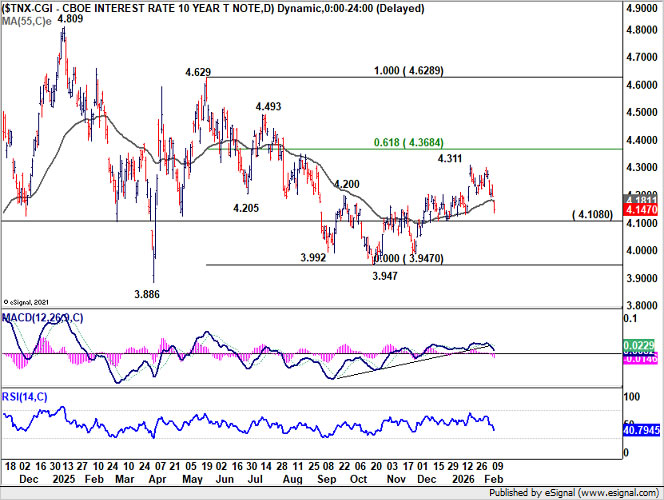
                              10-year yield rose 0.149 to close at 3.066 overnight, after hitting as high as 3.108. Recent up trend is still in force towards 3.248 long term resistance level (2018 high). The reaction to NFP from 10-year yield would provide the guide to Dollar’s next move, in particular against Yen.

                              Bitcoin accelerating down towards 33k low, follow risk-off sentiment

                                Bitcoin continued to gyrate lower this week and accelerated to as low as 35565 overnight. The move came with broad based risk-off selling in the US markets. Technically, the fall is seen as continuation of the decline from 48226, and outlook will stay bearish as long as 40014 resistance holds. Next near term target is 33000 low.

                                Structurally, rebound from 33000 to 48226 is seen as a three wave corrective pattern. The current stay below 55 day EMA is also a medium term bearish sign. Decline from 48226 is likely the third leg of the whole down trend from 68986 low. Current downside momentum doesn’t warrant a strong break of 33000 yet. But in that happens, bitcoin could easily falls through 30k handle to 61.8% projection of 68986 to 33000 from 48226 at 25986.

                                RBA SoMP: 2022 GDP forecasts downgraded to 4.5%, CPI raised to 6%

                                  In the Statement on Monetary Policy, RBA reiterated that a further lift in interest rates is required over the period ahead. Also, the Board will continue to closely monitor the incoming information and evolving balance of risks as it assesses the timing and extent of future interest rate increases

                                  In the new economic projections:

                                  • 2022 GDP growth forecast was downgraded from 5.50% to 4.50%.
                                  • 2023 GDP growth was upgraded from 2.50% to 2.75%.
                                  • 2022 year-end headline CPI forecast was raised form 3.25% to 6%.
                                  • 2023 year-end CPI headline forecast was raised from 2.75% to 3.25%.
                                  • 2022 year-end trimmed mean CPI was raised from 2.75% to 4.75%.
                                  • 2023 year-end trimmed mean CPI was raised from 2.75% to 3.25%.
                                  • 2022 year-end unemployment rate was unchanged at 3.75%.
                                  • 2023 year-end unemployment rate was us lower from 3.75% to 3.50%.

                                  Full SoMP here.

                                  US initial jobless claims rose to 176k, continuing claims dropped to 1.384m

                                    US initial jobless claims rose 19k in the week ending April 30, above expectation of 176k. Four-week moving average of initial claims rose 8k to 188k.

                                    Continuing claims dropped -19k to 1384k in the week ending April 23, lowest since January 17, 1970. Four-week moving average of continuing claims dropped -36k to 1417k, lowest since February 21, 1970.

                                    Full release here.

                                    BoE hikes by 25bps, three MPC members wanted 50bps

                                      BoE raises Bank Rate by 25bps to 1.00% as widely expected. The decision was made by 6-3 vote, with three members voted for 50bps hike, including Jonathan Haskel, Catherine Mann and Michael Saunders.

                                      In the accompany statement, BoE reaffirmed its preference that the Bank Rate will be used as the active policy tool in adjusting monetary policy stance. It will “consider” beginning the process of selling the assets purchased., but the decision will depend on economic circumstances. The strategy on offloading the assets will be provided at the August meeting.

                                      BoE also updated the economic projections conditions on a market-implied path for Bank Rate that rises to around 2.50% by mid-2023, before falling to 2.00% at the end of the forecast period. CPI is expected to rise further over the remainder of the year, averaging slightly over 10% at its peak in 2022 Q4, then falls back to 2% target in around two years. GDP is projected to fall in 2022 Q4 and calendar year GDP growth is broadly flat in 2023.

                                      Full statement here.

                                      ECB Lane: Gradualism is an important consideration in thinking about normalization

                                        ECB Chief Economist Philip Lane said in a speech, “in thinking about the normalization process, gradualism is an important consideration.” There are two basic reasons that make the timeline of completing normalization “intrinsically uncertain”.

                                        Firstly, ” the feedback loop between various steps in the policy normalisation process and inflation dynamics needs to be incorporated into the monetary policy decision process”.

                                        Secondly, “high uncertainty about the economic impact of the war in Ukraine, the energy shock and the post-pandemic recovery suggests that it is unlikely that the economy will quickly settle into a new steady-state equilibrium.”

                                        Lane reiterated that the calibration of policies will “will remain data-dependent and reflect our evolving assessment of the outlook”

                                        Full speech here.

                                        UK PMI services finalized at 58.9, twin headwinds of costs and war

                                          UK PMI Services was finalized at 58.9 in April, down from March’s 62.6. S&P Global noted that input cost inflation hit fresh record high. Activity and new business continued to rise, but a reduced rates. Business confidence was lowest in a year-and-a-half. PMI Composite was finalized at 58.2, down from March’s 60.9.

                                          Andrew Harker, Economics Director at S&P Global: “The twin headwinds of the cost of living crisis and the war in Ukraine started to bite on the UK service sector during April, as evidenced by a sharp slowdown in new order growth to the lowest in the year so far. Worryingly, companies seem to be expecting impacts to be prolonged, with business confidence dropping to the lowest in a year-and-a-half.”

                                          Full release here.