Bitcoin breaking down, 40k might only offer temporary support

    Bitcoin finally breaks down and it’s now heading back to 41908 spike low. Prior rejection by 55 day EMA maintains near term bearishness and fall from 68986 is likely resuming. There might be some temporary support between 39559/41908, around 40k handle. But outlook will stay bearish as long as 52101 resistance holds.

    We’d expect fall form 68986 to hit 61.8% projection of 68986 to 41908 from 52101 at 35366 before finding a bottom.

    UK PMI services finalized at 53.6, severe loss of momentum

      UK PMI Services was finalized at 53.6 in December, down from November’s 58.5, lowest level since February. Markit said export sales were hard-hit by renewed pandemic. Service provides remained upbeat about year ahead prospects. PMI Composite was finalized at 53.6, down from prior month’s 57.6.

      Tim Moore, Economics Director at IHS Markit: “December data revealed a severe loss of momentum for the UK economy as many customer-facing businesses experienced a drop in demand due to escalating COVID-19 cases. Total new orders in the service sector increased at the weakest pace for 10 months. Mass cancellations of bookings in response to the Omicron variant led to a slump in consumer spending on travel, leisure and entertainment. Survey respondents also noted that renewed pandemic restrictions had slowed the recovery in business services.

      Full release here.

      Germany factor orders rose 3.7% mom in Nov, strong foreign orders

        Germany factory orders rose 3.7% mom in November, better than expectation of 2.5% mom. Comparing with October, Largest increase in new orders (32.0%) was recorded in the manufacture of other transport equipment (aircraft, ships, trains etc.) for which extensive major orders were reported. New orders in the manufacture of motor vehicles, trailers and semi-trailers were up by 7.0%. Not including major orders, an 3.8% increase in new orders in manufacturing was recorded.

        The strong growth in new orders was attributable to foreign orders which increased by 8.0%. New orders from the euro area rose by 13.1%. New orders from other countries amounted to 5.0% in the current month. Domestic orders went up 2.5% in November 2021 on the previous month.

        Full release here.

        China PMI services rose to 53.1, composite rose to 53.0

          China Caixin PMI Services rose from 52.1 to 53.1 in December, above expectation of 51.9. PMI Composite rose from 51.2 to 53.0.

          Wang Zhe, Senior Economist at Caixin Insight Group said: “To sum up, the economy recovered in December with improvements in demand and supply of manufacturing and services. Inflationary pressure eased. But the job market was still under pressure and businesses were less optimistic, raising questions about the stability of the economic recovery. The repeated Covid-19 flare-ups and sluggish overseas demand were challenges to stability.”

          Full release here.

          10-year yield broke 1.7 after hawkish Fed minutes, DOW dropped

            US stocks tumbled overnight and treasury yields surged after surprisingly hawkish minutes of December FOMC meeting. Firstly, “participants generally noted that, given their individual outlooks for the economy, the labor market, and inflation, it may become warranted to increase the federal funds rate sooner or at a faster pace than participants had earlier anticipated.

            More importantly, “almost all participants agreed that it would likely be appropriate to initiate balance sheet runoff at some point after the first increase in the target range for the federal funds rate”. Also, once Fed starts to shrink its balance sheet, “the appropriate pace of balance sheet runoff would likely be faster than it was during the previous normalization episode” in October 2017.

            More on FOMC minutes:

            DOW closed down -1.07% or -392.54 pts at 36407.11. Despite the pull back, there is no threat to the up trend yet. However, it should not noted that DOW is close to an important fibonacci level of 100% projection of 18213.65 to 29199.35 from 26143.77 at 37129.47. Rejection by this level could trigger deep medium term correction through 55 week EMA (now at 33783.13).

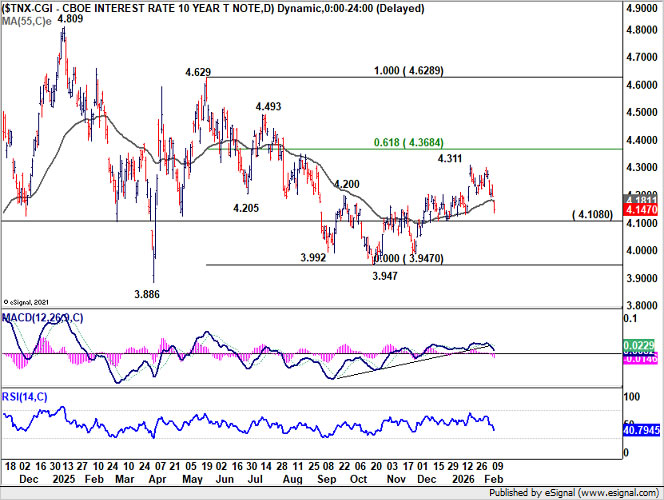
            Meanwhile, 10-year yield rose strongly by 0.037 to close at 1.705, breaking 1.693 near term resistance. The development is inline with the view that consolidation from 1.765 has completed after testing 55 week EMA. Up trend from 0.398 should be ready to resume. Break of 1.765 would send TNX through 2% handle to 61.8% retracement of 3.248 to 0.398 at 2.159.

            US oil inventories dropped -2.1m barrels, WTI accelerating as rally resumes

              US commercial crude oil inventories dropped -2.1m barrels in the week ending December 31. At 417.9m barrels, oil inventories are about -8% below the give year average for this time of year. Gasoline inventories rose 10.1m barrels. Distillate rose 4.4m barrels. Propane/propylene dropped -0.7, barrels. Total commercial petroleum inventories rose 10.2m barrels.

              WTI crude oil rises further after the release, as rally from 62.90 resumed. 100% projection of 62.90 to 73.66 from 66.46 at 77.22 is considered firmly taken out. Further rise is expected as long as 74.48 support holds. WTI is likely in another round of upside acceleration to 161.8% projection at 83.86, which is close to 85.92 high.

              For now, we’re not expecting a break of 85.92 yet. We’d expect at least one more down leg before the corrective pattern from there completes. Hence, we’d look for topping between 83.86/85.92. But we’ll see.

              US ADP employment grew 807k in Dec, broad-based gains

                US ADP private employment grew 807k in December, much better than expectation of 358k. Looking at some details, small businesses added 204k jobs. Medium businesses added 214. Large businesses added 389k. By sector, goods-producing jobs grew 138k. Service-providing jobs grew 669k.

                “December’s job market strengthened as the fallout from the Delta variant faded and Omicron’s impact had yet to be seen,” said Nela Richardson, chief economist, ADP. “Job gains were broad-based, as goods producers added the strongest reading of the year, while service providers dominated growth. December’s job growth brought the fourth quarter average to 625,000, surpassing the 514,000 average for the year. While job gains eclipsed 6 million in 2021, private sector payrolls are still nearly 4 million jobs short of pre-COVID-19 levels.”

                Full release here.

                Eurozone PMI composite finalized at 53.3, weakest growth since Mar

                  Eurozone PMI Services was finalized at 53.1 in December, down from November’s 55.9. PMI Composite was finalized at 53.3, down from November’s 55.4, lowest since March.

                  Looking at some member states, Ireland PMI composite dropped to 9-month low at 56.5. France dropped to 55.8. Spain dropped to 55.4, an 8-month low. Italy dropped to 54.7. Germany dropped to 49.9, an 18-month low.

                  Joe Hayes, Senior Economist at IHS Markit said:

                  “The accelerated expansion in output we saw in November unfortunately turned out to be brief. Amid a resurgence of COVID-19 infections across the euro area, growth slowed to the weakest since March in December. In Germany, where measures to combat COVID-19 have been more stringent than other monitored euro area countries, levels of economic activity broadly stagnated in December. Nonetheless, slower growth was seen across the board.

                  “There was also little to cheer with regards to inflation. Although there was a marginal easing of price pressures, we’re still in excessively hot territory – increases in both input and output costs were the second-quickest on record… As euro area nations deal with the latest developments in the pandemic, it’s clear that risks to the economy are now greater as tighter restrictions to curb the spread of COVID-19 are more likely than they have been recently.”

                  Full release here.

                  Gold resilient, back above 1800 after brief dip

                    Gold dipped notably after hitting 1831.66, following Dollar’s rally. But Gold remains resilient so far, holding above 1789.31 support, and it’s back above 1800 handle. Further rally is still in favor and break of 1831.66 will resume the rally from 1752.32 towards 1877.05 resistance next.

                    Nevertheless, we’re still seeing Gold as being a leg inside the range pattern from 1676.65. While a break of 1877.05 cannot be ruled out, we’re not seeing much chance of breaking through 1916.30 medium term resistance. Meanwhile, break of 1789.31 support will argue that fall from 1877.05 is probably ready to resume through 1752.32.

                    Dollar index range bound with bullish bias ahead of FOMC minutes

                      Minutes of the December FOMC meeting will be a major focus today. Back then, Fed decided to speed up tapering and end it in March instead of June. Also, the new projections saw three rate hikes this year. The markets would like to see more in-depth information an related discussion, and hints on the timing of the first hike. Currently, Fed fund futures are already pricing in nearly 60% chance that federal funds rate will be raised to 0.25-0.50% and above in March.

                      Dollar index is staying well in range of 95.51/96.93, much reflecting the movements in EUR/USD. With 95.51 support intact, further rally is expected in DXY, and an upside breakout could come as soon as a reaction to non-farm payroll report this week. A set of strong job numbers could easily push DXY through 61.8% retracement of 102.99 to 82.0 at 97.72. In the case, 100 handle would be within reach very soon.

                      Fed Kashkari: Threshold for rate hike could be met with Apr 2022 inflation data

                        Minneapolis Fed President Neel Kashkari said in an essay that he supported Fed’s decision to increase the speed of tapering back in December FOMC meeting. Also, it brought forward two rate hikes into 2022 because “inflation has been higher and more persistent than I had expected.”

                        Kashkari added, he’d prefer the forward guidance to commit to keeping federal funds rate at effective lower bound “until 12-month core PCE had exceeded 2 percent for 12 months.” Based on this criteria, “the test that I preferred will likely be met when the April 2022 data are released the following month”. The “threshold” (not trigger) for lift off would then be met.

                        Full essay here.

                        US ISM manufacturing dropped to 58.7, prices dropped sharply to 68.2

                          US ISM Manufacturing dropped from 61.1 to 58.7 in December, below expectation of 60.2. Looking at some details, new orders dropped -1.1 to 60.4. Production dropped -2.3 to 59.2. Employment rose 0.9 to 54.2. Prices dropped sharply by -14.2 to 68.2.

                          ISM said: “The past relationship between the Manufacturing PMI® and the overall economy indicates that the Manufacturing PMI® for December (58.7 percent) corresponds to a 4.4-percent increase in real gross domestic product (GDP) on an annualized basis.”

                          Full release here.

                          UK PMI manufacturing finalized at 57.9, upturn remains subdued

                            UK PMI Manufacturing was finalized at 57.9 in December, down slightly from November’s 58.1. The index has now remained above neutral 50 mark for 19 straight months. Markit noted that output, new orders and employment all rose. New export orders fell for the fourth month running. Selling price inflation hit fresh record high.

                            Rob Dobson, Director at IHS Markit, said: “While the uptick in growth is a positive step, the upturn remains subdued compared to the middle of the year, as supply chain constraints and weak export performance constrained attempts to raise production further. Manufacturers indicated that logistic issues, Brexit difficulties and the possibility of further COVID restrictions (at home and overseas) had all hit export demand at the end of the year.”

                            Full release here.

                            Swiss CPI at -0.1% mom, 1.5% yoy in Dec

                              Swiss CPI dropped -0.1% mom in December, matched expectations. the decline was due to several factors including falling prices for heating oil, fuel and air transport. For the 12-month period, CPI was unchanged at 1.5% yoy, below expectation of 1.6% yoy.

                              Average annual inflation in 2021 was at 0.6%. Prices for domestic products increased by 0.3% on average, those for imported products increased by 1.5%. Average annual inflation was –0.7% in 2020 and +0.4% in 2019.

                              Full release here.

                              CAD/JPY and AUD/JPY maintain bullish bias

                                While Yen is being sold sharp sharply, commodity Yen crosses are generally struggling in range. Nevertheless, they’s maintaining near term bullish bias. CAD/JPY’s prior break of 90.34 resistance suggests that correction from 93.00 has completed at 87.42 has defended medium term trend line support. Further rise is expected as long as 89.41 support holds. CAD/JPY should target a test on 93.00 high next, with prospect of resuming whole up trend from 73.80 (2020 low).

                                Similarly, AUD/JPY’s correction from 86.24 should have completed at 78.77, ahead of 77.88 support. Further rally is expected as long as 82.42 resistance turned support holds. Break of 83.84 will resume the rebound from 78.77 to retest 86.24, also with prospect of resuming the up trend from 59.85 (2020 low).

                                US 10-yr yield back above 1.6, 30-yr yield above 2.0

                                  US treasury yields surged sharply overnight as investors continued to adjust themselves “living with the virus”. Omicron is now generally taken as being much less harmful to the global economy as initially feared, despite record infection numbers.

                                  10-year yield closed up 0.116 to 1.628, back above 1.6 handle for the first time since November. We’re holding on to the view that consolidation pattern from 1.765 has complete with three waves at 1.343. TNX could accelerate upwards in the near term to 1.693 resistance. Firm break there would send TNX through 1.765 to resume larger up trend from 0.398 (2020 low).

                                  The picture in 30-year yield is similar. It’s now back above 2.0 handle after yesterday’s rise. Corrective pattern from 2.505 should have completed with three waves down to 1.678. Further rally should be seen to 2.177 in the near term. Sustained break there will raise the chance that it’s already resuming the up trend from 0.837 (2020 low) through 2.505 high.

                                  USD/JPY breakout with upside acceleration, targets 116.6 next

                                    USD/JPY accelerates to as high as 115.80 so far today, and breaks 115.51 resistance to resume the medium term up trend from 102.58. The rally comes as supported by strong rise in US treasury yields overnight, and the strength of Nikkei (which is up 1.5% or 438 pts at the time of writing).

                                    Technically, the strong support from 55 day EMA is taken as a solid bullish sign. Next target will be 61.8% projection of 109.11 to 115.51 from 112.52 at 116.67. Sustained break there could trigger further upside acceleration to 100% projection at 118.92, which is close to 118.65 long term resistance. Decisive break there would pave the way to 125.85 (2015 high), probably within the first half of the year.

                                    China Caixin PMI manufacturing rose to 50.9, improving demand and supply

                                      China Caixin PMI Manufacturing rose to 50.9 in December, up from November’s 49.9, above expectation of 50.0. The data signaled a renewed improvement in the sector with best reading since June. Caixin said rise in output was stronger amid renewed upturn in sales. Input cost inflation eased to 19-month low. Business confidence weakened amid pandemic and supply chain worries.

                                      Wang Zhe, Senior Economist at Caixin Insight Group said: “To sum up, manufacturing demand and supply improved in December with easing inflationary pressure. But the job market was still under pressure and businesses were less optimistic, indicating unstable economic recovery. The repeated Covid-19 flare-ups and sluggish overseas demand were factors of instability.”

                                      Full release here.

                                      Japan PMI manufacturing finalized at 54.3 in Dec, confidence dipped

                                        Japan PMI Manufacturing was finalized at 54.3 in December, slightly lower than November’s 54.5. But that was well above 2021’s average of 52.7. Markit said output and new orders increased at slower rates. Employment level rose at fastest pace in nearly four years. Business optimism eased to four-month low.

                                        Usamah Bhatti, Economist at IHS Markit, said: “Domestic markets were buoyed by a gradual recovery from the COVID-19 pandemic however a sharp rise in cases, particularly in South Korea, hindered international demand and continued to disrupt supply chains across the sector… Delivery delays and material shortages remained a dampener on production and sales… Average lead times across the final quarter of 2021 deteriorated further… Though still optimistic, Japanese goods producers were wary of the continued impact of the pandemic and supply chain disruption, which resulted in confidence dipping to the softest since August.”

                                        Full release here.

                                        US PMI manufacturing finalized at 57.7 in Dec, rate of cost inflation eased

                                          US PMI Manufacturing was finalized at 57.7 in December, down from November’s 583. Markit said output expansion was muted, as firms registered slower upturn in new orders. Rate of cost inflation remained marked despite easing to softest since June. Backlogs of work rose at slowest pace for ten months.

                                          Siân Jones, Senior Economist at IHS Markit said:

                                          “December saw another subdued increase in US manufacturing output as material shortages and supplier delays dragged on. Although some reprieve was seen as supply chains deteriorated to the smallest extent since May, the impact of substantially longer lead times for inputs thwarted firms’ ability to produce finished goods yet again.

                                          “Adding to the sector’s challenges was an ebb in client demand from the highs seen earlier in 2021, with new orders rising at the slowest pace for a year, largely linked to a reluctance at customers to place orders before inventories were worked through. Alongside a slight pick-up in hiring, softer demand conditions contributed to the slowest rise in backlogs of work for ten months.

                                          “While shortages remained significant, the end of the year brought with it some signs that cost pressures have eased. The uptick in input prices was the slowest for six months, and firms recorded softer increases in selling prices amid efforts to entice customer spending.”

                                          Full release here.