Fed Clarida: Will provide advance notice before making any changes to purchases

    Fed Vice Chair Richard Clarida said in a speech that “we are clearly a ways away from considering raising interest rates and this is certainly not something on the radar screen right now”.

    If outlook of inflation and unemployment turn out to be the actual outcomes, the necessary conditions for raising federal funds rate “will have been met by year-end 2022.” If inflation remain well anchored at 2%, commencing policy normalization in 2023 would then be “entirely consistent with our new flexible average inflation targeting framework.”

    As for asset purchases, he said FOMC members expected the economy to continue to move toward the standard of “substantial further progress.”

    FOMC will asses the progress in coming meetings. He reiterated the pledge that, “we will provide advance notice before making any changes to our purchases.”

    Full speech here.

    US ISM services rose to record 64.1, corresponds to 5.2% annualized GDP growth

      US ISM Services PMI rose to 64.1 in July, up from 60.1, above expectation of 60.4. That eclipses previous record in May and indicates the 14th straight month of growth.

      Looking at some details, business activity/production rose 6.6 to 67.0. new orders rose 1.6 to 63.7. Employment rose 4.5 to 49.3. Prices rose 2.8 to 82.3.

      ISM said: “The past relationship between the Services PMI® and the overall economy indicates that the Services PMI® for July (64.1 percent) corresponds to a 5.2-percent increase in real gross domestic product (GDP) on an annualized basis.”

      Full release here.

      US ADP employment grew just 330k, uneven progress slowed

        US ADP employment grew just 330k in July, well below expectation of 680k. By company size, small businesses added 91k jobs, medium businesses 132k, large businesses 106k. By sector, goods-producing job grew 12k while service-providing jobs rose 318k.

        “The labor market recovery continues to exhibit uneven progress, but progress nonetheless. July payroll data reports a marked slowdown from the second quarter pace in jobs growth,” said Nela Richardson, chief economist, ADP.

        “For the fifth straight month the leisure and hospitality sector is the fastest growing industry, though gains have softened. The slowdown in the recovery has also impacted companies of all sizes. Bottlenecks in hiring continue to hold back stronger gains, particularly in light of new COVID-19 concerns tied to viral variants. These barriers should ebb in coming months, with stronger monthly gains ahead as a result.”

        Full release here.

        ECB Kazaks: Current forward guidance not tying out hands too much

          ECB Governing Council member Martins Kazaks said, “given the uncertainty, given how much time is left, there is no need to decide on” what to do with the PEPP purchases after next March. He added, “we will discuss it, but at the moment it would still be premature.”

          “It’s quite unlikely that we will come out in late March 2022 and say this is it, we’ve done our job and we terminate it,” Kazaks added. “We would like to warn the markets in advance — but only as much as it’s reasonably possible.”

          Kazaks defended ECB’s new forward guidance, and said, it’s “a balanced view on how we may react when we see inflation approaching 2%.” “Is this tying our hands too much or too far into the future? I don’t think so,” He said. “If we find that this is not appropriate for the given economic situation then we can adjust our forward guidance.”

          Eurozone retail sales rose 1.5% mom in Jun, EU up 1.2% mom

            Eurozone retail sales rose 1.5% mom in June, below expectation of 1.9% mom. The volume of retail trade increased by 3.8% for automotive fuels and by 3.4% for non-food products, while it decreased by 1.5% for food, drinks and tobacco.

            EU retail sales rose 1.2% mom. Among Member States for which data are available, the highest monthly increases in total retail trade were registered in Ireland (+9.4%), Germany and Latvia (both +4.2%) and Lithuania (+2.0). The largest decreases were observed in Malta (-3.0%), Austria (-2.7%) and Croatia (-2.6%).

            Full release here.

            UK PMI composite finalized at 59.2, re-acceleration of growth looks unlikely

              UK PMI Services was finalized at 59.6 in July, down from June’s 62.4. PMI Composite dropped to 59.2, down from 62.2. Markit said there was weakest rise in business activity since March, but strongest input cost inflation in 25 years of data collection. Staff shortages constrained business capacity and recruitment.

              Tim Moore, Economics Director at IHS Markit: “UK economy has slowed… More businesses are experiencing growth constraints from supply shortages of labour and materials, while on the demand side we’ve already seen the peak phase of pent up consumer spending… Any re-acceleration of growth in August looks unlikely.. as new orders increased at a much-reduced pace at the start of the third quarter… business expectations softened again.

              Full release here.

              Eurozone PMI composite finalized at record 60.2, GDP growth accelerates in Q3

                Eurozone PMI Services was finalized at 59.8 in July, up from 58.3, highest since June 2006. PMI Composite was finalized at 60.2, up from 59.5, a new record high.

                Chris Williamson, Chief Business Economist at IHS Markit said: “Europe’s service sector is springing back into life. Easing virus restrictions and further vaccination progress are boosting demand for a wide variety of activities….Alongside the sustained elevated growth recorded in the manufacturing sector, the impressive strength of the service sector’s expansion in July means the eurozone should see GDP growth accelerate in the third quarter.

                “Worries about the Delta variant have become more widespread, however, subduing activity in some instances and raising concerns about the possibility of virus restrictions being tightened again…. Furthermore, up to now companies have generally seen little resistance from customers to higher prices, but this could change after the current rebound from lockdown restrictions has passed.”

                Full release here.

                Germany PMI composite finalized at record 62.4, rising costs look to remain a feature

                  Germany PMI Services was finalized at 61.8, up from June’s 57.5, surpassing previous record high set some 15 years ago. PMI Composite rose to record high of 62.4, up from 60.1. Markit said there was record expansion in activity as COVID-19 restrictions eased. Rate of job creation hit new record. Inflationary pressures remained elevated.

                  Andrew Harker, Economics Director at IHS Markit said: “The recent surge in activity in the German service sector continued in July, with growth hitting the highest in more than 24 years of data collection as companies feel the benefit of the reopening of the economy following the lifting of COVID-19 restrictions. The ramping up of activity is also proving to be good news for workers, with companies taking on extra staff at an unprecedented rate.

                  “Inflationary pressures remain elevated, however, and companies will take little solace from the fact that costs rose at a slightly weaker pace than in June. With the sector running hot and severe pressure on capacity signalled, rising costs look set to remain a feature in the near-term at least.”

                  Full release here.

                  France PMI composite finalized at 56.6, economic recovery has legs to continue through Q3

                    France PMI Services was finalized at 56.8 in July, down from June’s 57.8. PMI Composite was finalized at 56.6, down from July’s 57.4. Markit said robust demand supported strong activity growth. Backlogs rose at joint-fastest pace since April 2011. Output price inflation hit decade high.

                    Joe Hayes, Senior Economist at IHS Markit said: “Although the headline PMI dipped slightly, the data is consistent with activity growing at a strong pace, much like we saw in the previous two months since pandemic-related restrictions have been peeled back. Pent-up demand is considerable, and firms are struggling to meet it, as evidenced by one of the strongest increases in backlogs of work for a decade. This is a good thing in the short-term as it means the economic recovery will have legs to continue through the third quarter and hopefully beyond.

                    “That said, current conditions have handed businesses an incredible amount of pricing power. While inflationary pressures are not quite as alarming as they are in the manufacturing sector, there’s clear spillover effects from the severe supply chain disruptions, as firms cited this as a reason behind July’s 34-month high in input costs. In response, firms upped their fees to the greatest extent in a decade. If the price rises we’re seeing remain sticky, inflation will no longer be transitory.”

                    Full release here.

                    China Caixin PMI services rose to 54.9, but still faces enormous downward pressure

                      China Caixin PMI Services rose from 50.3 to 54.9 in July, well above expectation of 54.9. PMI Composite rose from 50.6 to 53.1.

                      Wang Zhe, Senior Economist at Caixin Insight Group said: “As the July surveys of Caixin China PMIs were conducted after the epidemic in Guangdong province was brought under control, and before Covid-19 resurged in Jiangsu province, the services sector expanded rapidly, though the manufacturing sector was slightly weaker.

                      The resurgence of the epidemic in some parts of China at the end of July is expected to hurt August’s PMI readings. China’s official second-quarter economic figures were in line with expectations, but the Caixin China PMIs in July suggest that the economic recovery is not on sure footing. The economy still faces enormous downward pressure, and we need to ensure business owners remain confident.”

                      Full release here.

                      New Zealand unemployment rate dropped to 4.0%

                        New Zealand employment rose 1.0% in Q2, above expectation of 0.7%. It’s also the lowest since Q4 2019. Employment rate rose 0.5% to 67.6%. Unemployment rate dropped from 4.6% to 4.0%, much better than expectation of 4.5%. Labor force participation rate rose 0.1% to 70.5%. Labor cost index rose 0.9% qoq, above expectation of 0.7% qoq.

                        “The fall in unemployment is largely in line with other labour market indicators, including declining numbers of benefit recipients and increased job vacancies, and recent media reports of labour shortages and skills mismatches,” work, wealth, and wellbeing statistics senior manager Sean Broughton said.

                        Full release here.

                        Australia retail sales dropped -1.8% mom in Jun, led by Victoria and NSW

                          Australia retail sales dropped -1.8% mom in June, unchanged from preliminary reading. Over the June quarter, sales rose 0.8% qoq.

                          ABS said: “States under longer periods of restrictions for the month saw a larger fall in their June turnover. The largest falls were in Victoria (-4.0 per cent), New South Wales (-2.0 per cent), and Queensland (-0.9 per cent). Other states and territories that saw stay-at-home orders for a least one day of the month included Western Australia (0.1 per cent), and the Northern Territory (-1.8 per cent).”

                          Full release here.

                          Australia AiG construction dropped to 48.7 on outbreaks and restrictions

                            Australia AiG Performance of Construction Index dropped -6.8 to 48.7 in July, recording the first contraction since September 2020. Looking at some details, activity dropped -14.4 to 40.4. Employment rose 2.5 to 60.8. New orders dropped -6.6 to 49.5. Supplier deliveries dropped -7.6 to 43.3. Input prices dropped -1.1 to 97.2. Selling prices dropped -4.0 to 81.2. Average wages rose 6.7 to 77.1.

                            Ai Group Head of Policy, Peter Burn, said: “With Australia’s two largest states affected by COVID-19 outbreaks and associated restrictions, the construction industry slipped into contraction in July after a robust nine-month expansion. The negative national result masked continued growth outside of NSW and Victoria and further expansions in both house building and commercial construction…

                            “The outlook over the next couple of months will depend heavily on the paths of the COVID-19 outbreaks and the extent of restrictions.”

                            Full release here.

                            Fed Daly: Americans want to work and it would be a mistake to assume otherwise

                              San Francisco Fed President Mary Daly said in a blog post that “myriad factors are tempering labor supply at the moment”. However, ” there is no reason to expect those to be permanent or even highly persistent features of the labor market.”

                              She pointed to the “aftermath of the Great Recession” as the downturn “put millions of prime-age men and women out of work “. And, “many believed that this would never reverse”.

                              “But none of those factors proved to be binding,” she said, “As the economy improved, workers came off the sidelines. And year after year, the employment rate rose, eventually surpassing its pre-recession peak”.

                              “The lesson is simple: Americans want to work and it would be a mistake to assume otherwise,” She concluded.

                              Full blog post here.

                              Fed Bullard: monetary policy needs to be more nimble in new regime

                                St. Louis Fed President James Bullard told Reuters that current inflation, which is well over Fed’s target, is at levels which former chairs like Alan Greenspan would have “immediately tried to quash.” He called for swift action on ending the asset purchase program. “We are not being that preemptive. Our models say this will settle down, but in the meantime it will be pretty volatile,” he said, “what I want to be prepared for and get the committee prepared for is the risk that this is an unpredictable situation.”

                                Bullard also said a new “regime” may have arrived and “monetary policy needs to be more nimble.” The global equilibrium was upset by the pandemic, and “the reverberations will continue, and you will have a lot more volatility than you are used to.”

                                “We will have long, lingering effects as the rest of the world recovers. You have shortages and bottlenecks everywhere. You have Europe likely to grow more quickly in coming quarters,” Bullard said. “You have industries still adjusting to the post-pandemic world – many things happening, and at a pace we are not used to.”

                                Eurozone PPI rose 1.4% mom, 10.2% yoy in Jun

                                  Eurozone PPI came in at 1.4% mom, 10.2% yoy in June, versus expectation of 0.9% mom, 10.3% yoy. For the month, industrial producer prices increased by 3.3% in the energy sector, by 1.3% for intermediate goods, by 0.4% for capital goods and by 0.3% for durable and non-durable consumer goods. Prices in total industry excluding energy increased by 0.7%.

                                  EU PPI rose 1.4% mom, 10.3% yoy. For the month, the highest increases in industrial producer prices were recorded in Denmark (+5.1%), Estonia (+4.6%) and Latvia (+3.1%), while the only decrease was observed in Ireland (-0.3%).

                                  Full release here.

                                  Swiss consumer climate surged to 8 in Q2, highest since 2010

                                    Swiss SECO Consumer Climate rose sharply from -7 to 8 in Q3. That’s the highest level since July 2010, and well above long-term average of -5. Expectations of general economic growth rose to record 48. Employment expectations rose to 29, just slightly below pre-crisis level. Expected financial situation also rose to 3, back above long-term average for the first time in over six years.

                                    Full release here.

                                    RBA maintains tapering plan, left rate unchanged

                                      RBA maintained cash rate target unchanged at 0.10%. Also, target for April 2024 government bond yield was also kept at 0.10%. More importantly, it maintained the tapering plan unchanged. Weekly purchases will be lowered from AUD 5B to AUD 4B starting early September, until at least mid-November.

                                      RBA also pledged to “maintain its flexible approach to the rate of bond purchases”. The conditions for rate hike is not expected to be met before 2024.

                                      The central bank said the outlook for the coming months is “uncertain” and depends up on the “evolution of the health situation and the containment measures”. Then, the central scenario is for the economy to grow by “a little over 4 per cent over 2022 and around 2½ per cent over 2023.”

                                      Unemployment is expected to trend lower to 4.50% at the end of 2022, and then 4.0% at the end of 2023. Inflation is expected to be at 1.75% over 2022 and than 2.25% over 2023.

                                      Full statement here.

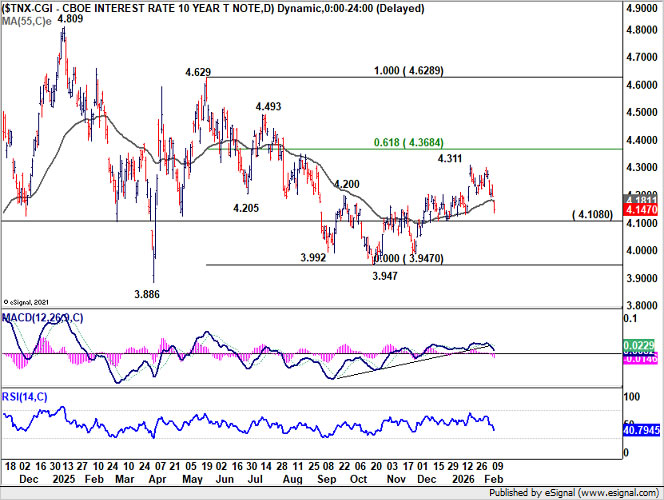
                                      US 10-year yield tumbled on delta concerns

                                        US benchmark treasury yields dropped sharply overnight on concern of the spread of delta variant in the country. According to latest CDC data, There were more than 72k new COVID cases a day on average in the US in the last seven days. That’s a level not seen since February. The fall in treasury yield lifted Yen generally higher, in particular against Dollar.

                                        10-year yield dropped -0.065 to close at 1.174, after dipping to as low as 1.151. The development suggests that corrective fall from 1.765 is probably resume to resume through 1.128 low. Still, we’d continue to expect strong support between 0.985/1.134 (50% and 61.8% retracement of 0.504 to 1.765) to contain downside to finish off the correction eventually.

                                        Fed Waller: Depending on job growth, could be ready to announce tapering in Sep

                                          Fed Governor Governor Christopher Waller told CNBC that if August and September jobs report show growth in 800k range, that would be “substantial progress”. Fed could then be “ready to do an announcement in September” on tapering asset purchases.

                                          “That depends on what the next two job reports do,” he added. “If they come in as strong as the last one, then I think you’ve made the progress you need. If they don’t, then you’re probably going to have to push things back a couple months.”

                                          “In my view, with tapering we should go early and go fast in order to make sure we’re in position to raise rates in 2022 if we have to,” he said. “I’m not saying we would, but if we wanted to, we need to have some policy space by the end of the year.”

                                          Waller also expected inflation to return to normal once the impacts of the pandemic wane. “My concern is just anecdotal evidence I’m hearing from business contacts, who are saying they’re able to pass prices through. They fully intend to. They’ve got pricing power for the first time in a decade,” he said. “Those are the sorts of issues that make you concerned that this may not be transitory.”