Canada employment rose 230.7k in June, unemployment rate dropped to 7.8%

    Canada employment grew 230.7k in June, above expectation of 172.5k. Statistics Canada noted, “employment growth in June was entirely in part-time work and concentrated among youth aged 15 to 24, primarily young women.”

    Unemployment rate dropped to 7.8%, down from 8.2%, matched expectations. Labor force participation rate also rose 0.6% to 65.2%. The figure remained above post-pandemic low of 7.5% recorded in April this year, but was considerably lower than recent peak at 9.4% in January, and the record high of 13.7% in May 2020.

    Full release here.

    ECB accounts: PEPP to continue with significantly higher pace

      In the accounts of June 9-10 meeting, ECB said, “it was stressed that the recovery was at an early stage and lacked robustness, as it depended heavily on policy support”. The projected path for the economy was ” was subject to significant uncertainties and risks”. An ” undue tightening of financing conditions at the current juncture could jeopardise the ongoing economic recovery and the outlook for inflation.”

      Hence, “a noticeable slowing of the pace of purchases for the next quarter was therefore seen as inappropriate at the current juncture”. A remark was even made that, “in view of the persistent inflation shortfall projected in the June staff projections, even an increase in asset purchases as the main monetary policy instrument could be justified at present.”

      Nevertheless, “in view of the better outlook for growth and inflation and the associated upside risks, it was, however, also argued that, to provide the same degree of accommodation, asset purchases should be scaled back somewhat.” Concerns were also expressed about potential side effects “if the highly accommodative monetary policy stance was maintained much longer.”

      Overall, most members consent that net PEPP purchases should continue at a significantly higher pace in Q3. But the “reaction function” on purchases would “continue to rely on a joint assessment of financing conditions and the outlook for inflation over the medium term”.

      Full meeting accounts here.

      Bundesbank Weidmann: ECB not striving for either lower or higher inflation

        Bundesbank President Jens Weidmann said ECB is “”not striving for either lower or higher rates” of inflation with the new symmetric target. He added, the 2% medium term inflation goal is a “clear and easily understandable objective,” and that “temporary deviations from the target in either direction can occur.”

        Separately, Governing Council member Olli Rehn said the “new inflation goal is unambiguous.” Clearly, the “medium-term core inflation forecast of 1.4% below new aim.”

        Another Governing Council member Francois Villeroy de Galhau said ECB will still need to analyze the meaning of a “temporary” overshoot of inflation. “We didn’t discuss any duration, we didn’t discuss any numbers. It’s all about the context,” he said. “In monetary policy, you have to combine the direction with judgment. We set the direction very clearly.”

        UK GDP grew 0.8% mom in May, still -3.1% below pre-pandemic level

          UK GDP grew 0.8% mom in May, well below expectation of 1.9% mom. That’s still the fourth consecutive month of growth. Service sector grew 0.9% mom. Production grew 0.8% mom, returned to growth. Manufacturing contracted -0.1% mom. Construction contracted for a second consecutive month, by -0.8% mom.

          Overall GDP was still -3.1% below pre-pandemic level seen in February 2020. Services was -3.4% low, production -2.6% lower, while manufacturing was -3.0% lower. But construction was 0.3% above the pre-pandemic level.

          Full release here.

          Fed Daly: We’re not through the pandemic, just getting through

            San Francisco Fed President Mary Daly said in an FT interview, “I think one of the biggest risks to our global growth going forward is that we prematurely declare victory on Covid.” She emphasized, “we are not through the pandemic, we are getting through the pandemic.”

            “If the global economy . . . can’t get . . . higher rates of vaccination, really get Covid behind, then that’s a headwind on US growth,” Daly said. “Good numbers on the vaccinations are terrific, but look at all the pockets where that isn’t yet happening.”

            On stimulus withdrawal, she said, “we’re ready to taper at the appropriate time.” But she added, “then I’d like to see, how is that going? How does the economy respond to that? Because we can forecast, we can project, but we need to know in order to actually say, ‘oh, OK, now it’s time to move on to the next phase’, which is discussing policy normalization and the fed funds rate coming up a bit.”

            US initial jobless claims rose to 373k, above expectations

              US initial jobless claims rose 2k to 373k in the week ending July 3, above expectation of 355k. Four-week moving average of initial claims dropped -250 to 394.5k, lowest since March 14, 2020.

              Continuing claims dropped -145k to 3339k in the week ending June 26, lowest since March 21, 2020. Four-week moving average of continuing claims dropped -44.5k to 3441k, lowest since March 21, 2020.

              Full release here.

              ECB adopts symmetric 2% inflation target negative and positive deviations equally undesirable

                ECB announced to adopts a symmetric 2% inflation target over medium term. Being symmetric meaning “negative and positive deviations of inflation from the target are equally undesirable”.

                “When the economy is operating close to the lower bound on nominal interest rates, it requires especially forceful or persistent monetary policy action to avoid negative deviations from the inflation target becoming entrenched,” ECB said. “This may also imply a transitory period in which inflation is moderately above target.”

                Also, HICP will remain the appropriate price measures, while the Governing Council recommends inclusion of owner-occupied housing over time.

                President Christine Lagarde said, “The new strategy is a strong foundation that will guide us in the conduct of monetary policy in the years to come.”

                Full release here.

                A look at falling AUD/JPY and GBP/CHF as risk aversion intensifies

                  Risk aversion comes back again today, as led by the -807pts, or -2.89%, free fall in Hong Kong HSI. At the time of writing, FTSE and DAX are down -1.4% while CAC is down -1.9%. DOW future is down around -400pts. In the bond markets, Germany 10-year yield is down -0.04 at -0.33. US 10-year yield dis down -0.05 at -1.265.

                  In the currency markets, Yen and Swiss Franc are currently the strongest ones. AUD/JPY breaks through 82.11 support to as low as 81.50 so far, resuming whole decline from 85.78. Rejection by 55 day EMA is a clear sign of near term bearishness. Such decline is seen as correcting the rise from 73.12 for the moment. Hence, we’d look for strong support from 38.2% retracement of 73.12 to 85.78 at 80.94 to contain downside and bring rebound. However, sustained break of 80.94 will argue that it’s indeed correcting whole up trend from 59.85 and target 73.12/78.44 support zone.


                  GBP/CHF’s sharp fall today now argues that consolidation from 1.2579 might have completed with three waves up to 1.2853. Immediate focus is now on 1.2579/2610 support zone. Decisive break there will confirm this bearish case and target 100% projection of 1.3070 to 1.2579 from 1.2853 at 1.2362. At this point, we’d expect strong support around 1.2259 resistance turned support to contain downside and bring rebound.

                  Hong Kong stocks in free fall on fear of more regulatory crackdown

                    While US stocks were strong, Asian markets are trading notably lower today, as led by the free fall in Hong Kong. Selloff in Chinese tech stocks intensified after the Chinese government announced a step up in oversight on Chinese stocks listing in the US. The announcement came just after the surprised crackdown on ride-hailing giant Didi, days after it’s mega IPO last week.

                    At the time of writing, HSI is down -2.5%. Considering the downside momentum, the break of 38.2.% retracement of 21139.26 to 31183.35 at 27346.50 is starting to make outlook bearish. Focus is now on 26782.61 resistance turned support. Sustained break there will suggest that whole rise from 21139.26 has completed at 31183.35 in a corrective three-wave structure. That would at least open up a bearish case for 61.8% retracement at 24976.10 and below.

                    RBA Lowe wants to see results, not forecast, for rate hikes

                      In a speech, RBA Governor Philip Lowe said, it is “not enough” for inflation to be “forecast” in the rate of 2-3% target for the central bank to lift interest rates. He emphasized, “We want to see results before we change interest rates”. Also, “the bond purchases will end prior to any increase in the cash rate”.

                      He added that for inflation be sustainably in target rate, it’s like that “wage growth will need to exceed 3 per cent”. It will take “until 2024” for inflation to be sustainably within the target range.

                      Lowe also emphasized that “the condition for an increase in the cash rate depends upon the data, not the date; it is based on inflation outcomes, not the calendar.” Also, the tapering to AUD 4B purchase in bonds a week “does not represent a withdrawal of support”.

                      Full speech here.

                      S&P 500 hit new records, shrugs off FOMC minutes

                        US stocks regained bullishness overnight, with S&P 500 and NASDAQ closing at new record highs. FOMC minutes noted that tapering of asset purchases would happen “somewhat earlier” than expected, after seeing more data over the “coming months”. Meanwhile, rate hike could also come “somewhat earlier” than expected. The overall messages were largely consistent with the prior statement and projections.

                        Suggested readings on FOMC minutes:

                        S&P 500 rose 0.34% or 14.59 pts to close at 4358.13. The current medium term up trend is still on track to 100% projection of 2191.86 to 3588.11 from 3233.94 at 4625.94. In any case, near term outlook will stays bullish as long as 4257.16 support holds, in case of retreat.

                        IMF: Monetary policy should tighten where inflationary pressures are high

                          In a note for G20 Finance Ministers and Central Bank Governors’ Meetings later in the week, IMF said that “global growth has progressed broadly in line with projections, with clear signs of divergence.”. It urged “immediate action” by G20 to “arrest the rising human and economic toll of the pandemic”.

                          Additionally, IMF said policy support should be “tailored to the stage of the crisis, avoiding abrupt transitions.” Monetary policy should “remain accomodative in most economies”. In particular, where “inflation expectations are anchored, ” continued monetary accommodation is warranted”.

                          However, in economies “furthest ahead in the recovery”, “communicated policy intentions will keep inflation expectations well-anchored and avoid adverse spillovers to weaker economies.” “Where inflationary pressures are high and expectations not firmly anchored, monetary policy should tighten.”

                          Full note here.

                          EU and Eurozone growth and inflation forecasts upgrade

                            In the Summer 2021 Interim Economic Forecast, European Commission upgraded EU and Eurozone GDP growth forecast for 2021 and 2022 respectively. EU GDP growth is projected to be at 4.8% in 2021 (prior 4.2%) and 4.5% in 2022 (prior 4.4%). Eurozone GDP growth is projected to be at 4.8% in 2022 (prior 4.3%) and 4.5% (prior 4.4%).

                            EU inflation is projected to be at 2.2% in 2021 (prior 1.9%) and 1.6% in 2022 (prior 1.5%). Eurozone inflation is projected to be at 1.9% in 2021 (prior 1.7%) and 1.4% in 2022 (prior 1.3%).

                            Valdis Dombrovskis, Executive Vice-President for an Economy that Works for People said: “The European economy is making a strong comeback with all the right pieces falling into place. Our economies have been able to reopen faster than expected thanks to an effective containment strategy and progress with vaccinations”

                            Paolo Gentiloni, Commissioner for Economy said: “The EU economy is set to see its fastest growth in decades this year, fuelled by strong demand both at home and globally and a swifter-than-expected reopening of services sectors since the spring. Thanks also to restrictions in the first months of the year having hit economic activity less than projected.”

                            Full release here.

                            NASDAQ staying on bullish track after 0.17% gain

                              DOW had a steep pull back overnight and was once down over -430 pts. Yet, it managed to recovered most losses to close down -208.98 pts, or -0.60% only, at 34577.37. S&P 500 dropped only -0.20% while NASDAQ even rose 0.17%. Overall market sentiments remain generally positive.

                              NASDAQ’s outlook is unchanged that further rise is expected as long as 14439.39 support holds. Current up trend should target 61.8% projection of 10822.57 to 14175.11 from 13002.53 at 15074.39. With 15k psychological level in proximity, that would be a key hurdle to overcome, that could shape the outlook for the second half of the second half of the year.

                              US 10-year yield dropped to lowest since Feb, more downside first

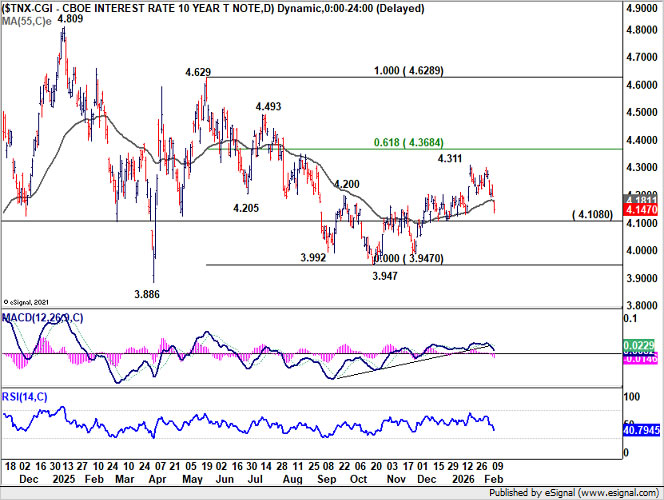
                                US 10-year yield dropped sharply overnight, by -0.061 to close at 1.370, hitting the lowest level since February. Some analysts noted that the move reflected believes that inflation in the US, and even the strong growth, were transitory only. The move also came in tandem with notable pull back in major stock indexes. Focuses will now turn to FOMC minutes for more guidance.

                                The speed of the fall in TNX was a surprise, even though the direction isn’t. Prior rejection by 55 day EMA already hinted that corrective pattern from 1.765 would more likely extend lower than not. For the moment, we’d expect strong support 38.2% retracement of 0.504 to 1.765 at 1.283 to contain downside and bring rebound. In other words, there is room for further decline in the near term, but downside is relatively limited.

                                Australia AiG services dropped to 57.8, question on filling positions to fill orders

                                  Australia AiG Performance of Services index dropped to 57.8 in June, down from 61.2. Sales dropped -2.5 pts to 66.1. Employment dropped -2.4 pts to 54.2. New orders dropped sharply by -11.7 to 56.6. Input prices dropped -2.7 to 65.4. Selling prices dropped -9.9 to 53.5. Average wages rose 2.9 to 66.0.

                                  Ai Group Chief Executive, Innes Willox, said: “Some adverse impacts on demand and supply chains were associated with the COVID lockdowns and restrictions imposed by other states and territories. Businesses were also constrained by an inability to fill positions required either to maintain existing levels of activity or to expand to meet higher demand. Wages growth accelerated in June and input prices continued to rise although at a more moderate rate than in the previous month. The healthy rise in new orders came on top of the sharp rise in the previous month and points to strong demand over coming months. A key question for many businesses will be whether they can fill positions required to fill these orders.”

                                  Full release here.

                                  DOW down sharply in early trading, Dollar and Yen rebound

                                    Yen and Dollar staged a strong rebound in early US session after stocks unexpectedly tumbled deeply. DOW was once down as much as -431 pts and it’s down nearly -1% at the time of writing. Slightly weaker than expected ISM services shouldn’t be that big an impact. However, both ISM manufacturing and services employment were back in contraction in June.

                                    There might also be speculations that Fed would be forced to tightening the tap a bit, as global central banks are starting to do so. Speculation might have intensified after RBA’s tapering and speculation of RBNZ rate hike, given that BoC has already cut down bond purchases.

                                    China’s way of crackdown on technology companies is also a source of concern. Ride-hailing giant Didi has just had a massive IPO lost week, but the Chinese government was quick to launch a so-called cyber security investigation, forcing the app down the shelves. Two smaller recent listings, Full Truck Alliance and Kanzhun are also believed to be under review.

                                    Technically, DOW’s steep pull back today doesn’t alter the near term bullish path yet. As long as 34186.13 support holds, it will still more likely to break through 35091.56 high to resume larger up trend. However, break of 34186.13 will likely extend the consolidation pattern with another falling leg towards 33271.93 support, in the less bearish case.

                                    US ISM services dropped to 60.1 in June, employment dropped to 49.3

                                      US ISM Services PMI dropped to 60.1 in June, down from 64.0, missed expectation of 63.5. Business activity/production dropped -5.8 to 60.4. New orders dropped -1.8 to 62.1. Employment dropped -6.0 to 49.3, back in contraction. Supplier deliveries dropped -1.9 to 68.5. Prices dropped -1.1 to 79.5.

                                      ISM said, “The past relationship between the Services PMI and the overall economy indicates that the Services PMI for June (60.1 percent) corresponds to a 3.8-percent increase in real gross domestic product (GDP) on an annualized basis.”

                                      Full release here.

                                      Germany ZEW dropped to 63.3, but current situation soared to 21.9

                                        Germany ZEW Economic Sentiment tumbled to 63.3 in July, down from 79.8, below expectation of 75.4. Though, Current Situation index jumped to 21.9, up from -9.1, above expectation of 5.0. Eurozone ZEW Economic Sentiment also dropped to 61.2, down from 81.3, below expectation of 84.4. Eurozone Current Situation rose 30.4 pts to 6.0.

                                        “The economic development continues to normalise. In the meantime, the situation indicator for Germany has clearly overcome the coronavirus-related decline. Although the ZEW Indicator of Economic Sentiment has once again fallen significantly, it is still at a very high level. The financial market experts therefore expect the overall economic situation to be extraordinarily positive in the coming six months,” comments ZEW President Professor Achim Wambach on current expectations.

                                        Full release here.

                                        Eurozone retail sales rose 4.6% mom in May, EU also up 4.6% mom

                                          Eurozone retail sales rose 4.6% mom in May, above expectation of 4.1% mom. Volume of retail trade increased by 8.8% for non-food products and by 8.1% for automotive fuels, while it decreased by -0.2% for food, drinks and tobacco.

                                          EU retail sales rose 4.6% mom. Among Member States for which data are available, the highest monthly increases in total retail trade were registered in France (+9.9%), the Netherlands (+9.3%) and Estonia (+8.1%). Decreases were observed in Latvia (-3.9%), Finland (-3.3%) and Luxembourg (-0.7%).

                                          Full release here.