Australia’s Westpac consumer sentiment edges higher as rate cuts clash with growth worries

    Australia’s Westpac Consumer Sentiment index rose a modest 0.5% mom in June to 92.6, reflecting a population still mired in what Westpac called a “holding pattern of cautious pessimism.”

    The data reveal “two clear opposing forces” shaping household attitudes: easing inflation and RBA’s May rate cut have improved perceptions around major purchases. On the other hand, sluggish domestic growth and global trade uncertainties continue to weigh heavily on expectations.

    Looking ahead, attention turns to the RBA’s next meeting on July 7–8. With economic data remaining mixed and labor market tightness still evident, Westpac expects the central bank to proceed with caution and keep the cash rate on hold. Nonetheless, a fresh round of economic projections in August could pave the way for another 25 basis point cut, as RBA recalibrates its stance amid still-sluggish growth.

    Full Australia Westpac consumer sentiment release here.

    ECB Kazimir: Likely at end of cuts, eyes summer data for fine-tuning

      Slovak ECB Governing Council member Peter Kazimir signaled a possible end to the current easing cycle, writing in an opinion piece today that “we’re nearly done with, if not already at the end of, the easing cycle.”

      While acknowledging the potential for weaker-than-expected economic growth in the eurozone, Kazimir emphasized the importance of staying focused on inflation to, which he warned could surprise to the upside.

      Looking ahead, Kazimir stressed the need for flexibility, noting that “incoming data throughout the summer will provide a clearer picture and guide our decisions on whether further fine-tuning is needed.”

      China’s trade surplus widens to USD 103.2B in May, US exports slump -34.5% yoy

        China’s trade surplus widened to USD 103.2B in May, exceeding expectations of USD 101.3, even as headline export and import figures undershot forecasts. Exports rose 4.8% yoy, just shy of the 5.0% yoy consensus. Imports fell -3.4% yoy, a sharper drop than the anticipated -0.9% yoy.

        Exports to the US plunged -34.5% yoy, highlighting the entrenched trade tensions despite Washington’s partial tariff rollback in April. However, the impact was cushioned by robust growth in exports to ASEAN (15% yoy), the European Union (12% yoy), and Africa (33% yoy).

        China’s CPI falls -0.1% yoy in May, negative for fourth month

          China’s headline CPI stayed in negative territory for the fourth consecutive month in May, coming in at -0.1% yoy, slightly better than the expected -0.2% yoy.

          The persistent softness in overall inflation was largely driven by a sharp -6.1% yoy decline in energy prices, which alone shaved off nearly half a percentage point from the annual CPI reading.

          On a monthly basis, CPI fell -0.2% mom, with energy again dragging down the figure through a -1.7% mom decline.

          In contrast, core inflation, which strips out food and energy prices, rose to 0.6% yoy, the highest level since January.

          Producer price pressures continue to weaken further, with PPI dropping to -3.3% yoy from -2.7% yoy previously, marking the deepest contraction in nearly two years. Wholesale prices have now been stuck in deflation since October 2022.

          ECB’s Nagel signals Pause, cites maximum flexibility at current rates

            German ECB Governing Council member Joachim Nagel indicated over the weekend that the central bank is likely entering a pause phase after last week’s eighth rate cut in the current easing cycle, which brought the deposit rate to 2.00%.

            Speaking on Deutschlandfunk radio, Nagel also noted that the current level of interest rates offers “maximum flexibility.” And, “We can now take the time to look at the situation first.”

            BoE’s Greene warns on inflation sensitivity, risk of wage-price spiral

              BoE Monetary Policy Committee member Megan Greene acknowledged at a Saturday conference that while UK inflation is moving “in the right direction,” the pace of decline is slower than she would prefer.

              Speaking candidly about April’s upside inflation surprise, Greene stated that while the MPC believes it can “look through” the jump, there remains a “pretty big risk” that price pressures could become more entrenched, especially if second-round effects materialize.

              Greene also highlighted the behavioral shift triggered by the recent cost-of-living crisis, warning that past inflation shocks may have left households and businesses more reactive to even small price increases. That, in turn, could “feed through the wage-price behavior.” S

              he noted that private-sector wage growth remains “way above” the level consistent with the BoE’s 2% inflation target.

              Canada’s employment grow 8.8k in May, unemployment rate rises to 7%

                Canada’s employment grew 8.8k in May, better than expectation of -11.9k fall. Growth in full-time employment (+58k; +0.3%) was offset by a decline in part-time work (-49k; -1.3%).

                Unemployment rate rose from 6.9% to 7.0%, matched expectations. Employment rate held steady at 60.8%.

                Average hourly wages among employees increased 3.4% you, same as in April.

                Full Canada employment release here.

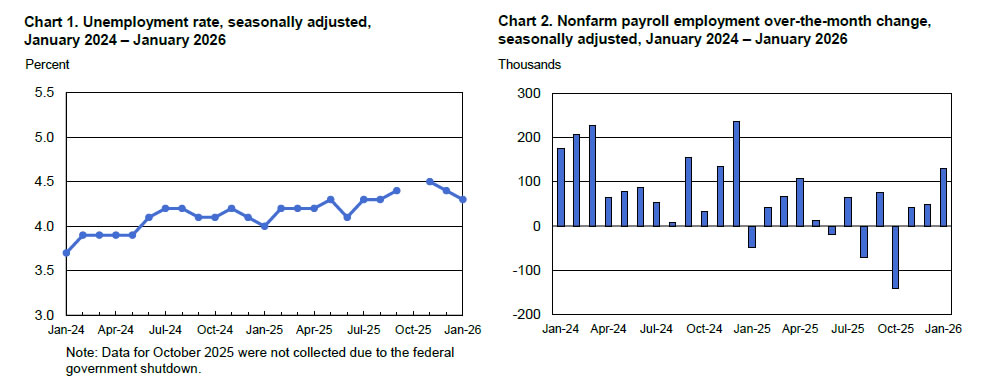
                US NFP grows 139k in May, unemployment rate steady at 4.2%

                  US non-farm payroll employment rose 139k in May, above expectation of 130k. That’s slightly below average monthly gain of 149k over the prior 12 months.

                  Unemployment rate was unchanged at 4.2%, matched expectations. Participation rate fell from 62.6% to 62.4%.

                  Average hourly earnings rose 0.4% mom, above expectation of 0.3% mom. Over the past 12 months, average hourly earnings have increased by 3.9% yoy.

                  Full US NFP release here.

                  Eurozone retail sales inch up 0.1% mom April, mixed national trends

                    Eurozone retail sales rose just 0.1% mom in April, falling short of expectations for a 0.2% mom rise. Modest gains in food, drink, and tobacco sales (+0.5%) and a solid rebound in automotive fuel purchases (+1.3%) were offset by a -0.3% decline in non-food product sales.

                    Across the EU, retail sales rose a more robust 0.7% mom, but the underlying data painted a sharply divided picture. Poland led with a remarkable 7.5% surge, followed by Slovakia and Sweden at 2.4%. In contrast, Germany—the region’s largest economy—saw a -1.1% drop, dragging on the overall Eurozone figure.

                    Full Eurozone retail sales release here.

                    ECB officials signal pause yesterday’s rate cut, emphasize flexibility

                      One day after ECB delivered its eighth rate cut in this easing cycle, a coordinated message emerged from several Governing Council members: ECB is not committing to further immediate action.

                      Latvian central banker Martins Kazaks was particularly blunt, stating that markets should not expect a rate cut at every meeting. He emphasized the value of preserving “policy space”.

                      “We don’t get much data between now and the July meeting so it may well be the case that we pause,” Kazaks said. “But uncertainty remains very high, the political situation may change every day. So forward guidance isn’t your friend in these circumstances.”

                      Greek central bank chief Yannis Stournaras echoed this sentiment, calling ECB’s work on inflation “nearly done,” while warning that further cuts would require growth to fall short of current forecasts.

                      Estonian Governor Madis Muller also struck a cautious tone, suggesting the rate-cutting cycle may be “almost finished,” but acknowledged that visibility is limited. All three policymakers stressed that decisions ahead would remain data-driven, and that it was too early to rule out any scenario.

                      French Governor François Villeroy de Galhau and Lithuania’s Gediminas Šimkus declared victory over inflation. However, both underlined the importance of maintaining flexibility in the face of mounting global uncertainty. Villeroy also reassured that “We have tools to react if there’s deflation.”


                      US NFP: Muted Hiring or Major Miss?

                        Markets are awaiting today’s US non-farm payrolls release, with little doubt that hiring had slowed meaningfully in May amid heightened tariff threats and elevated uncertainty. The key question now is just how sharp the slowdown was.

                        Consensus forecasts see NFP at 130K, unemployment steady at 4.2%, and average hourly earnings rising 0.3% mom. Recent labor indicators have painted a dismal picture. ADP private employment came in at just 37k, a stark miss. ISM Manufacturing employment stayed subdued at 46.8 and the Services component barely rose back into expansion territory at 50.7. Meanwhile, 4-week average of jobless claims has crept up to 235k.

                        While a modest softening in job growth would likely be tolerated as a natural response to macro headwinds, any significant downside surprise could reignite recession fears. An NFP reading below 100K could provoke a sharp risk-off response in equities. However, such a result would likely weigh further on Dollar, as markets would begin pricing in earlier Fed rate cuts in response to labor market deterioration.

                        Technically, S&P 500 extended the near term rise from 4835.04 this week, but continued to lose upside momentum as seen in D MACD. This rise is seen as the second leg of the corrective pattern from 6147.43. Hence, while further rise cannot be ruled out, given that S&P 500 is now close to 6000, upside potential is limited. On the other hand, break of 5767.41 support will signal that a short term top was already formed. Deeper pull back should be seen back to 38.2% retracement of 4835.04 to 5999.70 at 5554.79, with risk of bearish reversal.


                        Fed’s Schmid: Tariff impact uncertain, policy must stay nimble

                          Kansas City Fed President Jeff Schmid acknowledged in a speech overnight that monetary theory may suggest to “looking through a one-time price shock”, he would be “uncomfortable staking the Fed’s reputation and credibility on theory alone.”

                          Despite the expected drag from tariffs, Schmid remains “optimistic” about the economy’s momentum. However, he acknowledged that both the inflationary and growth implications of tariffs are highly uncertain.

                          As a result, he argued that Fed will “need to remain nimble”, and be prepared to adjust its stance as needed to maintain both price stability and maximum employment.

                          Fed’s Kugler: Tariffs may entrench inflation via expectations, pricing power, and productivity

                            Fed Governor Adriana Kugler cautioned that disinflation “has slowed” and that tariffs are beginning to exert upward pressure on prices, a trend she expects to continue into 2025. Speaking overnight, Kugler emphasized that the balance of risks has tilted, with “greater upside risks to inflation” now emerging, even as downside risks to employment and growth loom on the horizon. As a result, she reaffirmed support for holding the current policy rate steady.

                            Kugler outlined three channels through which tariffs could entrench inflationary pressures. First, she noted that rising short-term inflation expectations may grant businesses “more leeway to raise prices”, thereby increasing inflation persistence.

                            Second, she flagged the risk of “opportunistic pricing”, where firms use tariff headlines as cover to hike prices even on unaffected goods. This, combined with higher costs on intermediate goods, could generate “second-round effects” on inflation.

                            The third concern relates to “lower productivity”. As firms contend with elevated input costs and weaker demand, they may reduce capital investment and resort to less efficient production methods, reinforcing inflationary pressure through lower productivity.

                            Full speech of Fed’s Kugler here.

                            US initial jobless claims jump to 247k vs exp 235k

                              US initial jobless claims rose 8k to 247k in the week ending May 30, above expectation of 235k. Four-week moving average of initial claims rose 4.5k to 235k.

                              Continuing claims fell -3k to 1904k in the week ending May 24. Four-week moving average of continuing claims rose 8k to 1895k, highest since November 27, 2021.

                              Full US jobless claims release here.

                              ECB cuts 25bps, downgrades inflation forecasts

                                ECB lowered deposit rate by 25bps to 2.00% as widely expected. The central bank cited “exceptional uncertainty,” and its commitment to a data-dependent, meeting-by-meeting approach, refraining from offering forward guidance on the future path of interest rates.

                                In the updated economic projections, ECB now expects headline inflation to average 2.0% in 2025 and 1.6% in 2026—down 0.3 percentage points from March’s forecast. Headline inflation would then return to target at 2.0% in 2027. The revision was largely due to lower energy prices and a stronger Euro.

                                Core inflation is expected to ease to 2.4% in 2025 and 1.9% in both 2026 and 2027, broadly unchanged from previous forecasts.

                                On growth, ECB projects real GDP to expand by 0.9% in 2025, 1.1% in 2026, and 1.3% in 2027. While the 2025 GDP forecast remains unchanged due to a strong first quarter, ECB acknowledged that the remainder of the year looks weaker, in part due to trade-related uncertainty.

                                Weak global demand and potential retaliation to US tariffs could continue to drag on exports and business investment. However, rising public investment, particularly in defense and infrastructure, is expected to lend some support to growth in the medium term.

                                Full ECB statement here.

                                Eurozone PPI slumps -2.2% mom on energy prices

                                  Eurozone PPI dropped sharply by -2.2% mom in April, steeper than the expected -1.8% mom. decline. Annual PPI rose just 0.7% yoy, below forecasts of 1.2% yoy. PPI ex-energy was up 0.1% mom, 1.1% yoy

                                  The drag on Eurozone PPI was driven primarily by a -7.7% mom fall in energy prices. Prices for intermediate goods also declined slightly by -0.1% mom, while capital goods prices held flat. In contrast, consumer goods offered some offset, with durable and non-durable segments rising 0.1% mom and 0.3% mom respectively.

                                  The broader EU showed a similar picture, with PPI falling -2.1% mom and rising just 0.6% yoy. Country-level data revealed significant monthly drops in industrial prices in France (-4.3%), Ireland (-4.0%), and Bulgaria (-4.9%). Only a handful of smaller economies like Cyprus and Malta posted slight increases.

                                  Full Eurozone PPI release here.

                                  ECB to cut, focus on Lagarde’s signal for a July pause

                                    ECB is set to lower its deposit rate by 25 bps to 2.00% today, marking the eighth cut of this easing cycle and bringing policy deep into neutral territory. With inflation falling back below the 2% target in May, the case for further easing is clear in the near term. However, the main focus will be on President Christine Lagarde’s forward guidance, particularly whether she signals a July pause in rate cuts, and the ECB’s updated economic projections.

                                    The case for caution is clear. The Eurozone faces a highly uncertain backdrop with multiple crosscurrents. Trade war remain front and center, with US President Donald Trump’s tariff agenda weighing heavily on confidence and investment. Retaliatory moves from the EU could compound the hit to activity. At the same time, the surprised surge in Euro risks exerting additional downward pressure on inflation. Amid this uncertainty, ECB is expected to lower both its 2025 growth and inflation forecasts, acknowledging the softening outlook.

                                    At the same time, medium-term fundamentals could provide some support. The EU’s major rearmament plans and Germany’s fiscal pivot to expansion are likely to bolster investment and domestic demand over time. That said, these structural measures will take time to feed through.

                                    A July pause would allow policymakers to evaluate how these domestic tailwinds and external headwinds ultimately shape the outlook, particularly as geopolitical and policy unpredictability continues to cloud the picture.

                                    Technically, EUR/CHF’s near term price actions from 0.9445 are more likely than not a triangle consolidation pattern. That is, rise from 0.9218 is in favor to resume, even as a corrective move. Break of 0.9389 minor resistance will be a bullish sign and further break of 0.9419 should sent EUR/CHF through 0.9445 resistance.

                                    China’s Caixin PMI composite falls to 49.6, contracts for first time since 2022

                                      China’s Caixin PMI Services rose modestly from 50.7 to 51.1 in May, aligning with expectations. However, the gain in services was not enough to offset the drag from manufacturing, as PMI Composite slipped into contraction at 49.6, its first reading below 50 since December 2022.

                                      Wang Zhe of Caixin Insight Group noted that the manufacturing slump was weighing heavily on the overall market, with new export orders remaining “sluggish” across both goods and services. Although input costs rose slightly, firms were unable to pass these on to customers, with selling prices continuing to fall and compressing profit margins.

                                      Caixin flagged “unfavorable factors remain relatively prevalent”, with growing external trade uncertainty and “noticeable weakening” in macro indicators at the start of Q2. The “significantly intensified”downward pressure raises the urgency for further targeted policy support.

                                      Full China’s Caixin PMI services release here.

                                      Japan’s real wages fall -1.8% yoy in April, down for the fourth month

                                        Real wages in Japan fell by -1.8% yoy in April, marking the fourth consecutive month of decline as persistent inflation continued to erode household purchasing power.

                                        While nominal wages rose 2.3% yoy, slightly below the expected 2.6%, gains were outpaced by a still-elevated consumer inflation rate of 4.1%, driven by rising food and energy costs. The inflation metric used by the labor ministry has remained near 4% for five straight months, keeping real income in negative territory.

                                        On the positive side, base salaries rose 2.2% yoy, the fastest increase in four months and well above March’s 1.4% yoy gain. This also marked the 42nd consecutive month of growth in regular pay. Overtime pay rebounded with a modest 0.8% yoy rise, while special payments grew 4.1% yoy.

                                        Fed’s Beige Book: General tone slightly pessimistic and uncertain

                                          Fed’s Beige Book report paints a picture of slowing US economy marked by pervasive caution and subdued sentiment.

                                          Economic activity was reported to have “declined slightly” overall, with half of the twelve Districts seeing slight to moderate declines, while three reported no change and three noted slight growth. The general tone remains “slightly pessimistic and uncertain,” echoing the previous report, as elevated policy and economic uncertainty continues to weigh on both business and household decision-making.

                                          Consumer spending trends were mixed, with most Districts reporting little change or modest declines. However, in some cases, spending picked up on goods expected to be affected by tariffs—suggesting front-loading behavior amid trade concerns. Employment levels were largely stable, while price pressures persisted, rising at a moderate pace.

                                          Full Fed’s Beige Book report here.