China CPI turned positive in Dec, PPI deflation flowed to -0.4% yoy

    China’s CPI turned positive to 0.2% yoy in December, up from -0.50% yoy, above expectation of 0.1% yoy. Core CPI, excluding food and energy, stood at 0.4% yoy, down from 0.5% yoy.

    “Ahead of New Year’s Day and the Spring Festival, consumer demand increased, and feed costs also rose,” said Dong Lijuan, a senior statistician at the NBS. “At the same time, affected by unusual weather and rising costs, the CPI turned from a decline into an increase.”

    PPI dropped to -0.4% yoy in December, up from November’s -1.5% yoy, higher than expectation of -0.8% yoy. That’s also the slowest factory gate deflation since last February.

    Australia retail sales rose 7.1% mom in Nov, up 2.6% excluding Victoria

      Australia retail sales grew 7.1% mom in November, revised up from preliminary result of 7.0% mom, followed 1.4% mom rise in October. Ben James, Director of Quarterly Economy Wide Surveys, said: “The rise is led by Victoria (22.4%) as Melbourne retail stores were able to trade for a full month in November. Excluding Victoria, turnover rose 2.6%.”

      Other states and territories to record an increase in turnover were Queensland (4.5%), New South Wales (2.3%), Western Australia (1.2%), Tasmania (3.4%), the Australian Capital Territory (2.5%), and the Northern Territory (2.2 per cent). The brief lockdown in South Australia (-0.2%) led to a relatively flat result, as falls in most industries were offset by a rise in food sales.

      Full release here.

      Canada employment dropped -63k, unemployment rate ticked up to 8.6%

        Canada employment dropped -63k, or -0.3%, in December, much worse than expectation of -32.5k, and the first contraction since April. Unemployment rate ticked up to 8.6%, from November’s 8.5%.

        Full release here.

        US NFP employment dropped -140k, unemployment rate unchanged at 6.7%

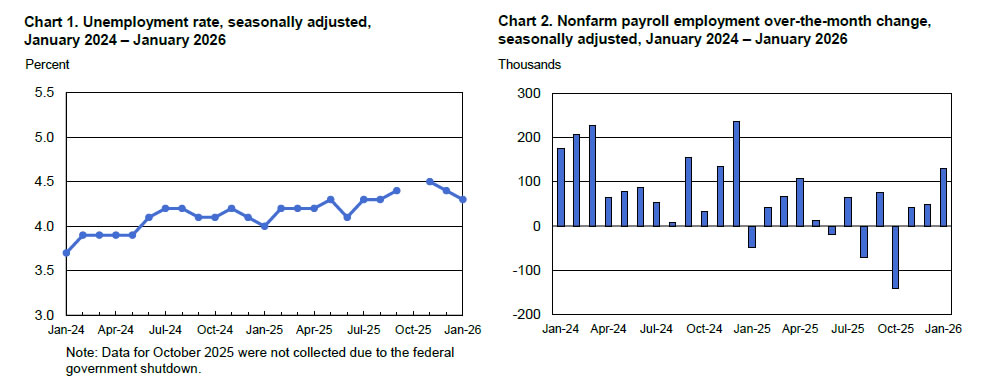
          US non-farm payroll employment contracted -140k in December, well below expectation. That’s the first decline in jobs since April. Though, prior month’s figure was revised up from 245k to 336k.

          Unemployment rate was unchanged at 6.7%, below expectation of 6.8%, with 10.7m people unemployed. Labor force participation rate was unchanged at 61.5%. Average hourly earnings rose 0.8% mom, above expectation of 0.2% mom.

          Full release here.

          Eurozone unemployment rate dropped to 8.3% in Nov, EU down to 7.5%

            Eurozone unemployment rate dropped to 8.3% in November, down from 8.4%, better than expectation of 8.5%. EU employment also dropped to 7.5%, down from 7.6%. Eurostat estimates that 15.933 million men and women in the EU, of whom 13.609 million in the euro area, were unemployed in November.

            Released earlier today, Germany industrial production rose 0.9% mom in November, versus expectation of 0.7% mom. Trade surplus narrowed to EUR 16.4B, smaller than expectation of EUR 18.5B.

            From France, industrial output dropped -0.9% mom in November, versus expectation of -1.2% mom. Consumer spending dropped -18.9% mom, versus expectation of -15.0%. Trade deficit narrowed to EUR -3.6B in November, versus expectation of EUR -4.5B.

            From Swiss, foreign currency reserves rose to CHF 891B in December.

            Gold accelerates down after taking out 1900, eye 1956 support

              Gold is in steep fall in early European session, and selloff accelerates to as low as 1877.6 so far, after breaking through 1900 handle. The current development suggests that prior rise from 1764.31 has completed at 1959.16 after rejection by 1965.50 resistance. Deeper fall is expected as long as 1927.49 minor resistance holds.

              Immediate focus is now on 1856.98 support. Decisive break there should confirm this bearish case and turn outlook bearish. More importantly, such development will argue that whole consolidation pattern from 2075.18 is not finished, and is extending with another falling leg. Further decline would then be seen through 1764.31 low. That could also help give Dollar a floor for stronger rebound.

              EUR/CAD heading to 1.5402 support with Euro now in selloff mode

                Euro drops notably in early European session, in particular against commodity currencies. EUR/CAD’s rebound from 1.5313 was stronger and longer than expected. Though, the structure still suggest it’s a corrective three wave move. The break through 55 day EMA, with today’s decline, suggests that the corrective rise might be completed.

                Further fall is now in favor as long as 1.5657 minor resistance holds. Decisive break of 1.5402 support should affirm that case that fall from 1.5978, as the third leg of the consolidation pattern from 1.5991, is resuming. In this case, we’d likely see EUR/CAD breaking through 1.5313 support to 100% projection of 1.5978 to 1.5313 from 1.5783 at 1.5118.

                Non-farm payrolls will more likely disappoint then not

                  US non-farm payroll report will be a major focus before the first full week of 2021 is wrapped up. Markets are expecting non-farm payrolls to grow 100k in December. Unemployment rate is expected to edge up to 6.8% while average hourly earnings are expected to rise 0.2% mom.

                  Looking at related indicators, ISM manufacturing employment turned back into expansion at 51.5 in December, up from 48.4. ISM Services employment, however, dropped back to contraction at 48.2, down from 51.5. ADP employment showed a contraction of -123k jobs. Four-week moving average of initial jobless claims rose nearly 100k to 837k.

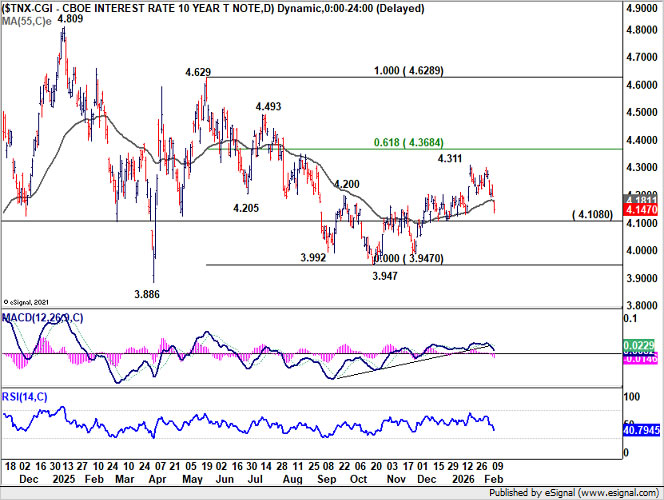
                  The NFP result will more likely disappoint market expectations than not. Nevertheless, traders could still look through the set of “old” data to the policies of the new administration. A focus would be on whether 10-year yield could extend this week’s powerful rally, and whether that could help set up a sustainable Dollar rebound.

                  NASDAQ back in driving seat, closed at new record high

                    NASDAQ was finally back in the driving seat overnight, closing at new record high at 13067.47, up 2.56% or 326.68 pts. S&P 500 rose 1.48% to 3803.79 while DOW rose 0.69% to 31041.14. All were new records. Technically, next medium term target for NASDAQ will be 61.8% projection of 6631.42 to 12074.06 from 10822.57 at 14186.12.

                    There are two things to pay attention to in NASDAQ. Firstly, it’s the reaction to near term channel resistance. Secondly, it’s whether daily MACD would bend upwards through prior high made last September. Both would indicate whether NASDAQ is re-accelerating and set the stage through above mentioned 14186.12 projection level.

                    Fed Barkin: Second half to be robust as businesses pull the trigger

                      Richmond Fed President Thomas Barkin said with initial slow vaccine distribution. a full return to normal “won’t be until sometime this summer at best”. Though, “I expect the second half of the year to be robust as businesses finally pull the trigger and return to the workplace and consumers with elevated savings unlock pent-up demand,” he added.

                      Barkin also noted, “I am encouraged to see the rise in market indicators of inflation expectations. … That is what we are trying to support”. Recent rise in bond yields was part of a “reflation trade”, as investors were pricing in future rise in prices.

                      Fed Evans: Probably going to be 2024 before interest rate hike

                        Chicago Fed President Charles Evans said, it’s “probably going to be 2024 before we see interest rates start to rise,: That would come with “continuations of labor market improvement, unemployment falling to 4% and hopefully below that”

                        At that point, he said, “we can start to gently increase the federal funds rate, while it will still be accommodative in order to sort of achieve this overshooting and average 2% (inflation).”

                        Fed Bullard: Health crisis will wane in the months ahead

                          St Louis Fed President James Bullard said in a presentation that “early arrival of vaccines suggests the health crisis will wane in the months ahead”. With vaccine distribution directed towards the most vulnerable, fatalities would also decline. Additionally, business have already learned to “produce at normal levels despite health restrictions”, contributing to rapid economic growth.

                          “Market-based inflation expectations have recovered from lows reached during March 2020,”he added. “TIPS-based breakeven inflation, based on CPI inflation measures, could move considerably higher and still be consistent with a PCE inflation outcome modestly above the 2% target.”

                          Bullard also told reporters, “the ingredients for higher inflation are in place”, with “very powerful fiscal policy”, a Fed that “wants to temporarily have inflation above target”, and the “economy poised to boom at the end of the pandemic”

                          Full presentation here.

                          US initial jobless claims dropped slightly to 787k, continuing claims dropped to 5.07m

                            US initial jobless claims dropped -3k to 787k in the week ending January 2, below expectation of 798k. Four-week moving average of initial claims dropped -18.8k to 818.8k.

                            Continuing claims dropped -126k to 5072k in the week ending December 26. Four-week moving average of continuing claims dropped -177k to 5274k.

                            Full release here.

                            Japan announced limited state of emergency in Tokyo, Saitama, Kanagawa and Chiba

                              Japan announced a limited state of emergency in Tokyo, and three neighboring prefectures of Saitama, Kanagawa and Chiba. 30% of the country’s population are covered. The one-month emergency measure would run from Friday to February 7. Restaurants and bars are asked to close by 8pm. Residents should refrain from non-urgent outings. Crowds at sports and big events are limited to 5000 people.

                              “The global pandemic has been a tougher one than we expected, but I’m hopeful we can overcome this,” Prime Minister Yoshihide Suga said. “For this to happen, I must ask citizens to endure life with some restrictions.”

                              Eurozone Economic Sentiment Indicator rose 2.7 pts to 90.4 in Dec

                                Eurozone Economic Sentiment Indicator rose 2.7 pts to 90.4 in December. Employment Expectation Indicator rose 1.4 pts to 88.3. Amongst the largest euro-area economies, the ESI increased significantly in Italy (+6.8), Spain (+3.3) and, to a lesser extent, in the Netherlands (+2.5) and France (+2.1), while it remained broadly unchanged in Germany (+0.1).

                                Looking at some details, industrial confidence rose from -10.1 to -7.2. Services confidence dropped from -17.1 to -17.4. Consumer confidence rose from -17.6 to -13.9. Retail trade confidence rose from -12.7 to -13.1. Construction confidence dropped from -9.3 to -7.9.

                                Full release here.

                                Eurozone CPI unchanged at -0.3% yoy in Dec, core CPI unchanged at 0.2% yoy

                                  Eurozone CPI was unchanged at -0.3% yoy in December, below expectation of -0.2% yoy. CPI core was also unchanged at 0.2% yoy. Looking at the main components, food, alcohol & tobacco is expected to have the highest annual rate in December (1.4%, compared with 1.9% in November), followed by services (0.7%, compared with 0.6% in November), non-energy industrial goods (-0.5%, compared with -0.3% in November) and energy (-6.9%, compared with -8.3% in November).

                                  Full release here.

                                  Eurozone retail sales dropped -6.1% mom in Nov, well below expectations

                                    Eurozone retail sales dropped sharply by -6.1% mom in November, well below expectation of -3.0% mom. Volume of retail trade decreased by -10.6% mom for automotive fuels, by -8.9% mom for non-food products (within this category mail orders and internet increased by 1.8% mom) and by -1.7% mom for food, drinks and tobacco.

                                    EU retail sales dropped -5.0% mom. Among Member States for which data are available, the largest decreases in the total retail trade volume were observed in France (-18.0% mom), Belgium (-15.9% mom) and Austria (-9.9% mom). The highest increases were registered in the Netherlands (+2.6% mom), Croatia (+2.5% mom) and Germany (+1.9% mom).

                                    Full release here.

                                    UK PMI construction dropped to 54.6, positive end to the year

                                      UK PMI Construction dropped slightly to 54.6 in December, down from 54.7, matched expectations. Markit noted that output expansion maintained for the seventh month in a row. Employment returned to growth amid strong rise in new orders. Supply shortages pushed up input costs.

                                      Tim Moore, Economics Director at IHS Markit: “December data illustrated a positive end to the year for the UK construction sector, mostly fuelled by a sharp rebound in house building. Overall output growth has slowed in comparison to the catch-up phase last summer, but now it is encouraging to see the recovery driven by new projects and stronger underlying demand.”

                                      Full release here.

                                      NZD/JPY resumed up trend after brief consolidation, targeting 77.07

                                        NZD/JPY’s up trend resumed after brief consolidations, following broad based risk-on sentiment. Outlook stays bullish as long as 73.78 support holds, even in case of retreat. Next target is 100% projection of 63.45 to 71.66 from 68.86, at 77.07. As the current rally could be the end of a five wave sequence from 59.49, we’d look for topping signal around 77.07.

                                        GBP/AUD resuming medium term down trend

                                          Australian Dollar stays firm and continues to ride on strong overall strong risk-on markets. GBP/AUD’s breach of 1.7423 low affirms our bearish view in a prior post. Down trend from 2.0854 should be resuming.

                                          Sustained trading below 1.7423 will target 38.2% projection of 2.0854 to 1.7493 from 1.8526 at 1.7242 first. Break will pave the way to 61.8% projection at 1.6449. Though, break of 1.7623 minor resistance will delay the bearish case and extend the consolidation from 1.7423 with another rising leg.