

Live Comments
US Consumers Turn More Pessimistic as Inflation Concerns Stay Elevated
US consumer sentiment deteriorated sharply in August, adding to signs that household confidence is weakening even as inflation concerns persist. University of Michigan Consumer Sentiment fell from 55.2 to 51.0, below 54.1 consensus. Current Conditions dropped from 54.8 to 51.8 and Expectations declined from 55.4 to 50.6. Survey said expected business conditions fell -11% for short run and -17% for long run, with weakness particularly pronounced among older, lower-income and non-college consumers.
Inflation expectations moved in opposite direction. One-year expectations edged up from 4.2% to 4.3%, remaining well above 3.4% in February before Iran conflict. Long-run expectations held at 3.3% for third straight month. Purchasing-power concerns remain acute: only 8% of consumers expect income growth to exceed inflation over next year, down from 18% in December 2024. That combination suggests households are becoming less confident about growth without becoming more comfortable about prices.
For Fed, report is awkward rather than clearly dovish. Weak sentiment adds to softer retail sales and July labor data, reinforcing evidence that demand is losing momentum. But elevated inflation expectations argue against assuming weaker activity will automatically translate into faster disinflation. Overall signal is mildly stagflationary: consumer confidence is deteriorating while inflation expectations remain too high, strengthening case for Fed to hold and wait for clearer August data.
Data Summary
| Component | Current | Previous | Trend |
|---|---|---|---|
| Consumer Sentiment | 51.0 | 55.2 | Sharp deterioration |
| Current Economic Conditions | 51.8 | 54.8 | Weaker |
| Consumer Expectations | 50.6 | 55.4 | Sharp deterioration |
| 1-Year Inflation Expectations | 4.3% | 4.2% | Higher |
| Long-Run Inflation Expectations | 3.3% | 3.3% | Unchanged |
Key Takeaways
- UoM Consumer Sentiment fell from 55.2 to 51.0 in August, well below 54.1 consensus, ending two consecutive months of improvement.
- Consumer Expectations weakened more sharply from 55.4 to 50.6, while Current Conditions fell from 54.8 to 51.8.
- Expected business conditions dropped 11% for short run and 17% for long run, pointing to growing concern over economic outlook.
- One-year inflation expectations edged up from 4.2% to 4.3%, remaining well above 3.4% seen before Iran conflict.
- Long-run inflation expectations stayed at 3.3% for third straight month, still slightly above 2024 range of 2.8–3.2%.
- Only 8% of consumers expect income growth to exceed inflation over next year, down from 18% in December 2024.
- Report carries a stagflationary tone: confidence is weakening while inflation expectations remain elevated, reinforcing Fed case to hold and assess incoming data.
US Retail Sales Slump -0.6% M/M in July as Consumer Momentum Fades
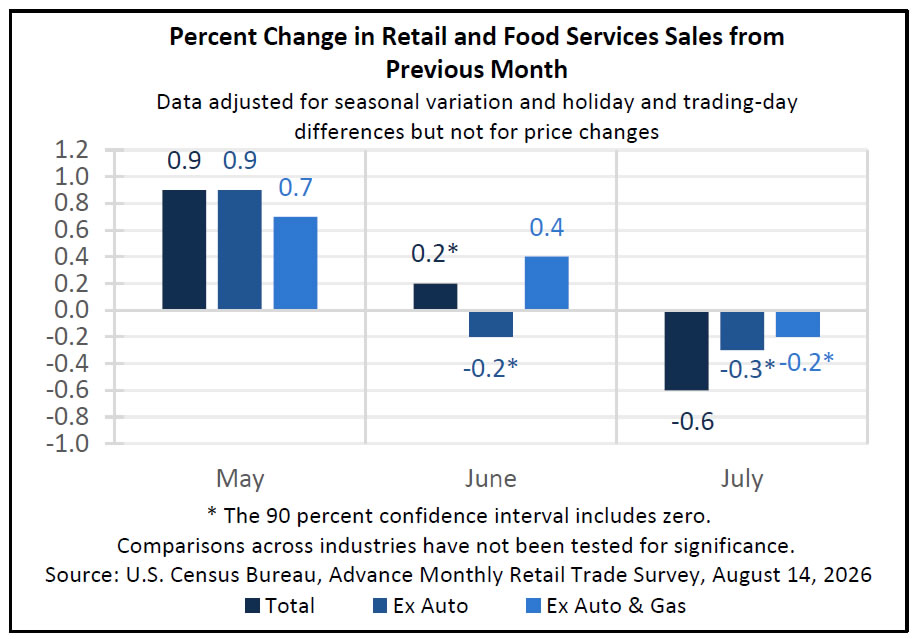
US retail sales weakened sharply in July, adding to evidence that domestic demand lost momentum at start of Q3. Headline sales slowed from 0.2% to -0.6% m/m, well below expectations for 0.2% growth. Sales excluding autos deteriorated from -0.2% to -0.3%, also missing 0.2% forecast. Even excluding both autos and gasoline, sales fell -0.2%, suggesting weakness extended beyond volatile categories. Retail sales excluding food services were softer still at -0.8%.
Monthly weakness contrasts with still-solid annual growth. Total retail and food-services sales were 5.0% higher y/y, while sales over May-July were 6.3% above same period a year earlier. Ex-auto sales rose 5.8% y/y and ex-auto-and-gasoline sales increased 4.8%. That argues against describing July as a collapse in consumption, but it does point to a clear loss of near-term momentum after May’s strong gains and modest June growth.
For Fed, July retail sales reinforce case for keeping rates unchanged in September. Weak payrolls already raised concern over labor market, while this week’s CPI and PPI reduced urgency to tighten again. Softer consumer spending now adds evidence that higher rates are restraining demand. One month is not enough to establish a sustained downturn, but another weak August reading would strengthen argument that Fed should remain patient rather than revive tightening.
Data Summary
| Indicator | Actual | Expected | Previous |
|---|---|---|---|
| Retail Sales m/m | -0.6% | 0.2% | 0.2% |
| Retail Sales ex Autos m/m | -0.3% | 0.2% | -0.2% |
| Retail Sales ex Autos & Gas m/m | -0.2% | — | 0.4% |
| Retail Sales ex Gasoline m/m | -0.6% | — | 0.8% |
| Retail Sales ex Food Services m/m | -0.8% | — | 0.2% |
Key Takeaways
- US retail sales swung from 0.2% growth to -0.6% m/m in July, sharply missing expectations for another 0.2% increase.
- Weakness extended beyond autos. Sales excluding autos deteriorated from -0.2% to -0.3%, while sales excluding both autos and gasoline fell 0.2%.
- Retail sales excluding food services dropped 0.8% m/m, reinforcing evidence of broad monthly softness.
- Annual spending remains much firmer, with total retail and food-services sales 5.0% higher y/y and May–July sales up 6.3% from same period in 2025.
- Data therefore point to loss of near-term consumer momentum rather than outright collapse in spending.
- Retail sales are nominal and not adjusted for price changes, so strong annual growth does not necessarily imply equally strong real consumption.
- Combined with weak July payrolls and benign CPI/PPI, report further strengthens September Fed hold case.
Europe’s June 14.4% YoY Export Rebound Masks Sharp First-Half Trade Deterioration
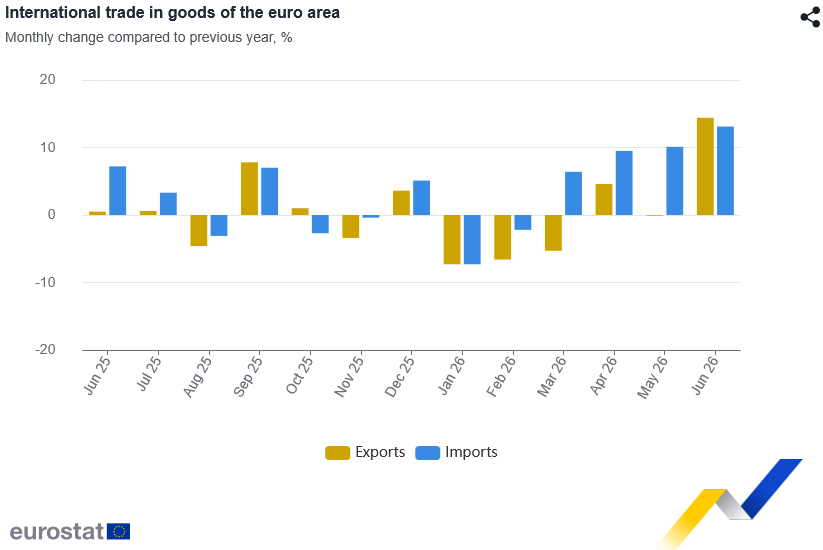
Eurozone goods trade surplus widened from EUR 4.8B last year to EUR 8.6B in June, as exports rose 14.4% y/y to EUR 272.5B and imports increased 13.1% y/y to EUR 264.0B. EU trade surplus, however, narrowed from EUR 5.2B to EUR 3.9B, with exports up 12.5% and imports rising a slightly faster 13.5%. June figures therefore point to a strong rebound in cross-border trade, but not a uniformly stronger external position across region.
First-half data paint a much weaker picture. Eurozone exports slipped -0.2% y/y in January-June while imports rose 4.9%, shrinking cumulative surplus from EUR 82.2B to EUR 9.8B. For EU, extra-regional exports fell -2.1% while imports increased 4.7%, swinging balance from a EUR 74.1B surplus to EUR 14.9B deficit. Intra-regional trade was firmer, rising 4.7% in Eurozone and 5.7% across EU.
Partner breakdown also remained mixed. EU kept sizeable surpluses with US, UK and Switzerland, while deficit with China widened from EUR 31.0B to EUR 35.1B in June. Overall, June rebound is encouraging, but it does not erase deterioration seen over first half. Stronger exports are beginning to help, yet Europe still needs a more sustained improvement before trade can be described as a durable growth tailwind.
Data Summary
| Indicator | Jun 2026 | Jun 2025 | Change |
|---|---|---|---|
| Eurozone Extra-EA Exports | €272.5B | €238.2B | +14.4% |
| Eurozone Extra-EA Imports | €264.0B | €233.4B | +13.1% |
| Eurozone Trade Balance | €8.6B | €4.8B | widened |
| EU Extra-EU Exports | €241.5B | €214.7B | +12.5% |
| EU Extra-EU Imports | €237.7B | €209.5B | +13.5% |
| EU Trade Balance | €3.9B | €5.2B | narrowed |
| Jan–Jun | 2026 | 2025 | Change |
|---|---|---|---|
| Eurozone Extra-EA Exports | €1,487.2B | €1,490.1B | -0.2% |
| Eurozone Extra-EA Imports | €1,477.4B | €1,407.9B | +4.9% |
| Eurozone Trade Balance | €9.8B | €82.2B | Narrowed sharply |
| EU Extra-EU Exports | €1,317.0B | €1,345.9B | -2.1% |
| EU Extra-EU Imports | €1,331.9B | €1,271.8B | +4.7% |
| EU Trade Balance | -€14.9B | €74.1B | Swung to deficit |
Key Takeaways
- Eurozone goods surplus widened from €4.8B to €8.6B y/y in June, as exports rose 14.4%, faster than 13.1% import growth.
- EU surplus moved in opposite direction, narrowing from €5.2B to €3.9B, as imports grew slightly faster than exports.
- June strength contrasts sharply with first-half trend: Eurozone surplus collapsed from €82.2B to €9.8B.
- EU external balance deteriorated further, swinging from €74.1B surplus to €14.9B deficit over January-June.
- EU continued to run sizable surpluses with US, UK and Switzerland, while deficit with China widened from €31.0B to €35.1B in June.
- Overall picture is improvement at margin rather than a completed trade recovery; June exports rebounded strongly, but first-half balances remain substantially weaker.