US oil inventories rose 0.5m barrels, WTI fails 40 handle

    US commercial crude oil inventories rose 0.5m barrels in the week ending October 2. At 492.9m barrels, inventories are about 12% above the five year average for this time of the year. Gasoline inventories dropped -1.4m barrels. Distillate dropped -1.0m barrels. Propane/propylene inventories dropped -0.1m barrels. Commercial petroleum dropped -2.0m barrels.

    Price actions in WTI crude oil remained very volatile but it still could regain 40 handle with conviction. After all, it’s staying in consolidative pattern from 43.50. Further rise cannot be ruled out for the moment. But even a break of 41.43 might be seen, we don’t expect a break of 43.50 high. Meanwhile, on the downside, any decline attempt should be contained by 34.36/35.98 support zone.

    Bundebank Weidmann sees not reason to deviate from ECB’s assessment

      Bundesbank President Jens Weidmann said ECB’s monetary stance is “currently appropriate” and “at the moment I see no reason to deviate from our assessment.”

      Indeed, he argued that the economy could turn out to be better than ECB’s baseline scenario, because the EUR 750B EU recovery package wasn’t counted in, nor the EUR 100B fiscal measures of France.

      Weidmann warned that Fed’s average inflation targeting could result in an asymmetric target. Central bank would be loath to cause a recession just to bring inflation back to an average after a period of overshooting.

      BoE Tenreyro: Productivity gain from WFH trend and online shopping

        BoE policymaker Silvana Tenreyro said “work-from-home trend” could bring productivity gains in the medium term. Also, shift to online shopping could bring productivity gain too.

        For Europe, US and the UK, the risk is that “we undershoot inflation targets. Also, she warned, the the full recovery from the pandemic could be hindered by stretched budgets of governments around the world..

        ECB Lagarde: Pandemic crisis might leave behind more pronounced divergences in Eurozone

          In a written interview with Harvard International Review, ECB President Christine Lagarde said the pandemic is a “common global shock” but the “local impact is going to be uneven”. Output losses in H1 ranged from less than -11.5% in Germany to more than -22.7% in Spain. These differences “reflect both the severity of the outbreak, the design of the national response – itself a function of diverse fiscal positions –, the economic structure, the sectoral activity, the fiscal absorption capacity and the resilience of the corporate and financial sectors.”

          “It is clear that the crisis might leave behind a legacy of even more pronounced divergences among the economies of the euro area than we have observed so far. Countries will return to pre-COVID GDP levels at different points in time, some earlier, some later. Those countries set to struggle for longer with the aftermath of the pandemic shock will likely suffer from deeper and longer-lasting scars. All this risks prolonging and even entrenching structural heterogeneity within the euro area.” She added.

          That’s the reason why the Next Generation EU recovery package is “so critical. It has a “dual function”, supporting depend and increase the structural resilience and growth potential of the “entire area”.

          Full interview here.

          UK Truss: We very clearly wants a Canada style deal with EU

            UK Trade Secretary Liz Truss told LBC that the UK was “very clear” about the deal they want with the EU. That is a “Canada style deal where we control our own rules and regulations, we are not subject to the European court and we get a good deal on fisheries.”

            “There’s a deal there to be done and I think it makes sense for the EU and the UK to sign that deal. But what I’m doing as trade secretary is making sure we’ve got options,” she added. “So we are working on a deal with the United States, we’re working on a deal with the trans-pacific partnership, because what I want is for British exporters to have lots of markets where they can send our fantastic products.”

            Gold rejected by trend line resistance, heading back to 1848 support

              Gold’s sharp fall and breach of 1681.30 support suggests that recovery from 1848.38 has completed at 1921.01, after rejection by near term falling trend line resistance. Further fall is now in favor to 1828.39 support. Break there will extend the correction from 2075.18 to 61.8% retracement of 1670.6 to 2075.18 at 1825.18. This will remain the favored case now as long as 1921.01 resistance holds. Also, such development, if happens this way, will likely be accompanied by stronger rebound in Dollar.

              US stocks tumbled as Trump pulled out of stimulus talks

                US stocks staged a reversal and tumbled sharply overnight after US President Donald Trump halted stimulus negotiations with Democrats, until after election. He revealed in a tweet “I have instructed my representatives to stop negotiating until after the election when, immediately after I win, we will pass a major Stimulus Bill that focuses on hardworking Americans and Small Business.” The USD 2.2 trillion price tag is an issue that some Republicans explicitly opposed to. Besides, they’re also against the bailout of state and local governments. Separately, Trump urged immediately approval of USD 25 billion bailout for airline and small businesses, with the unused funds from the Cares Act.

                DOW closed down -1.34% or 375.88 pts at 37772.76, nearly all of Monday’s gains. Our overall view on DOW is unchanged. Current rise from 26537.01 is seen as the second leg of the consolidation pattern from 29199.35 high. While further rise cannot be ruled out, we wouldn’t expect a clean break of 29199.35. Another falling leg is expected before the consolidation completes. Sustained break of 55 day EMA (now at 27407.26) will suggest that the third leg has started towards 38.2% retracement of 18213.65 to 29199.35 at 25002.81.

                Fed Powell: Risk of policy intervention still asymmetric

                  Fed Chair Jerome Powell said in a speech that the economic expansion is “still far from complete”. “At this early stage I would argue that the risks of policy intervention are still asymmetric,” he added. “Too little support would lead to a weak recovery, creating unnecessary hardship for households and businesses.”

                  Powell also noted, “the risks of overdoing it seem, for now, to be smaller. Even if policy actions ultimately prove to be greater than needed they will not go to waste. The recovery will be stronger and move faster.”

                  On the economy, Powell also said that the improvement has “moderated” and  “risk that the rapid initial gains from reopening may transition to a longer-than-expected slog back to full recovery.”

                  Full speech here.

                  US trade deficit widened to -67.1B in Aug

                    US exports of goods and services rose 2.2% mom to USD 171.9B in August. Import rose 3.2% mom to USD 239B. Trade deficit widened to USD -67.1B, larger than expectation of USD -66.2B. Year-to-date, goods and services deficit rose USD 22.6B, or 5.7%, from the same period in 2019. Average monthly exports for the three months rose USD 10.0B to USD 165.2B. Average monthly imports rose USD 13.1B to USD 226.6B.

                    Full release here.

                    UK PMI construction rose to 56.8, sustained rise in activity ahead

                      UK PMI Construction rose to 56.8 in September, up form 54.6, above expectation of 58.5. Eliot Kerr, Economist at IHS Markit: “Following August’s slowdown, growth in UK construction activity rebounded strongly in September…. Forward-looking indicators point to a sustained rise in activity… Meanwhile, latest PMI data pointed to another fall in employment numbers… That said, the rate of job shedding eased substantially, while building firms upped their purchasing activity in a further sign of encouragement for the months ahead.”

                      Full release here.

                      ECB Lagarde: Second arm of the V a little bit more shaky

                        ECB President Christine Lagarde said Europe’s recovery is ” incomplete, uncertain, uneven.” Policymakers now “fear that “the containment measures that have to be taken by authorities will have an impact on this recovery”. So, instead for a V-shape rebound, “we fear that it might have that second arm of the V a little bit more shaky.”

                        Lagarde also said ECB is “very attentive” to exchange rate developments. But she reiterated that ECB does not target the Euro exchange rate.

                        German Scholz: Sharp rise in coronavirus infections underlying the need of timely recovery fund

                          German Finance Minister Olaf Scholz said, “The new normal in times of the coronavirus pandemic requires that we remain vigilant and adapt our daily routine to the development of the pandemic.”

                          “The sharp rise in infections also underlines the need to implement Europe’s ambitious recovery programme timely and to set the right course for Europe’s future,” adding that Germany wants to ensure that the fund is available in 2021. “It is key for the recovery that member states can use the funds when the crisis is still ongoing”.


                          EU Sefcovic: We cannot exclude no-deal Brexit less than 100 days away

                            European Commission Vice President Maros Sefcovic told the European Parliament, that “in case we reach an agreement” on post Brexit relationship with the UK, ” both parties will have to ensure ratification in time for an entry in to force by Jan 1, 2021.” However, “if this is not the case, we will be in the no-deal territory. Given that we are less than 100 days away from this day we cannot exclude this scenario.”

                            “The full and timely implementation of the withdrawal agreement is simply not debatable,” Sefcovic emphasized. “The fact that our British friends now all of a sudden proposed a draft bill that is by its very nature a breach of the withdrawal agreement is a heavy blow to the British signature and reliability.”

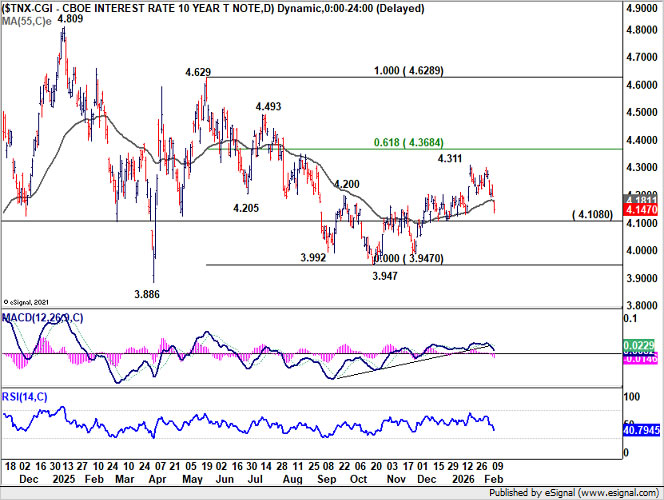
                            US 10-year yield posted strong rise, hit highest level since Jun

                              US treasury yields at the long end posted strong rally overnight. 10-year yield closed up 0.066 at 0.762, hitting the highest level since June.

                              There were a couple of explanations for the strong move. There appeared to be progress on the prospect of a fresh stimulus deal before election, especially after President Donald Trump contracted the coronavirus himself. Also, some noted that Democratic challenger Joe Biden’s lead is paving the way for bigger government spending, and deficit, after the election.

                              At the same time, we could also argue Trump’s speedy recovery showed huge progress in coronavirus treatment, which is the single most determinant factor for the economic course onwards. Additionally, Fed officials are clearly in unison to drive inflation overnight in the next couple of years.

                              In any case, 10-year yield should now be leading 55 day EMA behind while rise from 0.504 resumes. 0.957 resistance would be the next target. Though, we don’t expect a break there any time soon.

                              RBA: Addressing unemployment an important national priority, considers additional monetary easing

                                RBA left monetary policy unchanged as widely expected. Cash rate and 3-year Australian Government bond yield target are held at 0.25%. The parameters for the expanded Term Funding Facility is also kept unchanged.

                                Nevertheless, in the statement, RBA emphasized that “addressing the high rate of unemployment as an important national priority.” It reiterated the pledge to “maintain highly accommodative policy settings as long as required. Also, it “will not increase the cash rate target until progress is being made” on employment and inflation.

                                Additionally, “the Board continues to consider how additional monetary easing could support jobs as the economy opens up further.”

                                Full statement here.

                                DOW broke last week’s high while Trump returned to White House

                                  US stocks closed with strong gains overnight while President Donald Trump also returned to the White House after a three-night hospital stay due to coronavirus infection. DOW ended up 1.68%, S&P 500 rose 1.80%. NASDAQ rose 2.32%.

                                  DOW and S&P 500 led this time, breaking through last week’s high while NASDAQ lagged. Clear support is seen from 55 day EMA (now at 27393.73) for now. Further rise should be seen to retest 29199.35 in the near term. Though, we’re not expecting a clean break there yet. Another fall is still likely before the consolidation from 29199.35 completes.

                                  Fed Evans quite pleased if core inflation could hit 2.5% for a time

                                    Chicago Fed President Charles Evans said yesterday that inflation has to “cross over, beyond 2%, with some momentum”. He’d be “quite pleased” if Fed could get core inflation up to “2.5%” for a time.

                                    He expects inflation to “slowly improve, reaching 2% on a persistent basis in 2023 and then moderately overshooting 2% over the following few years”. He didn’t expect unemployment to come back to 4% until 2023.

                                    “My forecast assumes that additional federal fiscal policy actions are coming,” Evans added. “Without adequate fiscal support before too long, I am concerned that recessionary dynamics will gain more traction and lead to a slower trajectory back to maximum employment.”

                                    BoE Haskel ready to vote for more stimulus

                                      BoE policymaker Jonathan Haskel said risks are skewed to the downside for UK’s economy. “I stand ready to vote for more stimulus measures should they be needed”, he said.

                                      Haskel also noted the positive effects of negative interest rates for Eurozone . “That said, the effectiveness is probably going to be contingent on the structure of the financial system and the position where we are in the cycle, so we have to look at that very carefully,” he added.

                                      US ISM non-manufacturing rose to 57.8, fourth consecutive month of growth

                                        US ISM Non-Manufacturing Composite rose to 57.8 in September, up from 56.9, beat expectation of 56.0. Looking at some details, production rose 0.6 to 63.0. New orders rose 4.7 to 61.5. Employment rose 3.9 to 51.8, back in expansion. Prices dropped -5.2 to 59.0.

                                        ISM said: “The composite index indicated growth for the fourth consecutive month after contraction in April and May. Respondents’ comments remain mostly optimistic about business conditions and the economy, which correlates directly to those businesses that are operating. There continues to be capacity and logistics issues, as business volumes have increased.”

                                        Full release here.

                                        Eurozone retail sales rose 4.4% in Aug, EU sales up 3.8%

                                          Eurozone retail sales rose 4.4% mom in August, well above expectation of 2.4% mom. The volume of retail trade increased by 6.1% for non-food products, by 2.4% for food, drinks and tobacco and by 2.1% for automotive fuels.

                                          EU retail sales rose 3.8% mom. Among Member States for which data are available, the highest increases in the total retail trade volume were registered in Belgium (9.6%), France (6.2%) and Germany (3.1%). The largest decreases were observed in Romania and Slovenia (both -1.6%) and Portugal (-1.4%).

                                          Full release here.