US Empire State manufacturing rose to17, hours worked surged

    US Empire State Manufacturing index rose to 17.0 in September, up from 3.7, beat expectation of 6.2. Looking at some details, new orders rose 8.8 pts to 7.1. Shipments rose 7.4 pts to 14.1. Price paid rose 9.2 pts to 25.2. Prices received rose 1.8 pts to 4.7. Number of employees rose 0.2 pts to 2.6. Average employee workweek jumped sharply by 13.5pts to 6.7. The worweek number was also the first positive reading since the pandemic began. Future business conditions also rose 6 pts to 40.3, suggesting some optimism ahead.

    Full release here.

    German ZEW rose to 77.4, noticeable recovery expected despite Brexit and coronavirus

      Germany ZEW Economic Sentiment rose to 77.4 in September, up from 71.5, beat expectation of 70.0. Current Situation rose 15.1 pts to -66.2. Eurozone ZEW Economic Sentiment rose 9.9 pts to 73.9, Current Situation rose 8.9 pts to -80.9.

      “The ZEW Indicator of Economic Sentiment has increased again, signalling that the experts continue to expect a noticeable recovery of the German economy. Stalled Brexit talks and rising COVID-19 cases could not dampen the positive mood. However, the still negative outlook for the banking sector reveals fears of a rising number of loan defaults in the coming six months,” comments ZEW President Professor Achim Wambach.

      Full releaes here.

      UK unemployment rate rose to 4.1%, claimant count rose 73.7k

        UK unemployment rate rose to 4.1% in the three month to July, up from 3.9%, matched expectations. Unemployment rate for rose to 4.3% and that for women rose to 3.8%. Average earnings including bonus dropped -1.0% 3moy, above expectation of -1.1% 3moy. Average earnings excluding bonus rose 0.2% 3moy, better than expectation of -0.6% 3moy.

        Claimant count rose 73.7k or 2.8% mom to 2.7. Since March this year, Claimant count has increased by 120.8% or 1.5m.

        Full release here.

        China data beat expectations, USD/CNH breaks key fibonacci support

          August economic data released from China today were generally better than expected. Industrial production continued its bounce and rose 5.6% yoy versus expectation of 5.1% yoy. That’s also the fastest rise in eight months. Retail sales rose 0.5% yoy versus expectation of 0.0% yoy. Sales were finally growth after a seven-month downturn. Fixed asset investment dropped -0.3% ytd yoy, above expectation of -0.5% ytd yoy.

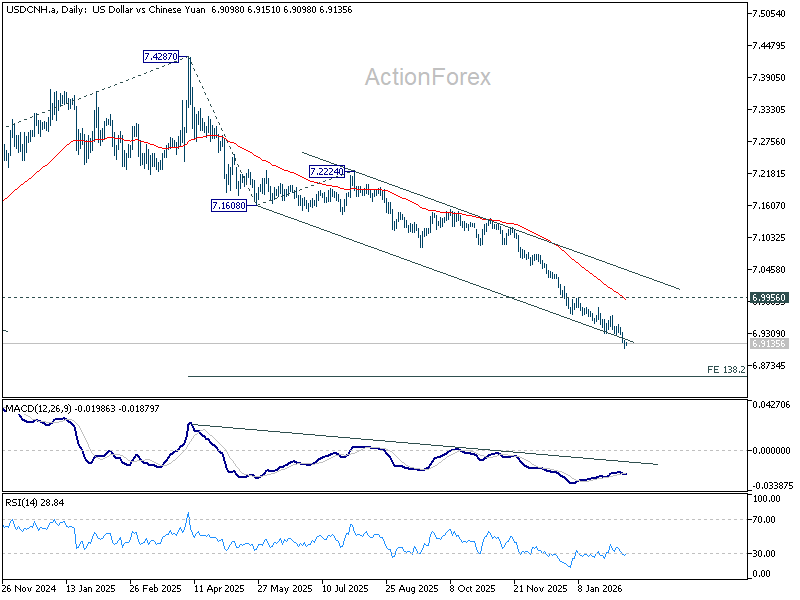
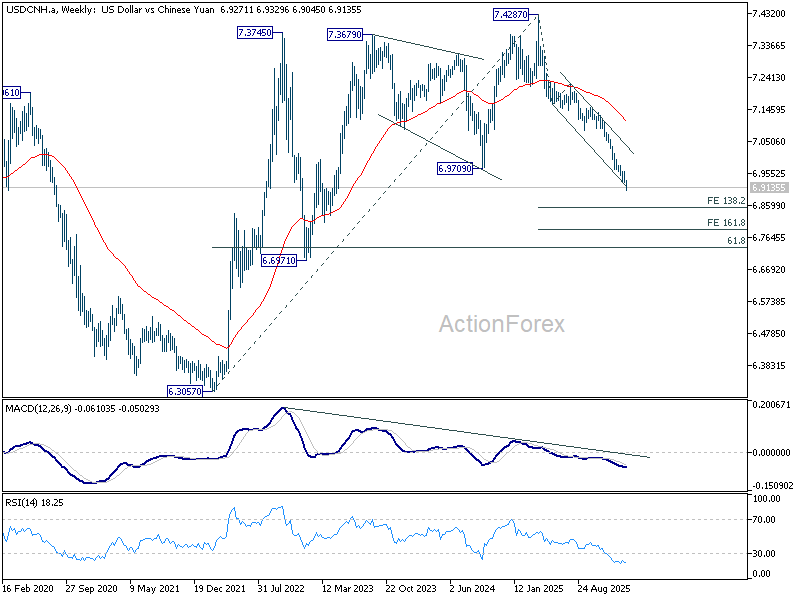
          Yuan’s exchange rate appreciated on optimism that China’s economy is now on firm footing for further bounce back for the rest of the year. USD/CNH resumed the fall from 7.1961 and hits as low as 6.7825 so far. Outlook will stay bearish as long as 6.8600 resistance holds. The firm break of 38.2% retracement of 6.2354 to 7.9153 at 6.8286 now argues that whole rise from 6.2354 has completed already. Deeper fall would be seen to 61.8% retracement at 6.6021. Though, the reaction from Chinese stocks is so far mild. We’re prefer to see the SSE (now at around 3288) to break through the key resistance zone of 3500 to further confirm the underlying strength in sentiments.

          RBA will continue to consider how further monetary measures could support recovery

            In the minutes of September meeting, RBA said the board agreed to “maintain highly accommodative settings as long as required”. A surprised addition in the language is that the central bank will “continue to consider how further monetary measures could support the recovery”. While it’s still early, the minutes indicated that RBA would be ready to ease further if circumstances warrant so.

            Other than that, the minutes continued little new. The pandemic economic downturn “had not been as severe as earlier expected”/. Recovery, however, was “likely to be uneven”, with the outbreak in Victoria having a major effect. Uncertainty was “continuing to affect the spending plans of many households and businesses”. Wage and price pressures “remained subdued” and this was “likely to continue for some time”.

            Full minutes here.

            ECB Makhlouf: Demand factors will dominate and lead to a fall in prices with coronavirus pandemic

              ECB Governing Council member Gabriel Makhlouf said “predicting how demand and supply shocks will interact over the medium to long term is not straightforward”. “Both demand and supply side factors will continue to impact on inflation”. But he believed that “demand factors will dominate and lead to a fall in prices” with the coronavirus pandemic.

              He explained, “fear of infection, weak labour markets, heightened uncertainty and higher precautionary savings will lead to lower demand for goods and services which implies that the real natural rate of interest is likely to remain at low levels.”

              Eurozone industrial production rose 4.1% mom in Jul, strong rise in Portugal, Spain and Ireland

                Eurozone industrial production rose 4.1% mom in July, above expectation of 2.8% mom. Production of capital goods rose by 5.3% mom, durable consumer goods by 4.7% mom, intermediate goods by 4.2% mom, non-durable consumer goods by 3.9% mom and energy by 1.1% mom.

                EU industrial production also rose 4.1% mom in the month. The highest increases were registered in Portugal (+11.9% mom), Spain (+9.4% mom) and Ireland (+8.3% mom). Decreases were observed in Denmark (-4.9% mom), Latvia (-0.8% mom) and Belgium (-0.5% mom).

                Full release here.

                Germany’s economic catch-up process slows

                  Germany’s Economy Ministry said the “catch-up” process in the economy continues but “has recently weakened”. Recovery is “likely to continue as the year progresses”. But pre-pandemic level of activity won’t be reached beginning of 2022.

                  Also, the recovery is uneven. Automotive and parts sector slowed after the dynamic recovery in the previous months. But mechanical engineering sector reported a decline. However, sentiments continue to improve as business expectations are more optimistic again. Additionally, there was no coronavirus related rise in unemployment.

                  Full release here.

                  Suga won landslide victory in LDP leadership votes, paving way to be next Japanese PM

                    Japanese Chief Cabinet Secretary Yoshihide Suga won a landslide victory in the leadership election of the ruling Liberal Democratic Party today. He got 377 votes out of the 534 votes cast. former defence minister Rival Shigeru Ishiba for 68 votes while ex-Foreign Minister Fumio Kishida got 89.

                    Suga will become the next Prime Minister in the parliamentary vote on Wednesday with virtually no doubt. For now, he’s expected to serve out out-going Prime Minister Shinzo Abe’s remaining term through September 2021. But a snap election is a possibility for the new PM.

                    For the markets, most importantly, Suga has indicated that he would continue with the signature “Abenomics”, suggesting continuity with the currency economic policies.

                    New Zealand to lift restrictions on Sep 21, except in Auckland, NZD/USD mildly higher

                      New Zealand Prime Minister Jacinda Ardern said coronavirus restrictions across the country will be lifted on September 21, except in Auckland where the situation will be reviewed next week. Additionally, physical distancing requirements on planes and other public transpose would be immediately eased. Though, masks will still be mandatory on all public transport.

                      NZD/USD strengthens mildly today and it could extend the recovery from 0.6600. Yet 0.6788 high should be a big challenge for that pair even it rises further. We’re slightly favoring a correction downward ahead, after NZD/USD failed to sustain above 0.6755 resistance, on bearish divergence condition in daily MACD. A break of 0.6488 support will confirm this view.

                      EU Barnier and UK Frost in twitter war on IE/NI protocol

                        UK Prime Minister Boris Johnson’s newspaper article, saying that EU is threatening a “blockade” in the Irish sea, triggered a twitter war between EU negotiator Michel Barnier and UK negotiator David Frost over the weekend.

                        Barnier insisted that “protocol on IE/NI is not a threat to the integrity of the UK”. EU is “not refusing to list” UK as a third country for food imports. But “we need to know in full what a country’s rules are, incl. for imports”.

                        Twitter

                        By loading the tweet, you agree to Twitter’s privacy policy.
                        Learn more

                        Load tweet

                        On the other hand, Frost quoted Barnier’s tweet and said the protocol is a “careful balance in order to preserve peace and the Belfast (Good Friday) Agreement”. “It is precisely to ensure this balance can be preserved in all circumstances that the Govt needs powers in reserve to avoid it being disrupted. He also emphasized, ” if GB were not listed (food), it would be automatically illegal for NI to import food products from GB.”.


                        Twitter

                        By loading the tweet, you agree to Twitter’s privacy policy.
                        Learn more

                        Load tweet

                        ECB Lagarde: Incoming data show a strong recovery, but uneven, uncertain and incomplete

                          ECB President Christine Lagarde said in a speech on Sunday, global “recovery is incomplete because there is still much ground to recover.” For Eurozone, a :similar assessment applies” as “incoming data show a strong recovery, but also one that is uneven, uncertain and incomplete.”

                          In particular, “the unevenness of the recovery is highlighted by the divergence between services and industry, in contrast to the crisis a decade ago when activity in these sectors moved in tandem”. She warned, “if the current strength of the rebound does not continue – or fails to spread across all sectors – it is unlikely that they will all be re-employed in the near term.”

                          She hailed that the EUR 750B Next Generation EU recovery fund “has the potential to make a significant difference to Europe’s economic trajectory over the next few year”. “Confidence in the private sector rests to a very large extent on confidence in fiscal policies,” She added. “Continued expansionary fiscal policies are vital to avoid excessive job shedding and support household incomes until the economic recovery is more robust.”

                          As for monetary policy, the “June recalibration” had, to a large extent, resulted in the upward revision in 2022 core inflation projections. But, “other factors, such as the appreciation of the euro have partly offset the positive pull coming from our measures.”

                          Lagarde’s full speech here.

                          NIESR expects 15% growth in UK GDP in Q3

                            NIESR noted that 6.6% mom growth in UK GDP in July, marking a third consecutive monthly increase. But “despite this recovery, the economy has still only recovered just over half of the lost output caused by the national lockdown.” And, “all the main sectors of the economy remain below pre-crisis levels.” NIESR forecast GDP to grow about 7% in the three months to August, and around 15% in Q3.

                            “There has been a welcome resumption of economic growth in the third quarter as the lockdown eased, signalling the end of a short, yet severe, recession in the first half of the year. The latest ONS estimates suggest that GDP grew by 6.6 per cent in July, a third consecutive monthly increase and is now 18.6 per cent higher than its April level. However, despite this recovery, we have still only recovered just over half of the output lost due to the Covid-19 pandemic. The evolution of the pandemic and the scale of expected withdrawals of government support pose downside risks on the pace of the recovery as we move to the end of this terrible year.” Dr Kemar Whyte Senior Economist – Macroeconomic Modelling and Forecasting.

                            Full release here.


                            ECB Lagarde: No complacency! Our accommodative monetary policy needs the support of fiscal policy

                              ECB President Christine Lagarde said in a press conference today, “this current moment is coined by this uneven, incomplete and asymmetric recovery that we have observed in the third quarter after a very catastrophic second quarter.”

                              “No complacency! Our accommodative monetary policy needs the support of fiscal policy, and none of us can afford complacency in the present time,” she urged.

                              US CPI accelerated to 1.3% yoy, core CPI rose to 1.7% yoy

                                US CPI rose 0.4% mom in August, above expectation of 0.3% mom. CPI core rose 0.4% mom, above expectation of 0.2% mom. Annually, headline CPI accelerated to 1.3% yoy, up from 1.0% yoy, beat expectation of 1.2% yoy. CPI core accelerated to 1.7% yoy, up from 1.6% yoy, beat expectation of 1.6% yoy.

                                Full release here.

                                ECB Lane: Recent appreciation of euro exchange rate dampens inflation outlook

                                  In a blog post, ECB Chief Economist Philip Lane said “recent appreciation of the euro exchange rate dampens the inflation outlook.” “Headline inflation is expected to remain persistently low over the medium term, notwithstanding a gradual pick-up over the projection horizon.”

                                  “Inflation remains far below the aim and there has been only partial progress in combating the negative impact of the pandemic on projected inflation dynamics,” he added. “Moreover, the outlook remains subject to high uncertainty and the balance of risks continues to be tilted to the downside.”

                                  Full post here.

                                  UK GDP grew 6.6% in July, still -11.7% lower than pre-pandemic levels

                                    UK GDP grew 6.6% mom in July, just slightly below expectation of 6.7% mom. It’s the third consecutive of increase in GDP. But only around half of the pandemic loss was recovered so far. Also, monthly GDP in July was -11.7% lower than the pre-pandemic levels seen in February.

                                    ONS director of economic statistics Darren Morgan said: “While it has continued steadily on the path towards recovery, the UK economy still has to make up nearly half of the GDP lost since the start of the pandemic…. All areas of manufacturing, particularly distillers and car makers, saw improvements, while housebuilding also continued to recover. However, both production and construction remain well below previous levels.”

                                    Looking at some details, index of services rose 6.1% mom in July. Index of production rose 5.2% mom. Manufacturing rose 6.3% mom. Construction rose 17.6% mom. Agriculture rose 1.1% mom.

                                    New Zealand BusinessNZ manufacturing dropped back to 50.7 on lockdown return

                                      New Zealand BusinessNZ Manufacturing PMI dropped sharply to 50.7 in August, down from 59.0. Looking at some details, productions dropped form 61.8 to 51.1. Employment improved from 46.9 to 49.0. New orders tumbled from 67.5 to 54.0.

                                      BusinessNZ’s executive director for manufacturing Catherine Beard said, “After two months of playing catch-up, the level 3 lockdown placed on New Zealand’s largest population and economic region meant the sector would experience another hit.  While results in other parts of the country led to the national result keeping its head above water, the latest results show how fragile and short the recovery can be.”

                                      BNZ Senior Economist, Doug Steel said that “an outcome above the 50 breakeven mark – indicating a modicum of growth occurred in the month – is arguably a commendable result given more than a third of the country moved into alert level 3 for more than half of the month.”

                                      Full release here.

                                      Japan Motegi to conclude trade deal with UK today

                                        Japan Foreign Minister Toshimitsu Motegi indicated he will speak to UK Trade Minister Liz Truss today to conclude the post-Brexit trade agreement. That, if agreed, would come just before Prime Minister Shinzo Abe steps down on September 15 for health reason.

                                        The bilateral trade agreement is expected to largely replicate the Japan-EU agreement. UK expects to deal to increase trade with Japan by around GBP 15B a year in the long run.

                                        Released from Japan, BSI large manufacturing conditions index rose to 0.1 in Q3, much improvement from -52.3. PPI picked up to -0.5% yoy in August, from -0.9% yoy.

                                        US oil inventories rose 2m barrels, WTI in favor to fall slightly further

                                          US crude oil inventories rose 2.0m barrels in the week ending September 4, versus expectation of -3.1m barrels fall. At 500.4m barrels, US crude oil inventories are around 14% above the five year average for this time of the year. Gasoline inventories dropped -3.0m barrels. Distillate dropped -1.7m barrels. Propane/propylene rose 2.2m barrels. Total commercial petroleum inventories dropped -3.4m barrels.

                                          WTI is steady after the release, digesting the steep losses from 43.50. It’s now in a consolidation to rally from March spike low, after being rejected by 55 week EMA. For now, we’d expect a sideway consolidation phase. That is, while further decline is in favor , we’re not expecting a decisive break of 34.36 support, barring any drastic development. On the upside, a break above 40 handle could bring a test on 43.5. But in that case, we’re not expecting a decisive break there, at least not on the next attempt.