Germany expects strong increase in Q3 GDP

    Germany’s Economy Ministry said the country is “back on the road to recovery” since tough shutdown was eased since May. Industry’s “rapid catching-up” is continuing, largely driven by automotive sector. But it’s expected to lose momentum due to “weak foreign demand”.

    Also, with “somewhat more favorable starting position”, there will be a “strong increase in gross domestic product in the third quarter.” But the course will depends on the pandemic at home and abroad. Some of Germany’s trading partners are “still heavily impacted by the pandemic”.

    “For this reason alone, after the first stronger recovery in May and June, the further recovery process of the German economy will only progress slowly and take a long time to complete.”

    Full release here.

    Eurozone GDP contracted -12.1% in Q2, EU down -11.7%

      GDP contracted -12.1% in Eurozone in Q2, -11.7% qoq in EU. Both were sharpest declines since the series began in 1995. Annually, GDP contracted -15.0% yoy in Eurozone, -14.1% in EU, also worst on record. Employment in Eurozone dropped record -2.8% qoq, and -2.6% in EU.

      Also released, Eurozone trade surplus widened to EUR 17.1B in June, up from EUR 8.0B, but smaller than expectation of EUR 18.0B.

      China retail sales unexpectedly contracted in July, USD/CNH channeling lower

        The batch of economic data released from China is mixed. In particular, retail sales contracted -1.1% yoy in July, versus expectation of 0.3% yoy. That showed vulnerability in domestic demand. Nevertheless, industrial production rose 4.8% yoy in July, slightly above expectation of 4.7% yoy. Fixed asset investment dropped -1.6% ytd yoy in July, above expectation of -3.3% ytd yoy.

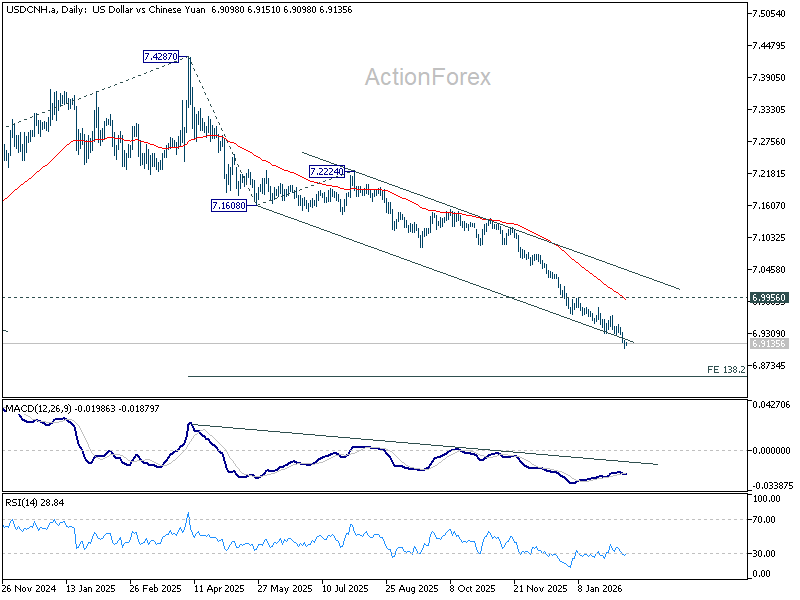
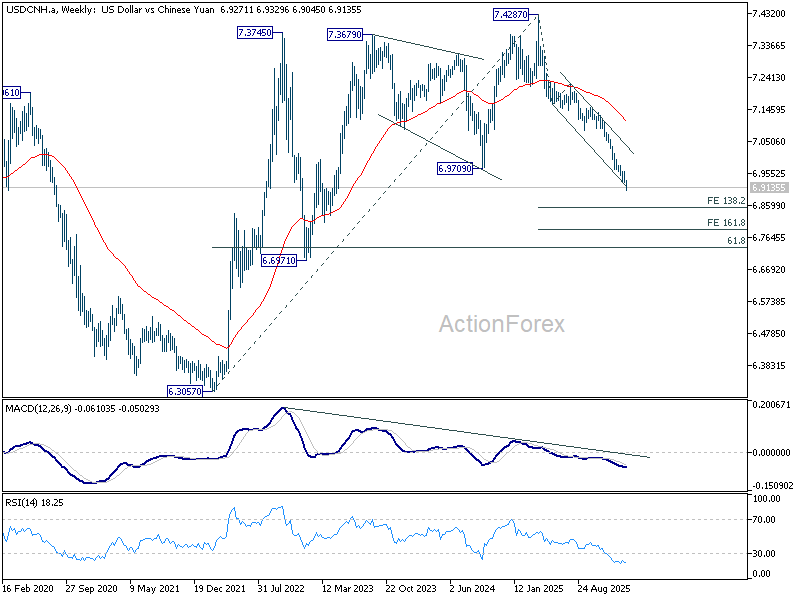
        USD/CNH is still channeling well as fall from 7.1961 extends. This decline is seen as the third leg of the consolidation pattern from 7.1953. Hence, while fall could be seen, we’d expect strong support from 6.8452 to contain downside and bring rebound. Meanwhile, break of 6.9804 resistance will now suggests short term bottoming and turn bias back to the upside.

        New Zealand BusinessNZ PMI rose to 58.8, but employment stays in contraction

          New Zealand BusinessNZ Performance of Manufacturing Index rose to 58.8 in July, slightly up from 56.2. Looking at some details, productions rose from 58.4 to 61.4. New orders rose from 58.2 to 67.4. However, employment dropped from 48.5 to 46.5. Employment remained weak and stayed in contraction for the 5th straight month.

          BusinessNZ’s executive director for manufacturing Catherine Beard warned: “we should be careful not to interpret this as a new dawn for the sector, rather a catch-up for many trying to get back to a new sense of normality.”

          BNZ Senior Economist, Doug Steel said that “July’s PMI had firmly set up the idea that manufacturing GDP would bounce back strongly in Q3 after what was surely a very large decline in Q2. The latest virus outbreak calls that into question and adds to the reservations that we already had for growth in Q4.”

          Full release here.

          RBA Lowe: Cash rate highly likely to stay at 0.25% for some years

            RBA Governor Philip Lowe reiterated the Board’s commitment on not raising interest rate until progress is made towards full employment, with confidence that inflation could sustain in 2-3% target range. He added that “, these conditions are not likely to be met for at least three years”. Hence, it’s “highly likely” that cash rate will be at the current 0.25% level “for some years”. The 3-year yield target of 0.25% also “reinforces this message”.

            Lowe also note again that the negative interest rates are not justified by the cost benefits. He added, “in a world that is so uncertain and fluid, I don’t think it is prudent to rule it out”. But as seen in some European countries and Japan, “negative interest rates also encourage people to save more, not spend more”. So, “negative interest rates can become contractionary”.

            He also noted that Australian Dollar’s exchange rate is not overvalued even though he’ like it to be lower. Huge amount of intervention is needed to push the Aussie down and it wouldn’t be a successful strategy.

            Fed to collaborate with MTI on digital currency research

              Governor Lael Brainard said Fed and MIT are working on a “multiyear effort to build and test a hypothetical digital currency oriented to central bank uses”.

              The objectives are “to assess the safety and efficiency of digital currency systems, to inform our understanding of private-sector arrangements, and to give us hands-on experience to understand the opportunities and limitations of possible technologies for digital forms of central bank money.”

              “Lessons from this collaboration will be published, and any codebase that is developed through this effort will be offered as open-source software for anyone to use for experimentation.”

              US initial claims dropped to 963k, below 1m for the first time since pandemic

                US initial jobless claims dropped -228k to 963k in the week ending August 8, well below expectation of 1200k. Four-week moving average of initial claims dropped -86.3k to 1253k.

                Continuing claims dropped -604k to 15486k in the week ending August 1. Four-week moving average of continuing claims dropped -455k to 16170k.

                Full release here.

                Australia employment rose 11.47 in July, participation rate jumped

                  Australia employment rose 114.7k to 12.46m in July, better than expectation of 40k. It’s also a positive for full-time job to rise 43.5k to 8.55m. Part-time jobs rose 71.2k to 3.91m. Unemployment rate rose less than 0.1% to 7.5%, better than expectation of 7.8%, even though that’s a 22-year high. Participation rate also rose 0.6% to 64.7%.

                  Still, Bjorn Jarvis, head of Labour Statistics at the ABS, said: “The July figures indicate that employment had recovered by 343,000 people and hours worked had also recovered 5.5 per cent since May. Employment remained over half a million people lower than seen in March, while hours worked remained 5.5 per cent lower. ”

                  “The July data provides insight into the Australian labour market during Stage 3 restrictions in Victoria. The August Labour Force data will provide the first indication of the impact of Stage 4 restrictions.” Jarvis said.

                  Full release here.

                  RBNZ Bascand would consider more monetary stimulus if coronavirus and lockdown prolong

                    RBNZ Deputy Governor Geoff Bascand said resurgence of coronavirus infections is “a major risk to out outlook”. “If we get periods of resurgence and have longer lockdown periods then the unfortunate consequence of that is we will see downside risks to our outlook…things will be worse. We would have to consider doing more in terms of our monetary stimulus,” he said.

                    While New Zealand has been doing better domestically, “this is a big economic shock and its not over,” he added. “It was a little bit of wonderful feeling when we had 100 days of containment, but its a long haul to recovery”.

                    Separately, chief economist Chief Economist Yuong Ha said the central bank would like a weaker exchange rate and lower bond yields. The expansion of QE from NZD 60B to NZD 100B reflects that intention. Negative rate remains a policy option for RBNZ, but it’s not inevitable.

                    Fed Kaplan: Resurgence in coronavirus muted economy recovery

                      Dallas Fed President Robert Kaplan said the resurgence in coronavirus has “muted the recovery” of the economy. While unemployment rate could fall to 9% or below by year end, “it requires adherence to protocols particularly wearing masks…If we don’t follow that, while people may feel freer, the economy will grow slower.”

                      Boston Fed President Eric Rosengren also warned, “limited or inconsistent efforts by states to control the virus based on public health guidance are not only placing citizens at unnecessary risk of severe illness and possible death – but are also likely to prolong the economic downturn.”

                      Fed Daly: Longer support to economy needed with resurgence in coronavirus

                        San Francisco Fed President Mary Daly said she expects recovery to be slow and gradual, depending on the coronavirus. A V-shaped recovery is not expected. “As we get more information about how the virus will affect the economy, we will be thinking about how can we use forward guidance to telegraph to people, to signal to markets, households and businesses what our intentions are in terms of supporting the economy going forward”, she said.

                        Also, with resurgence in infections, more stimulus is needed for the economy. “It’s becoming quite clear that the virus will be with us for longer and more vigorously than anyone had hoped for,” she said in an interview Tuesday. “The length of the support that the economy is going to need, before we can ever stimulate the economy, it just has to be longer.”

                        US holds off tariff hike on EU, to start new negotiations instead

                          The US held off from a threatened tariff hike on EU products regarding the 16-year Airbus subsidies dispute, and signal its willingness to go back to negotiation table. The amount of products subject to the tariffs are kept unchanged at USD 7.5B, with 15% rate for aircraft and 25% on for other products.

                          “The EU and member states have not taken the actions necessary to come into compliance with WTO decisions,” Trade Representative Robert Lighthizer stated. “The United States, however, is committed to obtaining a long-term resolution to this dispute. Accordingly, the United States will begin a new process with the EU in an effort to reach an agreement that will remedy the conduct that harmed the U.S. aviation industry and workers and will ensure a level playing field for U.S. companies. ”

                          “The Commission acknowledges the decision of the U.S. not to exacerbate the ongoing aircraft dispute by increasing tariffs on European products,” an EU official said in response. “The EU believes that both sides should now build on this decision and intensify their efforts to find a negotiated solution to the ongoing trade irritants.”

                          US oil inventories dropped -4.5m barrels, WTI range bound

                            US commercial crude oil inventories dropped -4.5m barrels in the week ending August 7, versus expectation of -3.4m barrels decline. At 514.1m barrels, crude oil inventories are about 15% above the five year average for this time of year. Gasoline inventories dropped -0.7m barrels. Distillate dropped -2.3m barrels. Propane/propylene dropped -2.6m barrels. Total commercial petroleum inventories dropped -6.2m barrels.

                            WTI crude oil is staying in the consolidation pattern from 43.38 after the release. Further rise is expected as long as 38.58 support holds. Focus is now on 55 week EMA (now at 44.02). Sustained break there could bring some upside acceleration to 55 month EMA (now at 54.24).

                            NIESR expect UK economy to grow15% in Q3

                              NIESR said UK economy is expected to grow around 15% in Q3 as the economy reopens, “on the assumption that Covid-19) remains contained. And that would leave GDP in September just around -10% lower than pre-pandemic level in February.

                              “Today’s ONS estimates suggest that GDP fell by a record 20.4 per cent in the second quarter of 2020, following a decline of 2.2 per cent in the first quarter of the year, thereby confirming the UK’s first recession since the financial crash. However, the monthly estimate for June suggests a rebound of 8.7 per cent, reflecting further easing of Covid-19 lockdown measures – though it remains a sixth below its level in February. Despite the recovery noted in June, the path ahead remains precarious. An extended period of growth will be required to make up the ground lost in recent months” Dr Kemar Whyte Senior Economist – Macroeconomic Modelling and Forecasting

                              Full release here.

                              US CPI picked up to 1.0% yoy, core up to 1.6% yoy

                                US headline CPI rose 0.6% mom in July, above expectation of 0.4% mom. CPI core rose 0.6% mom, also above expectation of 0.2% mom. Annually, CPI accelerated back to 1.0% yoy, up from 0.6% yoy, beat expectation of 0.8% yoy. CPI core picked up to 1.6% yoy, up from 1.2% yoy, also beat expectation of 1.6% yoy.

                                Full release here.

                                Eurozone industrial production rose 9.1% in June

                                  Eurozone industrial production rose 9.1% mom in June, below expectation of 10.0% mom. Annually, production dropped -12.3% yoy. Production of durable consumer goods rose by 20.2%, capital goods by 14.2%, intermediate goods by 6.7%, non-durable consumer goods by 4.8% and energy by 2.6%.

                                  EU industrial production rose 9.1% mom, dropped – 11.6% yoy. The highest increases were registered in Slovakia (+21.7%), Hungary (+17.1%) and Romania (+16.3%). Decreases were observed in Belgium (-1.4%) and Finland (-0.8%).

                                  Full release here.

                                  UK GDP rose 8.7% mom in June, down -20.4% qoq in Q2, -17.2% below Feb’s level

                                    UK GDP grew 8.7% mom in June, better than expectation of 8.0% mom, and a strong improvement from May’s 2.4% mom. For the quarter, Q2 GDP, however, still contracted -20.4% qoq, slightly below expectation of -20.2% qoq. That’s also notable deterioration from Q1’s -2.2% qoq. Overall, GDP remains -17.2% below levels seen back in February, before the full impact of the coronavirus.

                                    In June, services grew 7.7% mom. Production rose 9.3% mom. Manufacturing rose 11.0% mom. Construction rose 23.5% mom. Agriculture rose 2.7% mom. But all sectors were down in the rolling three-month to April-to June, with services down -19.9% 3mo3m, production down -16.9% 3mo3m, manufacturing down -20.2% 3mo3m, construction down -35.0% 3mo3m, and agriculture down -4.8% 3mo3m.

                                    Also from UK, goods trade deficit widened to GBP -5.1B in June, larger than expectation of GBP -4.5B.


                                    Australia consumer confidence plunged back near April low

                                      Australia Westpac consumer confidence dropped -9.5% to 79.5 in August, down from 87.9. Westpac said “the scale of the fall comes as a major surprise” and it’s now back near the “extreme low” of 75.6 made in April. Nevertheless, that could prove to be a “significant overreaction” to the return to lockdown.

                                      Westpac expects RBA to maintain current policies in the upcoming September 1 meeting. The next major event would be the Commonwealth Budget in October 6. As the consumer sentiment survey highlights the uncertainties around the current outlook, Westpac expects the government commit to providing “generous ongoing support the the economy”.

                                      Full release here.

                                      New Zealand delay dissolution of parliament, Auckland back in lockdown, NZD/JPY resilient so far

                                        New Zealand Prime Minister Jacinda Ardern put Auckland back into stage 3 lockdown, for three days as a “precautionary approach”. That came after the country recorded first new local coronavirus cases in 102 days. More importantly, the mystery cases, which were all diagnosed in one family, was spread from an unknown source.

                                        Besides, Arden also decided to postpone the dissolution of parliament, due on Wednesday, ahead of an election just weeks away. The electoral commission was working through the implications of the coronavirus outbreak, and a decision would be on on the elections which are scheduled for September 19.

                                        Despite the double hit by RBNZ and coronavirus, NZD/JPY is relatively resilient so far. Though, the condition is building up for a near term fall to correct the whole rebound from 59.49. Focus is now on 69.54 support and firm break there would pave the way to 38.2% retracement of 59.49 to 71.67 at 67.01.

                                        RBNZ expands QE, prepare for negative rates, NZD/USD tumbles

                                          RBNZ kept the Official Cash Rate unchanged at 0.25% today, but expanded the Large Scale Asset Purchase program to NZD 100B, up from NZD 60B. Eligible assets for the program remain unchanged. RBNZ also said a “package of additional monetary instruments must remain in active preparation”, including negative interest rates and purchases of foreign assets. Full statement here.

                                          NSD/USD tumbles notable after the announcement. The development should confirm short term topping at 0.6715, after rejection by 0.6755 medium term resistance, on bearish divergence condition in daily MACD. The correction will likely take some time to complete and should eventually target 38.2% retracement of 0.5469 to 0.6715 at 0.6239. This will now remain the favored case as long as 0.6626 resistance holds, in case of recovery.