

Live Comments
NZ PSI Recovery Holds, but Employment Still Refuses to Follow
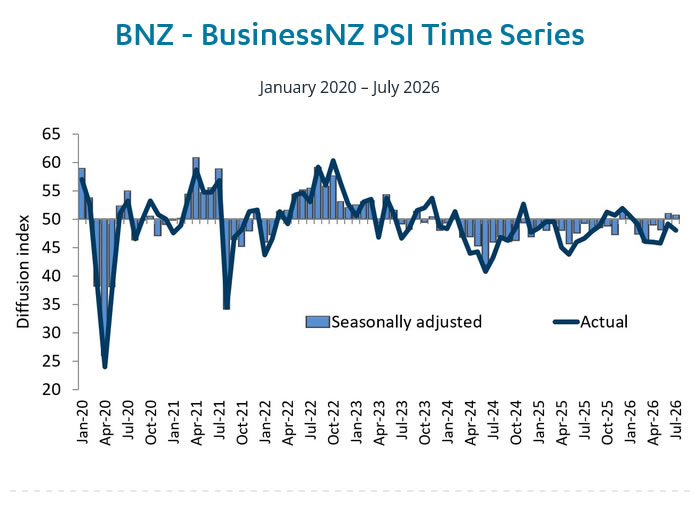
New Zealand’s services sector stayed in expansion in July, although momentum eased slightly. BNZ–BusinessNZ PSI slipped from 50.9 in June to 50.6 in July, marking a second consecutive month above 50 breakeven. Encouragingly, Activity/Sales improved from 49.7 to 50.5, moving into expansion for first time in six months, while Stocks/Inventories strengthened from 50.3 to 51.6.
Details nevertheless point to a recovery that remains narrow. New Orders/Business stayed strongest component despite easing from 53.3 to 52.6, while Employment slipped from 48.8 to 48.5 and Supplier Deliveries fell from 51.2 to 48.5. BusinessNZ said firms remain cautious about hiring, while respondent sentiment was notably weak, with 64% of comments negative amid concerns over living costs, fuel prices, interest rates and election uncertainty.
Overall, July PSI reinforces signs that New Zealand services activity is stabilizing rather than entering a strong rebound. Return of Activity/Sales above 50 is a meaningful improvement, but persistent employment contraction and subdued business sentiment argue against reading two months of headline expansion as broad recovery. For markets, mixed composition provides little reason by itself to overturn last week’s tension between RBNZ’s still-hawkish expected OCR path and sharply lower near-term inflation expectations.
Data Summary
| Component | Current | Previous | Trend |
|---|---|---|---|
| BNZ–BusinessNZ PSI | 50.6 | 50.9 | Expansion eased slightly |
| Activity/Sales | 50.5 | 49.7 | Returned to expansion |
| Employment | 48.5 | 48.8 | Contraction deepened slightly |
| New Orders/Business | 52.6 | 53.3 | Expansion moderated |
| Stocks/Inventories | 51.6 | 50.3 | Expansion strengthened |
| Supplier Deliveries | 48.5 | 51.2 | Fell into contraction |
Key Takeaways
- Services remained in expansion for second straight month, with PSI easing only slightly from 50.9 to 50.6.
- Activity/Sales provided strongest sign of improvement, rising from 49.7 to 50.5 and moving above 50 for first time in six months.
- Recovery remains narrow, as Employment stayed in contraction at 48.5 and Supplier Deliveries dropped sharply below 50.
- New Orders remained relatively firm at 52.6, suggesting demand has not rolled over despite cautious business sentiment.
- 64% of respondent comments were negative, with cost-of-living pressures, fuel prices, higher interest rates and election uncertainty weighing on confidence.
US Consumers Turn More Pessimistic as Inflation Concerns Stay Elevated
US consumer sentiment deteriorated sharply in August, adding to signs that household confidence is weakening even as inflation concerns persist. University of Michigan Consumer Sentiment fell from 55.2 to 51.0, below 54.1 consensus. Current Conditions dropped from 54.8 to 51.8 and Expectations declined from 55.4 to 50.6. Survey said expected business conditions fell -11% for short run and -17% for long run, with weakness particularly pronounced among older, lower-income and non-college consumers.
Inflation expectations moved in opposite direction. One-year expectations edged up from 4.2% to 4.3%, remaining well above 3.4% in February before Iran conflict. Long-run expectations held at 3.3% for third straight month. Purchasing-power concerns remain acute: only 8% of consumers expect income growth to exceed inflation over next year, down from 18% in December 2024. That combination suggests households are becoming less confident about growth without becoming more comfortable about prices.
For Fed, report is awkward rather than clearly dovish. Weak sentiment adds to softer retail sales and July labor data, reinforcing evidence that demand is losing momentum. But elevated inflation expectations argue against assuming weaker activity will automatically translate into faster disinflation. Overall signal is mildly stagflationary: consumer confidence is deteriorating while inflation expectations remain too high, strengthening case for Fed to hold and wait for clearer August data.
Data Summary
| Component | Current | Previous | Trend |
|---|---|---|---|
| Consumer Sentiment | 51.0 | 55.2 | Sharp deterioration |
| Current Economic Conditions | 51.8 | 54.8 | Weaker |
| Consumer Expectations | 50.6 | 55.4 | Sharp deterioration |
| 1-Year Inflation Expectations | 4.3% | 4.2% | Higher |
| Long-Run Inflation Expectations | 3.3% | 3.3% | Unchanged |
Key Takeaways
- UoM Consumer Sentiment fell from 55.2 to 51.0 in August, well below 54.1 consensus, ending two consecutive months of improvement.
- Consumer Expectations weakened more sharply from 55.4 to 50.6, while Current Conditions fell from 54.8 to 51.8.
- Expected business conditions dropped 11% for short run and 17% for long run, pointing to growing concern over economic outlook.
- One-year inflation expectations edged up from 4.2% to 4.3%, remaining well above 3.4% seen before Iran conflict.
- Long-run inflation expectations stayed at 3.3% for third straight month, still slightly above 2024 range of 2.8–3.2%.
- Only 8% of consumers expect income growth to exceed inflation over next year, down from 18% in December 2024.
- Report carries a stagflationary tone: confidence is weakening while inflation expectations remain elevated, reinforcing Fed case to hold and assess incoming data.
US Retail Sales Slump -0.6% M/M in July as Consumer Momentum Fades
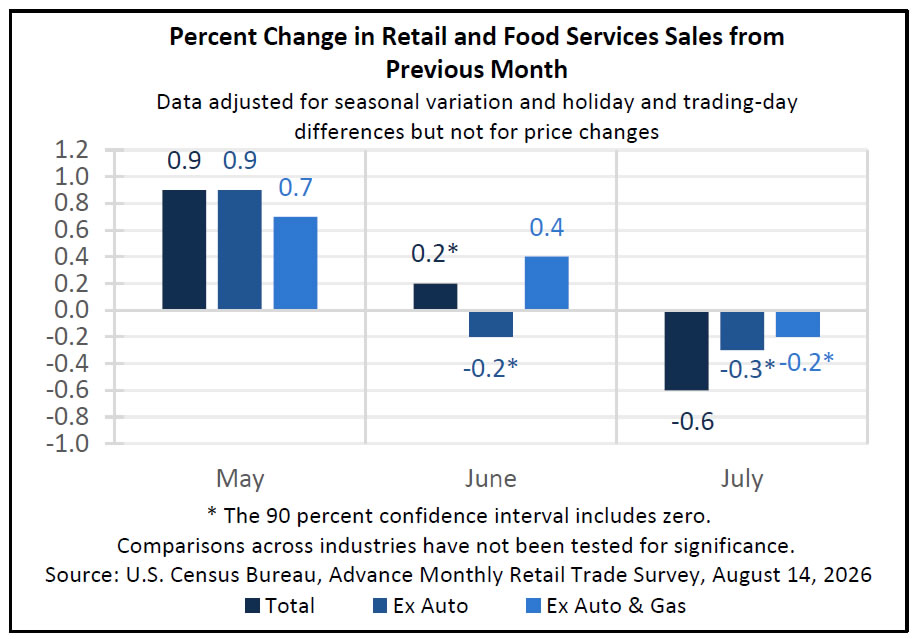
US retail sales weakened sharply in July, adding to evidence that domestic demand lost momentum at start of Q3. Headline sales slowed from 0.2% to -0.6% m/m, well below expectations for 0.2% growth. Sales excluding autos deteriorated from -0.2% to -0.3%, also missing 0.2% forecast. Even excluding both autos and gasoline, sales fell -0.2%, suggesting weakness extended beyond volatile categories. Retail sales excluding food services were softer still at -0.8%.
Monthly weakness contrasts with still-solid annual growth. Total retail and food-services sales were 5.0% higher y/y, while sales over May-July were 6.3% above same period a year earlier. Ex-auto sales rose 5.8% y/y and ex-auto-and-gasoline sales increased 4.8%. That argues against describing July as a collapse in consumption, but it does point to a clear loss of near-term momentum after May’s strong gains and modest June growth.
For Fed, July retail sales reinforce case for keeping rates unchanged in September. Weak payrolls already raised concern over labor market, while this week’s CPI and PPI reduced urgency to tighten again. Softer consumer spending now adds evidence that higher rates are restraining demand. One month is not enough to establish a sustained downturn, but another weak August reading would strengthen argument that Fed should remain patient rather than revive tightening.
Data Summary
| Indicator | Actual | Expected | Previous |
|---|---|---|---|
| Retail Sales m/m | -0.6% | 0.2% | 0.2% |
| Retail Sales ex Autos m/m | -0.3% | 0.2% | -0.2% |
| Retail Sales ex Autos & Gas m/m | -0.2% | — | 0.4% |
| Retail Sales ex Gasoline m/m | -0.6% | — | 0.8% |
| Retail Sales ex Food Services m/m | -0.8% | — | 0.2% |
Key Takeaways
- US retail sales swung from 0.2% growth to -0.6% m/m in July, sharply missing expectations for another 0.2% increase.
- Weakness extended beyond autos. Sales excluding autos deteriorated from -0.2% to -0.3%, while sales excluding both autos and gasoline fell 0.2%.
- Retail sales excluding food services dropped 0.8% m/m, reinforcing evidence of broad monthly softness.
- Annual spending remains much firmer, with total retail and food-services sales 5.0% higher y/y and May–July sales up 6.3% from same period in 2025.
- Data therefore point to loss of near-term consumer momentum rather than outright collapse in spending.
- Retail sales are nominal and not adjusted for price changes, so strong annual growth does not necessarily imply equally strong real consumption.
- Combined with weak July payrolls and benign CPI/PPI, report further strengthens September Fed hold case.