ECB Muller: Additional increase in PEPP might not be needed

    ECB Governing Council member Madis Muller said the central bank might not need to boost the crisis asset purchases. He said, “if in the second half economic growth in general recovers as the ECB forecasts and the inflation outlook doesn’t worsen additionally, then I think an additional increase in asset purchase program isn’t needed.”

    He emphasized, “we have to remember that the pandemic emergency purchase program is meant as temporary, to get over the most acute phase of the crisis.” Also, “inflationary expectations for the near term are very low but I see this as a rather short-term risk that is also affected by the recent sharp decline in energy prices,” Muller also said.

    Separately, another Governing Council member Peter Kazimir said the PEPP expansion as announced in the last meeting was to minimize deflation risks. “I wish we could talk about a specific date as to when to end it,” he added. “I wish it were as soon as possible.”

    Fed projections to reveal the perceived strength of economic rebound in H2

      FOMC meeting is the major focus for today and there is no doubt that Fed will keep policy unchanged. Federal funds rate target will be held at 0.00-0.25% while the QE-without-limit program will be maintained. A major focus will be on the first update to economic projections since last December. In particular, the expected strength of recovery in H2 would be revealed, as well as the time frame for the economy to go back to pre-crisis level. Given the strong May non-farm payroll report, there might be some pleasant surprise to the unemployment projections. Meanwhile, inflation forecasts could be off the mind of traders for now.

      Fed’s view on the economy will be heavily tied to its projected path of emergency stimulus exit. It’s still too early to call for an end of the stimulus for now. But eventually, Fed needs to lay down the conditions, and possibly the time frame. Unemployment rate has improved while stock markets are at record high, while economy is gradually reopening. Fed might hint on ending some of the lending program at least. This would be the second focus.

      The third focus would be on any information regarding “yield curve control”. WSJ reported over the weekend that officials are debating on whether to reinforce low-rate pledge with yield caps at the long-end. That could be seen as a way to keep long-term rates low, and help the economy to transit as Fed moves out from the current emergency measures at a later stage. Fed Chair Powell might reveal some information on his ideas.

      Here are some suggested readings:

      Dollar index might draw support from 95.8 projection level, on oversold condition

        Dollar index dropped further to close at 96.32 yesterday, mainly due to decline in USD/JPY this time. More pressure is likely to be seen today as EUR/USD looks set to resume recent rise through 1.1383 temporary top. while USD/JPY is still on track to 107.08 support and below.

        For now, considering oversold condition in daily RSI, we might seen some support around 100% projection of 102.99 to 98.27 from 110.55 at 95.83 to contain downside. Break of 97.06 minor resistance would bring recovery back towards 55 day EMA (now at 98.89). But firm break of 95.83 might bring further downside acceleration through 94.65 support.

        Australia consumer sentiment rose 6.3%, back around pre-COVID levels

          Australia Westpac-Melbourne Institute consumer sentiment rose 6.3% to 93.7 in June, up from May’s 88.1. Confidence is now “back around pre-COVID levels”, and has recovered “all of the extreme 20% drop” seen after the pandemic exploded. It’s been buoyed by the country’s “continued success” in bringing the coronavirus control and further easing of restrictions. The index is now just 2% below the average between September and February.

          Westpac said that the survey would “boost confidence” around the RBA board table as they meet again on July 7. RBA Governor Philip Lowe has been clear that he’s having a wait-and-see approach on monetary policy. Negative rate is “extraordinarily unlikely”. “An earlier than expected recovery in the economy will ease pressure on that current entrenched policy stance”

          Full release here.

          S&P downgrades Japan’s rating outlook as weak government finances deteriorated due to pandemic

            S&P Global Ratings affirmed Japan’s A+ long-term and A-1 short-term sovereign credit ratings. However, outlook is downgraded from positive to stable as the “weak government finances have deteriorated further in fiscal 2020 owing to the COVID-19 pandemic”.

            “The fiscal position should improve materially once the outbreak recedes and economic growth returns. Nevertheless, we expect the fiscal deficit will remain relatively high” in fiscal 2021 through 2023, it said.

            However, “should real interest rates increase sharply at some point, this would severely strain the government’s debt dynamics,” it added. “This could occur if investors demand a higher risk premium and push up nominal interest rates. But we believe the greater risk is from renewed and persistent deflation.”

            Eurozone GDP contracted -3.6% in Q1, worst in France, Spain and Italy

              Eurozone’s Q1 GDP contraction was revised up to -3.6% qoq, up from initial estimate of -3.8% qoq. That was still the sharpest decline on record since 1995. For EU, GDP contracted -3.2% qoq, also the worst since 1995.

              Household final consumption expenditure had a strong negative contribution to GDP growth in both Eurozone and the EU (-2.5% and -2.3%, respectively) . Contribution from gross fixed capital formation was also negative in both zones (-1.0% and -0.9% respectively) as was the contribution of the external balance. Contribution of changes in inventories was positive for both zones (+0.3% for Eurozone and +0.4% for EU).

              Among Member States for which data are available, Ireland (+1.2%), Bulgaria and Romania (both +0.3%) as well as Sweden (+0.1%) still recorded positive growth compared with the previous quarter. GDP fell in all other EU Member states, with the highest declines in France and Italy (both -5.3%) as well as Spain and Slovakia (both -5.2%).

              Full release here.

              Ifo: 24% of German business needed liquidity support, industries affected in very different ways

                Germany’s Ifo institute said 24% of companies said they need liquidity support during the coronavirus crisis. But “the corona crisis affects the industries in very different ways”. A particular large number of retailers and service providers were indeed of the support, at 30% each. Only 17% in industry and 5% in construction said they need the liquidity support.

                Looking at deeper details, 85% travel agencies and tour operators used liquidity assistance while 76% in hotels used. 69% in catering trade, 57% in film, 54% in car rentals, 49% in arts and entertainment, 41% in advertising and market research also used the assistance. In industry, there were 42% in clothing manufacturing, 34% in metal production were hardest hit.

                Full release here.

                ECB: Euro remains unchallenged as the second most used currency globally

                  ECB said Euro remains “unchallenged as second most used currency globally”, after US Dollar. Role of Euro remained “stable” as global reserve currency”. The international role declined after the global financial crisis but has now “bottomed out”. At the end of 2019, Euro accounted for 20.5% of global FX reserves, up from 20.3% a year earlier. Share in outstanding international debt securities, dropped -0.3% to 22.1%.

                  President Christine Lagarde also noted, “the recent COVID-19 pandemic underlines the urgency of these policies and reform efforts, which are paramount to raising the attractiveness of the euro globally”. Executive Board member Fabio Panetta said, “the swift implementation of an EU taxonomy of sustainable economic activities would provide a credible and standardised framework, ensure greater investor confidence and could thereby also contribute to strengthening the international role of the euro”.

                  Full release here.

                  UK and Japan to start trade talks, and Japan pushes for auto tariffs removal

                    UK and Japan are going to start trade talks today, for a free-trade agreement that would replace the current EU one, after the supposed Brexit date of January 1, 2021.

                    Ahead of of the video conference, UK International Trade Secretary Liz Truss said “We aim to strike a comprehensive free trade agreement that goes further than the deal previously agreed with the EU, setting ambitious standards in areas such as digital trade and services.” “This deal will provide more opportunities for businesses and individuals across every region and nation of the U.K.” Truss added.

                    On the other hand, Japan Trade Minister Hiroshi Kajiyama said, “in the negotiations, we hope to urge (UK) to bring forward the period for which tariffs will be removed mainly for auto and autoparts … as well as adopt high-level rules on digital trade.”

                    Australia NAB business confidence rose to -20, key factor in how businesses recover

                      Australia NAB Business Confidence rose to -20 in May, up from April’s -45. Business Conditions rose to -24, up from 34. Looking at some details, trading conditions rose to -14, up from -31. Profitability rose to -19, up form -35. Employment rose just slightly to -31, up from -34.

                      According to Alan Oster, NAB Group Chief Economist said negative conditions indicates that “activity was still extremely weak in May.” Also, “forward orders suggest that in the short-term activity is likely to remain weak in the business sector and combined with low capacity utilisation and still very weak confidence points to ongoing restraint in Capex spending”. Recovery in confidence will likely be a “key factor” in how businesses recovery from the largest downturn since 1930s.

                      Full release here.

                      New Zealand ANZ business confidence rose to -33, still a huge tourism-shaped hole

                        New Zealand ANZ Business Confidence rose another 9 pts to -33 in June’s preliminary reading, up from may’s -41.8. Activity outlook rose to -29.1, up from -38.7. Looking at some details, export intentions rose to 17.1, from -32.2. Investment intentions rose to -21.6, up from -31.7. Employment intentions rose to -34.0, from -42.4.

                        The improvement reflected New Zealand’s “continued steady progress out of lockdown”, but “levels remain very low”. ANZ also noted, emerging into Level 1 lockdown, “disruption has waned, and normality beckons”. But “there is a huge tourism-shaped hole” in the economy. Also, “people will feel comfortable going into a shop or restaurant – that’s a huge win – but whether they’ll feel comfortable spending money is another question again.”

                        Full release here.

                        BoE: Coronavirus could have longer-lasting scarring effects on the economy

                          In a report, BoE said “increased uncertainty, lower confidence and a tightening in financial and credit conditions can amplify the initial falls in spending and production” due to coronavirus pandemic and the measures taken to contain it.

                          There could be ” longer-lasting ‘scarring’ effects on the economy” despite the efforts to ease the severity of the economic downturn. Meanwhile, the impact of the pandemic on inflation is “very uncertain”.

                          Full report here.

                          Separately, Chief Economist Andrew Haldane said “we’ve seen activity across the economy collapse, and we’ve seen a rapid rise in inactivity among workers – both people being made unemployed, but importantly … 8 million people underemployed due to furlough schemes”

                          “That’s a level of inactivity in the jobs market we haven’t seen, possibly ever,” he added.

                          Gold recovers after hitting 1670, but correction still in favor to extend lower

                            Gold’s correction from 1765.25 extended to as low as 1670.66 last week, and met 100% projection of 1765.25 to 1693.54 from 1745.14 at 1673.5. But there is no clear sign of bottoming yet. Decline from 1765.25 is still seen as correcting the whole rise from 1451.16. Further fall is expected as long as 1721.90 resistance holds. Break of 1670.66 will target 38.2% retracement of 1451.16 to 1765.25 at 1645.26 next. Nevertheless, break of 1721.90 will argue that the correction has completed and bring rebound to 1745.14/1765.25 resistance zone.

                            ECB Lagarde: PEPP expansion essential in avoiding even deeper recession

                              In the hearing at European Parliament’s Committee on Economic and Monetary Affairs, ECB President Christine Lagarde said two main factors called for additional monetary policy announced at the last meet. They are the “deteriorating inflation outlook threatening our medium-term price stability objective and the unwarranted tightening of financial conditions.”

                              Hence, the central bank decided to rise the amount of the PEPP by additional EUR 600B to EUR 1350B, extend the program until at least end of June 2021, and to reinvest maturing assets until at least end of 2022.

                              She emphasized that the crisis-related measures are “temporary, targeted and proportionate”. And the measures “underscore the Governing Council’s continued determination and readiness to adjust all of its instruments, as appropriate, to ensure that inflation moves towards its aim in a sustained manner.”

                              The PEPP expansion will “prove to have been essential in avoiding an even deeper recession and in quickening our pathway to normalisation”

                              Full statement here.

                              German industrial production plunged record -17.9%, economy ministry said low point was reached

                                Germany industrial production plunged -17.9% mom in April, worse than expectation of -15.5% mom. That’s also a record decline, due to coronavirus pandemic and responding containment measures. Looking at some details, intermediate goods dropped -13.8% mom. Consumer goods dropped -8.7%. Capital goods dropped -35.5%. Automotive dropped -74.6%.

                                Nevertheless, in response to the release, Economic Ministry said “The low point has been reached. With the gradual easing of protective measures and the resumption of production in the automotive industry, the economic recovery is beginning now.”

                                Full release here.

                                Eurozone Sentix investor confidence rose to -24.8, An upswing but reversals not yet assured

                                  Eurozone Sentix Investor Confidence improved to -24.8 in June. That’s the second straight month of rebound, from April’s -42.9 then May’s -41.8. Current situation index rose from -73.0 to -61.5. Expectations index jumped from -3.0 to 21.8, turned positive, and hit the highest level since November 2017.

                                  Sentix questioned: “But what do these numbers mean? Is there a “normal” upswing that will soon bring us back to a normal, good economic situation? To get a better understanding of these figures, we conducted a special survey among investors. We wanted to know how much of the economic slump caused by the Corona pandemic will be made up within a year. So where does the recovery go?!”

                                  They then added: “The result is likely to disappoint optimists. For the eurozone, investors expect that within a year, just over 50% of the slump can be made up. This means that in a year’s time we would still be noticeably below the pre-crisis level. And this despite all the stimulus measures, the fiscal packages and monetary easing. An upswing has begun, but a real trend reversal is not yet assured.”

                                  Full report here.

                                  Japan Nishimura: Efforts to stimulate consumption should wait a bit more

                                    Japan Economy Minister Yasutoshi Nishimura said in the an interview that it’s “premature to consider fiscal, monetary steps aimed at stimulating consumption as Japan is still focusing on containing coronavirus pandemic.” And, ‘what’s most important now is to protect jobs and help businesses survive the pandemic.”

                                    For now, “we’re not at a stage yet where we want to stimulate consumption and encourage people to travel a lot,” he added. “Efforts to stimulate consumption should wait a bit more”. Though, he’s relatively optimistic as “we’re already reopening business,” and “so the economy will probably hit bottom from April through mid-May,”

                                    Capital injection into companies should be “an area the government can handle”. BoJ should instead “plays its part in helping financial institutions meet corporate funding strains.”

                                    Japan GDP finalized at -0.6% qoq in Q1, capital spending unexpectedly grew

                                      Japan GDP contraction was finalized at -0.6% qoq in Q1, better than earlier estimate of -0.9% qoq, marginally missed expectation of -0.5% qoq. In annualized term, GDP contracted -2.2%, revised up from -3.4%. The upward revision was largely thanks to capital expenditure, which rose 1.9% qoq, reversing from a preliminary -0.5% qoq decline.

                                      The data, nevertheless, confirmed that Japan was already in recession, with -1.8% qoq, -7.1% annualized GDP contraction back in Q4. The slump is expected to deepen again in Q2 with coronavirus pandemic impacts. Another -9% annualized contraction could be seen in Q2, reflecting the worst economic crisis since WWII.

                                      Also released form Japan, current account surplus narrowed to JPY 0.25T in April versus expectation of JPY 0.33T. Bank lending rose 4.8% yoy in May versus expectation of 3.2% yoy.Japan

                                      China trade surplus widened to record USD 62.9B as both exports and imports plunged

                                        In May, in US term, China’s exports dropped -3.3% yoy to USD 206.8B, better than expectation of -7.0% mom decline. Imports dropped -16.7% yoy to USD 143.9B, worst than expectation of -9.7% yoy. Trade surplus widened to USD 62.9B, up from USD 45.3B. That’s also a record monthly trade surplus, with much help from decline in prices of crud oil and commodities like soy beans.

                                        Year-to May, total exports dropped -7.7% yoy to USD 885.0B. Total imports dropped -8.2% to USD 763.6B. Trade surplus for the first give months of the year was at USD 121.4B.

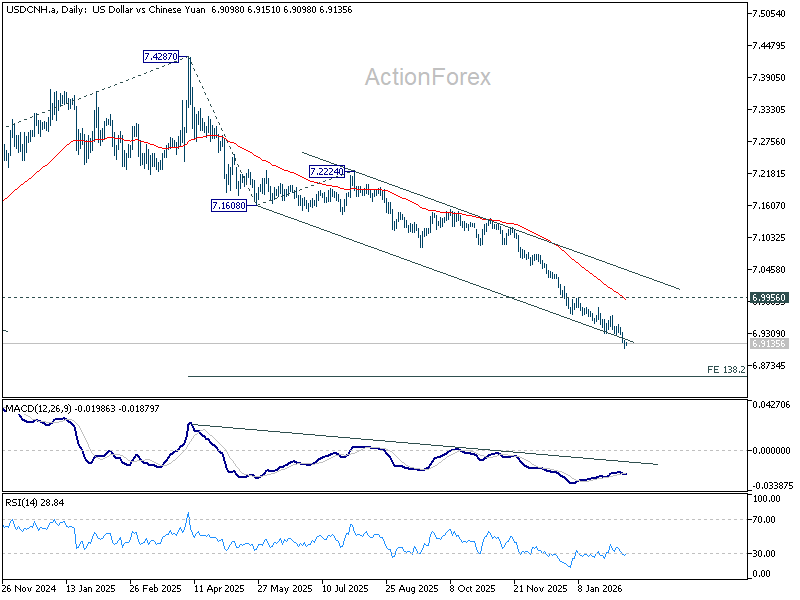
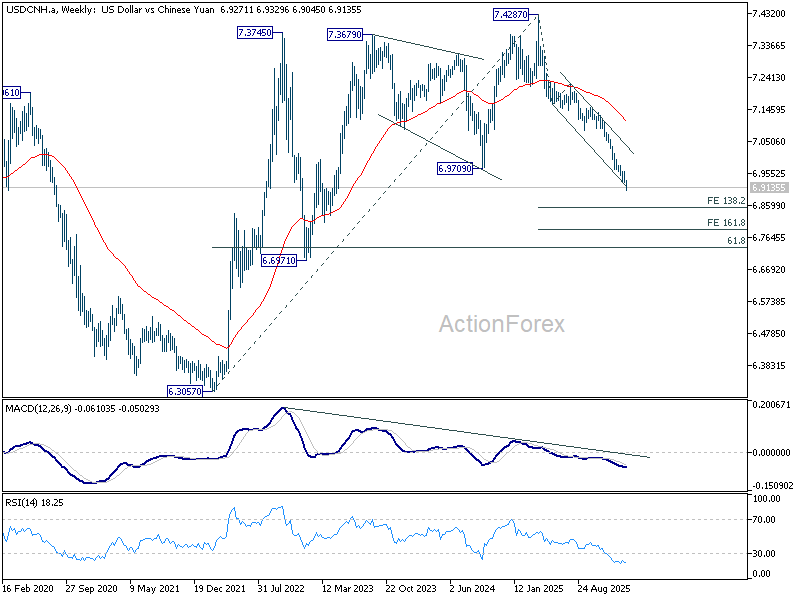
                                        USD/CNH recovers mildly today but there is no sign of near term bottoming yet. Further decline is expected as long as 7.1333 minor resistance holds. Fall from 7.1961 is seen as the third leg of the consolidation form 7.1953. Break of 7.0523 support will pave the way to retest 6.8452/9040 support zone.

                                        Limited progress made in Brexit negotiations

                                          Little progress has been made regarding Brexit negotiations as UK and EU officials indicated.

                                          UK chief negotiator, David Frost said, “progress remains limited but our talks have been positive in tone.” He added, “Negotiations will continue and we remain committed to a successful outcome. “We are close to reaching the limits of what we can achieve through the format of remote formal rounds,” Frost said. “If we are to make progress, it is clear that we must intensify and accelerate our work.”

                                          EU chief negotiator Michel Barnier said, “this week, there have been no significant areas of progress … We cannot go on like this for ever.”